
Custom Cleaning Brush
Beaker Brush
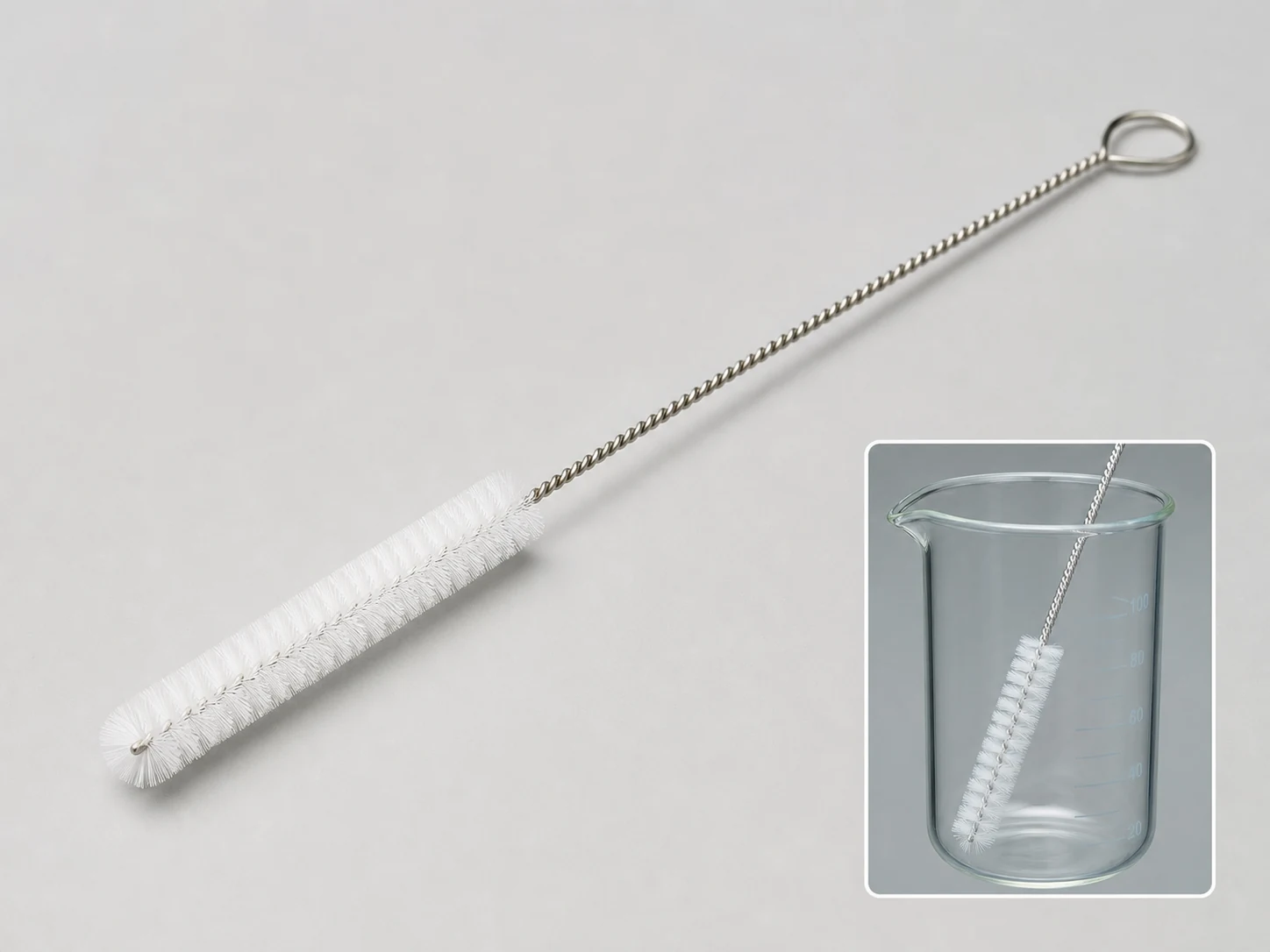
Custom nylon laboratory beaker brush for beakers, flasks, and glassware. Cylindrical and fan heads from 50-120 mm, 250-650 mm reach, Nylon PA or foam fill.
Small brush
500 pcs
Minimum order
Held in one hand: tube, bottle, detail and swab brushes — including long-handled ones with a small head.
Production lead time, once the specification is confirmed
- Up to 500 pcsWithin 7 days
- 501–50,000 pcsWithin 14 days
- Over 50,000 pcsWithin 21 days
Peak season can extend these times; the shipping date is confirmed in writing with your quotation. Sampling and shipping are quoted separately.
A long-reach laboratory beaker brush with a cylindrical or fan-shaped nylon filament head that removes reagent film, precipitates, powders, oils, and detergent residue from beaker walls, curved bases, and shoulder transitions. The twisted-wire stem keeps the head centered during rotation, and sizes are selected to match your vessel opening and working depth rather than guessed from a catalog.
What can this brush do for you?
Complete Wall Contact Without Losing the Bottom Corner
The cylindrical or fan-shaped head is formed on a flexible twisted-wire core, so it stays pressed against the sidewall as the operator rotates the brush. The end tuft or bottle-form tip reaches the fillet where the wall meets the base, which is the area where precipitates and settled powders accumulate first.
Controlled Filament Aggression Protects the Glass
Nylon PA filaments with a diameter from 0.15 to 0.40 mm remove soft and dried residue by flexing at the tip rather than gouging the surface. On borosilicate glass, that means scrubbing without the scratching risk of a metal brush. On disposable or coated plastic labware, a finer filament or foam fill is the lower-risk option.
Long Reach Stays Centered
The twisted-wire stem lets an operator reach into tall beakers and flasks without the head wandering or tipping. A looped end is simple to hang and keeps the brush stable in a rack; a molded long handle is available when repeated stroke work or heavier pressure is required.
Rinses Clean Between Reagents
The open filament matrix releases precipitates, powder, and reagent film during the rinse step instead of trapping them. That keeps the brush itself from becoming the next source of contamination in a multi-step lab workflow.
Bottle-Form Tip Covers Narrow-Mouth Vessels
When the vessel is a volumetric flask or media bottle, the head can be built with a compressible bottle-form tip that passes through the neck and expands inside. One brush style then handles open beakers and necked vessels without adding a second tool to the station.
What is a Beaker Brush?
A beaker brush is a hand-operated laboratory brush whose filament head is wound directly between the wires of a twisted metal stem. In use, the operator inserts the head into the vessel and scrubs with rotating, back-and-forth strokes, so the filaments wipe the sidewall, bottom radius, and, on tapered forms, the shoulder area.
The standard fill is Nylon PA, chosen for stiffness recovery, chemical resistance in common aqueous cleaning, and controlled wetting. The open beaker shape means the working diameter is usually larger than a tube brush made for the same vessel family, but the head must still pass through the mouth without folding over, and the stem must be long enough to reach the base while the user’s hand stays outside the vessel.
This is a general cleaning tool for routine laboratory use. It removes attached and loosely adherent residue; it does not replace soaking for baked-on deposits, aggressive descaling, or ultrasonic and solvent cleaning when a protocol requires those steps.
Technical Specifications
The table shows the configuration range we build from. Final dimensions are set to your vessel drawing or measured dimensions.
| Parameter | Value / Options |
|---|---|
| Brush head diameter | 50–120 mm, selected to the vessel ID and neck opening |
| Bristled length | 76–152 mm, adjusted to the contact zone |
| Overall length | 250–650 mm, matched to vessel depth plus hand clearance |
| Filament diameter | 0.15–0.40 mm; finer for films, heavier for powders and precipitates |
| Filament material | Nylon PA (PA6 or PA6.6 typical); foam fill for non-abrasive contact |
| End shape | Tufted, fan, full cylinder, bottle-form tip, or combined profile |
| Stem / core | Twisted galvanized or 304/316 stainless steel wire; loop or long handle interface |
| Handle option | Wire loop, molded plastic grip, knurled stainless handle |
| Interference fit | Near-size contact for wiping; 5–20% oversize for flexible polymer scrubbing; lower interference for wire-filled or fragile surfaces |
| Operating environment | Nylon for common aqueous lab cleaners; specify acid or alkali, solvent, wash temperature, and sterilization method so the correct fill and stem are selected |
| Brush type | Custom Tube & Pipe Bore Brushes |
| How it is driven | Hand-guided |
| Cleaning target | borosilicate glass beaker, volumetric flask, and graduated cylinder cleaning |
| Surface or part | vessels, beakers, walls, flasks, glass, plastic, shoulders, and glass bores |
| Residue or debris | reagent film, precipitate, detergent residue, powder, and oil |
| Mounting / connection | Threaded Removable / Fixed |
Where does this brush work best?
- Borosilicate glass beakers, Erlenmeyer flasks, and flat- or round-bottom vessels where reagent films and precipitates build on walls and the base.
- Volumetric flasks, media bottles, and narrow-mouth labware when equipped with a bottle-form tip.
- Graduated cylinders, columns, and glass bores where a long stem reaches the bottom without the user’s hand entering the vessel.
- Quality control and sample preparation stations where detergent residue and rinse water must be removed before the next batch.
- Plastic beakers and coated labware where a finer filament or foam fill reduces scratching during routine turnover.
How do I choose the right one?
Start by measuring the vessel, not the mudline.
1. Match the head diameter to the narrowest opening and the vessel body.
For open-mouth beakers, measure the internal diameter. A head that is near the ID wipes the full wall; a flexible nylon head can run 5–20% oversize to maintain scrub pressure. If the brush forces its way in, leaves scratches, or folds over and does not recover, it is too large. If a visible gap remains at the wall, it is too small. For narrow-neck flasks, the head must compress through the neck and still contact the body, so the bottle-form tip is generally the right starting point.
2. Select the filament for the residue and surface.
Nylon PA handles reagent films, loose powders, oils, grease, and detergent residue on glass and most plastics. Finer filament at 0.15–0.25 mm is softer and better for films; coarser filament at 0.30–0.40 mm gives more scrape for dried precipitate. If the beaker is disposable polymer, scratch-sensitive, or internally coated, switch to a foam fill or confirm the filament grade and tip treatment before ordering.
3. Set the stem length by the working depth.
The overall length should let the operator hold the brush outside the vessel with enough remaining reach that the head fully contacts the base without the hand bottoming against the rim. Tall columns and long glass bores need the upper end of the reach range and a stiffer twisted-wire core so the head does not sag.
4. State the cleaning environment.
Detergent type, solvent exposure, acid or base concentration, wash temperature, and sterilization method all affect the filament, stem coating, and handle choice. Nylon is a good general-purpose lab fill, but strong mineral acids, strong oxidizers, and prolonged high-temperature immersion will degrade it. Specify those conditions so a chemically compatible fill and corrosion-resistant stem can be supplied.
When to choose a different tool
- Use a tube brush for passages too small for a beaker-size head, typically where the diameter drops below the comfortable working size of a fan or cylinder form.
- Use a wire brush only on robust metal fittings outside glassware; wire risks scratching the surfaces this product is meant to protect.
- Soak first if the residue is baked on, polymerized, or mineralized. A nylon beaker brush removes what is attached, not what needs chemical softening.
- Use disposable swabs where protocol cross-contamination is the controlling concern and no reusable brush may enter the vessel.
Can I customize this brush?
Beaker brushes are not one-size. To define yours, provide the vessel ID, narrowest opening, usable depth, surface material, residue type, cleaning chemicals, wash temperature, any sterilization step, and the preferred handle form. A drawing, sample vessel, or photo of the worn brush helps reduce the first-article cycle.
We can adjust:
- Head geometry — diameter, bristled length, taper, fan angle, full-cylinder profile, bottle-form tip, end tuft, or multi-diameter form for flasks that widen below the neck.
- Filament system — Nylon PA grade, diameter, tip treatment, color, crimp, foam fill, or mixed fill for a defined scrub-to-soft contact balance.
- Stem and core — twisted galvanized or 304/316 stainless steel wire, loop or straight shank, flex and stiffness, and length.
- Handle and retention — wire loop, molded plastic grip, knurled stainless handle, hanging hole, or branding pad.
- Color, marking, and packaging — color coding by reagent class, ink or laser marking, bulk pack, individual wrap, or project-specific packing.
If the project requires material documentation, inspection records, or third-party testing support for your cleaning validation or quality system, we can coordinate those activities as part of the customization process.
When is a beaker brush worn out rather than just dirty?
How do I check whether the brush fills the beaker correctly?
Insert the dry brush and rotate once. It should touch the sidewall all around with light resistance, and the end form should contact the bottom radius without jamming. If the head binds at the rim or refuses to rotate, the diameter is too large. If it spins freely inside a gap, it is too small.
Can the brush handle autoclave cycles?
Do not assume that a nylon beaker brush will survive repeated autoclave cycles; nylon absorbs moisture and can lose filament recovery after repeated high-heat exposure. If the cleaning process includes autoclaving, specify the cycle time and temperature during selection so the filament, stem coating, and handle are matched to it.
How do I prevent cross-contamination between reagent classes?
Use one brush per reagent family or color-code the handles. Rinse the head with the same wash solution used in the vessel, then with a final rinse water, and hang it to dry. Nylon holds less residue than foam, but no reusable brush should carry a reactive residue into the next vessel.
What should I inspect before each use?
Check for bent or stretched wire, loose tufts, gummed or clumped filament, rust on a non-stainless stem, and permanent set after bending. If the filament does not spring back or the head no longer contacts the wall evenly, replace the brush before it releases broken filament or scratches the vessel.
Does a beaker brush replace soaking or ultrasonic cleaning?
No. Brushing loosens attached film and powder mechanically; soaking, sonication, or chemical cleaning may still be required for tenacious or baked residue. The brush is the mechanical step in the protocol, not the entire protocol.
What is the practical difference between a beaker brush and a bottle brush?
A beaker brush usually carries a wider cylindrical or fan head matched to an open mouth, while a bottle brush is built around a narrower head that must compress through a neck. If the vessel has a small neck and a wide body, start with the bottle-form tip on this beaker brush rather than forcing a full-diameter head through the opening.
Guides that go deeper on this
Custom Manufacturing RFQ
Describe Your Application
An accurate custom quote starts with the dimensions, working surface, residue, material choice, connection, quantity, and reference files.
Drawing or photo optional — it speeds things up, it does not gate the enquiry.
Custom Brush RFQ
Send Your Brush Project
Upload a drawing, product photo, or sample photo and provide the core dimensions and cleaning conditions.
“We need a brush to remove wet residue from a stainless steel conveyor, about 800mm wide. The current brush wears quickly. We can send photos.”
“We sell drinkware and need a cleaning brush to include with the product. Quantity around 5,000 pieces.”