
Custom Cleaning Brush
Brush Roller Pharmaceutical
Custom pharmaceutical brush rollers for tablet and capsule dedusting, polishing, and transfer. Nylon PA filaments, machined cores, drawing-specific fit.
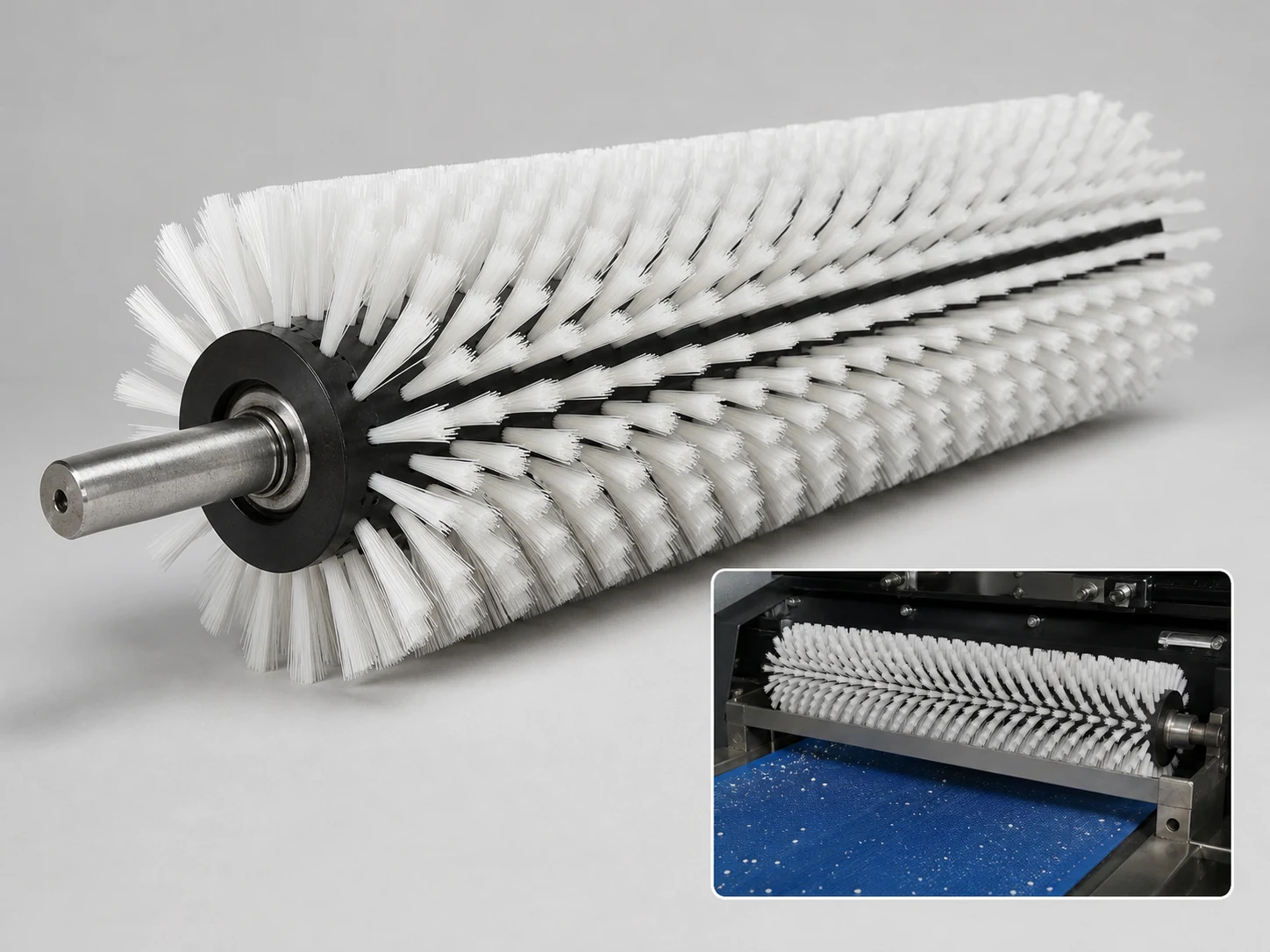
Large-format brush
100 pcs
Minimum order
Built one at a time on a core or channel: full-width rollers, sweeper brooms and long strip.
Production lead time, once the specification is confirmed
- Up to 100 pcsWithin 20 days
- 101–1,000 pcsWithin 30 days
- Over 1,000 pcsConfirmed with your quotation
Peak season can extend these times; the shipping date is confirmed in writing with your quotation. Sampling and shipping are quoted separately.
A cylindrical roller brush for tablet and capsule feed, transfer, dedusting, singulation, and polishing stations in pharmaceutical processing machinery. Nylon PA filaments with precision winding and machined cores deliver controlled product contact that moves and conditions tablets and capsules without crushing, chipping, or jamming.
What can this brush do for you?
Moves and singulates tablets without jamming
Many feed and counting stations rely on rubber rollers or hard wipers that wedge product when a tablet arrives slightly misaligned. A filament roller absorbs that variation: the tips deflect around the tablet, then recover to push it back into lane. The result is stable spacing, less bridging at tablet press discharge, and fewer jams where tablets enter counting or sorting channels.
Lifts dust and fines out of embossed and scored surfaces
Fine-diameter nylon PA filaments reach into logo lettering, breaklines, and edge crevices instead of skating over the surface. As the roller rotates, loose powder lifts from the tablet and moves toward the machine extraction or vacuum pickup point. Rounded or flagged tips are available when embossed or film-coated tablets need dust removal without visible contact marks.
Protects capsule shells and tablet coatings
Contact is spread across thousands of flexible filament tips, so local pressure stays low. Nylon PA bends under load rather than acting like a rigid scraper. That allows the roller to polish coated tablets and pass over capsule bodies without flattening, scuffing, or opening the shell.
Fits the existing station geometry
Working length, brush OD, core bore, journals, keyways, and stepped drive ends are machined from the customer machine drawing. This removes the most common retrofit failure: a brush roller that sits a millimeter or two out of position and either misses product or engages too deep. Balanced cores also keep high-speed driven rollers from shaking product out of lane.
Handles dry and washdown pharmaceutical environments
Construction options include stainless steel or engineering polymer cores, moisture-resistant filament grades, and sealed end hardware. The roller can be supplied for dust-laden dry areas or for machines that are cleaned in place with water and detergents, provided the environment is specified before the filament and core are selected.
What is a Brush Roller Pharmaceutical?
A Brush Roller Pharmaceutical is a cylindrical, power-driven or idler roller brush installed in tablet presses, dedusters, capsule fillers, sorters, counters, polishers, or transfer conveyors. The surface is strip-wound, spiral-wound, or section-wound with synthetic filament and turned to a precise finished outside diameter. During operation, the roller rotates against or above the product path and uses controlled filament deflection to remove dust and fines, separate touching units, hold product in pockets, polish coated surfaces, or carry tablets and capsules along a lane.
Compared with a rubber roller or rigid wiper, the brush applies distributed pressure instead of concentrated contact, which is why it can touch fragile product surfaces without the same risk of edge damage. Compared with a static brush, the rotating face continuously renews its contact area and moves loosened residue away from the product path in a controlled direction.
It is a product-handling and conditioning component, not a complete cleaning system. Vacuum extraction, air rinse, metal detection, and final visual inspection remain separate process steps. The correct configuration depends on the machine interface, tablet or capsule size and hardness, coating type, dust load, line speed, and whether the station runs dry or wet.
Technical Specifications
Most dimensions come from the machine drawing. The table below shows the parameters we confirm before building a pharmaceutical brush roller so the finished roller mounts correctly and performs the intended function.
| Parameter | Typical / Selection Basis |
|---|---|
| Working face length | Set from machine drawing; matched to track, disc, or lane width |
| Brush OD | Sized for the required engagement; commonly 40–200 mm depending on station |
| Core OD / ID | Selected for stiffness, weight, and shaft fit; solid or tubular core options |
| Shaft / journal | Cylindrical, keyed, hex, stepped, through-shaft, or custom drive end per drawing |
| Filament material | Nylon PA (PA6, PA66, PA612); PP or PBT options for wet or higher-stiffness duties |
| Filament diameter | 0.05–0.50 mm for product contact; up to 1.2 mm for heavier dust or mechanical stations |
| Filament tip treatment | Straight-cut, rounded, flagged, or heat-set tip profile selected for contact sensitivity |
| Winding pattern | Straight strip, close spiral, helical, multi-start, lane-separated section, or dense face fill |
| Fill density | Coarse, medium, or dense fill balanced for coverage and debris release |
| Concentricity / runout | Turned to drawing tolerance; face-to-core concentricity controlled for even contact |
| Operating speed | Balanced for the required line speed; dynamic balancing available for high-speed driven rollers |
| Operating environment | Dry or dust-laden air standard; stainless/polymer cores and low-moisture filament available for washdown |
| Engagement | Set from product trial, not a fixed interference rule; depends on tablet size, hardness, and process |
| Brush type | Custom Roller and Conveyor Brushes |
| How it is driven | Machine-driven, mounted in the equipment |
| Cleaning target | tablet press discharge and dedusting, capsule filling and rectification, and sorting and counting station cleaning |
| Surface or part | roller, channel, tracks, edges, bores, metal, chutes, and product paths |
| Residue or debris | dust, fines, powder, polish, sugar, and filler |
| Mounting / connection | Shaft-Mounted / Quick-Change Coupling |
Where does this brush work best?
- Tablet press discharge and dedusting. After compression, tablets pass under a brush roller that lifts dust and fines from the surface before coating, inspection, or packaging.
- Capsule filling and rectification. The roller settles capsules into feed channels, returns misoriented or protruding capsules to the feed path, and removes fill powder from shells.
- Sorting and counting stations. A roller over pocketed discs or slat tracks knocks excess product back and holds individual units in pockets for reliable counting.
- Coated tablet polishing. Soft, dense-faced rollers remove surface dust and improve visual gloss after film coating or sugar coating.
- Transfer lanes and direction changes. The brush controls spacing and momentum where tablets or capsules change direction, pass sensors, or enter a chute.
- Inspection and vision preparation. Dust removal keeps lenses, sensors, and light paths clear and reduces false rejects caused by powder on product surfaces.
How do I choose the right one?
Start from the machine interface
Face length, overall length, core bore, shaft diameter, keyway or hex detail, and mounting points determine fit. Send the station drawing or dimension sheet first. A nominal catalog roller that almost fits is the typical source of skipped product, buried filaments, and rapid face wear, because the contact path no longer matches the track.
Match filament to product sensitivity and dust load
Nylon PA is the default material because it flexes, recovers, resists wear, and can be extruded in very fine diameters. For wet or high-humidity areas, PP absorbs less moisture and holds dimension better. For stations that need a firmer push, PBT offers higher beam stiffness. Use finer, flagged, or rounded tips for coated, embossed, or friable cores; move to thicker straight filament only if dust remains or spacing is unstable. Always begin with the gentlest configuration that can do the job.
Choose the winding for the function
Straight or close-pitch dense winding wipes and polishes the full face. Helical or multi-start winding creates directional transport or singulation. Lane-separated strips match pocketed discs and multiple channels, and mixed zones can combine a dense wipe section, a helical feed section, and a low-density return section on one roller.
Set engagement from the process, not a general rule
There is no universal 2–10 mm interference that fits every tablet or capsule. Correct engagement removes dust and controls product without permanently bending the filament, raising drive torque, or chipping edges. Run a trial with actual product and inspect the tablet surface, capsule shell, and filament set after a short cycle before the roller is released to production.
| Goal | Recommended roller configuration |
|---|---|
| Light dust removal on embossed or coated tablets | 0.05–0.30 mm nylon, dense straight or spiral face, rounded or flagged tips |
| Singulation and feeding | Helical winding, direction matched to rotation, medium fill, 0.15–0.40 mm filament |
| Capsule handling | Low-density lane strips or larger resilient filament, low engagement, soft tips |
| Coated tablet polishing | Dense, soft flagged face, low interference, moisture-tolerant core if wet |
Consider the environment and drive
Dry dust-laden stations can use lighter aluminum or polymer cores. Washdown or condensation areas need stainless or polymer cores, sealed ends, and low-moisture-uptake filament. Driven rollers that run at high speed need stiffer cores and dynamic balancing; idler wipe rollers can often use a lighter build. Also state the motor rotation direction and speed range so the helix is wound in the correct direction for the feed action.
When another solution is the better call
If the target is heavy dried residue or sticky buildup on metal guides, use a scraper or a separate machine-cleaning brush; the product-conditioning roller is not a substitute for aggressive surface cleaning. For extremely friable, uncoated, or already damaged tablets, test a passive air jet, vibration feeder, or lower-contact solution before committing to a mechanical brush. At the tablet press discharge, use the brush together with a vacuum or air-wash deduster; the roller lifts dust, but the extraction system removes it.
Can I customize this brush?
Because the roller is built to the machine and product, customization starts with the information you already have: station drawing or annotated photos, product form and dimensions, coating type and hardness, dust load, operating speed, motor rotation direction, and the cleaning method used on the machine.
- Face geometry — working length, OD, trim profile, crowned or stepped face, sectioned zones, end chamfers.
- Filament — nylon PA, PP, or PBT; diameter, stiffness, crimp, tip treatment, color, and wear-indicator stripes.
- Winding — straight strip, close spiral, helical, multi-start, lane strips, gaps, mixed zones, pitch, and fill density.
- Core and shaft — solid or tubular core, material, bore, keyway, hex, integral shaft, stepped journals, flange or quick-release mount.
- Balance and tolerances — concentricity, runout, finished-OD tolerance, speed-rated balancing, and cleanroom-compatible finish.
- Packaging and marking — individual sealed bags, tray packing, bulk supply, labels, barcodes, and part identification.
For projects that require material declarations, extractables data, USP Class VI or similar third-party testing support, or inspection documentation tied to your quality system, we can coordinate the required support during the customization process.
When is a brush roller pharmaceutical worn out rather than just dirty?
How do I know the engagement depth is set correctly?
Start with the machine builder recommended interference or a controlled process trial. Correct engagement removes dust and stabilizes product without permanent filament set, chipped tablet edges, or rising drive torque. If filament tips remain bent after a short run, engagement is too deep or the filament is too soft for the product.
Will the roller damage embossed or coated tablets?
Not if the configuration is selected and set correctly. Use fine-diameter nylon with rounded or flagged tips, run trials on coated and uncoated samples, and inspect the surface under magnification for edge chips or coating rub-off. If marking appears, reduce engagement or switch to a softer, flagged configuration.
Does a brush roller replace a deduster or vacuum extraction?
No. The roller loosens and lifts dust from the product surface, but the deduster or vacuum removes that dust from the process. Using a brush roller without extraction can redeposit powder downstream and create false rejects at inspection or contamination in packaging.
How often should the roller be replaced?
There is no universal hours rating because wear depends on speed, engagement, product hardness, and dust load. Replace the roller when filament tips show permanent set, the effective OD is below drawing tolerance, zones develop flat spots, or product jams and dust issues return after previous successful operation.
Can the roller be used in a washdown or high-humidity area?
Yes, if the roller is specified for that environment before the materials are chosen. Nylon absorbs moisture and can change stiffness or dimensions in wet processes. For washdown or high-humidity stations, request moisture-resistant filament or PP or PBT, a stainless or polymer core, and sealed end hardware. Tell us the cleaning method during configuration, not after installation.
What should I check during incoming inspection?
Verify face length, OD along the face, shaft and journal fit, keyway or hex detail, winding gaps, and helix direction against the drawing. Rotate the roller by hand to check runout and free rotation, and inspect for loose filament, discoloration, or packaging damage that could indicate contamination.
Guides that go deeper on this
Abrasive Nylon Grit and Filament Selection
Read this guideGuideBrush Roller Conveyor Mistakes with Dry Dust
Read this guideGuideBrush Speed, Engagement, and Heat
Read this guideGuideConveyor Belt Cleaning Brush Design
Read this guideGuideFloor Scrubber Brush Selection: Disc Brush vs Roller Brush
Read this guideCustom Manufacturing RFQ
Describe Your Application
For a custom quote, we need the key dimensions, surface or part, residue, material preference, quantity, and reference image or drawing.
Drawing or photo optional — it speeds things up, it does not gate the enquiry.
Custom Brush RFQ
Send Your Brush Project
Upload a drawing, product photo, or sample photo and provide the core dimensions and cleaning conditions.
“We need a brush to remove wet residue from a stainless steel conveyor, about 800mm wide. The current brush wears quickly. We can send photos.”
“We sell drinkware and need a cleaning brush to include with the product. Quantity around 5,000 pieces.”