
Custom Cleaning Brush
Grout Cleaning Brush
Narrow-profile nylon/PBT grout cleaning brush for tile joints, corners and tracks. Choose head width, filament type, stiffness, and handle length.
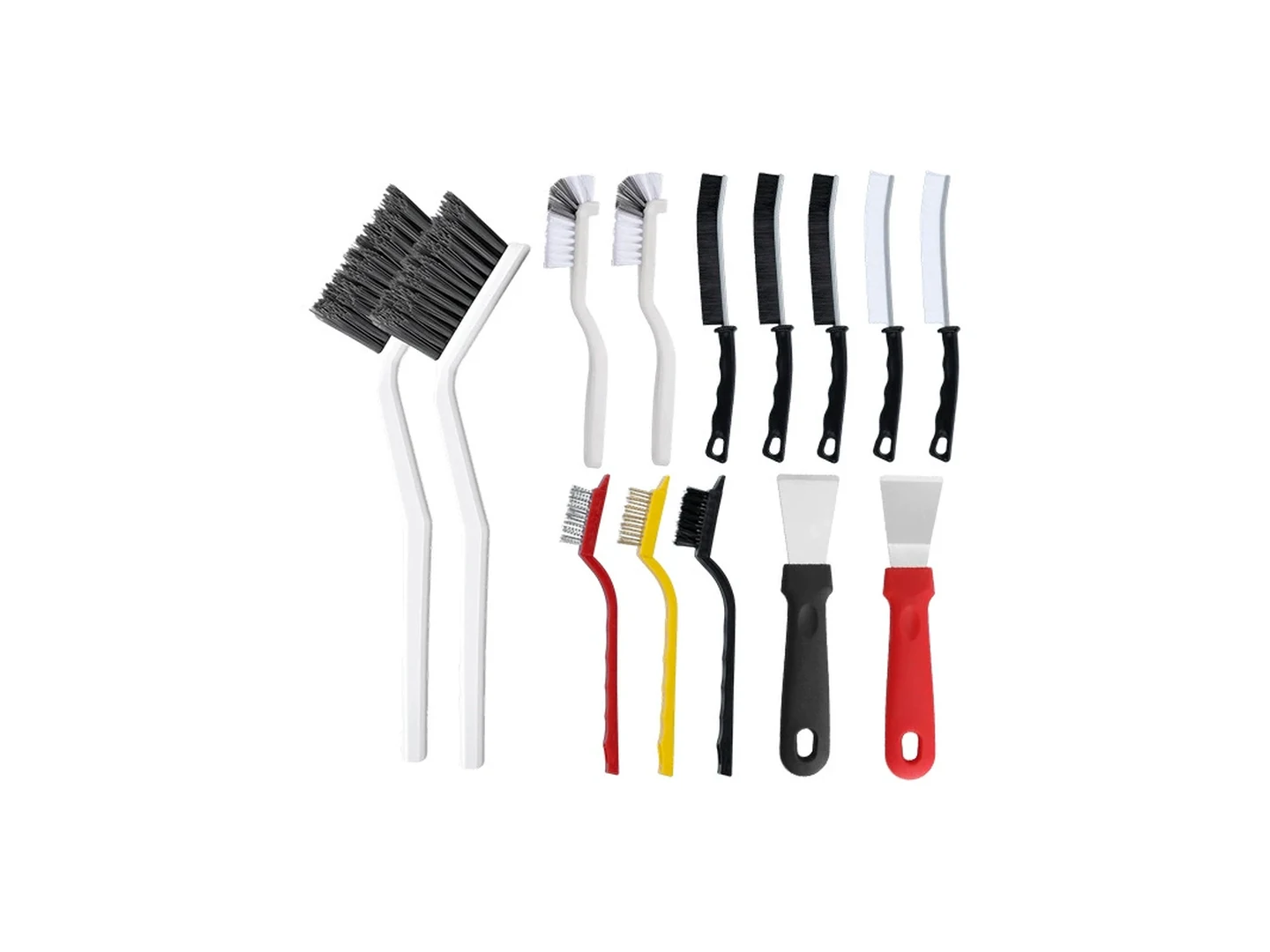
Small brush
500 pcs
Minimum order
Held in one hand: tube, bottle, detail and swab brushes — including long-handled ones with a small head.
Production lead time, once the specification is confirmed
- Up to 500 pcsWithin 7 days
- 501–50,000 pcsWithin 14 days
- Over 50,000 pcsWithin 21 days
Peak season can extend these times; the shipping date is confirmed in writing with your quotation. Sampling and shipping are quoted separately.
A narrow-profile nylon/PBT filament brush built to enter grout lines, tile joints, corners, and tight fixture gaps, then remove soap film, grease, mold, limescale, and embedded dirt without scratching the surrounding surface. Head width, working length, filament material, stiffness, and handle configuration are set to your cleaning situation.
What can this brush do for you?
Contact the joint, not the tile face
Head widths from 3 mm to 100 mm are selected to sit inside the grout line or recess, and V-shaped or angled trim profiles center the filament tips on the depression. That concentrates scrubbing force where the residue actually builds up instead of wasting motion on the surrounding tile, stone, or metal surface. The result is faster stain release and fewer contact marks on glazed or polished faces.
Stiff filaments that break bonded residue loose
Nylon PA and PBT filaments with diameters from 0.10 mm to 0.80 mm and trim lengths from 8 mm to 40 mm let you match cutting stiffness to the deposit. Short, heavy PBT trim attacks hardened soap scum, grease, and limescale, while finer nylon PA filaments clean lighter films on delicate grout or polished tile. PBT also holds bending stiffness when wet, so shower and outdoor use do not turn the brush soft halfway through the job.
Reach corners, base lines, and track bottoms
Working lengths from 10 mm to 120 mm put filament tips at the bottom of deep joints and U-channels, and angled or tapered head shapes trace wall-to-floor transitions, door tracks, and faucet bases where a straight flat brush leaves a dead zone. The brush follows the recess instead of riding across it.
Controlled pressure with less hand fatigue
Overall lengths from 120 mm to 450 mm and handle diameters from 8 mm to 35 mm allow a grip and reach matched to the job: short handles for close detail work, long handles for floor lines and standing use, larger diameters for prolonged heavy scrubbing. The brush stays comfortable when operators have to clean dozens of linear meters in one shift.
Clean release after every pass
The spaced filament rows shed soap film, grease, and loosened dirt under running water instead of trapping it inside the trim. Straight or lightly crimped nylon and PBT filaments spring back after bending, so the head keeps its cleaning shape through repeated wet use rather than matting down.
What is a Grout Cleaning Brush?
A Grout Cleaning Brush is a hand-guided cleaning tool with a narrow filament head shaped to work inside grout lines and similar recessed surfaces. Unlike a general scrub brush, the head is built to drive bristle contact into a shallow or deep groove while keeping the handle and backer out of the way.
In normal use, the operator moves the head along the grout line with short back-and-forth strokes or small circular passes. The filament tips contact the grout surface inside the joint, loosening soap film, grease, mold growth, mineral deposits, and fine debris. Only the sides of the filaments touch the surrounding tile or stone, so the surrounding surface receives minimal pressure.
The standard fill materials are nylon PA and PBT. Nylon PA is conformable and good for general bathroom and kitchen residues; PBT is stiffer and more dimensionally stable in wet or chemical environments. Filament diameter, trim length, head width, and handle design are all project variables rather than fixed values.
This is a surface-cleaning tool, not a grout removal tool. It will not cut out old grout, reshape joints, or erase deep staining that has penetrated the grout body. For those jobs, a grout saw, oscillating multi-tool, or regrouting process is the correct method.
Technical Specifications
| Parameter | Value / Options |
|---|---|
| Head width | 3–100 mm, selected to match grout joint or recess width |
| Working length | 10–120 mm, set to reach the bottom of the joint or channel |
| Trim length | 8–40 mm, controls exposed filament length and scrubbing stiffness |
| Filament diameter | 0.10–0.80 mm, finer for polished or delicate surfaces, heavier for stubborn deposits |
| Fill material | Nylon PA (PA6/PA612) or PBT, selected for stiffness, wet use, and chemical exposure |
| Head shape / trim profile | Flat, angled, V-shaped, tapered, or custom contour |
| Overall length | 120–450 mm |
| Handle diameter | 8–35 mm |
| Handle material | PP, TPE overmold, wood, stainless steel, or project-specific material |
| Use temperature | 5–100°C continuous exposure |
| Chemical exposure | Material grade selected for the specified detergent, acid, or alkaline cleaner; filaments should be rinsed after use |
| Brush type | Custom Handheld Detail Brushes |
| How it is driven | Hand-guided |
| Cleaning target | bathroom tile and shower enclosure, kitchen backsplash, and wall-to-floor corner cleaning |
| Surface or part | joints, tile, grout lines, corners, tile joints, molds, gaps, and tracks |
| Residue or debris | grease, soap film, mold, mineral deposits, limescale, soap scum, scale, and embedded dirt |
| Mounting / connection | Fixed |
Head width, working length, trim length, filament diameter, and handle dimensions are adjusted for each project. Tell us the joint width, depth, surface material, and residue type so we can recommend a starting configuration.
Where does this brush work best?
- Bathroom tile and shower enclosures where grout lines collect soap scum, hard water scale, and mildew.
- Kitchen backsplashes, counter-to-wall seams, and floor tile joints with grease and food splash buildup.
- Wall-to-floor corners, baseboard gaps, and other right-angle transitions that straight scrub brushes cannot enter.
- Sliding door tracks, window channels, and threshold grooves where dust, hair, and grit pack into the bottom.
- Faucet bases, drain collars, overflow openings, and sink rim seams with accumulated soap film and mineral deposits.
- Cookware seams, appliance door crevices, gasket channels, and handle joints with baked-on or dried residue.
How do I choose the right one?
Start with the joint width and depth. Measure the grout line at its narrowest point and the distance from the surface to the bottom of the joint. The head width should be slightly narrower than the joint so the filaments can work inside the groove without dragging hard on the tile edges. The working length should reach the joint bottom without bottoming out the handle or backer.
Use the table below to match the configuration to the surface and residue.
| Situation | Recommended configuration |
|---|---|
| Polished natural stone, soft or epoxy grout, light film | Nylon PA6 or PA612, filament diameter 0.10–0.25 mm, trim 20–40 mm |
| Glazed ceramic or porcelain with soap scum and grease | Nylon PA, filament diameter 0.30–0.50 mm, trim 12–20 mm, flat or angled profile |
| Wet shower with limescale and mold on sanded cement grout | PBT, filament diameter 0.50–0.80 mm, trim 8–15 mm, V-shaped profile |
| Wide expansion joints, deep tracks, or wide recesses | Head width 15–100 mm, working length 50–120 mm, double-row or dense fill |
| Long floor runs or standing use | Overall length 300–450 mm, handle diameter 22–35 mm |
| Close detail work around fixtures or small parts | Overall length 120–200 mm, handle diameter 8–16 mm, tapered or angled head |
Choose nylon PA when the surface is polished, coated, or easily marked and the residue is mostly light film. Choose PBT when the brush will stay wet for long periods, face stronger cleaning chemicals, or need to hold stiffness against bonded mineral deposits. Never assume the stiffest brush is best: on soft grout or polished tile it can abrade the surface faster than it cleans it.
Use a different tool in these cases: to remove old or damaged grout, use a grout saw or oscillating multi-tool; for deep stain removal that has penetrated the grout body, plan for regrouting or a penetrating cleaner rather than brushing alone; for hard mineral scale on metal parts, a fine wire brush may work better but can scar surrounding surfaces; for large open flat areas, a deck or floor scrub brush covers more area per pass.
Can I customize this brush?
Grout cleaning brushes are built around the actual joint and surface you need to clean. Send us the joint width, joint depth, tile or surface material, residue type, cleaning chemical or pH, operating temperature, and preferred handle form. A sample tile, photo of the recess, or simple sketch helps us confirm the head profile before production.
We can adjust:
- Head geometry: width from 3 mm to 100 mm, working length, flat, V-shaped, angled, tapered, or custom trim profile, single or double row
- Filament system: Nylon PA6, PA612, or PBT; filament diameter; crimped or straight; tip treatment; color coding
- Handle: length, diameter, straight, ergonomic, loop, or hang-hole style; PP, TPE overmold, wood, stainless steel, or other project material
- Head-to-handle angle: straight or angled at 15°, 30°, or 45° for corners and tracks
- Marking and packaging: custom color, pad print, laser marking, retail hook, individual bag, or bulk packing
If your project requires material documentation, inspection support, or third-party testing for the cleaning chemical or end-use environment, we can assist with those requirements as part of the customization process.
How long does a grout cleaning brush last, and how is it cleaned between runs?
How can I tell if the brush is too aggressive for my grout or tile?
Test a hidden section first. Scrub the joint and surrounding tile edge for ten to fifteen seconds with the intended cleaner. If you see scratching on the tile, grout powder, or edges of the joint breaking away, switch to a finer filament diameter or a softer nylon PA material with a longer trim. A brush that removes residue without leaving visible marks on the surface is the right stiffness.
Can this brush be used with bleach, vinegar, or acid-based cleaners?
Nylon PA and PBT tolerate many mild acidic and alkaline cleaning products, but high-concentration oxidizers, strong solvents, and prolonged soaking will shorten filament life. Rinse the brush with clean water after every use, and tell us the exact cleaning chemical during customization so the fill material and handle polymer can be selected to match it.
What is the practical difference between a V-shaped trim and a flat trim?
A V-shaped trim concentrates the filament tips along the center of the grout line and reduces side contact on the tile. It is the preferred profile for narrow joints and soft tile. A flat trim covers the full joint width and edges, which works better for wide joints or when you also want to scrub the grout-to-tile transition. If a flat brush is leaving scrub marks on polished tile edges, a V-shaped profile usually solves it.
How should I maintain the brush between uses?
Rinse the head under running water to remove loosened residue, then pick out any hair or debris caught at the base of the filaments with a coarse comb or pick. Air-dry the brush hanging or with the head down so water does not collect in the handle socket. Store it dry and out of direct sunlight; do not leave the brush submerged in cleaning solution between shifts.
When should I replace the brush?
Check the trim length before a large job. If the filaments have worn below roughly 60 percent of the original trim, are permanently splayed or matted, or no longer reach the bottom of the joint, the brush is no longer doing its job. A worn brush takes more time and pressure to produce a poorer result, so replace it before that point.
Will brushing alone remove black mold from grout?
Brushing loosens surface growth and the film that feeds it, but it does not sanitize the joint or remove staining that has penetrated porous grout. Use the brush as the mechanical step in a cleaning sequence that includes a suitable mold treatment, rinse, and drying. If dark staining returns immediately or remains after repeated treatment, the grout may need to be regrouted or sealed.
Guides that go deeper on this
Custom Manufacturing RFQ
Describe Your Application
Send the key measurements, cleaning requirement, residue, material direction, mounting method, quantity, and drawing or photo.
Drawing or photo optional — it speeds things up, it does not gate the enquiry.
Custom Brush RFQ
Send Your Brush Project
Upload a drawing, product photo, or sample photo and provide the core dimensions and cleaning conditions.
“We need a brush to remove wet residue from a stainless steel conveyor, about 800mm wide. The current brush wears quickly. We can send photos.”
“We sell drinkware and need a cleaning brush to include with the product. Quantity around 5,000 pieces.”