
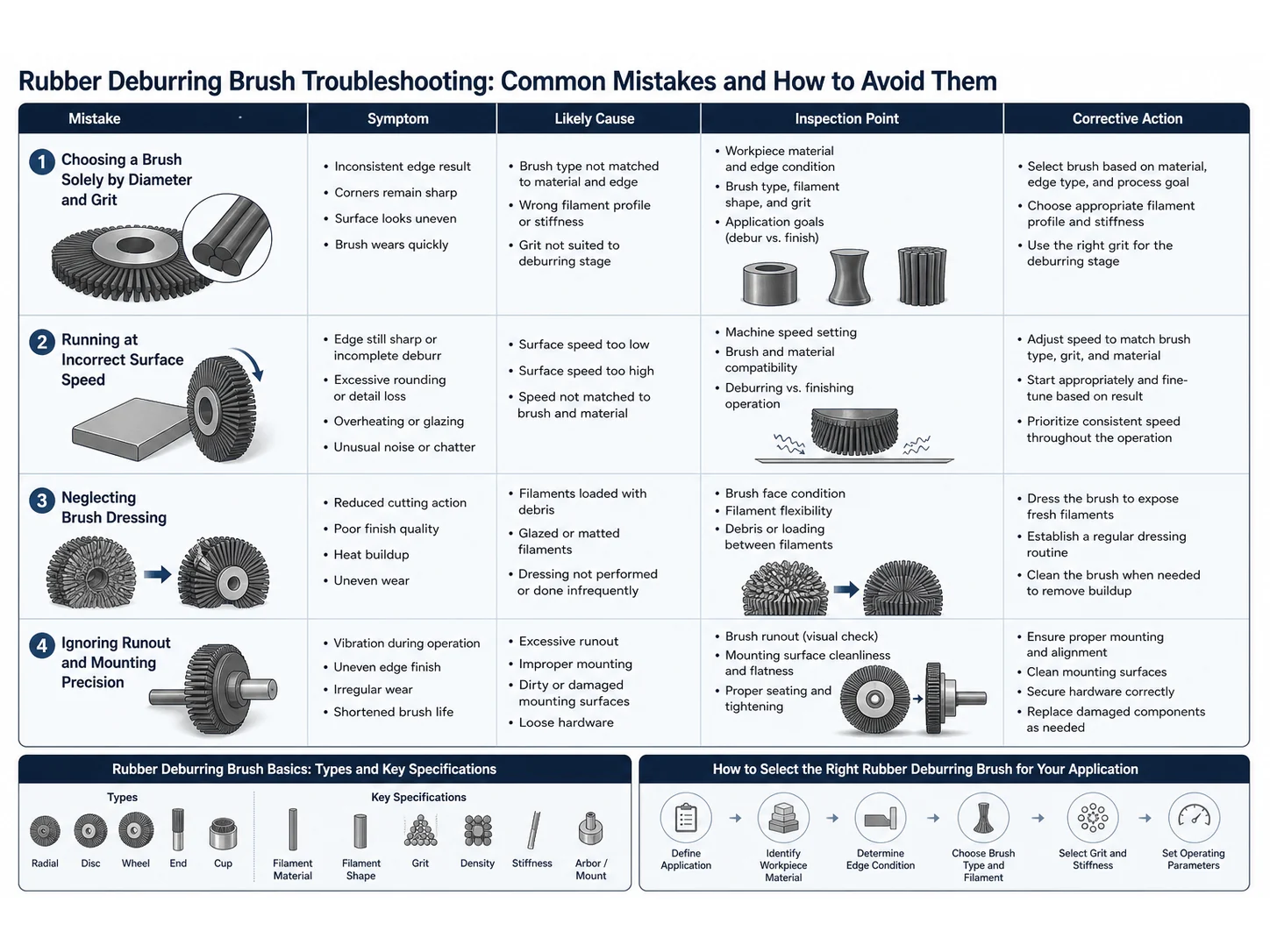
Rubber Deburring Brush Basics: Types and Key Specifications
Before diagnosing mistakes, it helps to know what you are working with. A rubber deburring brush typically falls into one of two form factors: a cylindrical wheel with an arbor hole or a mounted point with an integral shank. The abrasive most often used is aluminum oxide (good for general‑purpose deburring) or silicon carbide (sharper, preferred for harder or more brittle rubber compounds). Grit sizes range from coarse (around 60–80) for heavy flash to fine (120–240) for final surface blending. The rubber binder hardness directly controls aggression: softer grades allow the abrasive grains to release sooner, creating a cooler, less‑aggressive cut; harder grades hold the grains longer, producing a faster material removal rate at the risk of overheating or smearing.
The table below compares the key variables that buyers often overlook.
| Attribute | Common Options | What to Watch |
|---|---|---|
| Bond Type | Rubber‑bonded (elastic), hybrid (rubber‑polyurethane) | Pure rubber bonds run cooler; hybrids wear longer in wet conditions. |
| Abrasive Grit | Aluminum oxide (AO), silicon carbide (SC), cerium oxide | SC stays sharp longer on harder rubber; AO handles most general‑purpose work. |
| Grit Size | 60–240+ | Match grit to burr height: coarse for >0.5 mm flash, fine for <0.1 mm final finish. |
| Stiffness / Hardness | Soft (J–L), medium (M–P), hard (Q–T) | Letter‑grade scales vary by manufacturer; always request a durometer range instead of descriptive terms. |
| Diameter | 0.5 in – 6 in (mounted), up to 12 in (wheel) | Larger diameters increase surface speed at the same RPM; avoid exceeding manufacturer SFM limits. |
| Handle / Core | Integral shank (1/8, 1/4, 6 mm), arbor hole (common 1/2, 5/8, 1 in) | Verify collet or spindle compatibility before ordering. |
| Mounting | Straight shank for hand tools, keyed arbor for rotary machines, threaded stud for multi‑spindle heads | Poor mounting causes runout that ruins finish and shortens life. |
How to Select the Right Rubber Deburring Brush for Your Application
Choosing correctly prevents the mistakes we will cover later. Start by listing the actual burr characteristics, not assumptions.
- Residue type and thickness: Is it flash (thin, film‑like) or a true burr (thicker, raised)? Thin flash often only needs a soft, fine‑grit brush to prevent tearing the part. Thick burrs may require a coarser grit and harder bond.
- Parent material sensitivity: What is the Shore hardness of the part? Softer rubber (below 40 Shore A) scratches easily; use a soft‑bond, fine‑grit brush and test on scrap. Harder compounds (80+ Shore A) can tolerate more aggressive brushes.
- Equipment interface: Note the tool RPM, collet size, and available overtravel. Over‑speeding a brush generates heat, smearing, and premature bond breakdown. Under‑speeding yields poor cutting action.
- Wet or chemical exposure: Coolants, release agents, or post‑mold washing fluids can swell or degrade certain rubber bonds. Confirm chemical resistance of the bond with the brush supplier.
- Hygiene expectations: In medical or food‑contact applications, the brush must be free of contaminant‑retaining pores. Specify a closed‑cell bond or request washdown compatibility data.
- Maintenance frequency: Rubber deburring brushes wear and require occasional dressing to expose fresh grit. If production volume is high, plan for brush changes and dressing cycles; order slightly longer or larger brushes to extend service intervals.
- Custom size requirements: Many edge‑deburring stations need non‑standard diameters or multi‑profile brushes. A dimensioned drawing with tolerances helps the supplier propose a safe working range rather than just a “similar” off‑the‑shelf item.
Top Mistakes When Using Rubber Deburring Brushes
Even experienced shops fall into these traps. Recognizing them saves scrap, rework, and hidden tooling costs.
Mistake 1: Choosing a Brush Solely by Diameter and Grit
A common shortcut is to order “a 2‑inch, 80‑grit brush” without considering bond hardness. Two brushes with identical diameter and grit can behave completely differently if the rubber bond is soft versus hard. The result: one shop may see excellent life and finish; another may experience smearing and burning. Always specify bond hardness on the purchase spec—request a durometer value or sample for approval.
Mistake 2: Running at Incorrect Surface Speed
Rubber‑bonded abrasives have a narrow optimal surface‑feet‑per‑minute (SFM) range, typically 3,000–6,500 SFM. Overspeeding generates heat that melts the rubber bond, glazes the abrasive, and can scorch the workpiece. Underspeeding simply loads the brush instead of cutting. Check the manufacturer’s SFM recommendation and adjust RPM for the brush diameter. If no data exists, start at the low end and increase gradually while monitoring temperature.
Mistake 3: Neglecting Brush Dressing
Over time, the brush face loads with rubber debris and flattened abrasive grains. A loaded brush polishes instead of cuts, increasing cycle time and part temperature. Dress the brush regularly with a dressing stick or diamond tool to remove loading and expose fresh grit. Skipping dressing leads to inconsistent edge quality and premature disposal of still‑usable brushes.
Mistake 4: Ignoring Runout and Mounting Precision
A brush with even 0.003‑in runout can create vibration, uneven wear, and wavy edge finishes. Always dial‑indicate mounted brushes. Use high‑precision collets, not worn drill chucks. For arbor‑mounted wheels, balance them statically or dynamically if diameters exceed 4 inches.
Mistake 5: Using One Brush for Every Part Material
Rubber deburring brushes are not universal. Using the same aluminum‑oxide brush on EPDM, silicone, and natural rubber will give unpredictable results because hardness and filler content differ. Silicone, for example, often loads brushes quickly; silicon carbide grit with an open‑pore bond reduces loading. Map each part material to a validated brush specification and stick to it.
Mistake 6: Ordering Without an Application Drawing
Verbal descriptions like “medium‑hard, 2‑inch diameter” lead to costly trial and error. A dimensioned drawing—including shank diameter, length under shank, tolerances on profile, and grit/bond callout—gives the supplier what they need to reproduce a working solution. If a custom brush is needed, providing a drawing prevents misinterpretation.
Mistake 7: Forgetting About Storage and Shelf Life
Rubber bonds can age, harden, or absorb moisture when stored improperly. Keep brushes in a cool, dry place away from UV light and ozone sources (e.g., electric motors). Rotate inventory and test hardness on older stock before putting it into production.
When a Rubber Deburring Brush Is Not the Right Choice
Rubber deburring brushes excel at light to medium edge finishing, but they have limits. Recognize these boundaries to avoid forcing a tool beyond its capability.
- Heavy burrs or thick flash exceeding 1 mm: A rubber brush will likely wear too fast or burn the part. Consider a carbide burr or a roughing file for stock removal, then finish with a rubber brush.
- Ultra‑fine surface requirements (Ra below 0.2 µm): While fine grit brushes can approach low roughness values, a dedicated superfinishing process (lapping, polishing) may be needed for optical or sealing surfaces.
- Temperature‑sensitive materials: Some thermoplastics or low‑durometer elastomers can flow or deform under the friction heat of any rotary brush. In such cases, manual hand‑pad deburring or cryogenic deflashing may be safer.
- Need for absolute dimension tolerances: Rubber deburring brushes remove material gradually and are not precision sizing tools. If edge geometry must be held to ±0.05 mm or better, a fixed‑abrasive hard tool or CNC trim is necessary.
- When you lack supplier data: If you cannot obtain a durometer curve, SFM recommendation, or a test sample, the risk of a misfit is high. Request a supplier drawing review or a trial batch before committing to production volumes.
How to Check the Result
After brushing, inspect both the cleaned area and the brush. A good result removes the target soil while leaving the surface, bristles, mounting, and nearby components in acceptable condition. If cleaning improves only when pressure is increased sharply, the brush specification or the surrounding process should be reviewed.
Bottom Line
The best result comes from matching rubber deburring brush mistakes in edge deburring and how to avoid them to the real cleaning task rather than forcing one brush to solve every condition. Confirm access, residue, surface limits, and replacement routine first; then use a small trial or inspection step before scaling the method into daily work.
Frequently Asked Questions about Rubber Deburring Brushes
What grit size is best for removing flash from molded rubber parts?
For thin flash (<0.2 mm), a fine grit (120–240) with a soft bond is ideal to avoid scratching the base material. For thicker burrs, start with 80–100 grit and finish with a finer grit if needed.
How often should I dress a rubber deburring brush?
Dress the brush when you notice reduced cutting action or a glossy, loaded surface, typically after 2–4 hours of continuous use. Regular dressing extends brush life and maintains edge quality.
Can rubber deburring brushes be used on wet applications?
Yes, but confirm that the bond is chemically resistant to the specific coolant or release agent. Some rubber bonds can swell in certain fluids. Always consult the manufacturer’s chemical compatibility chart.
What should be checked before daily use?
Check access, residue type, surface sensitivity, bristle condition, and whether loosened debris can be removed after brushing.
When should a softer brush be used?
Use a softer brush when the surface is coated, polished, thin, hygienic, or sensitive to scratching and bristle shedding.
Technical References
Which elastomer grade fits this job — Rubber, Silicone Rubber or Silicone?
| Grade | Continuous temperature (°C) | Peak temperature (°C) | Water absorption | Hardness |
|---|---|---|---|---|
| Rubber | 100 | 130 | very low | Specified by compound and Shore hardness; published TPE families can span roughly 50–80 Shore A, but that is a product-family example rather than a universal rubber range. |
| Silicone Rubber | 200 | 230 | below 1% | Soft to medium elastomer; Shore A commonly about 30-80 depending grade. |
| Silicone | 200–250 | 280–300 | 0.1–1.0% | Shore A 20–80 |
| EPDM Rubber Brush Blade | 120–150 | 170–180 | 0.5–2.0% | Shore A 40–90 |
Figures as published by Material manufacturer TDS / ISO / ASTM / industry reference. Confirm the exact grade against the supplier datasheet before ordering.
When is Rubber the wrong choice for edge deburring?
- Rubber — Generic rubber cannot support a technical page claim without chemistry, hardness and compatibility data.
- Silicone — Not for aggressive scraping, rust removal or metal deburring.
What should replace Rubber for edge deburring?
- Rubber — Compare Rubber with Silicone elastomer, TPE, PVC profile, PVA sponge. Change material when wet stiffness, temperature, chemical resistance, conductivity, particle shedding, or surface marking becomes the limiting factor.
- Silicone — Compare Silicone with PP, TPE, Nylon. Change material when wet stiffness, temperature, chemical resistance, conductivity, particle shedding, or surface marking becomes the limiting factor.