
Custom Cleaning Brush
PB33A Brush
PB33A Brush is a 107.95 mm metal-free nylon CMP pad conditioner brush for semiconductor wafer polishing.
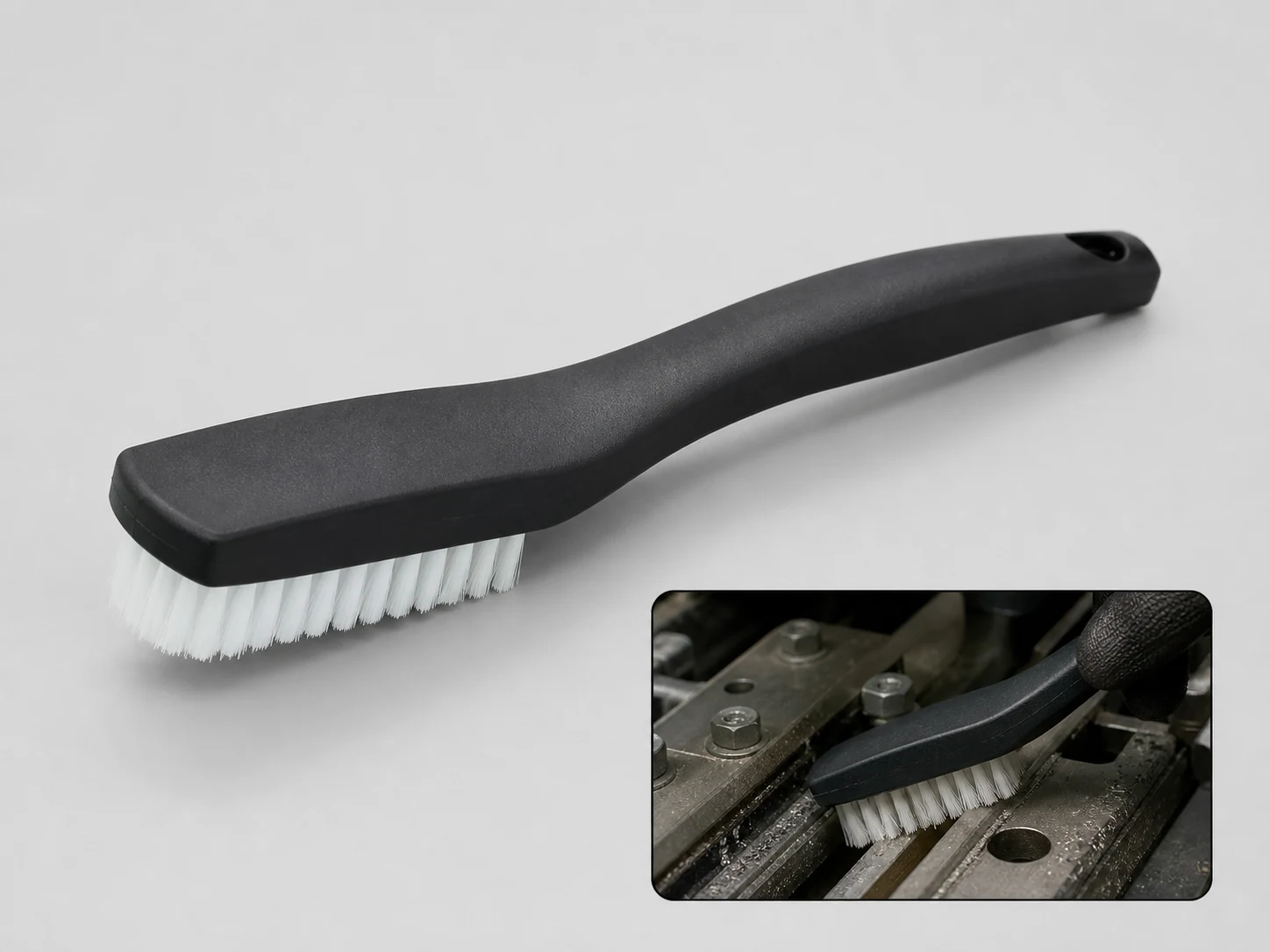
Medium brush
100 pcs
Minimum order
Worked with two hands or on a pole: chimney, gutter and pond-filter brushes, discs, cups and tank brushes.
Production lead time, once the specification is confirmed
- Up to 100 pcsWithin 7 days
- 101–5,000 pcsWithin 14 days
- 5,001–50,000 pcsWithin 21 days
- Over 50,000 pcsConfirmed with your quotation
Peak season can extend these times; the shipping date is confirmed in writing with your quotation. Sampling and shipping are quoted separately.
The PB33A Brush is a metal-free nylon CMP pad conditioner brush on a 107.95 mm (4.25 in) carrier for semiconductor wafer polishing tools. It clears slurry residue and embedded pad debris from polishing pad grooves and surface texture while helping redistribute slurry for stable removal rates.
What can this brush do for you?
Clears pad grooves that slurry and pad debris plug
The nylon bristles reach into grooved polyurethane pad channels and dislodge agglomerated slurry solids, pad wear particles, and wafer debris. Open grooves keep slurry moving to the wafer interface, so removal rate does not drop as the pad loads.
Lifts embedded particles without aggressive pad cutting
Bristle tips work the pad surface texture at low contact pressure and remove particles trapped in the top layer. Because the brush conditions the pad rather than cutting it like a diamond disk, it helps extend pad life while reducing the risk of surface roughening related to over-conditioning.
Eliminates metal contact in the wafer environment
The bristles are nylon PA polymer and the carrier is a chemical-resistant polymer construction. Without metal bristles or metal cores, the brush avoids releasing metal particles or ions into the CMP slurry loop, which matters for front-end device processes that are sensitive to metallic contamination.
Redistributes slurry across the pad
As the carrier rotates and traverses, the bristle pattern spreads slurry into low-flow areas and back into the grooves. Even slurry distribution supports uniform removal and reduces wafer non-uniformity.
Works through wet slurry and DI water cycles
Nylon PA retains its stiffness and recovery in continuous wet processing at typical CMP temperatures. The construction tolerates standard slurry pH ranges and repeated rinse cycles without corrosion or metal shedding.
What is a PB33A Brush?
The PB33A Brush is a rotary pad conditioning brush used in chemical mechanical planarization (CMP) tools. It mounts on a conditioning arm or disk drive and rotates against the polishing pad while the platen or head is in motion. Its job is not to remove pad material the way a diamond conditioner does; it is a lower-aggression conditioning tool that removes used slurry and pad loading from the pad surface and grooves, then redistributes fresh slurry for the next wafer pass.
During operation, the brush is kept wet with DI water or slurry. Nylon bristles flex under contact, enter the pad grooves, and sweep out debris. The brushing action also loosens the glazed layer that forms on polyurethane pads after repeated wafer cycles. For porometric and felt-based pads, the same mechanism opens surface pores that would otherwise close and reduce slurry transport.
The standard configuration uses a 107.95 mm (4.25 in) carrier with a center mounting interface, matched to common CMP pad conditioner arms. Bristle length, diameter, density, and trim pattern are set to the pad groove geometry and the tool’s conditioning gap, so the working length and contact pressure remain in the tool’s designed range.
Technical Specifications
| Parameter | Value / Options |
|---|---|
| Carrier diameter | 107.95 mm (4.25 in) standard; custom diameters available for different conditioner arms or pad sizes |
| Bristle material | Nylon PA (metal-free); PA6 or PA6.6 grade selected for slurry and DI water exposure |
| Bristle type | Straight or crimped nylon filament; straight filament recommended for groove penetration, crimped for softer surface contact |
| Bristle length | 6–15 mm standard range; trimmed to the conditioning gap and pad groove depth |
| Bristle diameter | 0.12–0.30 mm; thinner filaments for softer contact, thicker filaments for more scrubbing force |
| Bristle density / hole pattern | Project-configurable; specified in holes/cm² or tuft spacing to balance coverage and slurry flow |
| Carrier material | Chemical-resistant polymer (e.g., polypropylene or equivalent); metal-free carrier option available |
| Mounting interface | Center mounting hole with keyed or bolt-circle features, configured to the pad conditioner arm or rotary drive |
| Operating environment | Wet CMP process with DI water and slurry; nylon PA standard for neutral-to-alkaline pH (approx. 7–11) |
| Maximum continuous temperature | 60°C (140°F) typical for nylon PA in wet operation; verify for heated slurry or high-friction process conditions |
| Pad compatibility | Grooved polyurethane, porometric, and felt-based CMP pads; for pad dressing that requires aggressive removal, use a diamond conditioner disk |
| Brush type | Custom Roller and Conveyor Brushes |
| How it is driven | Machine-driven, mounted in the equipment |
| Cleaning target | dielectric and oxide cmp, pad groove maintenance, and porometric and felt-based pad cleaning |
| Surface or part | pads, grooves, carriers, metal, gaps, channel, process areas, and aluminum |
| Residue or debris | slurry, oxide, abrasive slurry, and particles |
| Mounting / connection | Center mounting hole with keyed or bolt-circle features, configured to the pad conditioner arm or rotary drive |
The values above describe the standard configuration. We adjust bristle length, diameter, density, and interface to the pad groove geometry and tool specifications before production.
Where does this brush work best?
Use the PB33A Brush in CMP pad conditioning and cleaning steps where the pad must stay open for slurry transport without aggressive pad removal:
- Dielectric and oxide CMP — silicon oxide ILD, STI, and passivation planarization pads where groove clogging and pad glazing reduce removal rate stability.
- Metal CMP — copper, tungsten, and aluminum polishing pad surfaces where residual metal/abrasive slurry must be swept from grooves between wafers.
- Pad groove maintenance — grooved polyurethane pads with fine channel patterns that load with slurry solids and pad wear debris.
- Porometric and felt-based pads — softer pad constructions that benefit from gentle pore opening rather than diamond-aggressive conditioning.
- High-purity wafer fabs — process areas requiring metal-free contact materials in the CMP wet bench.
How do I choose the right one?
Start with the pad and groove geometry. Measure the pad groove width, depth, and spacing. Bristle length must be long enough to reach at least the upper part of the groove under operating compression. If the brush only sweeps the land areas, slurry still packs in the grooves and the pad will load.
Match bristle stiffness to the pad hardness and the amount of debris loading. For harder polyurethane pads or heavier loading, choose 0.20 mm or larger nylon filament and a higher tuft density. For soft porometric or felt pads, use finer filaments and lower density to avoid tearing pad structure.
Check slurry chemistry. Nylon PA is reliable in neutral to alkaline slurries and DI water. In strongly acidic slurries, the filament can lose strength over time; confirm pH first or select an alternative polymer bristle if the process stays below pH 4 for long periods.
Confirm tool interface and motion. The standard 107.95 mm carrier matches tools designed for a 4.25 in conditioner brush, but verify the mounting hole, keyway, rotation direction, arm stroke, and conditioning gap before ordering. If the tool uses a different carrier size, we can modify the carrier.
Decide if the PB33A Brush is the right conditioning tool. Use the brush when the goal is groove clearing, debris removal, slurry redistribution, and light pad rejuvenation. Use a diamond conditioner disk when the process requires consistent pad cut rate, aggressive pad texturing, or heavy pad glaze removal. Many CMP sequences use both — diamond conditioning for pad removal, and a brush for cleaning and slurry distribution after the diamond step.
| If your process needs | Use |
|---|---|
| Groove clearing, slurry redistribution, low pad wear | PB33A Brush |
| Aggressive pad texturing or controlled pad removal rate | Diamond conditioner disk |
| Both pad conditioning and groove cleaning | Diamond disk plus PB33A Brush in tool |
Can I customize this brush?
The PB33A Brush is configured to the specific CMP tool and pad. To define the build, we need the pad groove dimensions, tool conditioning gap and pressure, slurry chemistry and temperature, rotation direction, and a drawing or photos of the current carrier. With that information we can adjust:
- Carrier geometry — diameter, thickness, mounting hole, keyway, bolt pattern, or drive features to match the conditioner arm or rotary head.
- Bristle material — nylon PA6 or PA6.6, straight or crimped filament, or alternative polymer grades for unusual acid/alkali or temperature conditions.
- Bristle dimensions — length, diameter, density, hole pattern, and trim profile (flat, stepped, spiral, or zone-specific).
- Carrier material — chemical-resistant polymer grades, colors, or material combinations for identification.
- Mounting interface — center hub, drive lugs, side index features, or other interface details required by the tool.
- Identification and logistics — color coding, laser marking, lot codes, cleanroom-compatible bulk bags, individual packaging, or project-specific packing.
If your process qualification requires material declarations, contamination/particle data, inspection reports, or third-party testing for the CMP line, we can support those requirements during the customization process.
How do you tell when a PB33A brush is worn out?
Can the PB33A Brush be used with acidic CMP slurries?
Nylon PA is best suited to neutral and alkaline slurries. If the process operates below pH 4 for extended periods, test a sample first or discuss an alternative polymer filament that offers better acid resistance. Never run the brush dry on a hot pad with acidic slurry present.
How do I know when the brush is no longer clearing pad grooves?
Monitor removal rate stability and defect counts. If removal rate drops while slurry pools on the pad and groove depth measurement shows packing, the bristles may be too short, compressed, or worn. Remove the brush and check bristle height, stiffness, and splay. A visible set or permanent flattening means replacement is needed.
Does this brush replace a diamond pad conditioner?
No. A diamond conditioner disk cuts and retextures the pad; the PB33A Brush cleans, clears grooves, and redistributes slurry. In tools that use both, the brush typically follows or runs with the diamond cycle. Use a diamond conditioner for processes that require controlled pad removal rate; use the brush where low-aggression conditioning is enough.
What should I verify on the tool before installing the brush?
Check the mounting hole and keyway alignment, rotation direction, conditioning arm stroke length, and the gap between carrier and pad at operating pressure. Run the brush wet with DI water or slurry only; dry operation on the pad can damage the nylon bristles and the pad surface.
How do I confirm the brush does not add metal contamination?
The bristles and carrier are metal-free polymer. After installation, run the normal wet conditioning cycle and take a slurry or DI water sample from the drain for trace metal analysis. A clean lot will show no increase above the fab’s baseline. Keep the brush packaging closed until installation and handle with cleanroom gloves.
Can the PB33A Brush be used for post-CMP wafer scrubbing?
No. The PB33A Brush is designed for conditioning the CMP polishing pad, not for contacting the wafer surface. Use a dedicated PVA or nylon wafer scrubber brush for post-CMP wafer cleaning. Installing a pad conditioner brush in a wafer scrubber station will damage wafers and the brush.
Guides that go deeper on this
Custom Manufacturing RFQ
Describe Your Application
An accurate custom quote starts with the dimensions, working surface, residue, material choice, connection, quantity, and reference files.
Drawing or photo optional — it speeds things up, it does not gate the enquiry.
Custom Brush RFQ
Send Your Brush Project
Upload a drawing, product photo, or sample photo and provide the core dimensions and cleaning conditions.
“We need a brush to remove wet residue from a stainless steel conveyor, about 800mm wide. The current brush wears quickly. We can send photos.”
“We sell drinkware and need a cleaning brush to include with the product. Quantity around 5,000 pieces.”