
Custom Cleaning Brush
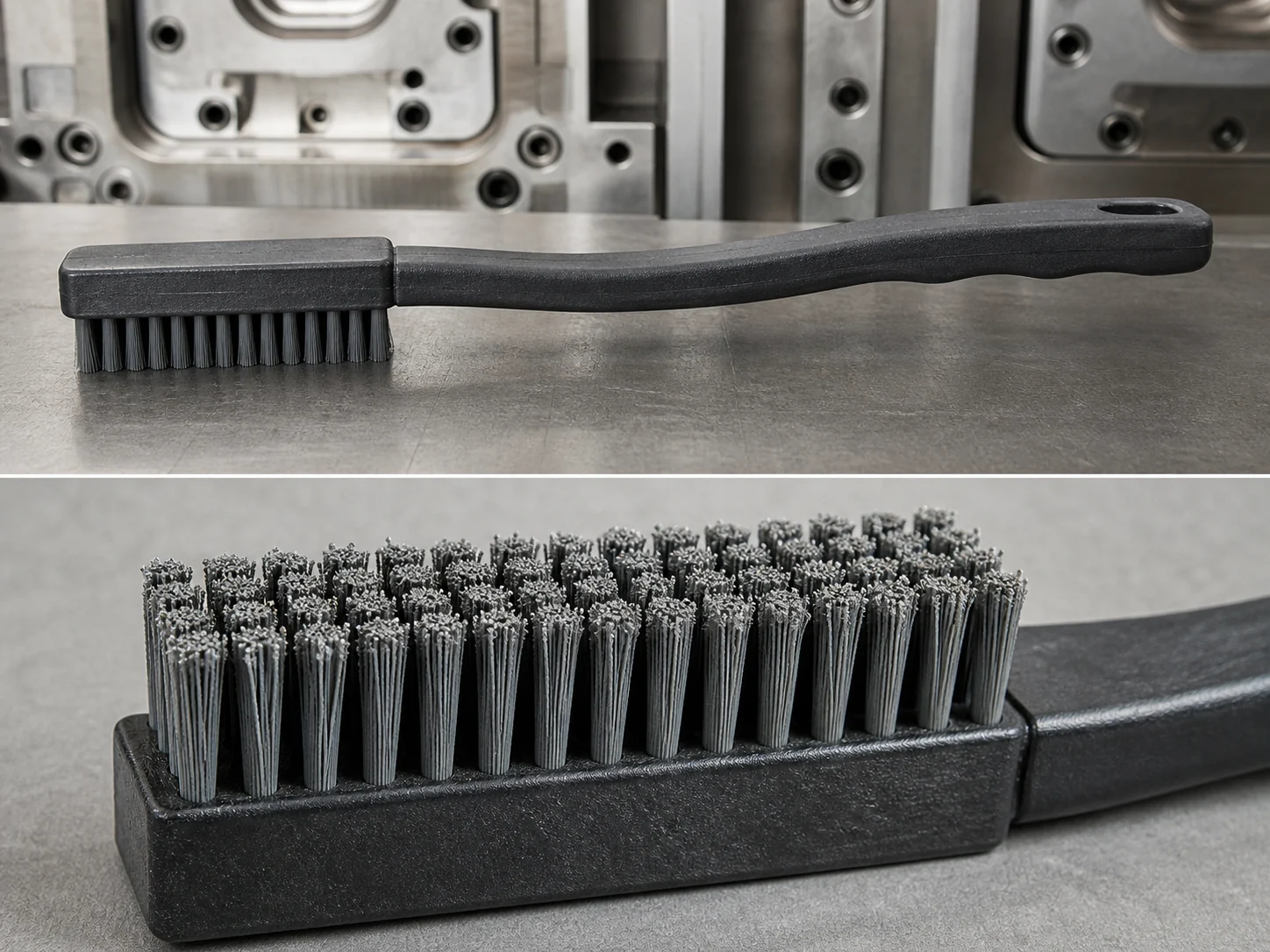
SiC Mold Cleaning Hand Brush
Silicon carbide abrasive nylon hand brush removes release agent, flash, and baked deposits from mold cavities and parting lines.
Small brush
500 pcs
Minimum order
Held in one hand: tube, bottle, detail and swab brushes — including long-handled ones with a small head.
Production lead time, once the specification is confirmed
- Up to 500 pcsWithin 7 days
- 501–50,000 pcsWithin 14 days
- Over 50,000 pcsWithin 21 days
Peak season can extend these times; the shipping date is confirmed in writing with your quotation. Sampling and shipping are quoted separately.
This hand-guided mold cleaning brush uses silicon carbide abrasive nylon bristles to scrub release agent, polymer flash, carbon, and baked deposits from mold cavities, parting lines, vents, and textured surfaces. The rectangular head and fixed glass-filled PA66 handle give maintenance crews a controlled manual tool for regular mold upkeep between production runs.
What can this brush do for you?
Removes Baked Residue Without Wire-Brush Gouging
Silicon carbide particles embedded in each nylon filament cut through cured release agent, oxidized plastic, and light carbon buildup. The nylon matrix flexes under hand pressure, letting the abrasive work without the deep scratching or metal smearing that a steel wire brush can leave on tool steel.
Cleans Flat Mold Faces and Parting Lines in a Single Pass
The rectangular head covers a 25 mm × 100 mm contact area, so a straight pass along a cavity wall or across a parting line removes residue evenly. Angled strokes let the corner of the head follow vent grooves and machined edges without switching tools.
Stands Up to Oily, Solvent-Soaked Mold Shops
The glass-fiber-reinforced PA66 handle resists the oils, release agents, and mild solvents found around molding machines. It stays dimensionally stable and does not soften during normal hand cleaning, so the brush can live near the press rather than in a storage cabinet.
Lets the Operator Control Abrasive Aggression
Grit size and bristle length can be specified to match the mold surface. Finer grits handle polished or EDM surfaces with light scuffing, while coarser grits cut through heavy buildup faster. Hand pressure becomes a real control variable, reducing the chance of over-cleaning a critical area.
One-Piece Design Eliminates Loose Parts
The bristle block is molded into the handle as a fixed assembly. There are no threaded connections to loosen, no replaceable heads to misplace, and no adjustments required on the shop floor. It is ready to use straight from the storage rack.
What is a SiC Mold Cleaning Hand Brush?
A SiC Mold Cleaning Hand Brush is a manual cleaning tool built specifically for maintaining injection, compression, and rubber molds. Instead of conventional nylon or wire bristles, it uses abrasive nylon filaments loaded with silicon carbide grit. The abrasive is dispersed through the filament cross-section, so as the outer surface wears, fresh grit keeps exposing itself until the bristle is nearly worn out.
In use, the operator holds the 150 mm ergonomic handle and works the rectangular head along cavity faces, core surfaces, parting line ledges, vents, and ejector pin areas. The brush removes release agent films, polymer flash, carbon smears, oxide stains, chips, and light baked deposits through a scrubbing action that the operator can feel and adjust in real time.
This is not a resurfacing tool. It is not designed to remove heavy flash, weld spatter, or deep damage, and it is not a substitute for polishing or stone work. It is a controlled-abrasive maintenance brush for keeping mold surfaces clean enough to hold dimensional tolerance and surface finish quality between scheduled servicing.
Technical Specifications
The standard configuration is listed below. Dimensions, grit size, bristle length, and handle geometry can be adjusted to match your mold and operator ergonomics.
| Parameter | Specification / Standard Options |
|---|---|
| Head length | 100 mm (adjustable) |
| Head width | 25 mm (adjustable) |
| Head shape | Rectangular, flat trim (chamfered, angled, or contoured trims available) |
| Bristle material | Silicon carbide (SiC) abrasive nylon |
| Grit options | 80 / 120 / 180 / 240 (finer or coarser on request) |
| Bristle length | 15 mm standard (10–25 mm range) |
| Bristle density | Medium density, straight trim |
| Handle/base material | Glass-fiber-reinforced PA66 (PA66-GF30) |
| Handle length | 150 mm (adjustable) |
| Grip diameter | 24 mm (adjustable) |
| Connection | Fixed, molded one-piece assembly (replaceable-head design available on request) |
| Overall length | Approximately 240 mm |
| Operating temperature | Continuous use up to 80°C; intermittent contact up to 100°C |
| Chemical compatibility | Resistant to common mold release agents, mineral oils, and mild solvents; avoid prolonged immersion in strong acids or alkalis |
| Brush type | Custom Handheld Detail Brushes |
| How it is driven | Hand-guided |
| Cleaning target | injection mold cavity and core, parting line surface, and vent groove and air channel cleaning |
| Surface or part | molds, cavities, parting lines, vents, grooves, plastic, pins, and channel |
| Residue or debris | mold, release agent, carbon, polymer flash, baked deposits, dust, oil, and carbon deposit |
| Mounting / connection | Fixed, molded one-piece assembly (replaceable-head design available on request) |
Where does this brush work best?
The brush is designed for maintenance crews, mold setters, and toolroom technicians who clean molds on the bench or in the press. Typical use areas include:
- Injection mold cavities and cores with baked release agent, gas-burn discoloration, or light carbon deposits.
- Parting line surfaces where polymer flash or cured material accumulates along the split line.
- Vent grooves and air channels clogged with compacted plastic dust or outgassing residue.
- Textured and etched mold faces where residue hides in micro-roughness and needs a scrubbing action to dislodge.
- Ejector pins, sleeves, and slide faces with carbon smears or burnt-on release agent.
- Rubber and silicone compression molds with cured rubber residue on cavity walls and flash traps.
- Mold bases, clamps, and auxiliary tooling surfaces coated with oil, grease, and light corrosion.
How do I choose the right one?
The correct configuration depends on the residue you need to remove, the surface finish you must protect, and the access space around the mold. Work through these checks:
Match Grit to the Residue and Surface Finish
Start by identifying the hardest material to remove. Light release agent film and soft polymer dust can be handled with 180 or 240 grit. Cured release agent, carbon, or oxidized plastic usually requires 120 grit. Heavy baked deposits may call for 80 grit, but coarser grit increases the risk of surface marking on polished steel. If the mold contains both delicate and heavily soiled areas, two brushes with different grits are often the cheapest way to avoid damage.
Check Head Dimensions Against the Mold Geometry
The standard 25 mm width and 100 mm length suit open cavity faces and parting lines. If your parting line has stepped ledges or the cavity is narrow, request a reduced width. For deep pockets or ribs, consider a custom head profile that contours to the surface instead of forcing a flat rectangle into a curved area. Bristle length matters too: longer bristles reach into shallow textures and corners, shorter bristles transfer more force for flat face scrubbing.
Verify Handle Fit for the Operator and Workspace
The 150 mm handle and 24 mm grip diameter fit average hand sizes, but operator gloves, reach distance, and available clearance around the mold may require a longer or shorter handle. If the mold is cleaned in a confined press area, a compact handle may be safer and easier to control.
When Another Brush or Method Is a Better Choice
Do not use this brush to remove heavy flash, weld spatter, deep gouges, or thick rust. A steel or brass wire brush, scraper, or abrasive stone is more appropriate for those conditions. If you need to polish a mold surface, switch to a finer abrasive pad, diamond compound, or polishing stone. For very narrow deep slots or capillary channels, a small-diameter tube brush or a pointed abrasive stick will reach where this rectangular head cannot. If cleaning is repeated hundreds of times per shift, consider an automated or machine-mounted abrasive brush to reduce operator fatigue.
Can I customize this brush?
The standard rectangular configuration is a starting point, not a limit. We regularly adjust head geometry, abrasive grade, and handle dimensions for specific molds and operator preferences. To specify a custom brush, we need the mold surface dimensions, the exact residue to be removed, the surface finish spec, the cleaning solvent or chemical used, and your preferred handle length and grip. A drawing or photo of the area to be cleaned speeds up the quoting process.
- Head geometry: width, length, thickness, corner radius, chamfer, angled trim, or contour-milled profile to match a specific cavity or parting line.
- Abrasive filament: grit size, filament diameter, bristle length, bristle density, trim shape (flat, feathered, center-cut), or a combination of coarse/fine zones on the same head.
- Handle material: PA66-GF30 is standard, but aluminum, stainless steel, or chemical-resistant thermoplastics can be used for special environments.
- Handle design: length, grip diameter, ergonomic contours, finger grooves, hang hole, or extended shaft for deep access.
- Connection: fixed one-piece standard; replaceable head design with a locking interface for high-volume consumption or multiple head options on one handle.
- Color and marking: molded-in color, laser marking, pad printing, or company identification for tool control.
- Packaging: bulk boxes, individual polybags, labeled sleeves, or project-specific packing.
If your project requires material documentation, inspection data, or third-party testing support for a specific cleaning process, provide the requirements and we can define the appropriate documentation package with the order.
What pressure keeps a sic mold cleaning hand brush clean without wearing it early?
How do I know when the brush needs to be replaced?
Check the bristle condition. When individual bristles are worn to about half of their original length or the tips appear rounded and glossy, the exposed abrasive is mostly consumed and cleaning efficiency drops. Also inspect the handle for cracks or deformation. Replace the brush if bristles shed excessively or the head no longer removes residue with the same number of passes.
Can I use this brush on polished or mirror-finish mold surfaces?
Only with the finest grit option and light pressure on a test area first. Silicon carbide abrasive nylon will leave micro-scratches on a mirror finish. For high-polish optical or medical molds, a non-abrasive nylon brush or a designated polishing pad is usually safer.
What cleaning solvents are safe to use with this brush?
The nylon bristles and PA66 handle tolerate most common mold cleaners, mineral spirits, isopropyl alcohol, and mild alkaline degreasers. Avoid prolonged soaking in strong acids, strong alkalis, or chlorinated solvents at elevated temperature, as these can degrade nylon and PA66. Rinse the brush after solvent use and let it dry away from direct heat.
How much hand pressure should I apply when cleaning a mold?
Light to moderate pressure is usually enough. The abrasive particles do the cutting; pressing harder mainly flexes the bristles and accelerates wear. If residue does not come off with moderate force, move to a coarser grit rather than increasing force and risking surface damage.
Is this brush suitable for cleaning deep ribs, narrow slots, or internal channels?
The standard 25 mm × 100 mm rectangular head is designed for open faces, parting lines, and accessible grooves. For deep ribs or slots narrower than the head width, request a custom narrow head profile or consider a small-diameter cylindrical brush. The fixed rectangular head will not conform into deep recesses.
How should I store the brush between uses?
Store it hanging or flat in a dry location away from direct sunlight and heat sources. Keep the bristles free of solvent and debris so they do not mat down. Storing the brush with the bristles facing down can deform them over time; hanging by the handle or placing it bristle-up is preferred.
Guides that go deeper on this
Custom Manufacturing RFQ
Describe Your Application
For a custom quote, we need the key dimensions, surface or part, residue, material preference, quantity, and reference image or drawing.
Drawing or photo optional — it speeds things up, it does not gate the enquiry.
Custom Brush RFQ
Send Your Brush Project
Upload a drawing, product photo, or sample photo and provide the core dimensions and cleaning conditions.
“We need a brush to remove wet residue from a stainless steel conveyor, about 800mm wide. The current brush wears quickly. We can send photos.”
“We sell drinkware and need a cleaning brush to include with the product. Quantity around 5,000 pieces.”