
Custom Cleaning Brush
Snail Lock Type Brush
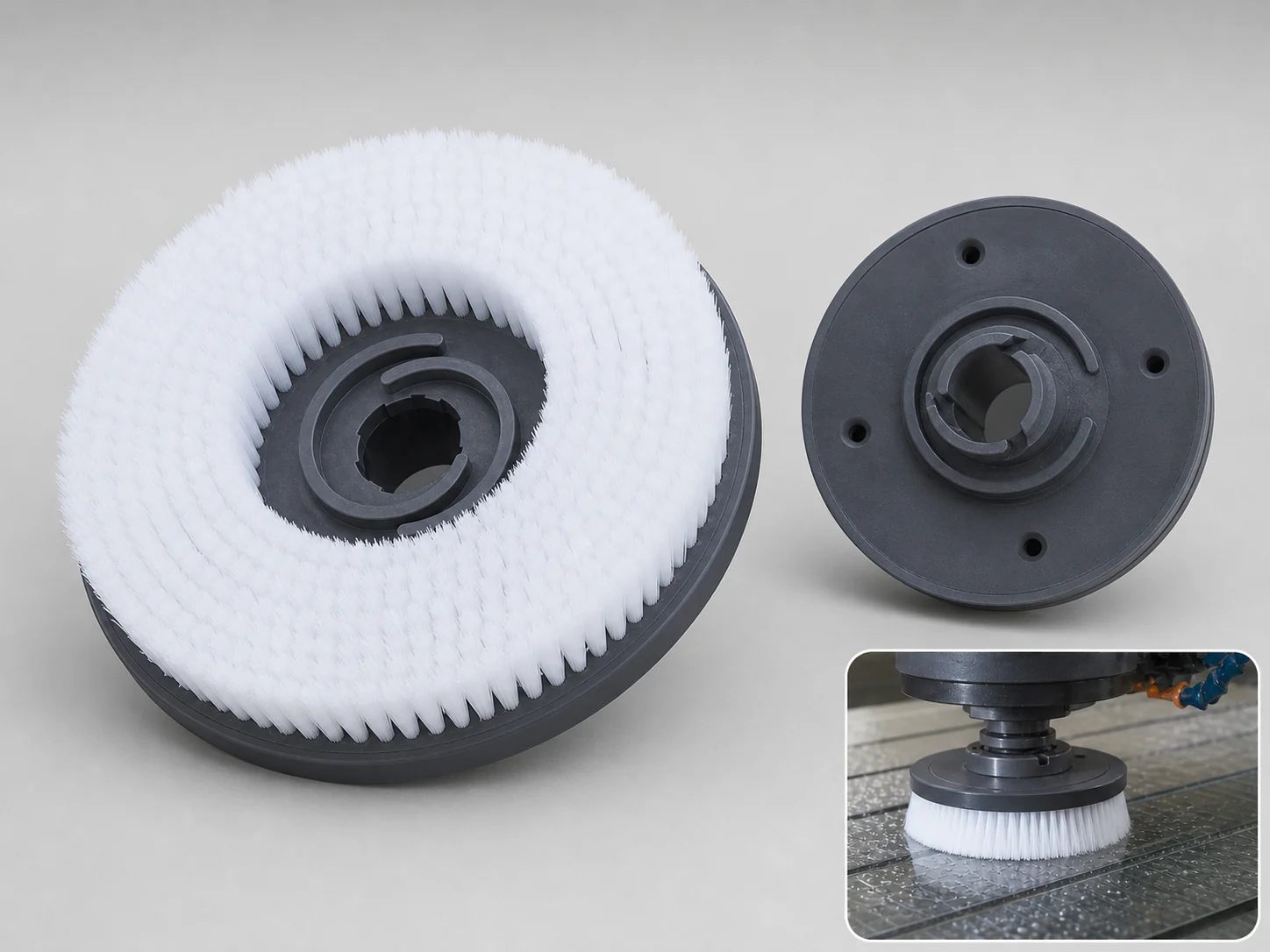
Round abrasive nylon disc brush with a snail-lock connection for antiquing, texturing and satin finishing on marble, granite and engineered stone.
Small brush
500 pcs
Minimum order
Held in one hand: tube, bottle, detail and swab brushes — including long-handled ones with a small head.
Production lead time, once the specification is confirmed
- Up to 500 pcsWithin 7 days
- 501–50,000 pcsWithin 14 days
- Over 50,000 pcsWithin 21 days
Peak season can extend these times; the shipping date is confirmed in writing with your quotation. Sampling and shipping are quoted separately.
A round abrasive nylon disc brush built for stone antiquing, texturing, cleaning, and satin finishing on marble, granite, and engineered stone. The snail-lock backing mounts quickly onto a compatible polishing machine, so shops can move through grit stages and change worn brushes without retooling.
What can this brush do for you?
One Lock System Moves Through Every Finish Stage
The molded backing plate carries a snail lock/quick-lock engagement that twists onto the machine holder and seats positively. Once the holder fits, a shop can use the same setup for coarse texture, medium hone, and fine cleaning brushes. Replacing a worn brush or changing grit takes seconds, not a pad change and re-centering routine.
Abrasive Keeps Working as the Filament Wears
Silicon carbide or diamond grain is dispersed through the abrasive nylon filament, not just coated on the surface. As the filament tips wear down, fresh grit is exposed. The brush keeps a more even cutting character through its working life instead of going blind after the first few slabs.
Filaments Follow the Texture Instead of Bridging It
The nylon filaments flex into flamed, honed, and lightly relieved surfaces. They reach seams, pits, and profile recesses that a rigid metal-bond disc would skip over, while the dense filament field still rides the surrounding plane. The result is consistent brushing action without deepening one spot and missing the next.
Finish Control Runs from Open Texture to Soft Satin
With a 24#–320# grit range, the same brush format can open an antiqued surface, refine it, or clean and homogenize sheen without adding new texture. A 24–46 grit opens and roughs, a 60–120 grit hones or satin-finishes, and a 180–320 grit cleans and evens the look for final presentation.
Wet or Dry, Matched to the Stone Process
The filament and backing perform in wet polishing conditions and can also run dry on lighter cleaning and fine-finishing steps. Water controls heat and dust on hard material; dry operation avoids wet clean-up and leaves the surface easier to inspect on soft stone.
What is a Snail Lock Type Brush?
A Snail Lock Type Brush is a rotating round brush with a rigid backing plate and a centered snail-lock/quick-lock connection for stone and ceramic machines. The working face is made of dense abrasive nylon filament, not a solid grinding rim. In use, the brush spins against the surface and cleans, textures, or softens the finish through controlled filament contact.
Operators typically mount it on a variable-speed handheld polisher or angle grinder with the matching holder, keep the brush roughly flat to the surface, and work the slab or edge with overlapping passes. The brush removes light material, opens the surface, clears loose grinding or polishing debris from the previous step, and spreads a consistent satin or antiqued character across the stone.
This is a finishing and cleaning tool, not a stock-removal tool. It will not remove deep saw marks, level lippage, or re-profile a broken edge. It is intended to control surface character and residue after those heavier operations are complete.
Operationally, keep the lock fully seated, stay inside the holder’s rated speed, and avoid dwelling in one area. A slow overlapping pass produces a more even finish than heavy hand pressure at high RPM, and protects both the brush and the stone from localized heat.
Technical Specifications
Standard stock diameters are 100–127 mm (4–5 in). Other diameters, grits, filament configurations, and lock geometries are built to project requirements.
| Parameter | Specification / Options |
|---|---|
| Brush type | Round abrasive nylon disc brush with snail lock/quick-lock backing |
| Connection | Snail-lock interface matched to the machine holder pattern |
| Outer diameter | 100–127 mm (4–5 in); other diameters available on request |
| Working face | Full-diameter filament field; edge, face, and trim configuration selected by application |
| Grit range | 24#–320#; common stages: 24, 36, 46, 60, 80, 120, 180, 240, 320 |
| Abrasive | Silicon carbide or diamond abrasive nylon filament, specified by SKU and stone type |
| Filament | Extruded abrasive nylon; diameter, density, and stiffness set to the finish target |
| Backing | Rigid engineered plate with molded/central snail-lock hub; construction chosen for wet or dry service |
| Process | Wet or dry operation according to the stone, stage, and shop procedure |
| Typical operating speed | 1,500–3,000 RPM; use the lower end for fine finish and the higher end only within machine/holder limits |
| Color coding | Grit-indicating filament or backing colors for fast shop-floor identification |
| How it is driven | Machine-driven, mounted in the equipment |
| Cleaning target | antiqued and leathered finish, granite and engineered stone countertop, and edge and profile work cleaning |
| Surface or part | stone, edges, marble, profiles, ceramic, travertine, recesses, and floors |
| Residue or debris | dust, and slurry |
| Mounting / connection | Snail-lock interface matched to the machine holder pattern |
The most important fit check is the lock pattern itself. Snail-lock holders vary by manufacturer, so specify the holder make/model or send a photo before finalizing the brush.
Where does this brush work best?
- Antiqued and leathered finishes on marble, limestone, and travertine vanity tops, thresholds, stair treads, and fireplace surrounds.
- Granite and engineered stone countertops where a honed or brushed surface needs to be opened, softened, or homogenized after grinding and polishing.
- Edge and profile work on bullnose, ogee, eased, and chamfered stone edges, where the flexible filaments contact the profile without flattening it.
- Cleaning and surface preparation between diamond tool stages — removing stone dust, slurry film, and grinding residue from pores and open texture before moving to the next grit or sealing.
- Tile and ceramic surface finishing where a light satin or brushed character is required without full-strength abrasion.
- Restoration of worn honed floors or slab surfaces where the goal is to clean and renew the existing finish rather than cut it deeper.
How do I choose the right one?
Confirm the lock first
Check the machine holder and compare it with the brush backing. Snail-lock/quick-lock systems are not all interchangeable: pin pattern, center recess, and lock depth differ between manufacturers. The brush must seat fully without rocking. When there is any doubt, send the holder make/model or a clear photo so the lock geometry can be verified.
Match the abrasive to the stone
Silicon carbide abrasive nylon is the economical choice for marble, limestone, travertine, and other soft natural stone. Diamond abrasive filament lasts longer and cuts more consistently on granite, quartzite, porcelain, and dense engineered stone, where silicon carbide wears out quickly and stops producing a repeatable texture.
Build a grit sequence, not a single-grit process
Use coarse grits to open or deepen texture, medium grits to shape the final satin or honed character, and fine grits to clean and homogenize. On hard stone an antiqued finish might require 36–46 followed by 120 and 240. On soft stone, starting at 60 or 80 avoids over-texturing. The right sequence is cheaper than pushing one brush to do two jobs.
Set stiffness, trim, and density to the working pressure
Shorter, denser, stiffer filaments cut faster and suit flat, open surfaces where the operator can apply consistent pressure. Longer, softer, lower-density filaments conform better around profiles, flamed texture, and detail areas, and are easier to control for light cleaning and fine finishing.
Use the selection table as a quick reference
| Condition | Recommended configuration |
|---|---|
| Marble / limestone / travertine, surface cleaning | Silicon carbide, 120–320#, medium to soft filament |
| Marble / limestone, antiqued finish | Silicon carbide, 60–120#, medium filament, wet use |
| Granite / quartzite, leathered or open texture | Diamond abrasive, 24–60#, stiff filament, wet use |
| Engineered stone, satin or honed surface | Diamond abrasive, 60–180#, medium filament |
| Edge and profile contact | Longer projection or edge-configuration filament, lower RPM |
When this brush is not the right tool
Use a metal-bond diamond cup wheel, rigid diamond disc, or profiling wheel for stock removal, lippage, and deep edge work. Use resin-bond diamond pads for a final high-gloss polish. A snail lock brush will only waste time and filament if the job requires major material removal or a mirror surface.
Can I customize this brush?
We configure the brush around the holder, stone, and finish result. The following can be adjusted:
- Outer diameter and backing plate profile
- Snail-lock geometry — pattern, center recess, and lock depth matched to the actual holder
- Filament type, diameter, trim length, and density
- Abrasive type and grit sequence, including multi-grit or marked color coding
- Backing material and construction for wet, dry, or chemical exposure
- Edge or face treatment for profile work
- Packaging — bulk, labeled cartons, or project-specific counting/packing
To specify a custom build, provide the machine make/model and holder photos, stone type, current finish and target finish, required diameter, wet or dry process, working RPM, and the number of brush stages in the sequence. A sample stone or finish photo is helpful.
When your project requires material documentation, third-party testing support, or inspection records, include that in the specification discussion and we can assist with the process.
When is a snail lock type brush worn out rather than just dirty?
How do I confirm the brush will lock onto my machine?
Compare the brush’s backing lock pattern with the holder on the machine. Snail-lock/quick-lock systems exist in different sizes and pin patterns. Check that the brush seats fully and does not wobble before running. If the pattern does not match, the brush cannot be forced onto an incompatible holder; specify the holder make/model or send photos so we can match the lock geometry.
Should I run the brush wet or dry?
Run wet when using coarse grits on hard stone or when dust and heat control matter. Dry operation is common for light cleaning and fine finishing on softer material. Whichever process, keep the brush moving and stay within the holder’s rated RPM; dwell in one area creates heat, uneven sheen, and shortens filament life.
Do I need to break in a new brush?
Yes. Before production, run the brush for a short pass on a waste piece of the same or similar stone at working speed. The filament tips settle into the cutting pattern and any loose or uneven fibers are knocked down. A brush that is not broken in can leave swirl marks or uneven texture on the first slab.
How will I know when the brush is worn out?
Watch for a visible flattening of the working face, longer cycle time to reach the same finish, reduced abrasive action, or uneven finish across the surface. Filament still projecting beyond the backing does not mean the brush still cuts; the abrasive may be consumed. Compare a new brush against the used brush on a scrap piece to judge remaining life.
Can one brush do both texturing and cleaning?
Not usually within the same grit. A 24–60 grit opens and textures; a 180–320 grit cleans and homogenizes. If you try to clean with the coarse brush you will deepen the texture, and if you try to texture with the fine brush you will only burnish. Assign each grit to one job and use a brush sequence, not one brush for all stages.
What should I do if the finish is uneven across the slab?
Check brush wear, lap overlap, pressure, and surface flatness. Uneven finish usually means the operator is pressing harder on some passes, the brush is not kept flat, or the lock is loose and the disc is running off-plane. Slow down, even out passes, and verify the lock seats positively before adjusting the brush itself.
Guides that go deeper on this
We have not written a guide specific to this one yet. The material that covers selection, filament, dimensions, maintenance and sourcing is collected in the technical resources library.
Custom Manufacturing RFQ
Describe Your Application
To prepare the correct quotation, provide the dimensions, cleaning task, residue, material, mounting details, quantity, and a drawing or photo.
Drawing or photo optional — it speeds things up, it does not gate the enquiry.
Custom Brush RFQ
Send Your Brush Project
Upload a drawing, product photo, or sample photo and provide the core dimensions and cleaning conditions.
“We need a brush to remove wet residue from a stainless steel conveyor, about 800mm wide. The current brush wears quickly. We can send photos.”
“We sell drinkware and need a cleaning brush to include with the product. Quantity around 5,000 pieces.”