
Custom Cleaning Brush
Tampico Fiber Brush Roller
Custom Tampico fiber brush rollers for conveyor, web, and machine guide cleaning. Widths 100–5000 mm, non-scratching contact, wet-service rated to 200°C.
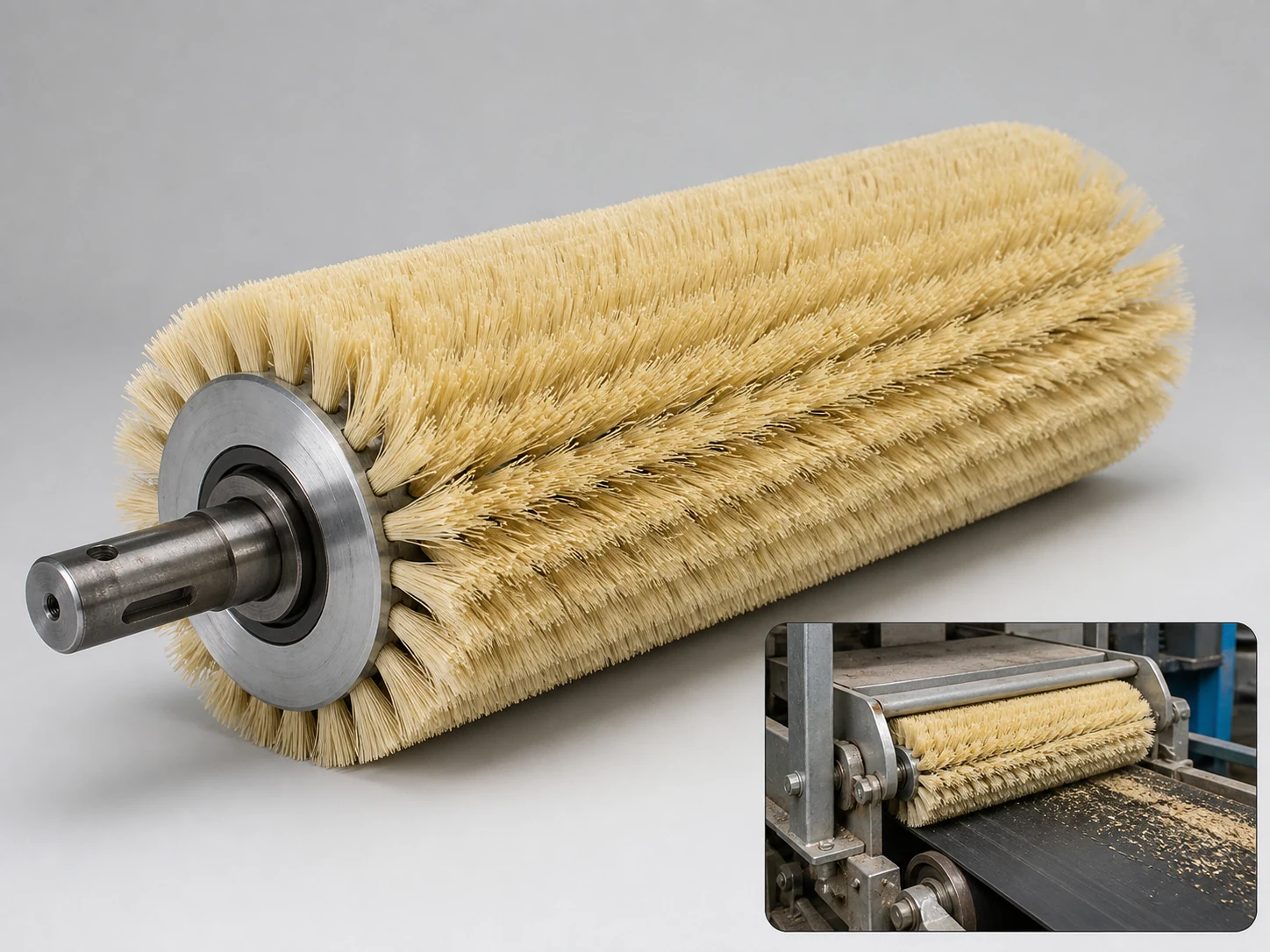
Large-format brush
100 pcs
Minimum order
Built one at a time on a core or channel: full-width rollers, sweeper brooms and long strip.
Production lead time, once the specification is confirmed
- Up to 100 pcsWithin 20 days
- 101–1,000 pcsWithin 30 days
- Over 1,000 pcsConfirmed with your quotation
Peak season can extend these times; the shipping date is confirmed in writing with your quotation. Sampling and shipping are quoted separately.
A natural Tampico fiber brush roller for continuous cleaning of conveyor belts, return rollers, chains, rails, web paths, and machine guides. It removes powder, crumbs, fibers, chips, oil, film fragments, labels, and sticky carryback without scratching metal, coated, or precision surfaces.
What can this brush do for you?
Cleans while the line keeps running
Mounted across the belt or web path, the roller stays in contact with the moving surface throughout the production shift. Operators do not need to stop the line or schedule manual scraping; carryback, loose product, and film fragments are swept off as they form.
Non-scratching contact on metal, coated, and polished parts
Tampico fiber tips are firm enough to lift powder and sticky residue but soft enough to leave painted rollers, chrome-plated guides, coated drums, and precision shafts unmarked. The natural fiber flexes under load instead of gouging the way steel wire can.
Keeps working stiffness in wet and hot conditions
Tampico is a natural vegetable fiber that retains its working stiffness when wet and recovers its shape after drying. In wet service it can operate at temperatures up to 200°C, making it suitable for steam-cleaned and washdown production areas where some synthetic filaments would soften.
Handles sticky carryback and fine particles together
The dense radial fill sweeps surface powder, crumbs, chips, and fibers while also loosening tacky residues such as dough, sugar, oil films, and label fragments. The rotating fiber tips lift material out of the contact zone so it does not re-deposit on the next revolution.
Spans the entire working width
Working widths from 100 to 5,000 mm let one roller cover the full belt or web. With 5–15 mm of edge overlap per side, no uncleaned margin remains at the edges of the moving surface.
What is a Tampico Fiber Brush Roller?
A Tampico Fiber Brush Roller is a cylindrical brush with natural Tampico fiber fill held around a central core and mounted on a shaft or shaft journals across a conveyor or web path. The roller is positioned so the fiber tips press lightly into the moving surface. It can be driven by a motor, run as a free-turning brush against a moving belt, or be indexed by the line itself.
During operation, the rotating fill contacts belts, return rollers, chains, rails, transfer points, and machine guides. Radial engagement of 2–10 mm keeps the fiber tips working without excessive deflection or premature wear. The brush removes loosely attached and lightly adhered material such as powder, crumbs, chips, oil films, label fragments, and sticky carryback.
The core and shaft carry the mechanical load and determine how the roller mounts to the machine. Common arrangements include a solid through shaft, stub shafts, threaded ends, keyed drive ends, or inserted bearing journals. Fiber trim length, fill density, fill pattern, and core material are selected around the application rather than fixed by a generic design.
This is a continuous-contact cleaning tool for production environments, not a replacement for aggressive wire brushing, abrasive descaling, or chemical stripping. Its job is to keep machine surfaces clean during normal operation and to reduce buildup that causes tracking problems, product contamination, and unplanned maintenance.
Technical Specifications
The table shows standard engineering ranges. Working width, roller diameter, core, shaft, trim length, and fill pattern are confirmed against the line drawings and the specific cleaning target.
| Parameter | Value / Options |
|---|---|
| Fill material | Tampico fiber (natural vegetable fiber) |
| Working width | 100–5,000 mm, matched to belt or web width including edge overlap |
| Roller outside diameter | 40–800 mm |
| Core outside diameter | 25–400 mm |
| Shaft or journal diameter | 12–160 mm |
| Free trim length | 10–180 mm (fiber projection beyond the core) |
| Contact setting | 2–10 mm radial engagement; 5–15 mm edge overlap per side |
| Fill pattern | Straight, spiral, or segmented strip fill on the core |
| Core material | Carbon steel, stainless steel, aluminum, or polymer, selected for environment and weight |
| Shaft / journal configuration | Through shaft, stub shaft, keyed ends, threaded ends, or bearing journals to match the drive and frame |
| Drive arrangement | Free-running against the moving surface, belt/chain driven, or direct motor drive via shaft |
| Operating temperature | Up to 200°C in wet service; dry-service limit confirmed per application |
| Mounting | Pillow block bearings, flange mounts, or existing frame journals |
| Brush type | Custom Roller and Conveyor Brushes |
| How it is driven | Machine-driven, mounted in the equipment |
| Cleaning target | belt and conveyor return, label line, and guide cleaning |
| Surface or part | roller, belts, webs, chains, conveyors, web paths, guides, and rails |
| Residue or debris | fiber, powder, oil, sticky carryback, chips, crumbs, film fragments, and adhesive |
| Mounting / connection | Free-running against the moving surface, belt/chain driven, or direct motor drive via shaft; Pillow block bearings, flange mounts, or existing frame journals |
Where does this brush work best?
- Belt and conveyor return cleaning: mounted under the return run of food, bakery, grain, packaging, or aggregate conveyors to remove carryback before it falls onto rollers, floors, or product. The non-scratch fiber tips are safe on belt covers, splices, and return idlers.
- Web, film, and label line cleaning: sweeps label fragments, film trims, adhesive particles, and coating powder from rollers, idlers, and web paths on converting, printing, and laminating lines.
- Chain, rail, and guide cleaning: cleans conveyor chains, guide rails, transfer points, and machine guides where powder, oil, or fiber buildup causes tracking or jamming.
- Roller and drum surface maintenance: keeps return rollers, drums, idlers, and cooling rolls clear of dust, product film, and fibers that otherwise cause belt slip or uneven tracking.
- Lightly adhered sticky materials: removes dough, sugar, chocolate, oil-based films, and label adhesive fragments during production, especially where wet-service operation is available.
How do I choose the right one?
Start with three measurements: the width of the surface to be cleaned, the available mounting envelope, and the residue that accumulates. These decide the roller working width, outside diameter, trim length, and drive configuration.
Set the contact width and edge coverage
The working width should cover the full moving surface plus 5–15 mm beyond each edge. That overlap prevents uncleaned margins and keeps belt edges from wearing the outer fill unevenly. If the frame has mounting brackets in the way, extend the core length and shaft journals rather than reducing the working width.
Match trim length and density to the residue
Short trim lengths, roughly 10–40 mm, give stiffer contact for sticky films and compact debris. Longer trim lengths, roughly 40–180 mm, follow surface variations more easily and are better for light powder and loose fibers. Higher fill density adds more contacting tips per revolution and cleans more completely; lower density traps less material and runs cooler on residue-heavy lines.
Choose the core and shaft for the drive and environment
A brush roller runs either free against a moving belt or is driven by a motor, gearbox, or chain. For driven operation, specify shaft diameter, keyway, or coupling end. For free-running installations, bearing journals or stub shafts are typical. Stainless steel core and shaft suit wet, washdown, or corrosive areas; aluminum reduces rotating mass on wide, high-speed lines; carbon steel is a cost-effective choice for dry, non-corrosive industrial settings.
Confirm temperature and moisture conditions
Tampico retains working stiffness when wet and tolerates wet-service temperatures up to 200°C. Dry continuous heat should be specified separately because natural fibers can embrittle with prolonged dry high-temperature exposure. If the line includes steam, hot water spray, or caustic washdown, state the chemical and temperature so the core coating, shaft material, and mounting hardware can be matched.
Check the engagement and deflection
Start with 2–10 mm of radial engagement. Too little engagement leaves a film on the surface; too much bends the fibers over, increases drive load, and shortens fiber life. After installation, watch the fiber tips under rotation: they should flick back after leaving the contact zone. A permanent lean or set means the engagement, line speed, or fiber stiffness is too high for the job.
When a different brush is the better answer
Use a wire brush roller for hardened scale, baked residue, weld spatter, or heavy rust. Use an abrasive-filament or nylon brush with grit for fine surface preparation or aggressive scrubbing of coatings. If chemical resistance, static control, or a specific synthetic fiber hardness is the main requirement, a custom nylon, PBT, or conductive-filament roller is worth evaluating. Tampico is the right choice when continuous, non-scratching removal of light to moderately sticky production residue is the goal.
Can I customize this brush?
Every Tampico fiber brush roller is defined around the line it mounts to. We need the surface width, available frame opening, shaft-to-surface distance, drive arrangement, line speed, residue description, and any washdown or temperature conditions. A drawing or photos of the mounting area and an example of the residue help eliminate fit errors.
We can adjust:
- Working width and edge overlap — built to the full belt or web width, including extra fill beyond the edges.
- Roller OD and core OD — tuned to installation clearance and required tip speed.
- Free trim length — 10 to 180 mm, selected for residue type and surface compliance.
- Fill pattern — straight, spiral, or segmented strips; segment length and strip position can match maintenance access.
- Core and shaft materials — steel, stainless steel, aluminum, or polymer, with keyways, threaded ends, flanged hubs, or bearing journals.
- Drive interface — free-running journals, sprocket or gear shaft ends, coupling stubs, or motorized shaft integration.
- Fiber preparation — trim length, tip finish, density, and dye options when visual wear marking is required.
- Mounting hardware — bearing housings, adjustable brackets, and frame adapters matched to the existing machine.
- Packaging — protective wrapping, palletized long-length packing, or project-specific labeling.
For projects requiring material documentation, inspection records, or third-party testing support, we can assist during specification and sample approval.
When is a tampico fiber brush roller worn out rather than just dirty?
How do I verify the brush is making proper contact after installation?
Run the line briefly and stop it. The fiber tips in the contact zone should show light deflection and return immediately once the roller is lifted away. Check the cleaned surface for a narrow residue streak near either edge — this usually means edge overlap or bracket alignment is off. Check drive load or free rotation resistance: a sudden increase after setup indicates the engagement is too deep or a bearing is binding.
Can the roller run with water spray or in a washdown line?
Yes. Tampico performs well in wet service and keeps enough stiffness to sweep sticky residue when wetted. The core, shaft, bearings, and mounting hardware still need to be specified for the moisture and chemicals present. Letting the roller dry between shifts helps the fiber recover its original shape and working stiffness.
Will the Tampico fiber scratch painted or coated machine surfaces?
With normal 2–10 mm engagement, Tampico does not scratch painted, plated, coated, or polished surfaces. Damage usually comes from excessive engagement, worn bearings causing the roller to wobble, or metal chips and swarf that become embedded in the fill. If the roller runs near a machining or grinding area, inspect the fill regularly for trapped metal particles.
How can I tell when the roller needs replacement?
Measure the remaining trim length against the original specification. When the fiber has worn back enough that the 2–10 mm engagement can no longer be maintained with the available mounting adjustment, schedule replacement. Permanent lean, flattened patches, clogging with hardened material, or visible runout are also replacement indicators. Track replacement by line hours and compare wear patterns between installations.
Does the brush roller replace belt scrapers or manual cleaning?
Not always. On high-dirt lines, a brush roller often works alongside belt scrapers, air knives, or washdown stations. The roller removes loose and lightly adhered material continuously; a scraper removes heavy slabs, and an air knife or rinse step clears fine particles. Configure the brush as one stage in the overall cleaning sequence rather than as the only cleaning device.
Can one roller clean both the product side and return side of a belt?
One roller cleans one contact surface at a time. To clean both sides, install separate rollers for the product side and the return run, or use a two-roller station if the frame permits. Forcing one roller to contact both surfaces causes uneven wear, poor surface contact, and inconsistent cleaning.
Guides that go deeper on this
Abrasive Nylon Grit and Filament Selection
Read this guideGuideBrush Roller Conveyor Mistakes with Dry Dust
Read this guideGuideBrush Speed, Engagement, and Heat
Read this guideGuideConveyor Belt Cleaning Brush Design
Read this guideGuideFloor Scrubber Brush Selection: Disc Brush vs Roller Brush
Read this guideCustom Manufacturing RFQ
Describe Your Application
Please share the brush dimensions, working area, residue type, material direction, quantity, and a drawing or photo for quotation.
Drawing or photo optional — it speeds things up, it does not gate the enquiry.
Custom Brush RFQ
Send Your Brush Project
Upload a drawing, product photo, or sample photo and provide the core dimensions and cleaning conditions.
“We need a brush to remove wet residue from a stainless steel conveyor, about 800mm wide. The current brush wears quickly. We can send photos.”
“We sell drinkware and need a cleaning brush to include with the product. Quantity around 5,000 pieces.”