
Custom Cleaning Brush
Thermocouple Well Cleaning Brush
Custom thermocouple well cleaning brushes in 5–20 mm diameters with brass, stainless steel, or anti-static nylon fill for removing oxide scale, ash.
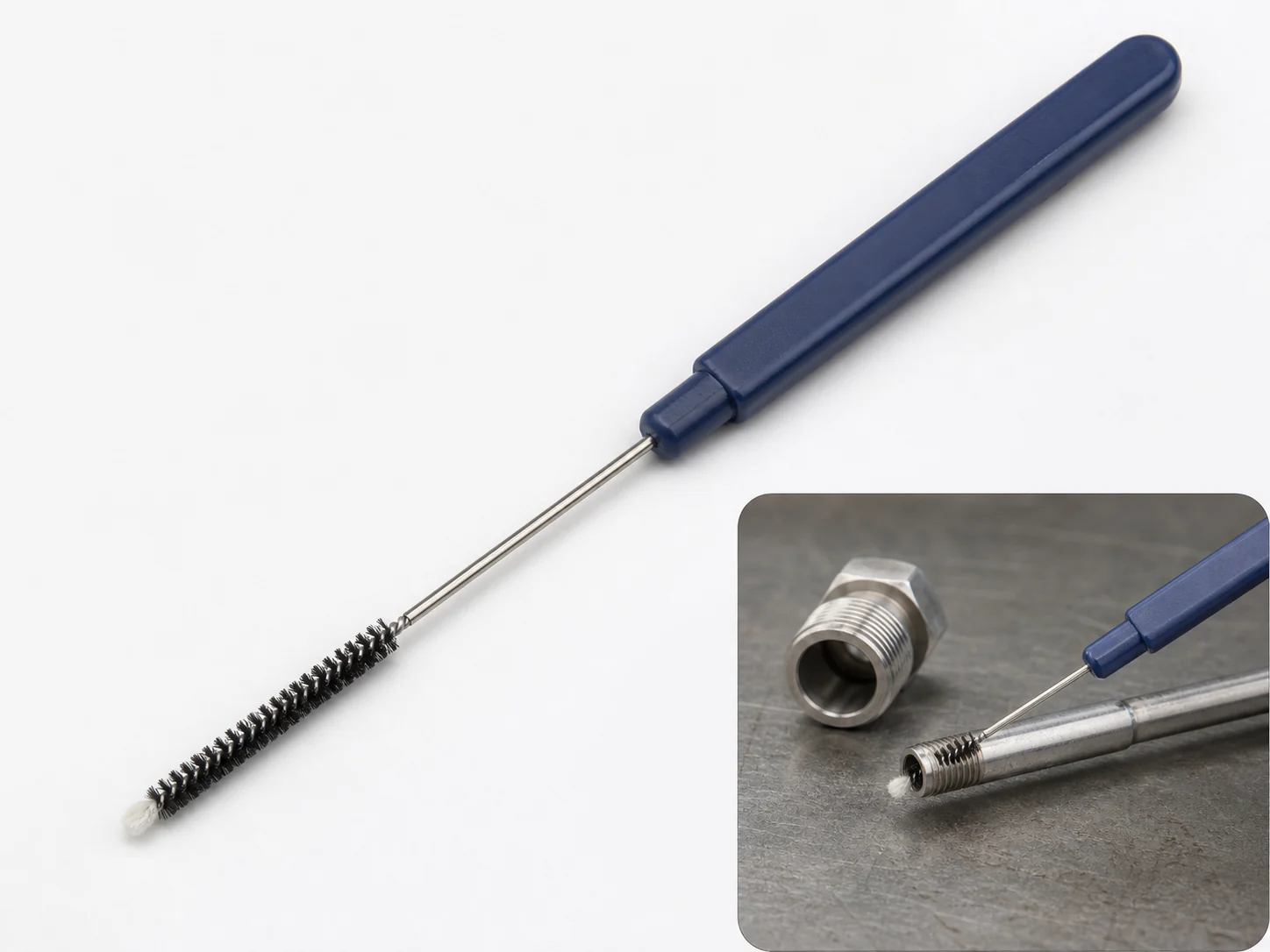
Small brush
500 pcs
Minimum order
Held in one hand: tube, bottle, detail and swab brushes — including long-handled ones with a small head.
Production lead time, once the specification is confirmed
- Up to 500 pcsWithin 7 days
- 501–50,000 pcsWithin 14 days
- Over 50,000 pcsWithin 21 days
Peak season can extend these times; the shipping date is confirmed in writing with your quotation. Sampling and shipping are quoted separately.
A narrow-diameter cleaning brush for thermocouple protection wells and sensor bores in furnaces, kilns, and thermal process equipment. It removes baked oxide scale, ash, carbon, and dust from blind cylindrical bores before a replacement thermocouple is installed, using soft brass, stainless steel, or anti-static nylon fill for well-material compatibility.
What can this brush do for you?
Full-Diameter Sweep in Small Bores
The brush is trimmed from 5 mm to 20 mm so the filaments contact the full internal circumference of the well, not just the mouth. Continuous spiral fill carries that contact to the bottom of the bore and removes deposits along the entire insertion path.
Soft Metal Fill That Preserves the Bore
Soft brass and soft-tempered stainless steel filaments break away oxide scale, ash, and carbon at the wall surface without cutting into ceramic, coated, or alloy well bores when the diameter is matched correctly. The result is a clean bore without opening up the original dimension.
Flexible Stem Reaches the Bottom of Blind Wells
The twisted wire core bends with minor misalignment or a curved access path and lets the brush follow the well to the closed end. A rounded or looped tip makes bottom contact without gouging the taper or seat surface.
Anti-Static Nylon Option for Instrumentation Areas
Conductive and anti-static nylon fills prevent static charge build-up while removing dry dust and soot. These options are used where metal bristles could scratch a sensitive bore or where dust attraction near thermocouple terminals needs to be controlled.
What is a Thermocouple Well Cleaning Brush?
A Thermocouple Well Cleaning Brush is a hand-operated bore brush designed for the inside of thermocouple protection tubes and wells. After the process has cooled and the thermocouple has been pulled, the brush is inserted into the blind bore and worked with short rotating and push-pull strokes. Its radial filaments scrub the sidewall, shoulder, and bottom to loosen oxide scale, ash, carbon, and loose dust that would otherwise shorten sensor life, slow response, or block the next insertion.
The brush is built around a small twisted stainless steel stem with soft metal or nylon filament projecting from the core. In use, the stem stays flexible enough to follow the bore without transferring high force to the well wall. Standard sizes cover well bores from roughly 6 mm to 25 mm and overall lengths from 100 mm to 200 mm.
This is a maintenance and insertion-preparation tool, not a general furnace brush. It is not meant to remove fused slag, ceramic glaze, weld spatter, or hardened mineral scale, and it should never be used while the well is hot or when the thermocouple is still installed.
Technical Specifications
| Parameter | Standard / Options |
|---|---|
| Brush diameter | 5–20 mm, selected to the well ID |
| Overall length | 100–200 mm standard; longer lengths configured to depth |
| Fill length | 25–120 mm typical; matched to the bore contact area |
| Stem / core | Twisted 304 stainless steel wire; flexible for offset bores |
| Fill material | Soft brass, soft-tempered 304 stainless steel, conductive nylon, or anti-static nylon |
| Filament trim | Continuous spiral fill to tip; full-circumference contact |
| Handle | Wire loop, straight shank, or molded grip selected for access space |
| Operating condition | Use on cooled equipment after thermocouple removal; dry or mild-solution cleaning |
| Brush type | Custom Tube & Pipe Bore Brushes |
| How it is driven | Hand-guided |
| Cleaning target | furnace and kiln thermocouple well, heat-treating and metal processing equipment, and incinerator flue gas path cleaning |
| Surface or part | bores, ceramic, thermocouple wells, metal, tubes, ports, walls, and welds |
| Residue or debris | scale, carbon, oxide, ash, oxide scale, dust, soot, and mineral scale |
| Mounting / connection | Threaded Removable / Fixed |
Diameter, fill material, and fill length are selected together. A brush that fits the bore but uses the wrong filament will either leave residue behind or mark the well wall. Provide the smallest internal diameter, total depth, well material, and residue type when specifying a size. All dimensions can be adjusted for the project.
Where does this brush work best?
- Furnace and kiln thermocouple wells where oxide scale, ash, and carbon accumulate during firing cycles and must be cleared before recalibration or sensor replacement.
- Heat-treating and metal processing equipment where metal-sheathed wells build up baked scale and carbon that changes insertion depth or thermal contact.
- Boiler, process heater, and incinerator flue gas paths where soot and dry carbon collect inside protection tubes and sensor ports.
- Ceramic protection tubes and coated wells where softer brass or anti-static nylon contact is required to avoid chipping or scratching the bore.
- Small sensor bores and nozzle passages with the same geometry when the diameter and depth match the configured brush.
How do I choose the right one?
Start with the internal bore, not the outside of the well. Use a pin gauge or caliper to measure the smallest internal diameter and then the full depth to the closed end. Select a brush whose trim diameter is equal to or up to about 2 mm larger than the bore so the filaments press lightly against the wall without binding.
Then match the fill material to the well and the residue:
| Well surface / residue | Recommended fill |
|---|---|
| Ceramic, coated, or softer alloy well with loose oxide or carbon | Soft brass or anti-static nylon |
| Hardened alloy or metal-sheathed well with heavier baked scale | Soft-tempered stainless steel |
| Instrumentation area with dry dust and static sensitivity | Conductive or anti-static nylon |
Check the overall length against the depth plus hand clearance. A brush that is too short leaves the bottom uncleaned; one that is too long becomes hard to control. Standard units cover 100–200 mm. Deeper wells require an extended stem and a stiffer core so the brush stays directed at the bottom.
Consider the access around the port when choosing a wire loop, straight shank, or molded handle. Recessed or angled ports may need a loop that can be pulled out without touching surrounding insulation.
When a different tool is the better choice: use a reamer or carbide drill for fused slag, ceramic glaze, weld spatter, or hard mineral scale. Use a vacuum or swab for very narrow bores below the 5 mm minimum or where no filament can be allowed to shed. This brush is for scale, oxide, ash, carbon, and dry deposits that yield to mechanical brushing on a cooled well.
Can I customize this brush?
Thermocouple well brushes are configured around the actual bore, so we will need the minimum ID, total depth, bore material, residue type, access clearance, handle preference, and any anti-static or conductivity requirement. A drawing or sample photo of the well helps.
- Diameter and profile: straight, stepped, tapered, or two-diameter fill for wells with a reduced-diameter lower section.
- Length: overall length, fill length, and exposed stem length built to the well depth.
- Fill material: brass, soft stainless steel, conductive nylon, or anti-static nylon; filament diameter, density, and twist pitch can be adjusted.
- Stem: twisted 304/316 stainless, coated wire, or flexible polymer core for metal-sensitive installations.
- Handle: wire loop, straight shank, T-handle, or no handle for attachment to an extension.
- Tip treatment: rounded wire tip, soft protective cap, or full-to-tip fill.
- Marking and packaging: custom color, identification label, bulk pack, individual bag, or maintenance-kit assembly.
Project-specific material declarations, inspection, or third-party testing support can be arranged as part of the customization process.
How do you confirm a thermocouple well cleaning brush has actually cleaned the surface?
How do I confirm the brush diameter is right for my thermowell?
Measure the bore at its narrowest point and compare it with the brush trim diameter. The brush should enter with light, even resistance and the stem should not bind or twist. If the filaments fold over permanently or the brush jams, it is too large. If it slides freely without touching the wall, it is too small to clean the full circumference.
Should the well be cooled before I use the brush?
Yes. Let the equipment cool to a safe handling temperature, remove the thermocouple, and follow normal lockout or isolation procedures. Hot residue can melt nylon or soften metal filaments, and cleaning an open hot well creates burn and dust ignition hazards that brushing cannot control.
What deposits should I not expect this brush to remove?
The brush removes loose and baked oxide scale, ash, carbon, and dry dust. It will not remove fused slag, ceramic glaze, weld spatter, or hardened mineral scale. Those conditions require mechanical reaming, chemical descaling, or replacement of the protection tube.
How do I verify the well is clean enough for a new thermocouple?
Inspect the full bore with a bore light or borescope and wipe the bottom with a clean swab. The new thermocouple should reach the original insertion depth without resistance and seat fully. If debris remains visible or the sensor stops short, repeat the brushing with the correct diameter or use a more suitable tool.
Can one brush clean a stepped or multi-diameter thermowell?
A straight single-diameter brush cleans the upper section but will not fully contact a smaller lower chamber. For stepped wells, specify a two-diameter or tapered fill so each bore section gets the correct trim diameter and contact pressure.
Will metal bristles leave particles inside the well?
A properly built brush with tightly twisted fill sheds very little. Inspect the brush before use and discard it if filaments are loose or damaged. After brushing, blow out the bore with dry air or vacuum it before installing the thermocouple to remove any loosened debris or stray filament.
Guides that go deeper on this
Custom Manufacturing RFQ
Describe Your Application
For a custom quote, we need the key dimensions, surface or part, residue, material preference, quantity, and reference image or drawing.
Drawing or photo optional — it speeds things up, it does not gate the enquiry.
Custom Brush RFQ
Send Your Brush Project
Upload a drawing, product photo, or sample photo and provide the core dimensions and cleaning conditions.
“We need a brush to remove wet residue from a stainless steel conveyor, about 800mm wide. The current brush wears quickly. We can send photos.”
“We sell drinkware and need a cleaning brush to include with the product. Quantity around 5,000 pieces.”