
Custom Cleaning Brush
Volumetric Flask Brush
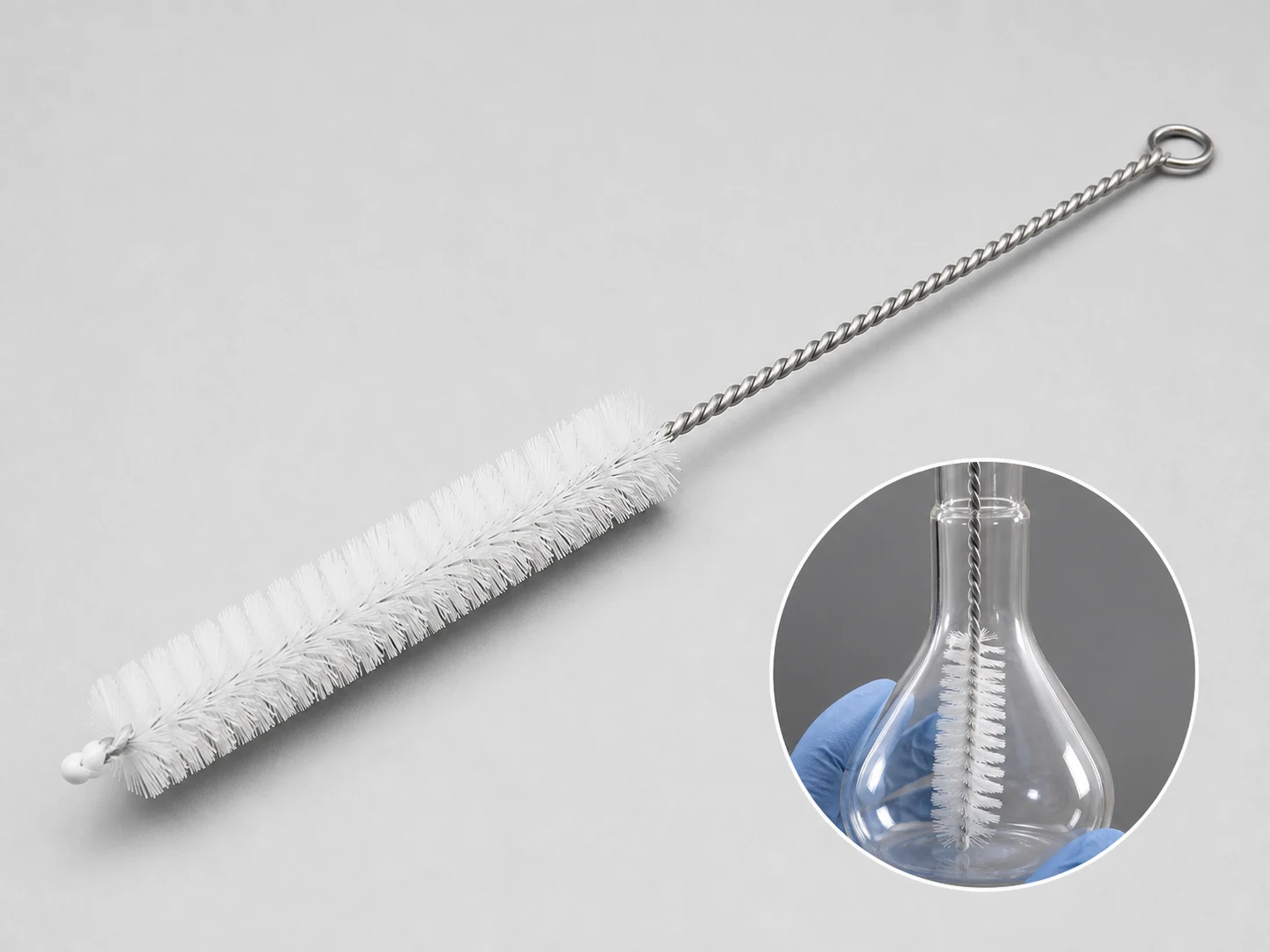
A flexible twisted-wire stem passes the narrow neck, then a head close to bulb diameter reaches shoulders and bottom without scratching the glass.
Small brush
500 pcs
Minimum order
Held in one hand: tube, bottle, detail and swab brushes — including long-handled ones with a small head.
Production lead time, once the specification is confirmed
- Up to 500 pcsWithin 7 days
- 501–50,000 pcsWithin 14 days
- Over 50,000 pcsWithin 21 days
Peak season can extend these times; the shipping date is confirmed in writing with your quotation. Sampling and shipping are quoted separately.
The Volumetric Flask Brush is a nylon PA laboratory cleaning brush with a flexible twisted-wire stem and a bottle-form or fan head. It passes through narrow volumetric flask necks to clean the bulb, shoulders, and bottom without scratching precision borosilicate glass, removing reagent film, precipitates, powders, oils, and detergent residue.
What can this brush do for you?
Passes a Narrow Neck, Then Contacts the Full Bulb
The brush head is built larger than the flask opening but close to the internal bulb diameter. It compresses briefly during insertion, then returns to its working diameter once inside the body. That lets an operator clean a flask whose bulb is much wider than its neck without jerking the stem or skipping the sidewall.
Soft Nylon Contact That Protects Accuracy-Critical Glass
Nylon PA filaments are softer than borosilicate glass, so they lift residues without creating surface scratches. On volumetric glassware, scratches and etching give future residues a place to adhere and can change how liquid drains from the interior. This brush applies enough pressure to remove film while keeping the inner surface smooth for reproducible volume delivery.
Fan and Tufted Tips Reach the Bottom Fillets
A straight cylindrical head can miss the corner where the bulb meets the flat base. The fan or tufted end form directs filaments outward and slightly downward, allowing the operator to work that bottom transition and the flat floor without turning the brush sideways or using excessive force at the neck.
Filament Diameter Matches the Residue, Not Just the Glass
Finer filaments in the 0.15–0.20 mm range wipe light reagent films, oils, and rinse residues. Coarser filaments from 0.25–0.40 mm scrub precipitated solids and softened powder deposits after soaking. The fill is selected for the expected residue load, so the brush is not left with a one-size-fits-all stiffness.
Long Stems Keep Hands Clear and Racks Organized
Overall lengths from 229 mm to 914 mm let a technician reach the bottom of tall flasks without inserting fingers into the vessel or touching the cleaning area. Loop handles hang on standard peg racks and dry quickly; straight handles give a firmer grip for controlled rotating strokes.
What is a Volumetric Flask Brush?
A volumetric flask brush is a hand-operated laboratory cleaning brush engineered around the shape of a volumetric flask: a narrow neck, a wide round bulb, and a flat bottom. Three parts work together. The twisted-wire stem carries the head through the neck and provides controlled flexibility. The nylon PA filament head contacts the glass, and the handle keeps the operator’s hand away from the vessel and cleaning solution.
In use, the brush is inserted through the neck and worked with a combination of rotating and reciprocating strokes. The bottle-form head scrubs the sidewall and shoulder, while the fan or tufted tip cleans the bottom fillet and flat base. This is a regular-cleaning and residue-removal tool, not a substitute for chemical soaking when residues are baked-on or heavily caked. The brush should be part of a sequence: compatible soak, mechanical brushing, and thorough rinsing with deionized water.
Technical Specifications
The table below shows the standard configuration range. Dimensions, head shape, and filament stiffness are set to the flask size and expected residue.
| Parameter | Value / Options |
|---|---|
| Head shape | Bottle-form, fan, cylindrical, or tufted end |
| Brush diameter | 30–50 mm, matched to the flask internal bulb diameter |
| Tufted length | 76–152 mm, adjusted to the depth below the neck |
| Overall length | 229–914 mm, matched to flask depth and operator preference |
| Filament diameter | 0.15–0.40 mm, selected for residue type and surface sensitivity |
| Fill material | Nylon PA (PA6 or PA66) |
| Stem core | Twisted wire — galvanized steel, 304 stainless, or polymer core for metal-free use |
| Handle type | Loop handle or straight handle in PP, wood, or project-specified material |
| Neck fit | Head compresses to pass narrow openings; minimum neck ID confirmed per flask model |
| Chemical exposure | Mild/neutral detergents, water, common organic solvents; avoid strong acids and oxidizing agents |
| Typical use temperature | Up to 80°C in aqueous cleaning solutions; verify for prolonged exposure |
| Brush type | Custom Bottle & Container Brushes |
| How it is driven | Hand-guided |
| Cleaning target | analytical and qc laboratories cleaning class, food testing lab, and narrow-neck borosilicate glassware cleaning |
| Surface or part | flasks, necks, glass, shoulders, glassware, vessels, narrow necks, and sidewalls |
| Residue or debris | powder, precipitate, reagent film, oil, detergent residue, and oil film |
| Mounting / connection | Threaded Removable / Fixed |
For most glass volumetric flasks, use a head diameter close to the internal bulb diameter for wiping. If more positive contact is needed, 5–20% oversize can be used for flexible polymer scrubbing, but keep interference lower on twisted-wire cores so the stem does not take a permanent set.
Where does this brush work best?
- Analytical and QC laboratories cleaning Class A volumetric flasks between sample preparations, dilutions, and standard solution work.
- Pharmaceutical, environmental, water, and food testing labs where reagent film or detergent residue can influence quantitative results.
- Narrow-neck borosilicate glassware with a wider body, including volumetric flasks, round-bottom flasks, boiling flasks, and reagent bottles with similar internal shapes.
- Removing soft precipitates, powder aggregates, oil films, and surfactant residues after a compatible soak cycle.
- Wet-bench glassware cleaning in universities, contract laboratories, and industrial analytical facilities.
How do I choose the right one?
Start with three measurements
Record the narrowest internal neck diameter, the largest internal bulb diameter, and the depth from the rim to the bottom. The brush must pass the neck without kinking the stem and then contact the bulb. Select a head diameter near the bulb ID for routine wiping. If stronger scrubbing is needed, 5–20% oversize works for flexible polymer contact, but reduce the oversize on twisted-wire stems to prevent permanent bending.
Match filament diameter and stiffness to the residue
Fine filaments around 0.15–0.20 mm remove films and loose powders without excessive force. Medium-to-coarse filaments around 0.25–0.40 mm provide the scrubbing action needed for dried precipitates after soaking. For plastic volumetric flasks, choose a finer filament and lower interference to avoid micro-scratches that can harbor residue.
Select the stem and handle for the lab environment
Galvanized steel twisted wire is cost-effective for general wet-lab use but can corrode in acid vapors or aggressive detergents. 304 stainless resists corrosion and stands up to more demanding wash solutions. For trace metal work, a polymer core or fully covered stem prevents any metal from contacting the flask or cleaning solution.
When nylon PA is not the right fill
Nylon PA absorbs water and can be degraded by strong mineral acids, oxidizing agents, phenols, and prolonged hot alkaline exposure. If the cleaning protocol includes those chemicals, specify PTFE or polypropylene filaments instead. If the flask has hard, carbonized, or baked-on deposits, brushing alone will not replace proper soaking with a compatible laboratory cleaner.
If the neck is too small for even a compressed head to pass, use a tube brush. For ultra-clean applications where any filament shedding would be unacceptable, consider disposable foam or swab cleaning instead.
Can I customize this brush?
Volumetric flask brushes are sized to the flask, not the other way around. We adjust:
- Head shape — bottle-form, fan, cylindrical, tufted end, bent tip, or a profile that reaches the bottom fillet.
- Brush diameter and tufted length — set from the flask body ID and the depth below the neck.
- Overall length — from 229 mm up to 914 mm, or longer for tall flasks and deep vessels.
- Filament diameter and fill material — nylon PA, PBT, PP, PTFE, or project-specified polymer; filament diameter from fine wiping to coarse scrubbing.
- Stem core — galvanized steel, 304/316 stainless, or polymer core for metal-free cleaning; flexibility matched to vessel shape.
- Handle — loop, straight, polypropylene, wood, color-coded, hanging hole, or molded size marking.
- Color, marking, and packaging — custom color, pad print or laser marking, bulk pack, individual bags, or lab kits.
To define the right configuration, provide the flask volume, neck ID, bulb ID, depth, expected residue, cleaning chemicals, temperature, autoclave requirements, trace metal sensitivity, and preferred handle. A sample flask or drawing speeds up the process. We can also support material documentation, inspection, or third-party testing if the lab protocol requires it.
Which filament survives the cleaning and still lasts on a volumetric flask brush?
How do I tell whether the brush head fits my volumetric flask?
The head should pass through the neck with light finger pressure and then spring back enough to make gentle contact with the bulb wall when rotated. If you need to force the twisted stem or the stem kinks, the head is too large. If the head spins freely and does not touch the sidewall, it is too small.
Can I use this brush on plastic volumetric flasks?
Yes, with the right configuration. Plastic flasks such as PMP or polypropylene scratch more easily than borosilicate glass. Use a finer filament, lower head interference, and less aggressive rotating pressure. We can set the brush diameter closer to the body ID instead of oversizing it.
Will the metal core affect trace metal analysis?
It can. A standard galvanized or stainless twisted-wire core may release traces if the core contacts the glass or soaks in cleaning solution. For ICP-MS, AA, and other trace metal work, choose a polymer core or fully covered stem so no metal is exposed inside the flask.
What is the correct cleaning sequence for a volumetric flask?
Pre-soak the flask with a compatible laboratory detergent, then brush with slow rotating and reciprocal strokes to cover the bulb, shoulders, and bottom. Rinse with tap water, followed by multiple rinses with deionized water, and dry inverted. Brushing loosens residues; it does not replace rinsing or, where required, a separate sanitizing step.
Which chemicals will damage the nylon PA filaments?
Strong mineral acids, oxidizing agents such as chromic acid or concentrated nitric acid, phenols, and hot strong alkaline solutions can degrade nylon PA over time. For those protocols, request PTFE or polypropylene fill and specify the exposure conditions at ordering.
When should this brush be replaced?
Inspect the stem for bends or kinks, the core for exposed wire, and the filaments for crushing, matting, or shedding. Replace the brush as soon as the metal core can touch the flask, because exposed wire can scratch glass and introduce contamination.
Guides that go deeper on this
We have not written a guide specific to this one yet. The material that covers selection, filament, dimensions, maintenance and sourcing is collected in the technical resources library.
Custom Manufacturing RFQ
Describe Your Application
Please share the brush dimensions, working area, residue type, material direction, quantity, and a drawing or photo for quotation.
Drawing or photo optional — it speeds things up, it does not gate the enquiry.
Custom Brush RFQ
Send Your Brush Project
Upload a drawing, product photo, or sample photo and provide the core dimensions and cleaning conditions.
“We need a brush to remove wet residue from a stainless steel conveyor, about 800mm wide. The current brush wears quickly. We can send photos.”
“We sell drinkware and need a cleaning brush to include with the product. Quantity around 5,000 pieces.”