
Custom Cleaning Brush
1000mm Helical PBT Conveyor Brush
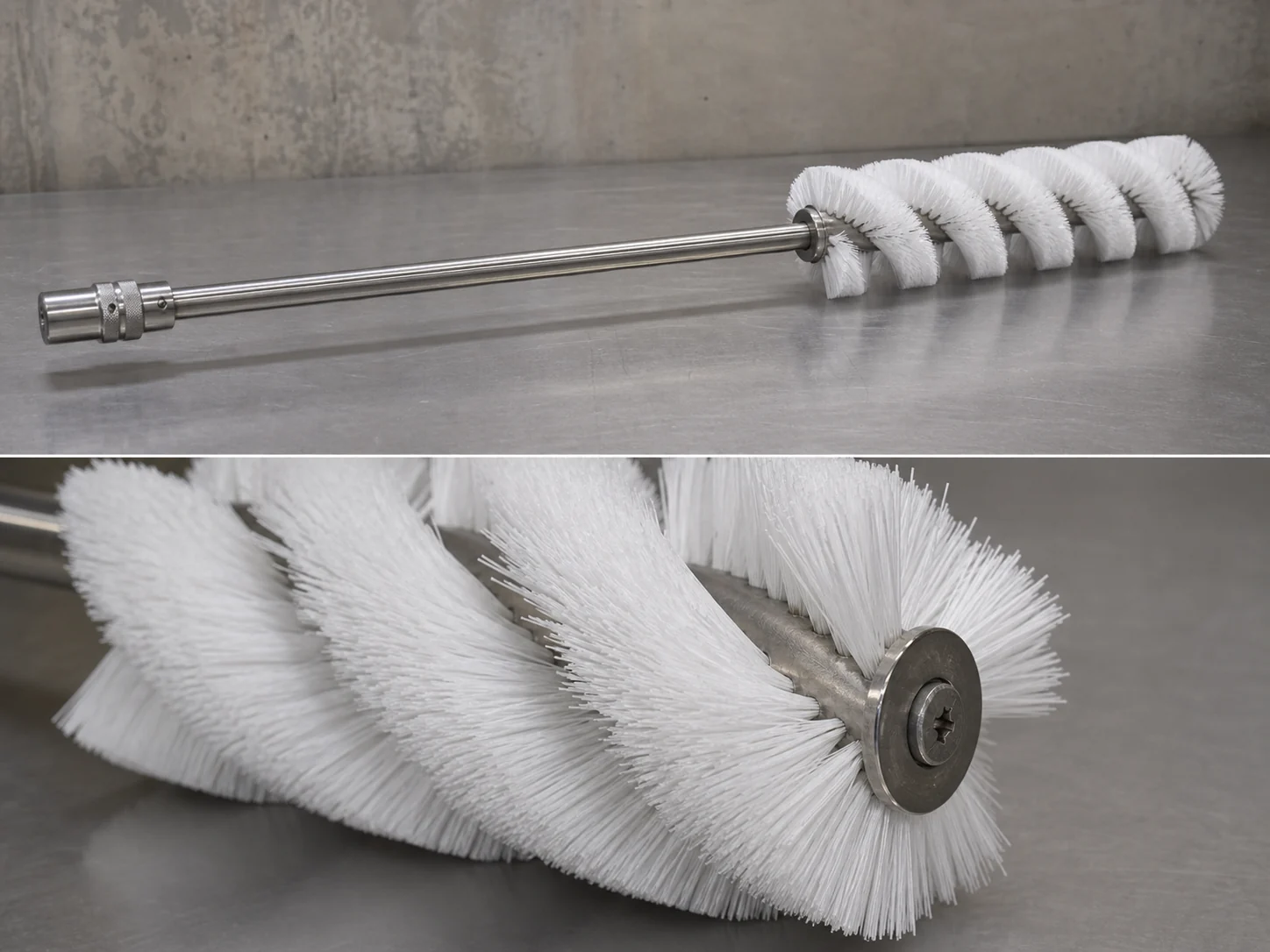
1000mm helical PBT conveyor brush with 150mm OD, AISI 304 core and quick-change coupling for conveyor belt cleaning and carryback removal.
Large-format brush
100 pcs
Minimum order
Built one at a time on a core or channel: full-width rollers, sweeper brooms and long strip.
Production lead time, once the specification is confirmed
- Up to 100 pcsWithin 20 days
- 101–1,000 pcsWithin 30 days
- Over 1,000 pcsConfirmed with your quotation
Peak season can extend these times; the shipping date is confirmed in writing with your quotation. Sampling and shipping are quoted separately.
A 1000mm rotary conveyor brush with a helical PBT filament face for continuous belt and roller cleaning. The 150mm outer diameter, AISI 304 stainless steel core, and quick-change coupling are built to remove carryback, labels, film fragments, powder, and sticky residues from the return side of conveyor belts without adding another maintenance-heavy component to the line.
What can this brush do for you?
Full-width cleaning across a 1000mm belt in one pass
PBT filament wound in a continuous helix around a 304 stainless steel core keeps filament tips in contact across the full working face as the belt moves. There is no unswept center zone where carryback can build into a ridge or transfer back onto return rollers.
Helical winding pushes debris to the edge instead of packing it into the face
The open spiral between filament rows gives displaced material a path to travel along the brush and discharge at one end. Crumbs, label fragments, fibers, and film pieces are less likely to wedge between rows, so the brush face stays open and effective between washdowns or maintenance intervals.
PBT keeps its stiffness when wet, oily, or washed down
PBT absorbs very little moisture, so filament stiffness does not drift with humidity, water spray, or condensation. The brush maintains consistent scrubbing pressure in wet washdown areas and on belts carrying oils, release agents, or sticky product residue.
304 stainless core and coupling survive washdown and chemical cleaning
The core and quick-change hardware are AISI 304 stainless steel, which resists rust from condensation, water sprays, mild cleaning agents, and food-area washdown. Brush changes do not become a corrosion repair job.
Quick-change coupling reduces belt cleaning downtime
The brush connects through a quick-change coupling at the drive or idle end, so a worn face can be swapped without pulling the entire shaft or re-aligning the conveyor. Maintenance teams can keep a spare brush set and replace it between shifts.
PBT tips scrub without gouging the belt cover
PBT filaments are stiff enough to remove stuck-on carryback but are not metallic, so the tips wear against the brush rather than cutting into synthetic or coated belt surfaces. Correct tip engagement removes residue while preserving belt cover life.
What is a 1000mm Helical PBT Conveyor Brush?
A 1000mm Helical PBT Conveyor Brush is a rotary cylindrical brush made for continuous conveyor belt and conveyor roller cleaning. The working face is a PBT filament strip wound in a helix around a stainless steel shaft. When mounted on the return run or under a roller, the brush either runs against the moving belt or is driven at a controlled speed through a quick-change coupling.
During operation, the belt carries powder, crumbs, labels, fibers, oil, or film fragments back from the head pulley. The brush tips meet the belt, dislodge the material, and the helical pattern guides loose debris laterally toward one edge. Because the brush face is 1000mm long and continuous, it leaves no unwiped section across that width.
This is not a random staple-set brush. The helical strip produces a continuous scrubbing line with an open spiral path, which is why it handles stringy or sticky carryback better than a dense straight-face brush. The AISI 304 core supports the 1000mm span without bowing under normal load, and the quick-change coupling allows the brush to be driven or removed without disturbing the shaft installation.
It is important to understand what this brush does not replace. It is not a primary scraper for heavy slabs, mud, or abrasive mineral buildup, and it is not intended for continuous operation above about 100°C. For fine, light, sticky, or fibrous residue, it is the working part of the belt cleaning system.
Technical Specifications
Reference configuration for the standard 1000mm version. Dimensions, filament specifications, and coupling details can be changed to match the conveyor and drive arrangement.
| Parameter | Standard / Selectable Values |
|---|---|
| Brush face length | 1000 mm wound section |
| Brush outer diameter | 150 mm nominal; adjusted for clearance and tip engagement |
| Filament material | PBT (polybutylene terephthalate) |
| Filament diameter | 0.40–1.00 mm; chosen by residue type and surface sensitivity |
| Trim length | 30–60 mm free filament; shorter for stiffer action, longer for conformability |
| Helical construction | Continuous single or double helix; pitch and hand specified by debris flow and discharge side |
| Core / shaft material | AISI 304 stainless steel |
| Core configuration | Solid or hollow; journals, keyways, and end extensions per drive arrangement |
| Connection | Quick-change coupling, keyed or clamped to suit existing drive |
| Recommended operating speed | 100–300 rpm for 150 mm outer diameter; confirm with load and belt speed |
| Maximum continuous temperature | Approximately 100°C (212°F) for PBT; short excursions higher |
| Wet exposure | Suitable for water, humidity, washdown, oils, mild acid and alkali; verify chemical concentration |
| Brush type | Custom Roller and Conveyor Brushes |
| How it is driven | Machine-driven, mounted in the equipment |
| Cleaning target | return-side belt, food and beverage packaging conveyor, and dry bulk conveying of grain cleaning |
| Surface or part | belts, conveyors, roller, edges, metal, and guides |
| Residue or debris | powder, film fragments, crumbs, fiber, labels, dust, oil, and release agent |
| Mounting / connection | Quick-change coupling, keyed or clamped to suit existing drive |
Where does this brush work best?
- Return-side belt cleaning in bakeries, snack, and confectionery plants: powdered sugar, flour, crumbs, oil-based release agents, and sticky caramel residues that would otherwise re-contact return rollers.
- Food and beverage packaging conveyors: label fragments, glue dots, film scraps, and product dust that stick to belts and transfer to rollers.
- Dry bulk conveying of grain, feed, flour, powder, and granular materials: fine carryback from the head pulley and buildup on idlers.
- Textile and nonwoven production lines: fibers, lint, and fabric dust removed continuously from belts and rollers before they wrap around bearings.
- Paper, folding carton, and print finishing lines: paper dust, coating particles, and small trim waste.
- Washdown production environments: wet clean-up lines need a brush core that will not rust and PBT filament that retains stiffness in water.
How do I choose the right one?
Confirm these points before ordering a 1000mm Helical PBT Conveyor Brush.
Belt width versus brush length
The standard working face is 1000mm, so it matches a 1000mm belt width directly. For a belt wider than 1000mm, specify a longer brush or mount multiple brushes end to end. For a narrower belt, a custom shorter face is usually cleaner than trimming a standard brush in the field.
Diameter and clearance
The 150mm outside diameter must fit between the conveyor structure and create the intended tip engagement against the belt or roller. Check guard clearance, bearing centers, and drive capability. If the existing mounting location has tighter clearance, the outside diameter can be reduced.
Match filament diameter and trim length to the residue
Fine powdery product calls for a thinner filament, shorter trim, and moderate density. Sticky oil, label fragments, or film pieces need a heavier filament and longer trim to maintain scrubbing pressure. Coarse chips require still thicker filament and careful tip engagement to avoid over-deflection.
Decide between a fixed or driven brush
A fixed brush relies on belt motion to create the scrubbing action. A driven brush with the quick-change coupling maintains a controlled relative speed regardless of belt speed, which is better for fine carryback and sticky films. PBT filament works in both arrangements.
Specify helix hand, pitch, and discharge direction
The helical pattern can be wound right-hand or left-hand. Select the hand so debris moves toward the edge of the belt where collection or cleaning is practical, not into a machine panel. A tighter pitch puts more filament per meter into the face for fine residue. A wider pitch opens the spiral for stringy or sticky debris and reduces wrapping.
Confirm chemical and temperature exposure
Wet washdown, mild cleaners, oils, and water are fine for PBT and 304 stainless steel. Caustic or solvent cleaning agents and constant heat above 100°C are outside PBT comfort; choose a different filament for those conditions.
When to choose a different brush
If the belt carries tramp metal, sharp chips, or heavy abrasive mineral slurry, PBT filaments will wear quickly; a wire or abrasive filament brush is more suitable. If the line sees thick slabs, mud, or heavy buildup, the brush should follow a primary belt scraper rather than act as the only cleaner. For belt temperatures consistently above 100°C, consider a high-temperature filament such as PEEK or a heat-resistant nylon.
Can I customize this brush?
The 1000mm Helical PBT Conveyor Brush is configurable because conveyor geometry, residue, and drive conditions vary. We will need the belt width, belt speed, return-side layout, available mounting centers, drive type and shaft size, residue description, washdown chemicals, and operating temperature. A drawing, photo, or existing coupling sample helps us match the arrangement faster.
We can adjust:
- Brush length and diameter: face length shorter or longer than 1000mm; outside diameter adjusted to clearance and engagement.
- Filament: PBT filament diameter, trim length, color, stiffness grade, and optional alternative filament for high temperature or aggressive chemical exposure.
- Helix geometry: single or double helix, pitch, hand, strip width, and discharge direction.
- Core and shaft: outside diameter, wall thickness, solid or hollow construction, 304 or 316 stainless steel, journals, keyways, and end extensions.
- Connection: quick-change coupling size, bore, keyway, taper, drive-end orientation, or customer-specified interface.
- Mounting details: pillow block journals, flanges, or end plates matched to the conveyor frame.
- Marking and packaging: laser or pad marking on metal parts, identification tags, and protective tube or crate packaging that prevents filament crushing during 1000mm shipments.
If your project requires material declarations, incoming inspection data, or third-party testing support, we can provide the appropriate technical documentation as part of the customization package.
How long does a 1000mm helical PBT conveyor brush last, and how is it cleaned between runs?
How much should the brush tips press into the belt?
Start with 2–6 mm of tip deflection and observe carryback removal on the return side. Too little engagement leaves film on the belt. Too much engagement causes heat, filament splay, and accelerated wear. Adjust in small increments and inspect the tips after the first shift.
Does the helical pattern need to run in a specific direction?
A helical brush runs in either direction, but debris travels toward one edge according to the helix hand and rotation. Match the hand to the desired discharge side. Running it reversed sends debris to the opposite edge and can deposit material in an unwanted area.
How can I tell when the brush is worn enough to replace?
Carryback reappears on the return side, visible filament length shortens, or the gap between the brush face and belt opens up. A practical check is to measure free filament length at several points across the face; when it has shortened by roughly one-third from new, scrubbing pressure is no longer reliable.
Can this brush be used as the only belt cleaner?
For fine powder, light film, and ordinary carryback, it can often work alone. For heavy slabs, mud, or abrasive debris, use a primary belt scraper before the brush. The brush is most effective as a secondary or polishing stage in those applications.
Will sticky residue wrap around the helical face?
The open spiral reduces wrapping, but heavy sugar, adhesive, or oil can still build up if the brush runs with too much engagement. A wider helix pitch, coated filament, or scheduled clean-off cycles help. If wrapping starts, reduce engagement and check the residue condition before the face packs solid.
How should the brush be protected during shipping and storage?
Keep the brush supported along the full 1000mm length and avoid resting it on the filament face. Store it horizontally on the core journals or in the original protective tube, and never hang it by the filaments. Protective packaging is available to prevent tip crushing during transit and long storage.
Guides that go deeper on this
Abrasive Nylon Grit and Filament Selection
Read this guideGuideBrush Roller Conveyor Mistakes with Dry Dust
Read this guideGuideBrush Speed, Engagement, and Heat
Read this guideGuideConveyor Belt Cleaning Brush Design
Read this guideGuideConveyor Brush Pressure: Residue Removal Without Belt Damage
Read this guideCustom Manufacturing RFQ
Describe Your Application
To prepare the correct quotation, provide the dimensions, cleaning task, residue, material, mounting details, quantity, and a drawing or photo.
Drawing or photo optional — it speeds things up, it does not gate the enquiry.
Custom Brush RFQ
Send Your Brush Project
Upload a drawing, product photo, or sample photo and provide the core dimensions and cleaning conditions.
“We need a brush to remove wet residue from a stainless steel conveyor, about 800mm wide. The current brush wears quickly. We can send photos.”
“We sell drinkware and need a cleaning brush to include with the product. Quantity around 5,000 pieces.”