
Custom Cleaning Brush
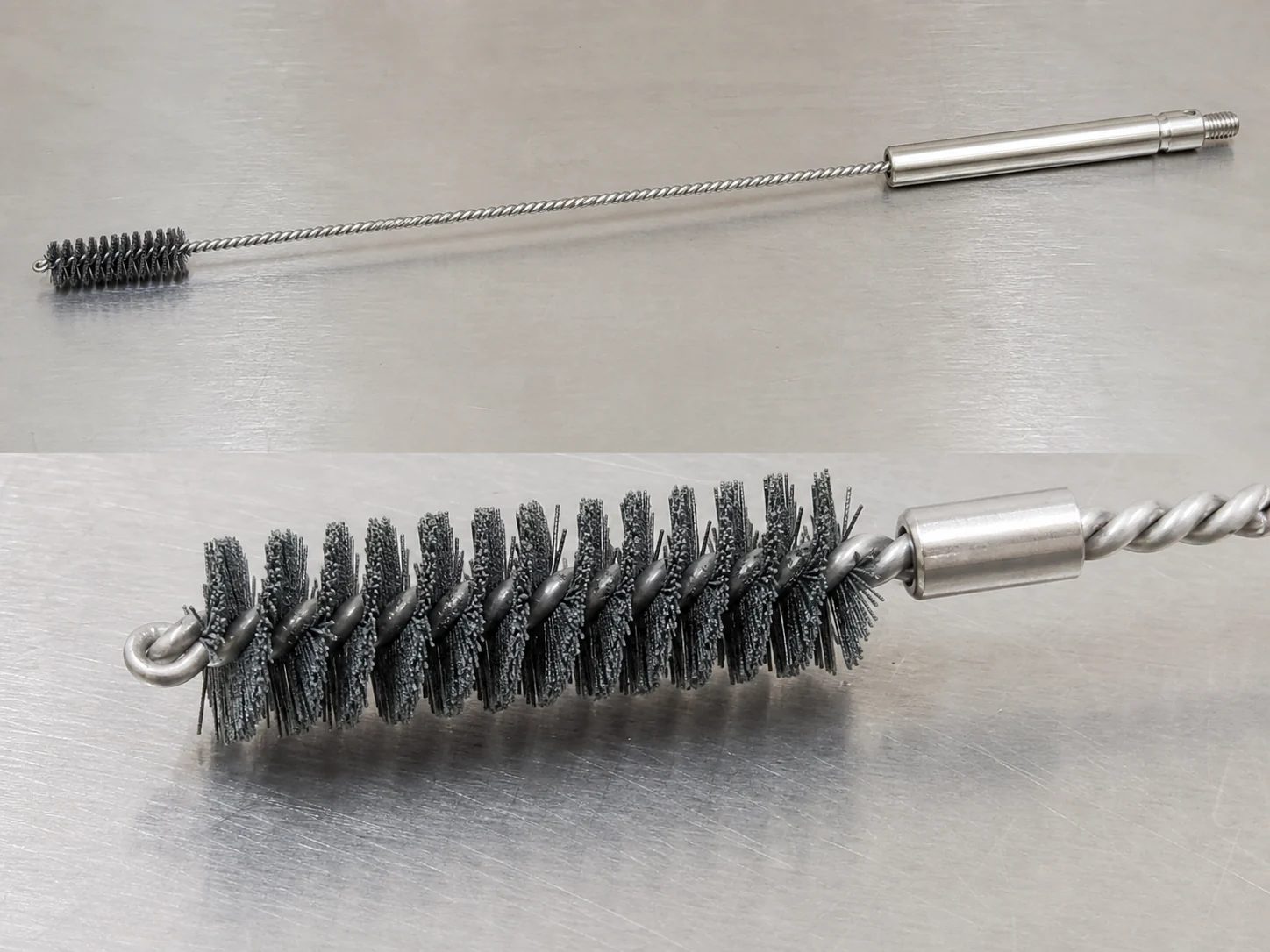
18mm P180 SiC Tube Brush
P180 silicon carbide in nylon gives full-circumference contact in an 18 mm bore, clearing scale and carbon without the gouging risk of steel wire.
Small brush
500 pcs
Minimum order
Held in one hand: tube, bottle, detail and swab brushes — including long-handled ones with a small head.
Production lead time, once the specification is confirmed
- Up to 500 pcsWithin 7 days
- 501–50,000 pcsWithin 14 days
- Over 50,000 pcsWithin 21 days
Peak season can extend these times; the shipping date is confirmed in writing with your quotation. Sampling and shipping are quoted separately.
An 18 mm diameter tube brush built with P180 silicon carbide abrasive-filled nylon filaments for controlled internal cleaning of heat exchanger tubes and similar bores. It removes light scale, rust, carbon, coolant residue and machining chips while protecting copper, brass and other relatively soft tube materials from the gouging risk of steel wire brushes.
What can this brush do for you?
Full-circumference contact inside the 18 mm class tube
The round 18 mm head is sized so the abrasive filaments flex into contact with the entire internal wall during rotation. In heat exchanger tube bundles, a brush that only touches part of the circumference leaves deposit bands that later show up as hot spots or reduced heat transfer. This geometry keeps the cleaning action around the full bore on every stroke.
Aggressive enough for deposited film, soft enough for tube metal
P180 silicon carbide particles are carried on flexible nylon filaments instead of rigid steel wire. That puts many small contact points on the fouling while letting the filament carrier bend under load. The result is effective removal of thin oxides, scale, carbon and dried coolant film with far less scoring than a twisted wire brush would leave on the same surface.
Works on copper and brass heat exchanger tubing
Abrasive nylon is a practical replacement for wire when the tube material is softer than the brush. Spiral scratches from steel wire can become future corrosion initiation sites in copper, brass and cupronickel tubes. The P180 SiC head breaks up the deposit and leaves the base metal smoother, which is what maintenance teams want before retubing, inspection or putting the unit back in service.
Replaceable threaded head keeps tool cost down
The abrasive head threads onto the 304 stainless stem as a separate component. When bristles lose diameter, lean over, or no longer make full contact, the operator changes the head in seconds and keeps using the same stem. For shutdown crews that run hundreds of tube brushes, this matters just as much as the cleaning result.
Accepts hand or rotary drive
The 8 mm round shank sits in a standard drill chuck or a fixed tube brush handle. Short touch-ups can be done by hand; longer tube runs can be run with a variable-speed drill for consistent rotation and faster deposit removal.
What is an 18mm P180 SiC Tube Brush?
An 18mm P180 SiC Tube Brush is a cylindrical, internally cleaning brush whose working head is built from silicon carbide abrasive-impregnated nylon filaments arranged in a round cross-section. P180 is the grit grade; the number tells you the abrasive particle size, and for this head it indicates a medium-fine cut intended for regular deposit removal and surface preparation rather than coarse metal removal.
The brush is used by inserting the head into the open end of a tube or port, rotating it, and moving it in and out along the bore. The rotating filaments scrub the internal wall, dislodge attached residue, and carry the loosened material out of the filament pack as the head is withdrawn. In heat exchanger work, the brush is typically run after chemical soaking or water flushing to break up what flushing alone leaves behind, and before final rinse or inspection.
This is not a through-tube cleaning system. It cleans from the open end to the reach of its stem, so long tubes are either cleaned from both ends, matched to a longer stem, or handled with pass-through equipment when full-length coverage is required.
Technical Specifications
| Parameter | Value / Options |
|---|---|
| Head diameter | 18 mm nominal |
| Head profile | Round / cylindrical |
| Working head length | 80 mm |
| Filament material | Abrasive nylon with silicon carbide (SiC) |
| Grit grade | P180 (medium-fine) |
| Stem / shank material | AISI 304 stainless steel |
| Stem / shank length | 180 mm |
| Shank / grip diameter | 8 mm |
| Head connection | Threaded, replaceable head |
| Typical tube ID range | 16–22 mm depending on fouling thickness; full contact is best around 17–21 mm |
| Overall length | Approx. 260 mm including head and stem |
| Drive | Hand or variable-speed powered driver with 8 mm chuck |
| Brush type | Custom Tube & Pipe Bore Brushes |
| How it is driven | Hand-guided |
| Cleaning target | shell-and-tube heat exchanger and condenser, brass and cupronickel hvac/chiller tube, and hydraulic manifold bore cleaning |
| Surface or part | tubes, bores, walls, ports, tube walls, internal walls, metal, and long tubes |
| Residue or debris | scale, carbon, coolant, chips, rust, light scale, oxide, and coolant residue |
| Mounting / connection | AISI 304 stainless steel; Threaded, replaceable head; Hand or variable-speed powered driver with 8 mm chuck |
The fit column is about the tube, not just the brush. Actual clearance depends on deposit thickness, out-of-roundness, and how freely chips and scale can escape during rotation.
Where does this brush work best?
- Shell-and-tube heat exchangers and condensers where 17–21 mm internal diameter tubes carry fouling films, scale, oxides or light corrosion product and the crew needs controlled mechanical cleaning between chemical runs or before inspection.
- Copper, brass and cupronickel HVAC/chiller tubes where steel wire brushes are considered too damaging for the tube wall and a softer abrasive contact is required.
- Hydraulic manifold bores, ports and cross-drilled intersections where chips, dried coolant and light carbon collect in places a rag or stick tool cannot reach.
- Tube ends and small fittings after machining, where internal surfaces need a uniform P180 finish before assembly, plating or coating.
- Process and utility piping with straight or gently curved sections where the 80 mm head can follow the bore and the 260 mm overall length covers the accessible section.
How do I choose the right one?
Match the head to the minimum internal diameter
Measure the smallest clear ID the brush must pass through, not just the design tube size. A tube that has built up 0.5 mm of scale has a smaller working bore than its drawing dimensions. The 18 mm head works best in roughly 17–21 mm clean IDs. In heavier fouling or smaller bores the filaments compress too much and lose their scrubbing action; in larger bores they stop contacting part of the wall.
Match the grit to the deposit
P180 is the right choice for thin oxide, light scale, carbon dust, dried coolant and the residue left after chemical cleaning. If the deposit is thick mineral scale, baked carbon or rust that resists the brush, move to P80 or P120 abrasive, or to a wire tube brush on tolerant steel tubes. P240 and finer grades are for finishing after the main deposit is gone.
Consider reach and rotation
The 180 mm stem plus 80 mm head gives about 260 mm of usable reach from the tube end. If the fouled section is longer, plan to clean from both ends or specify a longer stem. Long thin stems flex under heavy pressure, so longer reach works better with lower force and higher repetition than with aggressive pushing.
Check environment and tube material
AISI 304 is fine for oils, coolants, neutral detergents and normal washdown. For chloride-rich or seawater systems, request a 316 stainless or polymer stem. For copper and brass tubes, the SiC nylon head is usually the safer mechanical choice; for plain carbon steel tubes with heavy rust scale, a wire tube brush may remove more material faster.
| Condition | Best configuration |
|---|---|
| 17–21 mm clean tube ID, light film/scale/carbon | 18 mm P180 SiC head |
| Heavy rust, calcite or baked deposit | P80–P120 abrasive or wire tube brush; pre-soak or hydrolance first |
| Copper/brass/aluminum tube wall | SiC nylon to limit scoring |
| Tube reach beyond approx. 260 mm | Longer stem, two-end cleaning, or pass-through equipment |
| Thin final preparation before assembly | P240–P320 finishing head |
Can I customize this brush?
Yes. The 18 mm P180 configuration is a starting point, not a fixed catalog item. We adjust the head, stem and connection to the tube schedule and the maintenance plan.
- Head diameter and length — change the OD to fit a different tube schedule, alter the working length, or create a tapered or stepped head for transition bores.
- Grit and abrasive type — P180 can be changed to P80, P120, P240, P320 or another grade, and the abrasive can be selected for the deposit and the tube material.
- Stem construction — length, diameter, 304/316 stainless, coated stainless, or polymer stem for metal-free or chloride-sensitive applications.
- Connection — threaded head, solid one-piece construction, hex shank, or interface matched to the customer’s existing handle or driver.
- Color and identification — custom filament color, shank marking, pad printing or laser marking for crew identification and fleet control.
- Packaging — bulk, individual sleeve, tube-brush set, or project-specific packing.
To define the configuration, provide the minimum tube ID, deposit thickness and type, tube material, accessible length, cleaning speed, chemical exposure, and whether the crew works by hand or with a powered driver. A tube drawing or a representative fouled sample helps us match the head before production.
If the project requires material documentation, inspection records, third-party testing, or cleaning-procedure support, we can assist with those requirements during the customization process.
What size should a 18mm P180 sic tube brush be, and how long does it last?
What tube IDs will the 18 mm head actually fit?
Measure the narrowest internal diameter with a pin gauge or dial bore gauge after noting deposit thickness. In practice, the 18 mm head cleans best in about 17–21 mm IDs. If the tube passes 16 mm after fouling, the head will be too tight and the filaments will smear instead of scrub. If the bore is 24 mm or larger, the brush cannot reach the full wall and a larger head should be specified.
Can I run this brush in a drill?
Yes. The 8 mm round shank fits a standard drill chuck. Use a variable-speed driver at moderate speed, keep the head moving in and out, and avoid holding the head in one spot at high speed. Dwelling in one position concentrates wear, overheats the abrasive filaments, and increases the risk of marking the tube wall.
How do I know when to replace the head?
Check the brush before every shift. If the filaments have taken a permanent lean, the head diameter no longer fills the bore, or the brush slides through with little resistance while residue remains, the head is worn. Because the head is threaded, replace only the abrasive section and keep the stem for the next head.
Will P180 remove hard mineral scale or baked-on carbon?
P180 is intended for thin oxide, light scale, carbon film and normal process deposits. Hard calcite, thick rust and baked coke layers usually require a coarser grit, a wire brush on suitable steel tubes, or chemical/hydrolance pretreatment before mechanical brushing. Forcing this brush into heavy buildup shortens filament life and produces poor cleaning.
Does brushing replace flushing or chemical cleaning?
No. Brushing dislodges attached deposit; loosened material still needs to be flushed from the tube. In many heat exchanger procedures the brush is used between a chemical soak and the final water flush, or before eddy-current testing. It is part of the cleaning sequence, not a substitute for the rest of it.
Is the brush safe for every metal or coating inside the tube?
SiC nylon is far less aggressive than steel wire, but it is still abrasive. On copper, brass, aluminum and cupronickel it is usually the safer mechanical option. For elastomer linings, polymer-coated bores or very thin-walled tubing, test on a scrap section first or use a non-abrasive nylon brush if the base surface must remain untouched.
Guides that go deeper on this
Custom Manufacturing RFQ
Describe Your Application
To prepare the correct quotation, provide the dimensions, cleaning task, residue, material, mounting details, quantity, and a drawing or photo.
Drawing or photo optional — it speeds things up, it does not gate the enquiry.
Custom Brush RFQ
Send Your Brush Project
Upload a drawing, product photo, or sample photo and provide the core dimensions and cleaning conditions.
“We need a brush to remove wet residue from a stainless steel conveyor, about 800mm wide. The current brush wears quickly. We can send photos.”
“We sell drinkware and need a cleaning brush to include with the product. Quantity around 5,000 pieces.”