
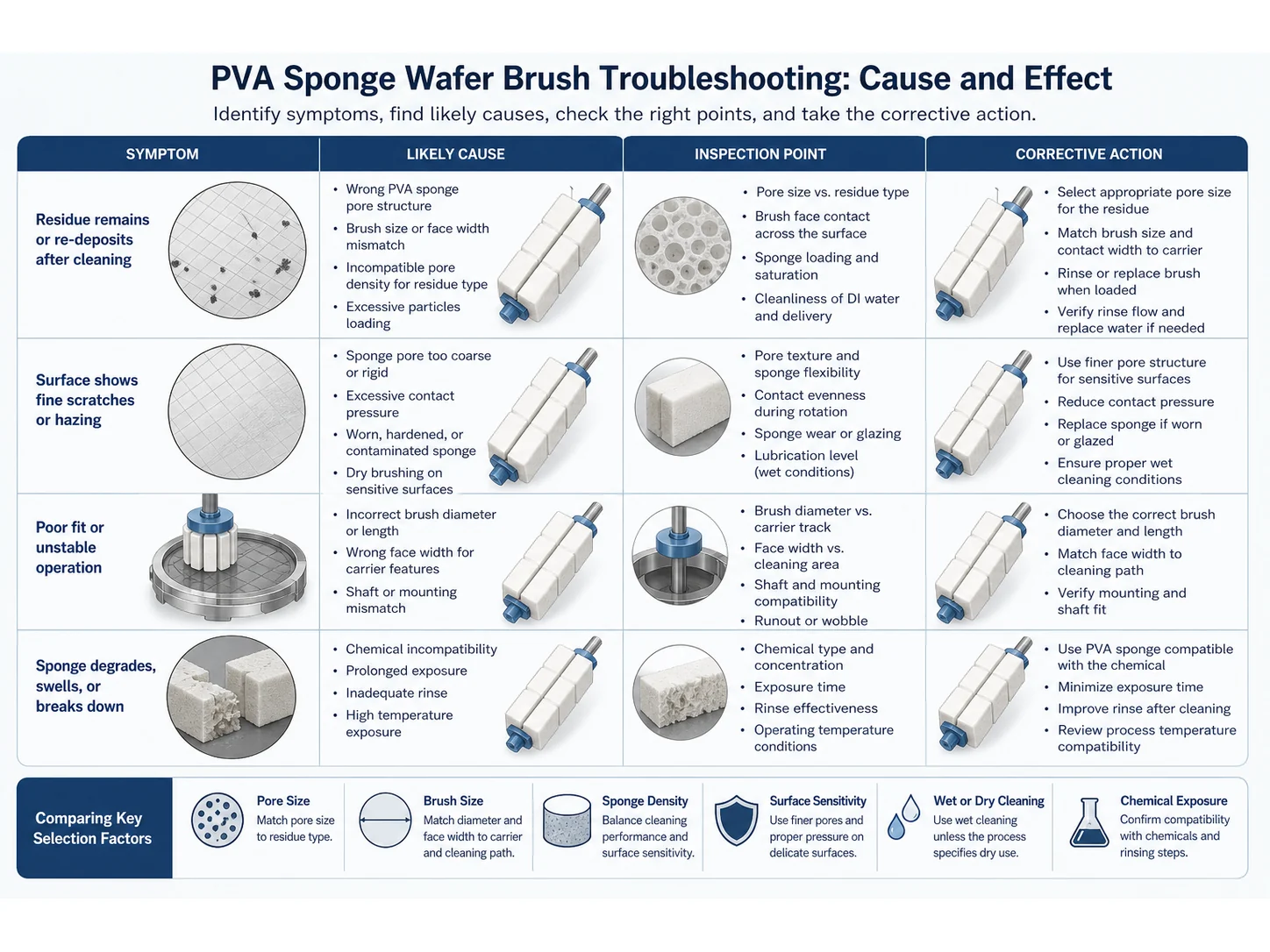
What Is a PVA Sponge Wafer Brush?
A PVA sponge wafer brush uses a highly absorbent, open-cell polyvinyl alcohol foam that is soft, lint-free, and chemically resistant when wet. Unlike conventional sponges or cloths, PVA sponge generates very few particles, making it suitable for cleanroom environments. In precision carrier cleaning, the brush gently scrubs surfaces while holding moisture or cleaning solutions, reducing the risk of micro-scratches and electrostatic discharge. Its primary job is to remove polishing slurry residues, organic films, dust, and other contaminants from sensitive substrates before further processing.
Common Types and Options
Wafer brushes vary by physical design, mounting method, and sponge characteristics. Understanding these options helps you specify the right brush for your equipment and process:
- Diameter and length – Standard ranges from 10 mm to 50 mm outside diameter, with working lengths matched to wafer size (e.g., 100 mm to 300 mm). Custom dimensions are common for proprietary handling systems.
- Core material – Plastic (PVC, polypropylene) for lighter weight and chemical resistance; stainless steel (304 or 316) for rigidity and durability in aggressive chemicals.
- Handle/End fitting – Fixed handles for manual cleaning; threaded studs, flanges, or quick-release mounts for automated brush arms.
- Pore size – Fine pore (tight cell structure) for ultra-smooth surfaces and low particulate retention; coarse pore for faster absorption and rougher substrates (still gentle).
- Stiffness – Soft for minimal contact pressure, often used with fragile wafers; medium for slightly more mechanical action on tougher residues.
- Specialty versions – Some brushes incorporate mild abrasive particles in the sponge matrix for a gentle polishing effect, or anti-static additives for static-sensitive handling.
Comparing Key Selection Factors
The table below contrasts typical choices within PVA sponge wafer brush design, helping you weigh trade-offs.
| Factor | Option A | Option B | Notes |
|---|---|---|---|
| Pore size | Fine (high density) | Coarse (open cell) | Fine pores shed fewer particles; coarse pores hold more liquid but can trap larger debris. |
| Stiffness | Soft (low durometer) | Medium (higher durometer) | Soft for delicate films; medium for dried slurry or stubborn organics without scratching. |
| Core material | Plastic (PVC/PP) | Stainless steel (304/316) | Plastic resists many acids/alkalis; steel offers dimensional stability and cleanroom compatibility but may corrode in strong acids. |
| Mounting style | Fixed handle | Threaded or flanged | Fixed handles suit manual stations; threaded/flanged interfaces ensure repeatable positioning in automated arms. |
| Chemical compatibility | Standard PVA (pH 2–10) | Special PVA (pH 1–14) | Standard PVA works with mild cleaners and DI water; aggressive solvents or strong acids require verified compatibility. |
How to Choose the Right PVA Sponge Wafer Brush
Match the brush to your specific cleaning task by evaluating these real-world factors:
Type of Residue
Is it loose particles, dried polishing slurry, fingerprint oils, or organic films? Heavier residues may require a slightly coarser pore or medium stiffness to lift contaminants without excessive pressure.
Surface Sensitivity
Bare silicon wafers, resist-coated surfaces, or soft metal layers demand the softest possible brush to avoid microscratches. Ask your brush supplier for surface roughness data if available.
Wet or Dry Cleaning
PVA sponges are designed for wet use; dry PVA can generate static and shed particles. Always use with a compatible cleaning solution or DI water to keep the sponge lubricated and debris in suspension.
Chemical Exposure
Will the brush see IPA, acetone, aggressive strippers, or acidic cleaners? Confirm chemical resistance of both the PVA foam and the core material. Even short exposure to incompatible solvents can cause swelling or disintegration.
Equipment Interface
Automated wafer tracks or robotic arms need precise mounting dimensions and often require a threaded insert or flange. Manual cleaning stations may only need a simple handle. Provide your equipment drawing to the brush supplier early.
Cleanroom Class
ISO Class 5 or better typically requires PVA that is clean-processed, bagged, and certified low-particle. Standard PVA may be acceptable in lower cleanliness zones.
Maintenance Frequency
How often will the brush be replaced or cleaned? In high-throughput fabs, brushes are single-use or changed daily. In R&D or low-volume lines, a reusable brush with a robust core might be preferred.
Custom Size Requirements
If your carrier or wafer size is non-standard, off-the-shelf brushes may not fit. Custom diameter, length, and mounting features often have minimum order quantities, but avoid the mistake of forcing a standard brush into a custom application.
Common Specification Mistakes
These errors often lead to contamination events, damaged wafers, or wasted procurement cycles:
- Ignoring pore size. A “soft” sponge with the wrong pore structure can still trap particles and re-deposit them. Match pore size to the particle size you are trying to remove.
- Choosing stiffness by feel, not by process. A brush that feels soft to the touch may still be too stiff for a 50-micron-thick wafer. Always refer to application data or request a trial sample.
- Overlooking chemical compatibility. Many PVA sponges degrade in solvents above 30% concentration or at extreme pH. If your cleaner is proprietary, share the SDS with the brush manufacturer.
- Using a metal core when it is not needed. Stainless steel adds cost and may introduce metallic contamination risk if not passivated correctly. If a plastic core meets rigidity needs, use it.
- Skipping the mounting detail. A brush that spins on the shaft or mounts at the wrong offset will clean unevenly. Provide the exact thread size, flange pattern, or handle socket dimensions.
- Assuming “one size fits all” across wafer sizes. A brush designed for 200 mm wafers may not clean the edges of a 300 mm carrier properly. Brush length must match the contact path.
- Ordering production quantities without a sample test. Even with perfect specs, a quick trial with actual residue and chemicals can reveal mismatch in stiffness, shedding, or wear. Always test first.
When a Standard PVA Sponge Wafer Brush Is the Wrong Choice
PVA sponge brushes are excellent for light residue and particle removal on smooth, flat surfaces. However, they have limitations:
- Deep scratches or embedded contaminants. A brush cannot remove physical damage or particles lodged in crystal lattice defects. Consider a rework or etching step.
- Heavy, caked-on residues. Thick films or slurry that has dried for days may require pre-soaking, ultrasonic cleaning, or a different mechanical action (e.g., high-pressure spray).
- Complex geometries with deep trenches or vias. A sponge brush only contacts the top surface; high-aspect-ratio structures need megasonic energy or fluidic cleaning methods.
- Extreme static sensitivity. In very dry environments, even wet PVA can generate enough charge to damage sensitive devices. An anti-static version or ionization may be necessary.
- When a drawing review reveals a design mismatch. If the supplier’s standard brush cannot meet your tolerance or mounting requirement, a custom engineering review is essential. Do not force-fit a near-match.
Final Takeaway
A PVA sponge wafer brush is not a commodity; it is a precision tool that directly impacts yield. Start by defining your residue type, surface sensitivity, and cleaning chemistry. Then select pore size, stiffness, and core material to match, and never skip the sample test for new processes. Pay equal attention to the mounting interface—a brush that won’t stay in position will create more problems than it solves. In high-volume fabs, treat the brush as a process parameter, not an afterthought.
Frequently Asked Questions
What makes PVA sponge better than a regular sponge for wafer cleaning?
PVA (polyvinyl alcohol) sponge has an extremely low particle-shedding tendency, is chemically clean, and does not leave lint or fibers. Regular cellulose or polyurethane sponges can break down and release particles, which is unacceptable in semiconductor or optics cleanrooms.
Can I use a PVA brush with isopropyl alcohol (IPA)?
Many PVA formulations tolerate brief contact with IPA at room temperature, but prolonged soaking or high concentrations can cause swelling. Always request chemical compatibility data from your brush supplier, especially if using IPA above 70% or at elevated temperatures.
How do I determine the right pore size for my process?
Fine pores (70–90 ppi) are ideal for blanket wafers and polished surfaces where any particle fingerprint must be avoided. Coarser pores (40–60 ppi) may be acceptable on textured surfaces or for pre-cleaning heavy slurry where absorption speed matters more. A sample test is the best way to confirm.
Is a rigid core or a flexible core better for automated equipment?
Rigid cores (metal or thick-wall plastic) maintain exact alignment and are preferred for robotic arms with tight tolerances. A flexible core can compensate for minor misalignment or gently conform to slightly curved carriers but may reduce positional repeatability. Match the core to your machine’s alignment capability.
What are signs that I need a custom brush instead of an off-the-shelf one?
Non-standard wafer/carrier dimensions, unique mounting thread or flange patterns, special cleanroom packaging requirements, or the need for a mixed stiffness profile are all triggers for a custom design. If a standard brush leaves a soiled edge or vibrates loose, it is time to discuss a drawing-based solution.
How do I properly store PVA sponge brushes between uses?
Always rinse thoroughly with DI water after use, then store the brush damp in a sealed cleanroom bag. Do not allow the sponge to dry out completely—once dehydrated, PVA becomes stiff and may crack upon re-wetting. Replace any brush that shows signs of hardening or surface cracking.
Can PVA brushes be used dry?
Dry PVA is abrasive, generates high friction, and can shed particles. Only use PVA sponge brushes when they are saturated with a compatible cleaning liquid. For dry dust removal on wafers, consider an anti-static polymer brush or a vacuum wand instead.
When should I request a sample test before placing a bulk order?
Always test a sample when introducing a new chemical, a new wafer material, or a new cleaning step. Also test when changing brush suppliers or moving from R&D to production. A small batch of sample brushes can reveal mismatch in stiffness, shedding behavior, or dimensional fit before a costly mistake occurs.
Technical References
- EOS/ESD Association — ESD Fundamentals
- EOS/ESD Association — Principles of ESD Control
- NISTIR 4653 — Metrology for the Semiconductor Industry
- ISO 14644-1 Cleanrooms and Associated Controlled Environments
- British Plastics Federation — Thermoplastics
- NIST — Metric SI
Which bristle material fits this job — PVA Sponge, AISI 304 Stainless Steel Wire or PVC?
| Material | Continuous temperature (°C) | Peak temperature (°C) | Water absorption | Hardness |
|---|---|---|---|---|
| PVA Sponge | 60 | 90 | — | Soft absorbent contact material; hardness/compression is controlled by foam or sponge density. |
| AISI 304 Stainless Steel Wire | 400 | 500 | 0% | Rockwell B 70–95 depending on temper and cold work |
| PVC | 50–70 | 75–90 | 0.04–0.40% | Shore A 70–95 or Shore D 70–85 |
Figures as published by Alleima; Perlon. Confirm the exact grade against the supplier datasheet before ordering.
What should replace PVA Sponge for wafer carriers?
- PVA Sponge — Compare PVA Sponge with PU sponge, PP sponge, microfiber. Change material when wet stiffness, temperature, chemical resistance, conductivity, particle shedding, or surface marking becomes the limiting factor.
- AISI 304 Stainless Steel Wire — Use AISI 316 stainless steel wire for chloride, marine, dairy, beverage, chemical washdown, or higher pitting-resistance requirements. Use carbon steel for dry aggressive cutting and brass or abrasive nylon for lower marking risk.
- PVC — Compare PVC with PE board, PP, elastomer, aluminum holder. Change material when wet stiffness, temperature, chemical resistance, conductivity, particle shedding, or surface marking becomes the limiting factor.