
Custom Cleaning Brush
20mm P320 AO Tube Brush
20mm P320 AO tube brush with aluminum oxide abrasive nylon for cleaning heat exchanger tubes, ports, and bores.
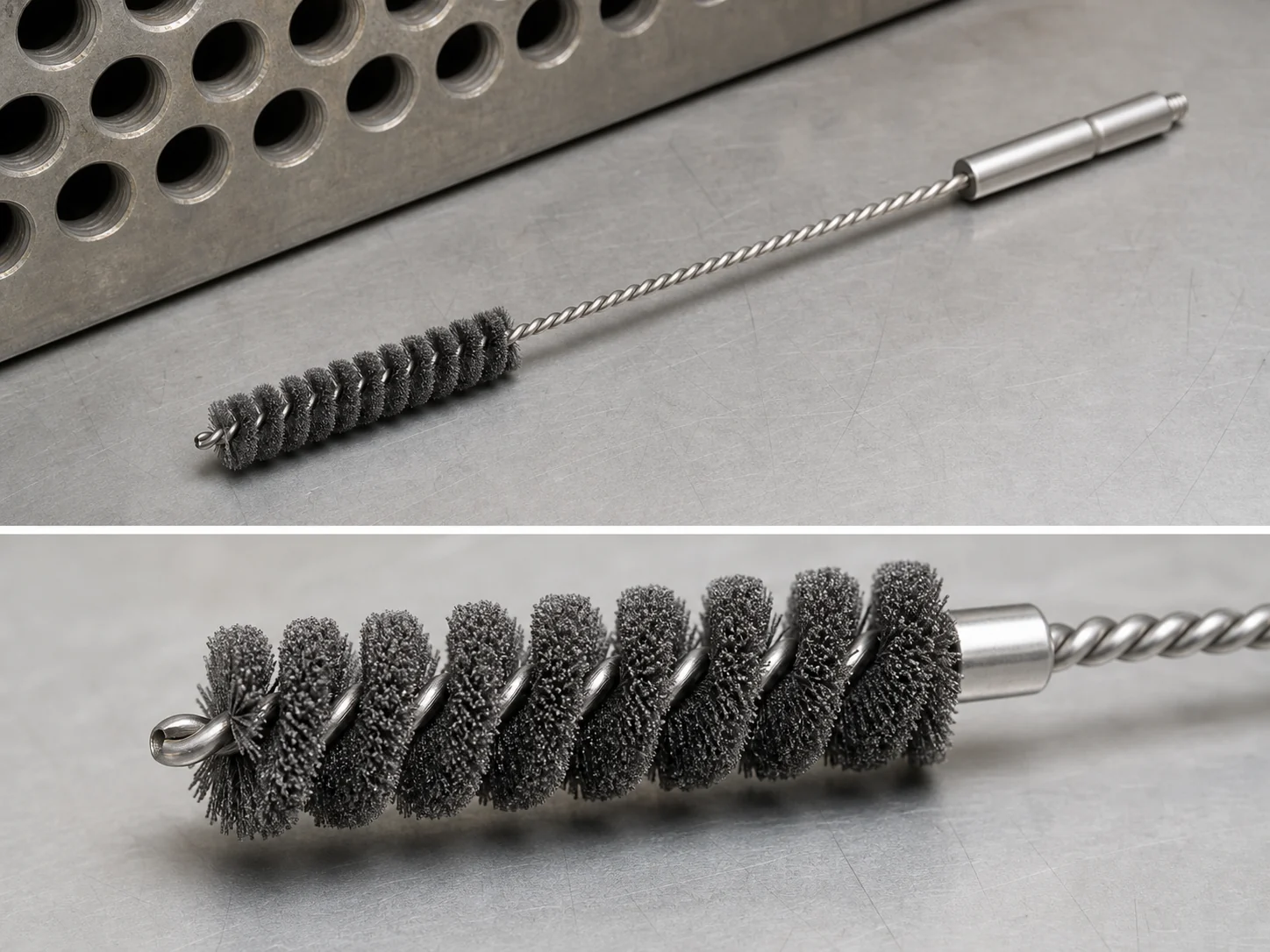
Small brush
500 pcs
Minimum order
Held in one hand: tube, bottle, detail and swab brushes — including long-handled ones with a small head.
Production lead time, once the specification is confirmed
- Up to 500 pcsWithin 7 days
- 501–50,000 pcsWithin 14 days
- Over 50,000 pcsWithin 21 days
Peak season can extend these times; the shipping date is confirmed in writing with your quotation. Sampling and shipping are quoted separately.
A 20 mm diameter abrasive nylon tube brush with P320 aluminum oxide filaments for deburring, surface conditioning, and light deposit removal inside heat exchanger tubes, ports, and small bores. The 100 mm brush head on a 200 mm stainless steel handle reaches deep into straight or gently curved passages, while the threaded end accepts extensions or low-speed rotary drive.
What can this brush do for you?
Controlled abrasive action with P320 aluminum oxide
Aluminum oxide crystals are distributed throughout each nylon filament, not just on the surface. As the filament wears, fresh abrasive is exposed, so the brush maintains a consistent cutting action from first stroke to last. P320 is a fine grit that removes light scale, surface oxidation, carbon films, and process residues while leaving a uniform texture rather than gouging the tube wall. That makes it suitable for pre-inspection cleaning and surface preparation before coating, plating, or bonding.
Full-circumference contact in 20 mm bores
The 20 mm outside diameter is matched to tubes and ports with an internal diameter close to 20 mm. The flexible abrasive filaments compress slightly against the wall and maintain contact around the full circumference during push, pull, and rotating strokes. A tightly packed filament head resists collapsing, so the brush does not skip over deposits in low spots or leave dead zones at the tube bottom.
Deep reach without losing control
The 100 mm brush head cleans a full tube section in a single stroke, and the 200 mm stainless steel handle keeps the brush stable while you work farther from the opening. This combination reaches scale and carbon deposits that short brushes or hand pads cannot, and it lets you inspect or clean without disassembling the entire heat exchanger.
Corrosion-resistant handle and threaded drive interface
AISI 304 stainless steel resists rust from water, coolants, mild acids, and cleaning solutions, which is important when the brush will be used repeatedly in wet environments. The threaded removable connection allows you to extend reach with additional rods, replace the brush head when it wears, or mount the brush in a low-speed rotary tool for powered cleaning without buying a separate tool.
Works wet or dry without loading
Abrasive nylon does not absorb oil, coolant, or wet residue the way a cloth or natural-fiber brush does. After use, rinse the head with water or a compatible solvent and it is ready for the next cycle. The brush does not retain the contaminants it just removed, which reduces cross-contamination between tube sections.
What is a 20mm P320 AO Tube Brush?
A 20mm P320 AO Tube Brush is a cylindrical abrasive brush designed for internal cleaning and surface conditioning of tubes, ports, and machined bores. “AO” stands for aluminum oxide, the abrasive mineral loaded into the nylon filaments. “P320” is the grit size, a fine grade that removes thin films and light deposits without aggressive stock removal.
In use, the brush is inserted into the opening and either manually stroked or driven at low speed. The abrasive-loaded nylon filaments conform to the tube wall and scrub away scale, rust, carbon, powder, and process residues. The stainless steel core provides axial stiffness so you can apply pressure without the head folding over, while the threaded end allows extension or mechanical drive.
This is not a heavy descaling tool. Use low RPM if powered, and avoid temperatures above 150 °C (302 °F) to prevent nylon softening. The brush follows gentle curves, but tight elbows may require a more flexible core configuration.
Technical Specifications
| Parameter | Value / Options |
|---|---|
| Brush diameter | 20 mm |
| Brush head length | 100 mm |
| Head shape | Round |
| Bristle material | Abrasive nylon with aluminum oxide |
| Grit | P320 |
| Handle / core material | AISI 304 stainless steel |
| Handle length | 200 mm |
| Grip diameter | 9 mm |
| Connection | Threaded removable |
| Recommended operating temperature | Up to 150 °C (302 °F) continuous |
| Wet / dry use | Suitable for wet or dry operation |
| Brush type | Custom Tube & Pipe Bore Brushes |
| How it is driven | Hand-guided |
| Cleaning target | heat exchanger tube internal, hydraulic and pneumatic port, and machined bore and blind hole cleaning |
| Surface or part | tubes, bores, ports, aluminum, thread, walls, curved passages, and holes |
| Residue or debris | scale, rust, oxide, light scale, coolant, carbon, process residue, and coolant residue |
| Mounting / connection | Threaded removable |
The 20 mm diameter is the nominal outside diameter of the brush. In use, the abrasive nylon filaments compress slightly to create an interference fit inside a tube whose ID is close to 20 mm. If your actual bore is significantly different, we can adjust trim length, filament stiffness, or overall diameter. The threaded connection can be specified to match your extension rod or rotary drive.
Where does this brush work best?
- Heat exchanger tube internal cleaning: removes light scale, rust, and process film from tube IDs before inspection, hydrotesting, or retubing.
- Hydraulic and pneumatic ports: cleans internal walls, threads, and cross holes without leaving loose metal particles.
- Machined bores and blind holes: reaches the bottom of a 20 mm bore to remove chips, coolant residue, and light oxidation after machining.
- Threaded fittings and adapters: cleans thread roots without damaging the thread profile, which matters for sealing surfaces.
- Surface preparation for coating, plating, or adhesive: P320 grit creates a uniform surface texture that improves bond strength.
How do I choose the right one?
This 20 mm P320 AO tube brush fits a specific set of jobs. Check these points before ordering:
- Measure the tube ID. The brush works best in bores with an internal diameter between approximately 19 and 22 mm, depending on filament flexibility and the interference fit you want. A smaller bore will not allow entry; a larger bore will give only partial contact. For other diameters, ask for a different OD or trim length.
- Evaluate the deposit. P320 is fine grit, designed for light scale, surface rust, carbon films, and process residues. If you are dealing with heavy mill scale, thick rust, or baked-on carbon, use a coarser grit (P80–P180) or a stainless or carbon steel wire brush. P320 will polish rather than remove heavy deposits.
- Check the reach. The head is 100 mm long and the handle adds 200 mm. If you need to clean a tube deeper than about 300 mm, use a threaded extension or specify a longer handle. For very deep or highly curved tubes, consider a twisted wire core brush or a flexible shaft tool.
- Decide on motion. For manual use, the 9 mm grip diameter gives comfortable hand control. For powered use, the threaded connection allows mounting in a low-speed drill or rotary tool; keep speed below 600 RPM and avoid continuous heat build-up. Abrasive nylon softens near 150 °C.
- Consider the environment. The 304 stainless handle handles water, coolants, and mild chemicals. For strong acids, chlorides, or high-humidity environments, we can quote a 316 stainless or coated handle.
When to choose a different brush: Use a wire brush for hard scale or weld spatter, a smaller diameter for bores under 19 mm, a larger diameter for bores over 22 mm, a brass or steel brush for temperatures above 150 °C, or a flexible spiral brush for tight bends. This abrasive nylon tube brush is for fine surface conditioning and light deposit removal, not heavy stock removal.
Can I customize this brush?
Every tube cleaning job has a specific bore, deposit, and access condition. We can adjust this brush to match your project. Common changes include:
- Brush diameter: from 15 to 30 mm or custom OD, with trim length adjusted for the right interference fit.
- Brush head length: shorter or longer than 100 mm to match the tube section you need to clean.
- Handle length and grip diameter: standard 200 mm x 9 mm, or custom dimensions for deeper reach or ergonomic needs.
- Thread size and type on connection: M6, M8, 1/4-20, or your specified thread for extension rods or rotary tools.
- Bristle material and grit: P320 is standard; other grits such as P80, P120, P180, P240, P400, or P600 are available. Silicon carbide or ceramic abrasive nylon can be specified for harder surfaces.
- Handle material: 304 stainless is standard; 316 stainless, coated steel, or non-metallic options for specific chemical environments.
- Filament density and stiffness: adjust fill density, filament diameter, and trim length to control cleaning pressure and conformability.
- Color coding and marking: custom color, laser marking, or pad printing for identification in multi-brush operations.
- Packaging: bulk, individually bagged, or project-specific packing.
To define the custom configuration, provide tube ID and tolerance, tube length, deposit type and thickness, wet or dry use, chemical exposure, manual or powered drive, and any spindle or extension interface. A drawing or sample tube speeds up the specification. If your project requires material certifications, inspection reports, or third-party testing, we can coordinate those during the specification phase.
What size should a 20mm P320 AO tube brush be, and how long does it last?
What tube ID should I have for this 20 mm brush?
The brush is designed for tube IDs close to 20 mm, typically 19–22 mm depending on filament flexibility and desired contact pressure. Measure your bore at its narrowest point. If the brush enters easily but does not press against the wall, or if it binds, the diameter is wrong for your bore.
Can I drive this brush with a power drill?
Yes, the threaded connection can be mounted to a low-speed rotary tool or drill. Keep the speed below 600 RPM and avoid extended continuous operation. Abrasive nylon generates heat from friction; if the brush becomes too hot to hold near the head, reduce speed or switch to a wet process.
How do I know when the brush head needs replacement?
Check the brush diameter against the tube ID with a caliper. When the filaments wear down enough that the brush no longer creates a slight interference fit, or when the aluminum oxide abrasive is mostly gone and the surface looks polished rather than clean, replace the head. Also replace if filaments are permanently bent or melted.
Will P320 remove heavy rust and scale from heat exchanger tubes?
No. P320 is a fine finishing grit for light oxidation, carbon films, and process residues. Heavy rust, mill scale, or hard mineral deposits require a coarser abrasive nylon (P80–P180) or a stainless/carbon steel wire brush. Using P320 on heavy deposits will polish the surface without removing the bulk material.
Should I use this brush wet or dry?
Both work. Wet use with water, coolant, or a mild cleaning solution keeps the brush cooler and flushes loosened debris out of the tube, which reduces clogging and extends filament life. Dry use is fine for light dust, powder, or where liquids are not allowed.
How should I clean and store the brush after use?
Rinse the head with water or a compatible solvent to remove abrasive swarf and residue, shake off excess liquid, and allow to air dry. Store the brush hanging by the handle or lying flat in a dry area below 60 °C (140 °F). Avoid leaving it in strong acids or alkalis.
Guides that go deeper on this
Custom Manufacturing RFQ
Describe Your Application
Send the key measurements, cleaning requirement, residue, material direction, mounting method, quantity, and drawing or photo.
Drawing or photo optional — it speeds things up, it does not gate the enquiry.
Custom Brush RFQ
Send Your Brush Project
Upload a drawing, product photo, or sample photo and provide the core dimensions and cleaning conditions.
“We need a brush to remove wet residue from a stainless steel conveyor, about 800mm wide. The current brush wears quickly. We can send photos.”
“We sell drinkware and need a cleaning brush to include with the product. Quantity around 5,000 pieces.”