
Custom Cleaning Brush
Chromatography Brush
Fine-filament nylon PA chromatography brush for GC injector ports, inlet liners, detector inlets, and capillary column exteriors.
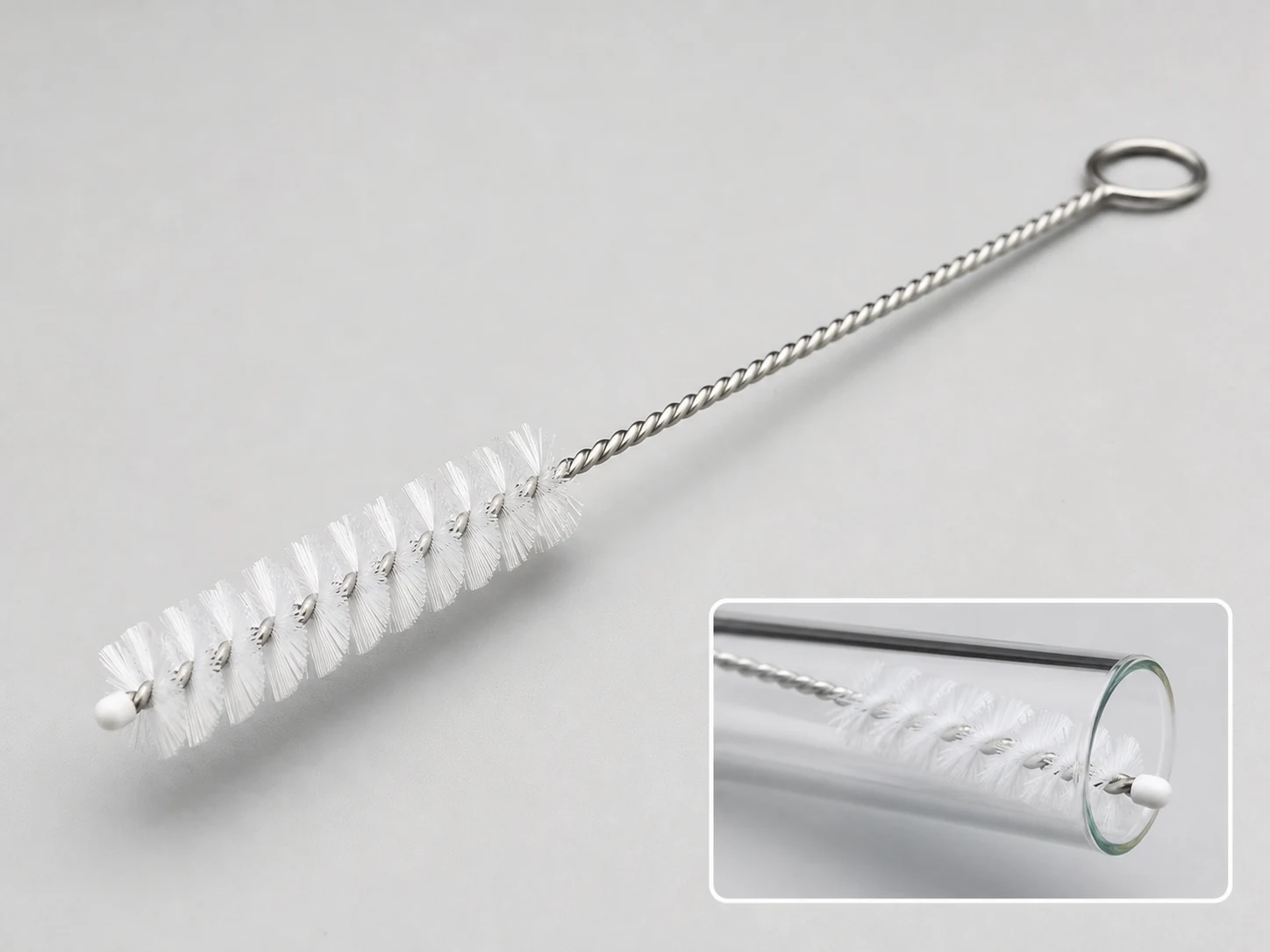
Small brush
500 pcs
Minimum order
Held in one hand: tube, bottle, detail and swab brushes — including long-handled ones with a small head.
Production lead time, once the specification is confirmed
- Up to 500 pcsWithin 7 days
- 501–50,000 pcsWithin 14 days
- Over 50,000 pcsWithin 21 days
Peak season can extend these times; the shipping date is confirmed in writing with your quotation. Sampling and shipping are quoted separately.
A fine-filament nylon PA cleaning brush for gas chromatography injector ports, inlet liners, detector inlets, and small-bore glass surfaces. It is sized and shaped to remove septum fragments, liner residue, and sample debris from contact areas a general laboratory brush cannot reach.
What can this brush do for you?
Enters the narrow bores general laboratory brushes miss
The brush is built around a 1–5 mm stem and a 2–20 mm head, with overall lengths from 150 mm to 800 mm. That combination allows the working end to enter an injector port or liner cavity while the operator still controls the tool from outside the inlet. Working lengths of 30–250 mm put filament contact where residue actually settles, including the bottom of a liner rather than only the entrance.
Fine nylon filaments dislodge septum fragments without grinding the glass
Filament diameters from 0.08 mm to 0.40 mm give a controlled contact fine enough to lift small particles from a glass bore. Nylon PA is much softer than borosilicate glass, so routine hand-powered scrubbing removes film and debris without scratching the liner wall. This makes the brush suitable for glass inlet liners and other scratch-sensitive chromatography surfaces.
End styles matched to inlet geometry
A cylindrical end cleans straight through-bores, a conical end follows tapered inlet passages, and tufted or flat ends wipe the bottom of a liner or shallow port. A fan end can cover a wider detector cavity. The end geometry reduces the dead zones at the transition between wall and base, where straight cylindrical brushes often leave residue behind.
Anchored fill reduces fiber fallout
Filaments are retained in a twisted-wire or supported core so the cleaning action does not shed stray fibers into the sample path. Loose filament fragments in an injector or detector can create ghost peaks or block a small jet, so the fill retention method is part of the cleaning result, not an afterthought.
Designed to work with normal chromatography maintenance chemicals
Nylon PA holds its shape after contact with many of the mild solvents and detergent solutions used in routine instrument maintenance. The brush can be used wet to suspend loosened residue, then rinsed clean. For aggressive solvents or strong acids and alkalis, compatibility should be checked before ordering.
What is a Chromatography Brush?
A Chromatography Brush is a hand-operated, narrow-profile cleaning tool used during routine GC and HPLC maintenance. It is built for injector ports, inlet liner cavities, detector inlets, column ferrules and nuts, and the exterior surfaces of capillary column ends. It is not designed to clean the inside of a capillary column bore, which is too narrow for any practical brush head.
In typical use, the operator removes the inlet liner or opens the port, inserts the brush to the working depth, and cleans with push, pull, and rotation strokes. The fine nylon fill sweeps the bore wall and collects small particles, while the long handle keeps fingers outside the hot or restricted inlet area. Wetting the brush with a compatible solvent helps loosen residues and keeps the removed debris suspended until the part is rinsed.
This is a routine-maintenance brush, not an aggressive abrasion tool. It removes septum fragments, film, and soft deposits. It will not reliably remove baked-on carbon or heavily polymerized residue that requires oven burnout or aggressive mechanical removal. Determine the expected deposit condition before specifying the brush.
Technical Specifications
Dimensions and geometry are set to the liner series or injector model. The table shows the standard production ranges available for configuration.
| Parameter | Standard Range / Options |
|---|---|
| Filament material | Nylon PA, grade selected for the cleaning solvent and residue |
| Head diameter | 2–20 mm, matched to the narrowest internal diameter |
| Working length | 30–250 mm, set to liner or port depth |
| Overall length | 150–800 mm, according to reach and handle preference |
| Stem diameter | 1–5 mm |
| Stem construction | Twisted stainless steel wire or corrosion-resistant core |
| Filament diameter | 0.08–0.40 mm, finer for film wiping, coarser for particle pickup |
| End style | Tufted, fan, cylindrical, conical, or flat |
| Fill density | Low, medium, or high, matched to deposit type and required scrubbing pressure |
| Handle | Loop, straight, or ergonomic grip; project-specific material and color |
| Operating method | Hand-held push, pull, and rotation |
| Recommended contact fit | Near-size for wiping films; 5–20% oversize for flexible polymer scrubbing |
| Secondary fill option | Horsehair for water-based cleaning where a softer, more absorbent fill is preferred |
| Brush type | Custom Tube & Pipe Bore Brushes |
| How it is driven | Hand-guided |
| Cleaning target | gc injector port and split/splitless inlet bore, glass inlet liner, and detector inlet and narrow transfer line fitting cleaning |
| Surface or part | ports, glass, bores, walls, columns, cavities, narrow necks, and glassware |
| Residue or debris | particles, dust, soft deposits, and carbon |
| Mounting / connection | Threaded Removable / Fixed |
Head diameter is selected relative to the narrowest internal bore. Near-size contact produces a wiping action that removes a thin residue film without heavy force. A 5–20% oversize on the flexible nylon fill gives firmer wall contact for lifting loose particles. The correct fit depends on the surface sensitivity and the deposit being removed.
Where does this brush work best?
- GC injector ports and split/splitless inlet bores after the liner has been removed, where septum fragments, ferrule dust, and sample residue collect on the port wall and seat.
- Glass inlet liners, including straight and gooseneck forms, for cleaning the interior after a solvent soak and for removing particles from the wall and bottom.
- Detector inlets and narrow transfer line fittings, where a fan or tufted end can clear shallow cavities without damaging small bore walls.
- Capillary column exterior ends, ferrules, and column nuts, which need particulate-free surfaces before reinstallation.
- Laboratory glassware with narrow necks or tapered internal transitions that a general-purpose brush cannot enter.
How do I choose the right one?
Measure the narrowest internal diameter and the full depth of the port or liner first. These two dimensions determine whether the brush will enter and where the working length must begin. A pin gauge or caliper is usually enough for the measurement.
For a thin film or residue that wipes away easily, choose a head diameter close to the bore inside diameter for near-size contact. For soft, loose deposits on glass or metal, a 5–20% oversize flexible nylon head provides more scrubbing contact. A head that binds at the entry is too large; a head that slides without contacting the wall is too small.
Filament diameter controls the cleaning action. Fine filaments from 0.08 mm to 0.15 mm are best for light films and delicate deactivated liner surfaces. Medium filaments from 0.15 mm to 0.25 mm handle everyday septum fragments and ferrule dust. Coarser filaments from 0.25 mm to 0.40 mm can lift sticky residues from metal ports but should be used on glass only when the deposit requires it, because the higher surface pressure can accelerate wear on coated surfaces.
Select the end style from the geometry of the contact area. Straight cylindrical ends suit uniform bores. Conical ends follow tapered inlets. Tufted or flat ends clean the flat bottom of a liner or shallow port. Fan ends cover wider, shallow detector cavities. Multi-diameter heads are available when one brush must clean both the bore and the bottom transition.
Confirm solvent and temperature exposure. Nylon PA tolerates many common laboratory cleaning solvents, but it is not suitable for strong acids, strong alkalis, high-temperature sterilization, or prolonged phenolic solvent contact. For water-based cleaning only, horsehair may be acceptable. Specify the actual cleaning chemical during configuration.
Use a different tool when the job falls outside this brush range. The inside of a capillary column cannot be brushed; use a solvent flush. Heavily carbonized deposits in an inlet are best handled by replacing the liner or using an aggressive mechanical tool, not a nylon maintenance brush. If the surface cannot accept any filament contact, a solvent soak with a lint-free swab is the better method. For metal-bristle or abrasive cleaning, choose the appropriate wire or abrasive brush product instead.
Can I customize this brush?
Chromatography brushes are configured to the instrument and liner series. To produce a custom version, provide the narrowest internal diameter, full contact depth, surface material, expected residue, cleaning solvent, preferred end style, and handle form. A drawing or a used liner helps confirm the geometry.
Typical project variables include:
- Head geometry — diameter, taper, length, rounded or flat tip, multi-diameter steps, and custom end profiles
- Filament — nylon PA grade, filament diameter, fill density, trim length, or horsehair alternative
- Stem and core — length, diameter, stainless steel grade, flexibility, and coated-core option
- Handle — loop, straight, ergonomic grip, color, lot marking, or hanging feature
- Configuration — single diameters or size-assorted kits for a laboratory’s common liner portfolio
- Packaging — bulk, individual sleeve, lab kit, or project-specific identification labeling
If the project requires material declarations, inspection support, documentation, or third-party testing, we can assist with these requirements during the customization process.
Which filament survives the cleaning chemicals a chromatography brush meets?
Can this brush clean the inside of a capillary column?
No. A capillary column internal diameter is far below the smallest practical brush head. This brush cleans injector ports, inlet liners, detector inlets, and exterior surfaces of capillary column ends and ferrules. Internal capillary contamination should be addressed by solvent flushing and column conditioning.
How can I verify the correct head diameter before ordering?
Measure the narrowest internal diameter with calipers or pin gauges. Choose near-size contact for wiping or up to 20% oversize for flexible nylon scrubbing. If a sample brush binds on entry or folds over and loses contact, the head is too large. If it passes through with no wall contact, it is too small.
Will the nylon filaments scratch a glass inlet liner?
Nylon filament is much softer than borosilicate glass and will not scratch under normal hand pressure. On liners with a surface deactivation layer, repeated hard scrubbing with coarse filament can wear the coating. Use fine filament, near-size contact, and a solvent soak before brushing when the coating must be preserved.
How should I clean and store the brush after use?
Rinse the fill with a compatible solvent or detergent, remove loosened debris, and air-dry. Store the brush hanging by the loop or in a protective sleeve. Do not expose nylon fill to strong acids, strong alkalis, or high heat. Replace the brush when filaments are flattened, missing, or no longer recover their shape.
Will brushing remove a baked-on carbon deposit from an inlet?
Usually not. Nylon maintenance brushes remove septum fragments, film, and soft deposits. Heavily carbonized or polymerized residue typically requires liner replacement, thermal cleaning, or aggressive mechanical removal. If the deposit resists normal hand pressure, stop and choose another method rather than increasing force.
Can the brush be used with aggressive chromatography solvents?
Nylon PA tolerates many common laboratory cleaning solvents, but aggressive or highly polar formulations require verification. Avoid strong acids and alkalis. If water-based detergent cleaning is the only requirement, horsehair fill can be specified. Provide the exact cleaning solvent during configuration so the filament grade can be matched.
Guides that go deeper on this
Custom Manufacturing RFQ
Describe Your Application
For an accurate quotation, please provide the main dimensions, material preference, working surface, residue, quantity, and a drawing or photo.
Drawing or photo optional — it speeds things up, it does not gate the enquiry.
Custom Brush RFQ
Send Your Brush Project
Upload a drawing, product photo, or sample photo and provide the core dimensions and cleaning conditions.
“We need a brush to remove wet residue from a stainless steel conveyor, about 800mm wide. The current brush wears quickly. We can send photos.”
“We sell drinkware and need a cleaning brush to include with the product. Quantity around 5,000 pieces.”