
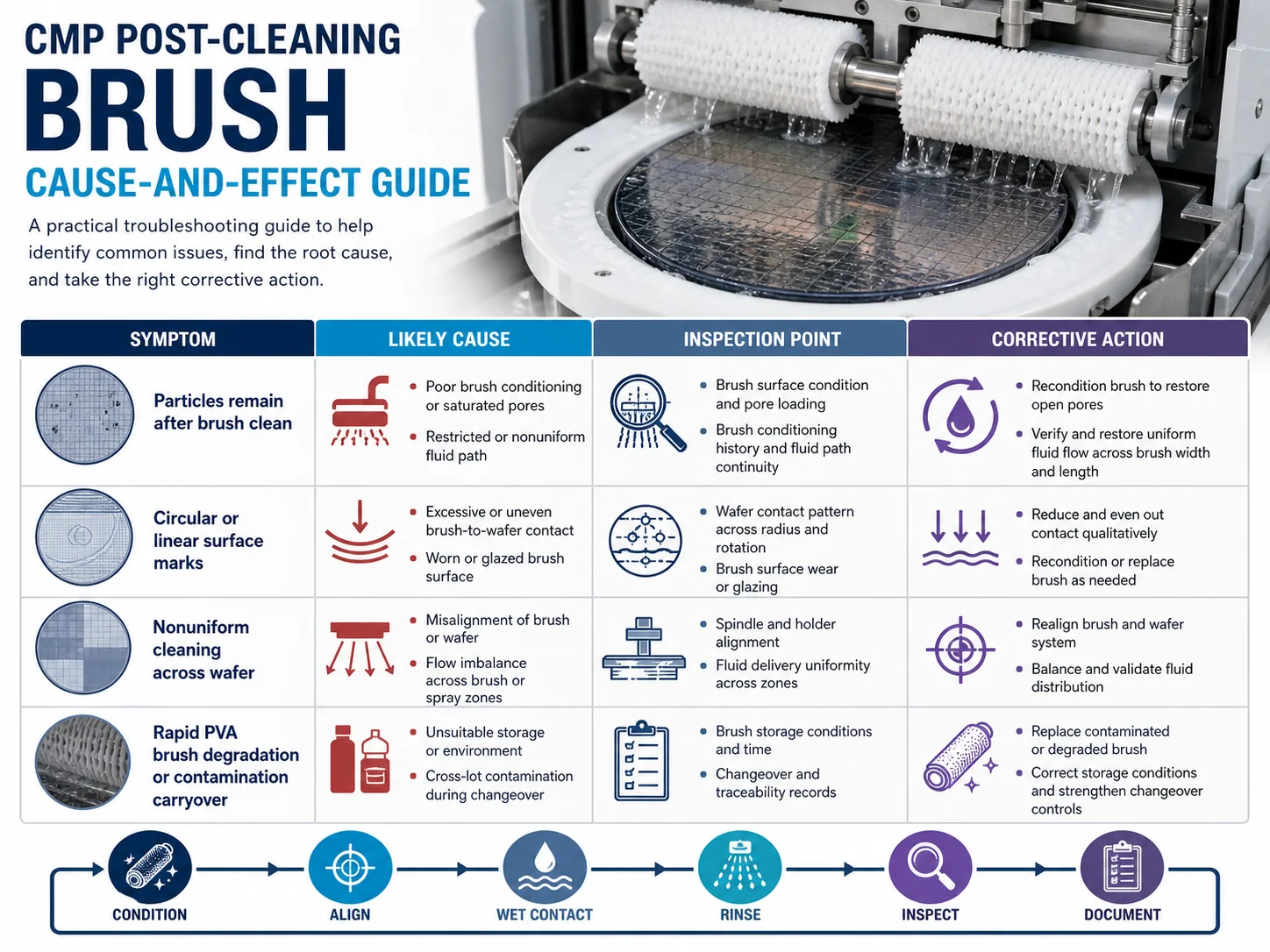
What Is a CMP Post-Cleaning Brush?
A CMP post-cleaning brush is a cylindrical or roller-type scrubbing tool used in wafer cleaning equipment after chemical mechanical planarization. Its main function is to remove residual slurry particles, organic contaminants, and metallic impurities from the wafer surface through direct mechanical contact combined with chemical cleaning agents. The brush must be soft enough to avoid scratching or adding particle defects, yet effective enough to dislodge submicron particles under controlled pressure and rotation speed.
Common Brush Types for Post-CMP Cleaning
Several brush materials and designs are used in post-CMP cleaning, each offering distinct trade-offs in contact behavior, chemical resistance, and lifetime.
- PVA (Polyvinyl Alcohol) Sponge Brushes: The most widely used type. PVA sponge is highly porous, hydrophilic, and compressible. It conforms well to wafer topography and can hold a large amount of cleaning chemistry, providing gentle but effective scrubbing. PVA brushes require wet conditioning to achieve the right softness and particle entrapment characteristics.
- Nylon Bristle Brushes: Use fine, resilient bristles that can provide more aggressive mechanical action. They are often chosen for processes with tenacious residues or when higher scrub energy is needed, but they carry a higher risk of micro-scratches and bristle breakage.
- PVA Composite / Nodule Brushes: Some designs combine a PVA core with surface nodules or textured patterns to balance softness and cleaning efficiency. These can help with fluid transport and particle removal without excessive contact pressure.
- Other Specialty Brushes: For niche applications, brush materials like polyurethane or coated fabrics may be used, but they are less common.
PVA Sponge vs. Alternative Brushes: Key Comparison
When selecting a brush, several factors beyond just material must be evaluated. The table below compares PVA sponge brushes with alternative types (such as nylon) on critical process attributes.
| Factor | PVA Sponge Brush | Nylon Bristle Brush |
|---|---|---|
| Contact Behavior | Conforms to surface; uniform low-pressure contact; minimal micro-scratch risk | Point contact from bristle tips; higher localized pressure; potential for scratches |
| Chemical Compatibility | Excellent with aqueous chemistries; limited tolerance for strong solvents or extreme pH | Broad chemical resistance; may degrade with certain oxidizers or high pH over time |
| Conditioning Requirement | Requires pre-soak and continuous wetting to maintain softness and porosity; conditioning disks common | Typically no conditioning needed; may require occasional cleaning to remove trapped particles |
| Contamination Risk | Low particle shedding if properly conditioned; can absorb and release chemistries | Risk of bristle breakage; shed particles may be larger and harder |
| Equipment Interface | Compatible with most brush box designs; adjustable roller pressure and rotation | May require different brush core and mounting; retraction mechanisms to avoid damage during idle |
How to Choose the Right Brush for Post-CMP Cleaning
Rather than defaulting to the most common material, consider these decision factors:
- Substrate Material and Film Stack: Fragile low-k dielectrics or soft metals may demand the gentle touch of a PVA sponge, while robust oxide or tungsten processes could tolerate a nylon brush if needed.
- Particle Type and Size: Slurry particles smaller than 100 nm often require the conformal contact of a sponge brush to avoid pushing particles into the surface.
- Chemical Environment: Ensure the brush material is resistant to your cleaning chemistry (e.g., acidic, alkaline, solvent-based). Consult compatibility charts from the brush supplier.
- Process Window: PVA brushes often require tighter control of pressure, speed, and wetness to perform optimally; nylon may offer a wider mechanical tolerance.
- Lifetime and Cost of Consumables: Compare brush change-out frequency, conditioning consumables, and the impact on equipment uptime.
- Defect Sensitivity: For defect-critical layers (e.g., gate module), invest in brush types with extensive performance data and consider in-line defect metrology to verify choice.
Common Mistakes in Brush Selection and Process Setup
Even with the right brush material, misapplication leads to yield loss. Avoid these frequent errors:
- Applying the same pressure, speed, or conditioning recipe from one CMP step to another without testing. Each film stack and slurry chemistry produces unique post-polish residues.
- Assuming that a “harder” brush cleans better. Overly aggressive scrubbing can embed particles or create scratches that are invisible without high-sensitivity inspection.
- Neglecting brush conditioning. PVA sponges lose their effectiveness if not properly saturated and dressed; skipping conditioning often causes particle redeposition and scratching.
- Overlooking equipment integration. Brush wobble, incorrect gap setting, or misalignment can cause uneven cleaning and wafer edge defects. Always work within the equipment maker’s specifications.
- Changing brush type without revalidating the entire cleaning sequence. Even a material change can shift chemistry flow patterns and rinse effectiveness.
When Process Validation and Metrology Are Required
A brush swap is not a trivial change. In these situations, formal validation is essential:
- When introducing a new brush material or supplier for a defect-sensitive layer or production node.
- When post-cleaning defect counts show an unexpected shift even without a brush change—this signals possible conditioning degradation or equipment drift.
- When moving from one CMP platform to another (e.g., from a legacy tool to a new brush box design). Interface differences require re-optimization.
- When process chemistry changes, even if the brush remains the same, because chemical–brush interactions affect particle release and redeposition.
- In these cases, involve the equipment manufacturer, metrology team, and process engineering to run short-loop tests, monitor particle-per-wafer-pass (PWP) data, and confirm defect Pareto before committing to production.
Final Takeaway
Selecting a CMP post-cleaning brush is not about choosing the “best” material in the catalog; it’s about matching the brush’s mechanical and chemical behavior to the specific film, slurry residue, and equipment setup. Start with a PVA sponge as the default low-defect option, then evaluate alternatives only when process data shows a clear need for more mechanical energy, and always verify through controlled tests. Document conditioning steps and monitor brush age, because a poorly maintained brush—regardless of type—will become a defect source.
Frequently Asked Questions
Can I use the same PVA brush for oxide and metal CMP cleaning?
It is generally not recommended. Metal CMP slurries often leave different residue compositions and may require different cleaning chemicals. Cross-contamination and incompatibility risks are high. Dedicated brushes or extremely thorough cleaning protocols between processes are needed.
How often should post-CMP brushes be conditioned?
Conditioning frequency depends on brush material and process load. PVA brushes typically require continuous wetness and periodic surface conditioning (e.g., with a conditioning disk or high-pressure rinse) after every few wafers or at least daily to maintain consistent surface properties. Follow your equipment and brush supplier guidelines.
What is the main contamination risk if brushes are not properly cleaned or conditioned?
Unconditioned PVA brushes can dry out, harden, and shed particles, or they may become saturated with old residues and redeposit them onto subsequent wafers. This can cause micro-scratches, organic residues, or metallic contamination, leading to increased defect counts.
Can nylon brushes be used for post-CMP cleaning of advanced low-k films?
Nylon brushes are typically avoided for fragile low-k materials because the localized pressure from bristles can cause scratch damage or delamination. The softer, conformal contact of a properly conditioned PVA sponge is the safer choice unless extensive testing proves otherwise for a specific film.
Does a higher scrub pressure always improve particle removal efficiency (PRE)?
No. While increasing pressure can enhance mechanical removal of large particles, it often reduces PRE for submicron particles by pressing them into the surface or deforming the brush too much, reducing fluid exchange. Optimal pressure is process-specific and must be determined by defect data, not by intuition.
What equipment parameters are most critical when changing brush types?
Brush gap, rotation speed, downforce, and chemical flow rate are the main parameters. Changing from a PVA sponge to a stiffer nylon brush may require recalibrating the gap to avoid excessive wafer bending or edge effects. Always consult the brush manufacturer and equipment manual for initial settings.
How do I know if my brush is reaching end of life?
Signs include visible wear, loss of porosity, permanent deformation, or a rising trend in post-clean defect counts. Some fabs use a statistical process control (SPC) chart on particle test results to trigger brush replacement. Do not rely solely on wafer count; defect data is the ultimate indicator.
Technical References
Which sponge and foam grade fits this job — PVA Sponge, PU Sponge or PU Foam?
| Grade | Continuous temperature (°C) | Peak temperature (°C) | Water absorption | Hardness |
|---|---|---|---|---|
| PVA Sponge | 60 | 90 | — | Soft absorbent contact material; hardness/compression is controlled by foam or sponge density. |
| PU Sponge | 80 | 110 | — | Soft absorbent contact material; hardness/compression is controlled by foam or sponge density. |
| PU Foam | 80–100 | 110–130 | Open-Cell Structure Can Absorb 5–30 Times Its Own Weight; Polymer Itself 1–5% | Shore OO 20–80 or Shore A 10–40 |
| Melamine Foam | 150–180 | 200–240 | Open-Cell Structure Can Absorb 10–40 Times Its Own Weight | Shore OO 20–60 |
Figures as published by Material manufacturer TDS / ISO / ASTM / industry reference. Confirm the exact grade against the supplier datasheet before ordering.
When is PVA Sponge the wrong choice?
- PVA Sponge — Not for abrasive scrubbing or dry high-friction brushing.
- Nylon PA — The nylon family spans several grades, so heat, moisture and chemical limits should follow the selected PA resin rather than a generic nylon value.
What should replace PVA Sponge when it stops working?
- PVA Sponge — Compare PVA Sponge with PU sponge, PP sponge, microfiber. Change material when wet stiffness, temperature, chemical resistance, conductivity, particle shedding, or surface marking becomes the limiting factor.
- Nylon PA — Compare Nylon PA with PP, PBT, PET. Change material when wet stiffness, temperature, chemical resistance, conductivity, particle shedding, or surface marking becomes the limiting factor.