
Custom Cleaning Brush
Sisal Brush Roller
Custom sisal brush rollers for industrial conveyor cleaning. Removes carryback, labels, film, and sticky residue from belts, rollers, and guides.
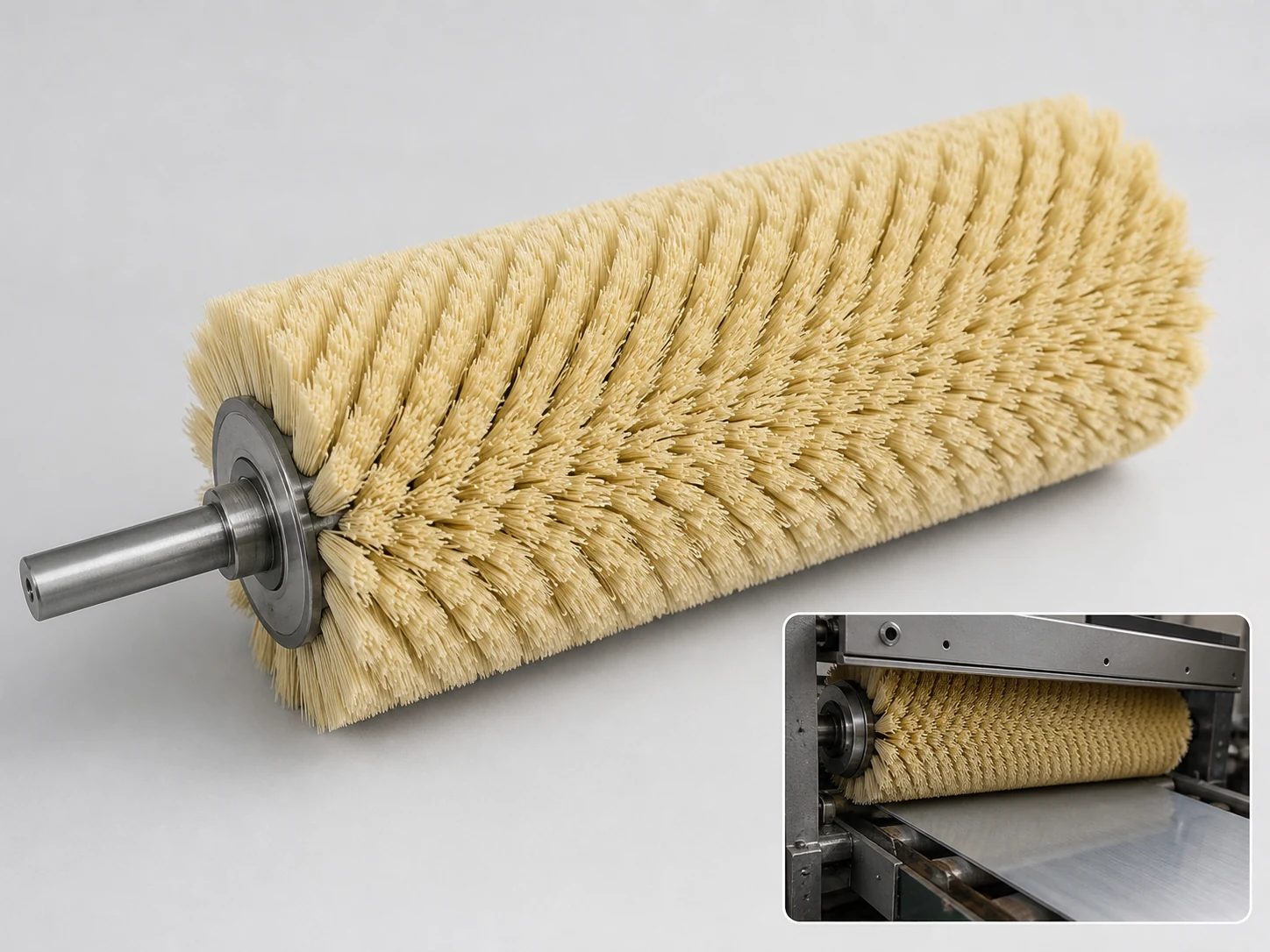
Large-format brush
100 pcs
Minimum order
Built one at a time on a core or channel: full-width rollers, sweeper brooms and long strip.
Production lead time, once the specification is confirmed
- Up to 100 pcsWithin 20 days
- 101–1,000 pcsWithin 30 days
- Over 1,000 pcsConfirmed with your quotation
Peak season can extend these times; the shipping date is confirmed in writing with your quotation. Sampling and shipping are quoted separately.
A rotating cylinder brush with sisal fiber fill for in-line conveyor and production-line cleaning. It scrubs belts, rollers, rails, transfer points, web paths, and machine guides to remove powder, crumbs, fibers, chips, oil, label fragments, film, and sticky carryback.
What can this brush do for you?
Aggressive scrubbing without metallic scratching
Sisal is a stiff natural fiber that gives the roller enough bite to lift sticky carryback, label fragments, and compacted film from conveyor belts and rollers. Because the fiber is non-metallic, it removes this residue without gouging the belt surface, scoring metal guides, or leaving wire fragments behind. That combination of scrubbing power and surface safety is the main reason sisal is chosen over wire or coarse synthetic filaments for belt cleaning.
Continuous full-width contact
The roller is built as a strip-wound or spiral-wound cylinder, so the working face has no dead spots along its length. When the roller spans the full conveyor width with a slight edge overlap, the entire surface sees the same brushing action. This matters at transfer points where residue builds unevenly and where partial-width brushes leave a dirty strip down the middle.
Rotating contact does the cleaning work
The brush roller rotates against the moving surface rather than being pushed by hand. Whether the roller is driven independently or rotates from friction contact with the belt, the bristle tips maintain consistent engagement across the working width. Operators do not need to scrub manually, and the cleaning result is repeatable from shift to shift.
Absorbs and traps residue instead of just spreading it
Sisal fiber has a slightly open, fibrous surface that absorbs oil film and traps fine particles within the fill. As the roller rotates, it picks up residue, carries it away from the contact point, and releases it on the next rotation or into a collection zone. This reduces re-deposition on the belt and keeps powders and crumbs from being pushed around the line.
A low-cost wear item you can replace on your schedule
As a natural fiber, sisal wears by design. The cost per meter is typically lower than engineered synthetic fills, which makes it practical to use the roller as a consumable that is swapped when fiber trim gets short or the cleaning performance drops. Replacement rollers can be specified with the same core and shaft dimensions so changeover takes minutes.
What is a Sisal Brush Roller?
A Sisal Brush Roller is a cylindrical industrial brush made from sisal fiber fill wound onto a shafted core. It mounts across a conveyor or production line, rotates against the moving surface, and removes residue by continuous brushing contact. The working principle is simple: bristle tips engage the surface at a controlled depth, flex, and flick or lift debris as the roller spins.
The fill is typically strip-wound or spiral-wound around the core. Strip-wound construction creates a dense, uniform face, while spiral construction provides a slight channel pattern that lets looser debris fall out of the brush. Both forms use the same sisal fiber and differ mainly in how residue is released and how the brush wears.
In a typical installation, the roller is positioned on the return side of a conveyor, under a transfer point, or against a roller or guide face. Radial engagement is set between 2 and 10 mm so the fiber tips press into the surface just enough to scrub without excessive bending. The roller either has its own drive, is coupled to an existing shaft, or is free-running and rotated by friction from the moving belt.
Sisal is a stiff, short-fiber natural material. It works best in dry or lightly oiled environments. Constant water immersion, steam, or prolonged high humidity will soften and degrade the fiber. For those conditions, a synthetic fill such as nylon or polypropylene is usually a better choice. This roller is a dry-scrubbing and oil-film-cleaning tool, not a wash-down brush.
Technical Specifications
The ranges below cover typical project configurations. We adjust every dimension to the conveyor width, mounting location, and residue type.
| Parameter | Value / Options |
|---|---|
| Working width | 100–5000 mm, matched to surface width plus edge overlap |
| Roller outside diameter | 50–400 mm, selected together with core and trim length |
| Core outside diameter | 25–400 mm, sized for the required shaft and stiffness |
| Shaft or journal diameter | 12–160 mm, plain, keyed, or machined ends as required |
| Free trim length | 10–180 mm; longer for uneven surfaces, shorter for firm contact |
| Fill material | Sisal fiber, natural or oil-treated grade |
| Fill pattern | Strip-wound or spiral-wound, continuous across the width |
| Fill density | Project-set by rows per inch and staple count; higher density for fine residue |
| Core material | Steel, stainless steel, aluminum, or engineering plastic as required |
| Contact setting | 2–10 mm radial engagement; working width plus 5–15 mm edge overlap per side |
| Operating orientation | Counter-rotating to belt motion for cleaning, co-rotating for light polishing |
| Operating temperature | Typically up to 80°C continuous for dry contact; confirm for specific environment |
| Brush type | Custom Roller and Conveyor Brushes |
| How it is driven | Machine-driven, mounted in the equipment |
| Cleaning target | return-side conveyor belt, transfer point and chute area, and packaging and labeling line cleaning |
| Surface or part | roller, belts, conveyors, transfer points, guides, machine guides, web paths, and rails |
| Residue or debris | fiber, crumbs, powder, chips, particles, sticky carryback, oil, and dust |
| Mounting / connection | Shaft-Mounted / Fixed |
Core diameter is usually 25–100 mm for most conveyor cleaning rollers. Larger cores are used when the roller spans a long width and needs extra support, or when a large-diameter shaft is required. Shaft ends can be journaled for pillow block bearings, extended for a drive sprocket or coupling, or machined with flats for torque transmission.
Where does this brush work best?
- Return-side conveyor belt cleaning: Remove carryback, compacted fines, and sticky residue that would otherwise build up on idlers and below the belt.
- Transfer points and chute areas: Clean belts, transfer rollers, and guide rails where debris accumulates at material drop points.
- Packaging and labeling lines: Scrub label fragments, film scraps, adhesive residue, and dust from rollers, belts, and machine guides without damaging the surfaces.
- Food processing conveyors (dry or lightly oiled): Remove powder, crumbs, fibers, and loose product residue from belts and transfer points before the next production cycle.
- Textile and fiber processing lines: Clean rollers and web paths where lint, loose fibers, and dust collect and reduce product quality.
- Woodworking and board handling lines: Remove sawdust, chips, and small particles from return belts and machine guides.
How do I choose the right one?
Selecting a sisal brush roller for a conveyor or production line is mostly about matching the contact geometry to the surface and the residue. Work through the points below before specifying the roller.
Start with the surface width
Measure the full width of the belt, roller face, or guide surface that needs cleaning. The brush working width should equal that surface width plus 5–15 mm of edge overlap on each side. This keeps the outer edges from wearing faster and ensures the brush cleans all the way to the machine frame or belt edge.
Set the radial engagement from the residue type
Light powder and loose crumbs need only 2–4 mm of engagement. Sticky carryback, oil film, and label fragments require deeper engagement, usually 5–8 mm. Heavy compacted film may need up to 10 mm, but every extra millimeter increases fiber deflection, heat buildup, and wear. Start at the low end of the range and increase only if the cleaning result is incomplete.
Choose trim length to fit the surface and mounting space
Short trim (10–30 mm) gives the stiffest contact and is best for flat belts and hard residue. Medium trim (30–80 mm) suits slightly uneven surfaces, crowned rollers, or transfer points where the brush must follow some variation. Long trim (80–180 mm) is used for deep-cleaning positions, large roller diameters, or when the mounting bracket cannot place the core close to the surface.
Match the core and shaft to your mounting and drive
The core must be stiff enough to hold the working width without sagging. A 1000 mm wide roller can often use a 25–40 mm core; a 4000–5000 mm roller will need a larger core or intermediate supports. The shaft design depends on how the roller mounts: through-shaft for two bearing blocks, stub shafts for flange mounting, or keyed ends for direct drive.
Consider how the roller is driven
If the roller contacts a moving belt, friction may be enough to spin it. For counter-rotation or consistent speed control, a driven shaft is required. Counter-rotation produces a more aggressive scrubbing action because the relative surface speed is higher. Co-rotation is gentler and is used when the brush is polishing or removing light dust without disturbing the product.
Choose fill density for the particle size
Fine powder and dust require higher fill density so the fibers are close enough to catch small particles. Large chips, crumbs, or long fibers need lower density with wider channels so debris does not pack between the bristles and clog the brush. Density is adjusted through staple count per row and rows per inch.
When a different brush material may work better
Sisal is the right fill when the residue is sticky, oily, or film-like and the surface is metal, rubber, or hard plastic that would be damaged by wire. For constant wet conditions, chemical washdown, or high humidity, switch to polypropylene or nylon. For heavy scale, rust, or cured deposits, a wire or abrasive nylon fill is more effective. For extremely fine contamination or static-sensitive environments, a conductive fiber fill may be required.
Can I customize this brush?
Every sisal brush roller is built to the project. To start, we need the surface width, roller mounting position, available space, residue description, belt or roller speed, and whether the brush will be driven. A photo or sketch of the mounting point speeds up the process.
What we can adjust:
- Working width and roller length: Cut to any width from 100 mm to 5000 mm, with ends configured for your frame.
- Roller outside diameter and core diameter: Sized to available space, stiffness requirements, and shaft choice.
- Shaft and journals: Through-shaft, stub shafts, keyed ends, splines, or bearing seats machined to your drawing.
- Fill pattern and density: Strip-wound or spiral-wound, with staple rows and fiber density selected for your residue particle size.
- Fiber grade and treatment: Natural sisal or oil-treated sisal for extended life in oily environments; custom blends with other fibers can be discussed if needed.
- Free trim length: From 10 mm to 180 mm, with uniform or stepped trim across the width.
- Core material: Steel, stainless steel, aluminum, or engineered plastic depending on weight, corrosion, and stiffness needs.
- End fittings and hubs: Bearing adapters, drive flanges, or custom interface plates.
- Color, marking, and packaging: Identification marks, batch codes, bulk packing, or individual protection for installation.
If your project requires material documentation, inspection reports, third-party testing, or certification support for a specific industry, we can assist with those requirements as part of the customization process.
What speed and pressure keep a sisal brush roller from wearing early?
How do I know if the brush engagement is set correctly?
Run the conveyor or roller for a short period and inspect the contact area. The bristle tips should flex visibly but not bend over completely. After operation, check the surface: if residue remains in stripes or patches, increase engagement by 1–2 mm. If the roller motor loads up or the fiber shows rapid melting or crushing, reduce engagement.
Will sisal fibers damage a rubber conveyor belt?
Sisal is stiffer than nylon or polypropylene, so it can scuff soft rubber if engagement is too deep or the belt is very soft. For standard industrial rubber belts with a durometer of 60 Shore A or higher, a 2–6 mm engagement is generally safe. Test on an unused section of belt or start with minimum engagement before committing to full production.
Can the brush roller run wet?
Occasional light moisture or oil is acceptable, but sisal is a natural fiber and will absorb water. Constant wet operation softens the fiber, reduces scrubbing performance, and accelerates rot or mold growth. If the line uses water sprays, steam cleaning, or food-grade washdowns, choose a synthetic fill such as polypropylene instead.
How often should I replace a sisal brush roller?
Replacement depends on operating hours, engagement depth, residue abrasiveness, and belt speed. A practical check is to measure the free trim length: when the fiber has worn down to about 50% of its original trim, cleaning performance typically drops noticeably and the roller should be replaced. Keep a log of weeks between changes to build a preventive replacement schedule.
Does the brush need to counter-rotate against belt movement?
Not always. Counter-rotation increases the relative surface speed between bristle tip and belt, which improves scrubbing of sticky or compacted residue. Co-rotation reduces that relative speed and is better for light dust removal or when the brush must not disturb product on the belt. If the roller is friction-driven by the belt, co-rotation is the natural result; for counter-rotation, an external drive is required.
Can I use the same roller on multiple machine positions?
Only if the surface width, engagement, and mounting are identical. Conveyor widths and frame positions vary, and a roller with the wrong edge overlap will wear unevenly or miss residue at the edges. For a multi-position fleet, standardize the machine widths and mounting brackets first, then order identical rollers for each position.
Guides that go deeper on this
Abrasive Nylon Grit and Filament Selection
Read this guideGuideBrush Roller Conveyor Mistakes with Dry Dust
Read this guideGuideBrush Speed, Engagement, and Heat
Read this guideGuideConveyor Belt Cleaning Brush Design
Read this guideGuideFloor Scrubber Brush Selection: Disc Brush vs Roller Brush
Read this guideCustom Manufacturing RFQ
Describe Your Application
For an accurate quotation, please provide the main dimensions, material preference, working surface, residue, quantity, and a drawing or photo.
Drawing or photo optional — it speeds things up, it does not gate the enquiry.
Custom Brush RFQ
Send Your Brush Project
Upload a drawing, product photo, or sample photo and provide the core dimensions and cleaning conditions.
“We need a brush to remove wet residue from a stainless steel conveyor, about 800mm wide. The current brush wears quickly. We can send photos.”
“We sell drinkware and need a cleaning brush to include with the product. Quantity around 5,000 pieces.”