
Custom Cleaning Brush
80x300mm Tampico Polishing Roller Brush
80x300mm Tampico polishing roller brush for denibbing, satin finishing, and compound polishing on wood, metal, and stone.
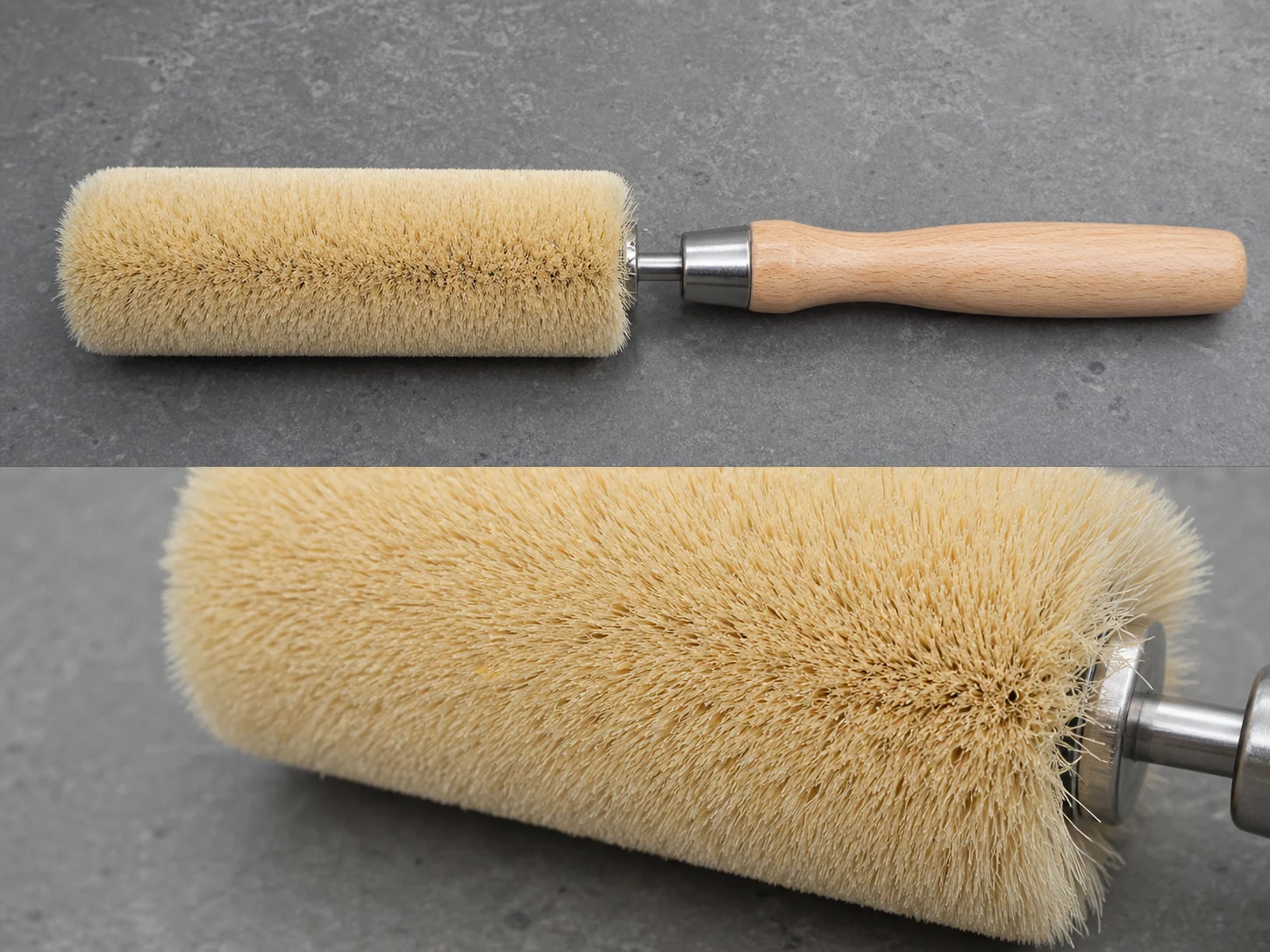
Medium brush
100 pcs
Minimum order
Worked with two hands or on a pole: chimney, gutter and pond-filter brushes, discs, cups and tank brushes.
Production lead time, once the specification is confirmed
- Up to 100 pcsWithin 7 days
- 101–5,000 pcsWithin 14 days
- 5,001–50,000 pcsWithin 21 days
- Over 50,000 pcsConfirmed with your quotation
Peak season can extend these times; the shipping date is confirmed in writing with your quotation. Sampling and shipping are quoted separately.
A cylindrical machine brush with an 80 mm outside diameter and a 300 mm working face, filled with natural Tampico fiber for polishing, denibbing, and finishing on wood, metal, and stone. It mounts to your existing roller equipment and holds water, polishing compound, or light abrasive slurry while delivering a uniform, non-scratching contact across the full face width.
What can this brush do for you?
Puts the same contact pressure across the entire 300 mm face
The full-length fill and uniform fiber density keep the contact consistent from one edge of the roller to the other. On panel lines, wide-surface finishing stations, and conveyor brushing positions, that means no high-gloss bands, no dull strips, and no second pass just to even out the surface.
Holds water and polishing compound without matting or collapsing
Tampico fiber absorbs and releases water-based or solvent-based compounds while staying upright and springy. The roller can run wet, damp, or with buffing compound and still maintain its working stiffness through the run. Synthetic fills often slick over when wet; this fiber continues to work.
Removes nibs, overspray, and mill marks without cutting into the substrate
Tampico is firm enough to knock off raised fibers, dust nibs, sealer ridges, light overspray, and soft surface defects, but the fiber tips are rounded enough to avoid scratching the underlying wood, coated panel, or polished metal. It corrects the surface rather than changing its profile.
Springs back pass after pass for longer useful life
Natural Tampico resists permanent set and recovers its shape between passes. The roller keeps a full, active contact profile instead of flattening into a dead band, so it wears evenly across the face and holds its finishing quality over a longer production interval.
What is a 80x300mm Tampico Polishing Roller Brush?
A 80x300mm Tampico Polishing Roller Brush is a machine-mounted cylindrical brush built around a steel or aluminum core with natural Tampico fiber filled across a 300 mm working length. The 80 mm dimension is the outside diameter of the trimmed brush face, not just the core, so the roller has a known contact height for head clearance and machine setup.
In use, the roller is fitted to a rotating shaft in a sanding or brushing head, a dedicated polishing machine, or a conveyor-line brush station. The machine spins the roller at a controlled speed while the surface passes beneath it. Tampico tips contact the workpiece continuously and work in combination with water, polishing compound, or light abrasive slurry to smooth, rub out, or clean the surface.
This roller is not a hand tool. It has no handle, grip, or manual operation. The mounting is fixed: the core ends are machined or fitted to your existing shaft, bore, flange, or hub. The roller is balanced for machine rotation and intended to be driven by the equipment, not pushed by an operator.
Technical Specifications
| Parameter | Value / Options |
|---|---|
| Roller outside diameter | 80 mm nominal after trimming |
| Working face length | 300 mm |
| Bristle material | Natural Tampico fiber (Agave lechuguilla) |
| Core material | Steel tube or aluminum tube, project-selected |
| Mounting interface | Fixed; plain bore, keyed bore, or machined hub ends to customer drawing |
| Fill construction | Full-face continuous fill, wound strip or staple-set according to density requirement |
| Fill density | Medium or high, selected for surface contact and wear |
| Trim length | Sized to produce 80 mm OD; shorter trim available for firmer contact |
| Diameter tolerance | ±1 mm on standard runs |
| Maximum operating speed | 1,500 RPM for standard steel or aluminum core under balanced conditions |
| Operating environment | Wet or dry use with water, mild detergents, buffing compounds, or light slurries; avoid prolonged immersion in strong acids or solvents |
| Core corrosion protection | Plain steel, zinc-plated or stainless steel option for wet/chemical environments |
| Brush type | Custom Roller and Conveyor Brushes |
| How it is driven | Machine-driven, mounted in the equipment |
| Cleaning target | wood finishing and denibbing, metal surface finishing, and stone honing and burnishing cleaning |
| Surface or part | roller, metal, wood, stone, aluminum, panels, bores, and hubs |
| Residue or debris | fiber, polishing compound, abrasive slurry, dust, overspray, adhesive, and oxide |
| Mounting / connection | Fixed; plain bore, keyed bore, or machined hub ends to customer drawing |
The dimensions above are the stock values for this roller. If your machine uses a different bore, keyway, bearing spacing, or overall length, the core ends can be machined to match without changing the 80 mm OD or 300 mm face.
Where does this brush work best?
This roller is designed for flat and low-profile surfaces that pass under a rotating brush in a continuous or semi-continuous process. Typical positions include wide-belt sanders with brush attachments, dedicated polishing machines, conveyor cleaning stations, and edge or panel line finishing heads.
- Wood finishing and denibbing: removing raised grain and dust nibs after stain, sealer, or first topcoat on cabinet doors, furniture panels, flooring blanks, and millwork. Tampico produces an even sheen without cutting through the coating.
- Metal surface finishing: cleaning and satin-finishing stainless steel sheet, aluminum plate, flat bar, and formed panels before coating, printing, or assembly. The roller removes light oxide, smut, and handling marks without aggressive scratching.
- Stone honing and burnishing: working water-based polishing compounds into marble, limestone, and engineered stone to develop a soft honed or semi-polished surface. The fiber’s water retention helps keep compound active on the stone.
- Pre-coating preparation: lifting dust, fibers, and light overspray from panels, foils, and sheets before lacquer, film, or adhesive application.
The roller is most effective on surfaces up to 300 mm wide in a single pass. Wider workpieces can be handled with multiple rollers mounted side by side or by indexing the workpiece across the face.
How do I choose the right one?
Start by confirming the machine fit, then adjust the fill and core for the surface and the process.
Check the mounting interface first
Measure the drive shaft diameter, bore, keyway or set screw position, and the distance between bearing supports. The roller’s fixed core ends must match those dimensions exactly. If the shaft passes through the roller, we machine the core ID to your shaft. If the roller mounts between flanges, we machine the end hubs and bolt pattern to your drawing.
Set the fill density for the finish
Lower fill density gives a softer, more forgiving contact for delicate coatings, thin veneers, or polished metal. Higher fill density makes the face stiffer and faster at removing nibs, mill marks, or soft defects, but it applies more pressure to the surface. Choose density by the softest surface in your line, not the hardest defect.
Match the core material to the process
Aluminum is lighter and easier to balance on high-speed heads, but it can corrode in aggressive wet chemistry. Steel is stiffer and more durable, and can be zinc-plated or made from stainless steel for wet polishing with water-based compounds. Specify the core after the chemistry, not before.
Decide whether Tampico is the right fiber
Tampico is the correct choice when you need water and compound retention, resilient contact, and a non-scratch finish on wood, coated surfaces, or polished metal. If the job requires cutting action, scale removal, or aggressive surface conditioning, switch to silicon carbide–impregnated nylon, abrasive grit brushes, or wire. If the process runs hot, above about 150°C at the contact face, or continuously in strong acid or solvent, a synthetic fill such as nylon or PBT will survive longer.
Can I customize this brush?
Yes. The 80 mm outside diameter and 300 mm face length are the nominal standard for this roller, but the construction can be adjusted to your machine and your finish requirement. To define a custom roller, provide the shaft or bore dimensions, bearing support centers, machine RPM, process direction, surface material, and the finish target.
We can adjust:
- Core ends and mounting: plain bore, keyed bore, set-screw hub, split flange, through-shaft, or custom hub machining
- Core material: steel, zinc-plated steel, stainless steel, or aluminum
- Fill density and trim length: medium or high fiber density, shorter or longer trim relative to the core to change contact stiffness
- Fiber grade: coarse or fine Tampico fiber selection based on the required scrubbing energy and surface sensitivity
- Fill construction: continuous wound strip for even wear or staple-set segments for larger diameter options
- Identification: color-coded end caps, serial marking on the core, or project labeling
- Packaging: bulk cartons, individual protective sleeves, palletized with shaft supports, or project-specific packing
If your project requires material documentation, inspection reports, balance verification, or third-party testing support, we can work with those requirements during customization.
How do you tell when a 80x300mm tampico polishing roller brush is worn out?
How do I know when the roller needs to be replaced?
Measure the outside diameter at several points across the face. When the OD falls below about 75–76 mm or the Tampico fibers no longer spring back after cleaning and use, the roller has lost its effective contact length. Uneven wear from edge to edge usually indicates a pressure or alignment problem, not a normal wear pattern.
Can I use the same roller on wood and metal?
It is possible, but Tampico fibers can hold fine metal particles or wood resins. If you switch materials, clean the roller thoroughly between runs and inspect for trapped debris. For critical finishes, such as white wood or bright stainless, dedicated rollers per material prevent cross-contamination.
Should I run the roller wet or dry when applying polishing compound?
Match the roller condition to the compound. Water-based compounds usually run wet or damp, and Tampico holds that water well. Oil or wax-based compounds often work better dry. After wet use, run the roller briefly at low speed or remove it to drain and dry so the core does not sit against a wet fiber mass for long periods.
What maintenance does the roller need between shifts?
Remove built-up compound, wood dust, or metal fines by rotating the roller slowly against a soft brush or combing the face. If needed, rinse with mild detergent and water, then allow it to air dry with the face up or hanging, not resting on the fibers. Do not soak the roller overnight in water or solvent.
How can I check that the roller is running balanced?
Run the machine at low speed first and watch for visible wobble or vibration. For a more precise check, use a dial indicator on the roller OD and core ends. Out-of-roundness or runout beyond your machine tolerance may indicate a bent shaft, misaligned hub, or unbalanced fill. The roller should run smooth before you bring it to operating speed.
Will the Tampico fibers burn or degrade from frictional heat?
Tampico tolerates normal frictional heating in polishing and denibbing operations, but it is a natural fiber and will char or burn if the surface temperature exceeds roughly 150°C or if excessive pressure and speed are combined. Keep the machine within its rated surface speed and pressure, and if you smell scorching fiber, stop and inspect the setup.
Guides that go deeper on this
Abrasive Nylon Grit and Filament Selection
Read this guideGuideBrush Roller Conveyor Mistakes with Dry Dust
Read this guideGuideBrush Speed, Engagement, and Heat
Read this guideGuideCapsule Polishing Machine Brushes: Selection and Maintenance
Read this guideGuideConveyor Belt Cleaning Brush Design
Read this guideCustom Manufacturing RFQ
Describe Your Application
Send the key measurements, cleaning requirement, residue, material direction, mounting method, quantity, and drawing or photo.
Drawing or photo optional — it speeds things up, it does not gate the enquiry.
Custom Brush RFQ
Send Your Brush Project
Upload a drawing, product photo, or sample photo and provide the core dimensions and cleaning conditions.
“We need a brush to remove wet residue from a stainless steel conveyor, about 800mm wide. The current brush wears quickly. We can send photos.”
“We sell drinkware and need a cleaning brush to include with the product. Quantity around 5,000 pieces.”