What Is Brush Speed Selection?
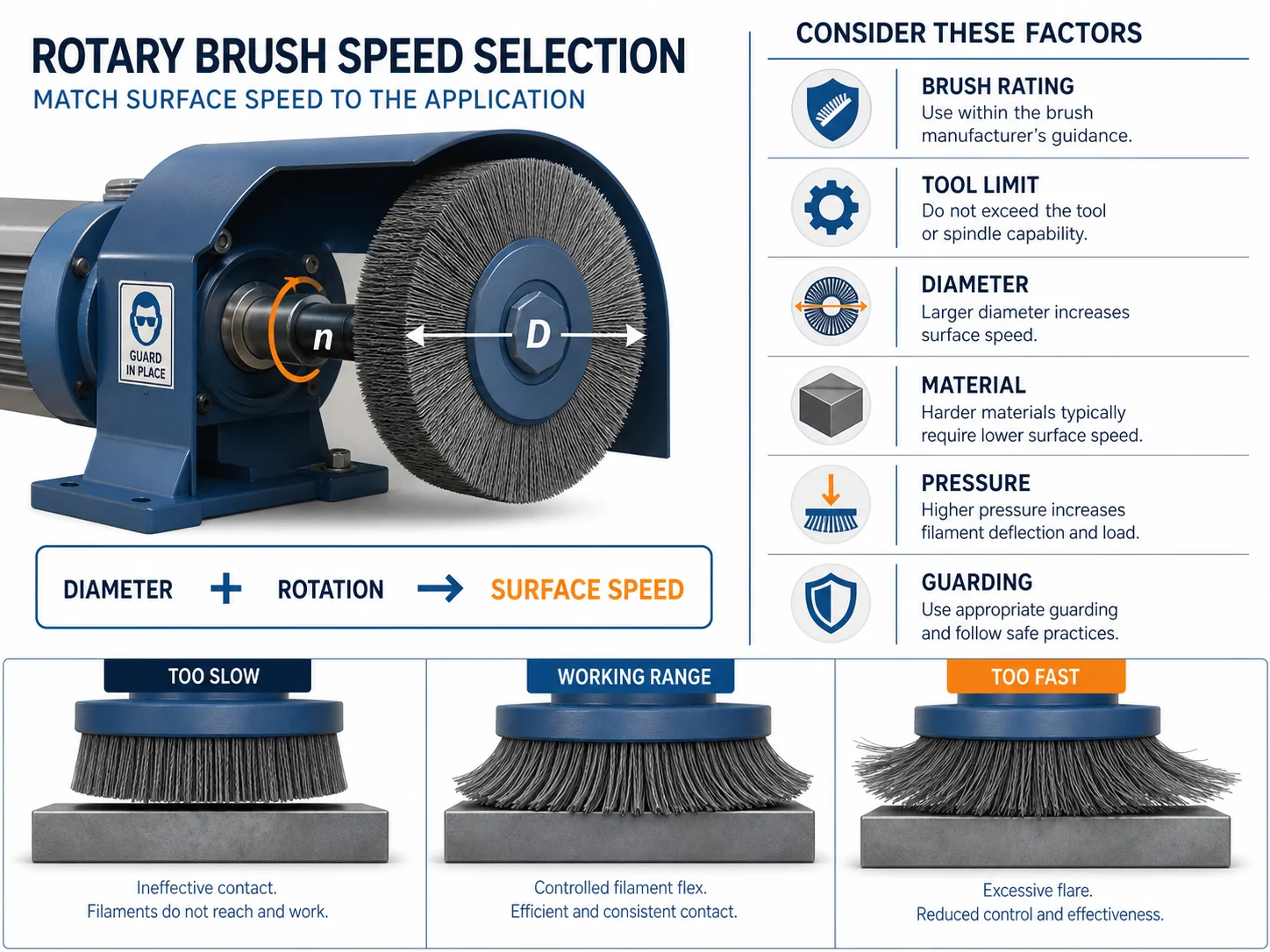
Brush speed selection is the process of matching a brush’s rotational speed (RPM) to the tool that drives it, while also considering the relative velocity at the brush’s working surface. It involves reading and respecting the maximum RPM marked on the brush, understanding the tool’s spindle speed, and accounting for brush diameter, holder design, bristle material, and contact conditions.
Key Factors That Influence Safe Brush Speed
Several factors determine the safe operating speed of an industrial brush. Overlooking any one of them can lead to dangerous overspeed conditions:
- Brush diameter: Larger diameters create higher surface speeds at the same RPM. A small change in brush size can drastically alter centrifugal forces on bristles and bonding.
- Tool spindle speed: Fixed-speed tools may push brushes beyond their listed maximum if the spindle RPM exceeds the brush rating. Variable-speed tools may need adjustment or an initial speed check.
- Holder/adaptor design: Bent shafts, extensions, or brush holders can introduce imbalance or vibrations that reduce the safe top speed.
- Bristle material: Wire, abrasive nylon, and natural fibers have different heat and fatigue limits. Abrasive brushes often require lower speeds to prevent glazing or workpiece damage.
- Workpiece contact: Intermittent contact, deep engagement, or side loading can raise bending stresses on bristles, effectively pulling the brush toward failure at speeds below the “no-load” maximum.
RPM vs. Surface Speed: What’s the Difference?
RPM (revolutions per minute) tells you how many times the brush spins in a minute, but it does not directly describe how fast the bristle tips are moving. Surface speed—usually measured in surface feet per minute (SFPM) or meters per second—is the linear speed at the outermost point of the brush. This number is what truly determines the safe working range.
| Metric | What It Measures | Why It Matters |
|---|---|---|
| RPM | Rotational frequency of the spindle | Directly compared against the brush’s marked maximum RPM |
| Surface Speed | Linear velocity at the brush periphery (SFPM or m/s) | Reveals the actual working load on bristles; helps compare brushes of different diameters |
For example, two brushes with the same RPM but different diameters will have very different surface speeds. A 6-inch brush at 6,000 RPM has a surface speed over 9,000 SFPM, while a 10-inch brush at the same RPM exceeds 15,000 SFPM—a huge increase in bristle stress. Always convert RPM to surface speed when switching brush sizes or types.
How to Determine the Right Operating Speed
Start with the equipment manual and brush labeling:
- Check the tool’s rated no-load speed. Most portable power tools and pedestal machines list a maximum RPM. If your tool has a variable-speed trigger or dial, identify the setting that delivers the lowest practical speed for your task.
- Read the brush’s maximum safe speed. This is often printed on the brush block, metal cup, or packaging. Never exceed this number. If the brush is unmarked, contact the supplier for the rated RPM before use.
- Look for any holder or adaptor speed limits. Some holders are only rated up to a certain RPM. An adaptor can reduce the safe speed well below the brush’s own rating.
- Calculate surface speed if you plan to compare brushes. Use a surface speed chart or the simple formula: SFPM ≈ RPM × Diameter (inches) × 0.262. In metric: m/s ≈ RPM × Diameter (mm) × 0.0000524.
- Consider the application. For delicate surface conditioning at high surface speeds, an abrasive nylon bristle cup brush often requires a lower RPM than a wire wheel for heavy deburring. Let the brush finishing requirements guide your speed range—not just the maximum allowed.
Common Mistakes to Avoid
Even experienced operators can make speed-related errors. Avoid these frequent oversights:
- Exceeding the marked maximum RPM. This is the most obvious, yet it still happens when operators “test” a brush at tool full speed without checking the label.
- Using a high-speed wire brush on a straight die grinder or angle grinder without a speed limiter. Many wire brushes are rated for lower speeds than the tool’s maximum. A “high speed wire brush” might be designed for die grinders turning 20,000+ RPM—but a standard wire cup brush is not.
- Ignoring the holder or shank speed limit. A brass bristle wire brush with a 20,000 RPM rating may be attached to a holder only rated for 12,000 RPM. The system fails at the weakest link.
- Assuming all brushes of the same diameter run at the same speed. Brush design matters: a knot-type wire brush may have a higher RPM rating than a crimped wire brush of the same size because the knot resists centrifugal unwinding better.
- Overlooking workpiece contact effects. Engaging the brush deeply so that the bristle mid-section hits the workpiece can create bending stresses far above the pure centrifugal load. Reduce speed or use a smaller brush to avoid premature fatigue.
When Standard Speed Ratings Are the Wrong Choice
There are situations where simply matching RPM limits isn’t sufficient:
- Custom or oversized brushes: If you are using a non-standard diameter or a brush with an unfamiliar bristle material, have the supplier verify the maximum safe surface speed. Never extrapolate from a similar-looking product.
- Automated or robotic applications: Consistent, high-cycle contact can heat the brush and degrade bonding faster. A variable-speed drive may be necessary to tune speed precisely to the process, and automatic guarding must be evaluated for the chosen speed range.
- Unusually heavy or light workpieces: Very heavy parts may require slower speeds to avoid burning the brush or buckling bristles. Conversely, very light or delicate work may require a careful ramp-up trial with a dummy part.
- Retrofitting an old machine: When mounting a modern brush on a vintage pedestal grinder or large-diameter production machine, the machine’s original speed ratings may not align with today’s brush standards. Consult the brush manufacturer or a safety engineer before proceeding.
If you cannot find a published speed rating for a specific combination, treat it as non-standard and seek a manufacturer review. The cost of a phone call is always less than a workplace injury.
Final Takeaway
Safe brush speed selection isn’t about memorizing a universal chart. It’s a systematic check: know your tool’s RPM, read the brush label, account for diameter and surface speed, and never ignore the holder rating. When you move to a different brush style, size, or supplier, start the evaluation again. A few extra minutes of verification can prevent tool breakage, scrapped parts, and serious accidents.
Frequently Asked Questions
What happens if I exceed the maximum RPM marked on the brush?
Exceeding the rated RPM can cause bristles to eject from the brush at high velocity, potentially causing laceration or eye injuries. The bonding or mechanical retention that holds the bristles may also fail, leading to a catastrophic disintegration of the brush wheel.
How do I calculate surface speed if only RPM and diameter are known?
In imperial units, surface speed in feet per minute approximately equals RPM × Diameter (inches) × 0.262. For metric, meters per second ≈ RPM × Diameter (mm) × 0.0000524. Always use the brush’s actual outside diameter under no-load conditions, as centripetal expansion can slightly increase the effective diameter during use.
Can I use a wire brush on a high-speed angle grinder?
Only if the wire brush is specifically rated for the grinder’s maximum RPM. Many angle grinders spin between 10,000 and 12,000 RPM, while typical wire cup brushes are rated for 6,000 to 9,000 RPM. Using an under-rated wire brush on a high-speed grinder is a common cause of wire ejection. Always verify compatibility.
Is there a universal safe RPM for all industrial brushes?
No. Safe RPM varies by brush type, diameter, bristle material, and construction. Even within the same product family, a larger diameter brush will have a lower RPM rating because surface speed increases with size. Always rely on the maximum RPM printed on the product label or data sheet.
Why does brush diameter matter more than RPM for safety?
Diameter multiplies the effect of RPM on surface speed. Doubling the diameter doubles the surface speed at a given RPM, which quadruples the centrifugal force on each bristle. That’s why a seemingly small increase in brush size can quickly create unsafe conditions, even if RPM stays the same.
Should I reduce speed for abrasive nylon brushes compared to wire brushes?
Often, yes. Abrasive nylon bristle brushes can generate more heat and may glaze or melt if run too fast. Many manufacturers recommend lower surface speeds for nylon abrasives than for steel wire. Consult the brush supplier for the optimal speed window for your specific finishing task.
What safety equipment is recommended when testing a new brush at full speed?
As a minimum, wear safety glasses with side shields or a face shield, hearing protection, and heavy-duty gloves. Secure the workpiece firmly, stand clear of the brush rotation plane, and run the tool for at least one minute in a protected area before bringing it into contact with the part. Always read and follow the tool and brush safety instructions.
How often should I re-check the speed rating when switching between different brushes on the same tool?
Every time. Never assume that because one brush worked at a certain tool speed, a different brush—even one of the same nominal size—will be safe. Bristle materials, density, and mounting methods all affect the maximum safe RPM. Make speed checking a mandatory step in your tool change procedure.
Technical References
- ABMA — ANSI B165.1 Power Brush Safety Slips
- OSHA — 1910.242 Hand and Portable Powered Tools
- OSHA — 1910.215 Abrasive Wheel Machinery
- OSHA — Personal Protective Equipment
Which abrasive filament fits this job — Abrasive Nylon, Silicon Carbide Abrasive Nylon or Aluminum Oxide Abrasive Nylon?
| Filament | Continuous temperature (°C) | Peak temperature (°C) | Water absorption | Hardness |
|---|---|---|---|---|
| Abrasive Nylon | 120 | 150 | 0.1–1.0% | Abrasive filament; stiffness and cutting level is controlled by PA base, grit type, grit size, filament diameter and trim height. |
| Silicon Carbide Abrasive Nylon | 80–120 | 140–170 | 0.3–2.0% | Carrier Shore D 70–85; SiC Mohs Hardness Approximately 9.2 |
| Aluminum Oxide Abrasive Nylon | 80–120 | 140–170 | 0.3–2.0% | Carrier Shore D 70–85; Al2O3 Mohs Hardness Approximately 9 |
| Ceramic Abrasive Fiber | 80–120 | 140–170 | 0.3–2.0% | Carrier Shore D 72–86; Ceramic Grain Mohs Hardness Approximately 9 |
| Diamond Abrasive Filament | 80–120 | 140–170 | 0.3–2.0% | Carrier Shore D 72–86; Diamond Mohs Hardness 10 |
Figures as published by Perlon. Confirm the exact grade against the supplier datasheet before ordering.
What should replace Abrasive Nylon when it stops working?
- Abrasive Nylon — Compare Abrasive Nylon with PP, PBT, PET. Change material when wet stiffness, temperature, chemical resistance, conductivity, particle shedding, or surface marking becomes the limiting factor.
- Nylon PA — Compare Nylon PA with PP, PBT, PET. Change material when wet stiffness, temperature, chemical resistance, conductivity, particle shedding, or surface marking becomes the limiting factor.