What Is a Strip Brush?
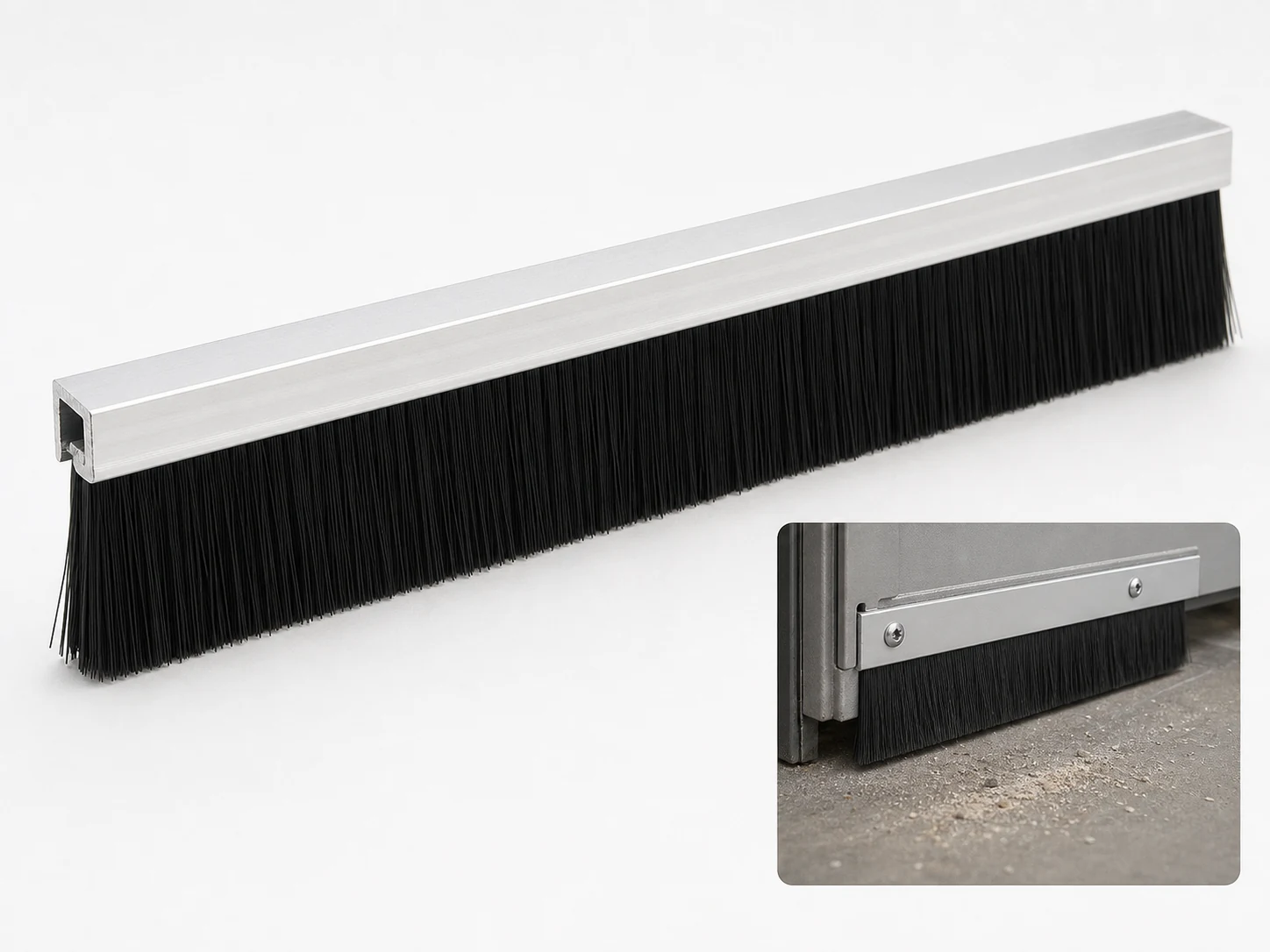
A strip brush is a linear sealing or cleaning component made of bristles crimped into a metal or plastic channel. The bristles, typically nylon, polypropylene, horsehair, or metal, form a flexible curtain that conforms to uneven surfaces while allowing some airflow or controlled passage of material. Common strip brush uses include door sweeps, conveyor skirting, dust containment, spray deflection, and static dissipation.
What Is a Rubber Seal?
A rubber seal is a flexible barrier made from elastomeric materials such as EPDM, silicone, neoprene, or PVC. It can take the form of a flat strip, D-shaped profile, P-shaped bulb, or skirt. Rubber seals are used where a reliable liquid-tight, airtight, or noise-reducing barrier is required, such as in door gaskets, machine enclosures, and automotive trim.
Key Differences: Strip Brush vs Rubber Seal
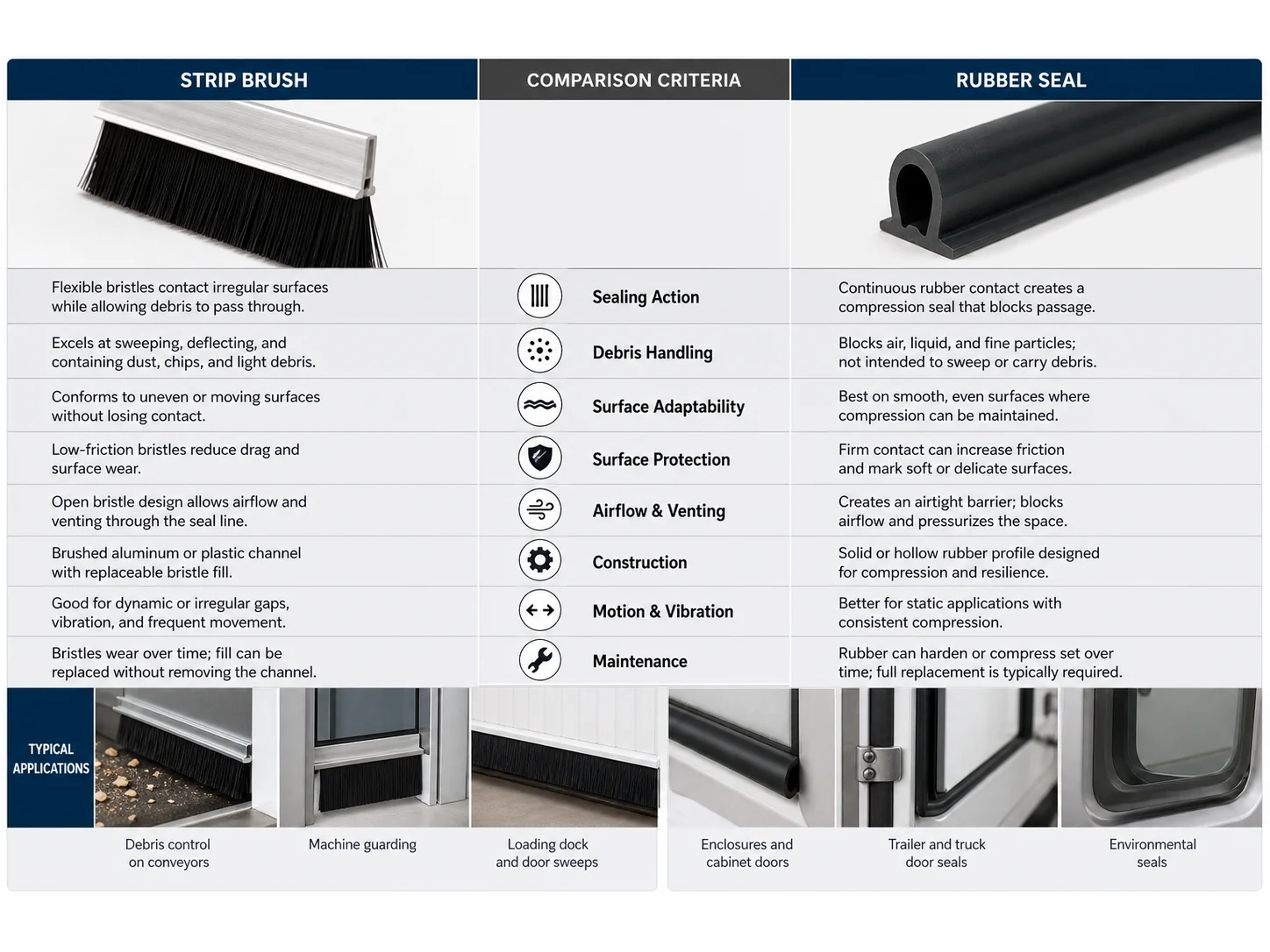
The table below compares the most important structural and performance characteristics of strip brushes and rubber seals.
| Feature | Strip Brush | Rubber Seal |
|---|---|---|
| Structure | Bristles held in a channel | Solid or hollow elastomer profile |
| Bristle / Material | Nylon, polypropylene, horsehair, metal | EPDM, silicone, neoprene, PVC |
| Surface Safety | Low friction, conforms to rough surfaces | Can grip or mar, less forgiving |
| Wear Behavior | Gradual bristle loss; easy push-through | Compression set, cracking, abrasion |
| Mounting Method | Aluminum, plastic, or metal retainers | Adhesive, press-fit, or clamping |
| Suitable Conditions | Dry, dusty, high-temp, light spray | Wet, liquid-tight, low pressure differential |
| Replacement | Often modular, replace brush strip only | Usually full seal replacement needed |
How to Choose Between a Strip Brush and a Rubber Seal
Start by answering three questions:
- What are you sealing against? For dry dust, chips, or thermal barriers, a brush usually works better. For liquids, coolants, or sound, choose a rubber seal.
- What surface does the seal contact? Uneven or abrasive workpieces favor a brush because bristles flex individually. Smooth, regular surfaces can use a rubber lip without damage.
- What are your maintenance and replacement capabilities? Strip brushes often allow you to replace just the brush insert, reducing downtime and cost. Rubber seals typically require replacing the entire extrusion.
Additional factors include operating temperature. Nylon bristles handle temperatures up to 200°F (93°C), while silicone rubber can handle higher heat. Chemical exposure may dictate the polymer choice for either option.
Common Mistakes When Selecting Strip Brushes or Rubber Seals
- Ignoring surface variation: A rubber seal may not conform to wavy plates or welds, leaving gaps. A brush with appropriate density can fill those gaps.
- Choosing by cost alone: Cheaper seals can fail faster when the tribology (friction and wear) of the application is not considered, leading to higher total cost.
- Mismatching mounting method: Ensure the holder or adhesive is compatible with the substrate and environmental stress. A brush in an aluminum retainer may corrode in certain washdown environments.
- Overlooking continuous movement: Rubber seals under constant dynamic contact can generate heat and wear quickly, while a brush may be more forgiving.
- Assuming all strip brushes are soft: Abrasive nylon or metal-filled bristles can scratch delicate surfaces. Confirm brush material suitability.
When Neither Option Is Enough
Strip brushes and rubber seals cover many applications, but some situations require a different approach:
- Combined sealing: Heavy spray with solids may call for a brush with a rubber backing or a dual lip design that uses both materials in one profile.
- Custom brush design: Non-standard trim length, extreme bristle density, or special materials may be necessary for high-speed or high-temperature applications where stock products fail prematurely.
- Alternative cleaning methods: For sticky, adhesive, or stringy residues, neither brush nor rubber may work well. Air knives, scrapers, or washdown systems might be more effective.
- Expert review: When safety or regulatory compliance is involved, consult with a seal manufacturer or an engineer who can provide a validated design.
Final Takeaway
Deciding between a strip brush and a rubber seal depends on the operational environment and performance demands. Use a strip brush when you need a flexible, low-friction barrier that tolerates rough surfaces and dry debris. Choose a rubber seal when you need a tight, liquid- or noise-resistant closure on smooth surfaces. Evaluate your specific workpiece material, residue type, and maintenance plan before committing. In borderline cases, consider a hybrid solution or expert guidance to prevent costly redesigns.
Frequently Asked Questions
Can a strip brush be used in wet environments?
Yes, but only if the bristle material is suited to moisture. Nylon absorbs water and may swell, so polypropylene or polyester are better choices for wet applications. Brushes deflect spray but do not create a liquid-tight seal.
What bristle material is best for high-temperature applications?
For moderate heat (up to 300°F/150°C), nylon offers good wear resistance. For higher temperatures, polyester or Nomex® bristles are options. Metal strip brushes can withstand extreme heat but may scratch surfaces.
How do I mount a strip brush on an uneven surface?
Most strip brushes come with a flexible aluminum or plastic holder that can be bent to follow slight contours. For significant irregularities, choose a brush with a longer trim length and softer bristles so the tips maintain contact without excessive pressure.
Is a rubber seal better for soundproofing?
Yes. Rubber seals, especially bulb or lip designs, provide a much better acoustic barrier than a brush because they close the gap completely and dampen vibration. Brushes allow some sound transmission through the bristles.
How often should I replace a strip brush?
There is no fixed schedule; inspect wear periodically. Replace the brush insert when bristles become matted, trimmed, or too sparse to function, or when the channel shows signs of corrosion. In abrasive applications, check frequent.
Can I cut a strip brush to length?
Yes. Strip brushes can be cut with a hacksaw or tin snips for the channel. Trim bristles to the desired length after installation if needed. Some holders allow you to slide out the brush and cut separately.
Are there combination brush-and-rubber seals?
Yes. Some manufacturers offer co-extruded profiles that combine a rubber sealing lip with a brush strip for applications that need both dust exclusion and liquid sealing, such as sliding door edges or automatic gates.
Which bristle material fits this job — Rubber, Nylon PA or Horsehair?
| Material | Continuous temperature (°C) | Peak temperature (°C) | Water absorption | Hardness |
|---|---|---|---|---|
| Rubber | 100 | 130 | very low | Specified by compound and Shore hardness; published TPE families can span roughly 50–80 Shore A, but that is a product-family example rather than a universal rubber range. |
| Nylon PA | 93 | 121 | 0.3–9% by PA grade and conditioning | Medium to firm; filament diameter and trim length control bending force. |
| Horsehair | 60–80 | 100–120 | 8–15% | — |
| AISI 316 Stainless Steel Wire | 400 | 500 | 0% | Rockwell B 70–95 depending on temper and cold work |
| AISI 304 Stainless Steel Wire | 400 | 500 | 0% | Rockwell B 70–95 depending on temper and cold work |
Figures as published by Brushtec / DuPont; Alleima. Confirm the exact grade against the supplier datasheet before ordering.
When are Strip Seal Brushes the wrong choice for strip brush?
- Strip Seal Brushes — Use rubber lips, foam, labyrinth seals, air curtains, or rigid scrapers when pressure sealing or liquid containment is required.
- Rubber — Generic rubber cannot support a technical page claim without chemistry, hardness and compatibility data.
- Nylon PA — The nylon family spans several grades, so heat, moisture and chemical limits should follow the selected PA resin rather than a generic nylon value.
- Horsehair — Not for aggressive scrubbing or wet chemical process cleaning.
What should replace Strip Seal Brushes for strip brush?
- Strip Seal Brushes — Strip brushes create a linear barrier or guide; machine-table brush plates distribute load and support products over a broad area. Closest alternative: Machine Table Brush Plates.
- Rubber — Compare Rubber with Silicone elastomer, TPE, PVC profile, PVA sponge. Change material when wet stiffness, temperature, chemical resistance, conductivity, particle shedding, or surface marking becomes the limiting factor.
- Nylon PA — Compare Nylon PA with PP, PBT, PET. Change material when wet stiffness, temperature, chemical resistance, conductivity, particle shedding, or surface marking becomes the limiting factor.
- Horsehair — Compare Horsehair with Boar bristle, goat hair, microfiber. Change material when wet stiffness, temperature, chemical resistance, conductivity, particle shedding, or surface marking becomes the limiting factor.