What Is an Aluminum Coil Brush?
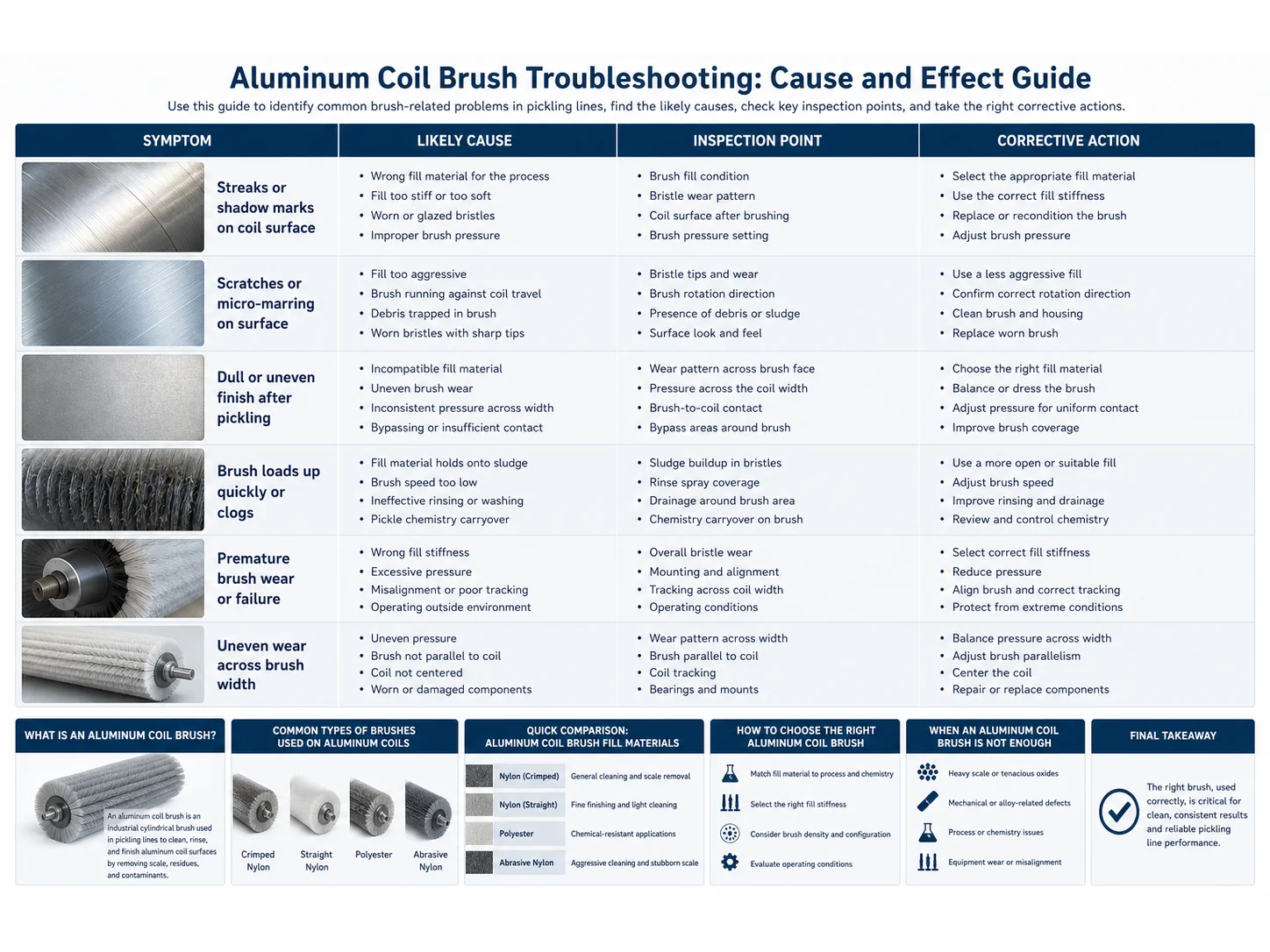
An aluminum coil brush is a rotary or stationary brush that contacts the surface of aluminum strip during processing. Its filaments—either abrasive-impregnated nylon, stainless steel wire, or natural fibers—remove oxides, residues, and scale while the strip passes through a pickling bath or rinse section. The brush must balance aggressive cleaning with surface preservation to avoid scratching or embedding contaminants.
In pickling lines, these brushes operate under wet, acidic conditions and at high line speeds. The right brush design reduces chemical consumption, improves rinsing efficiency, and helps achieve uniform surface finish before downstream coating or rolling.
Common Types of Brushes Used on Aluminum Coils
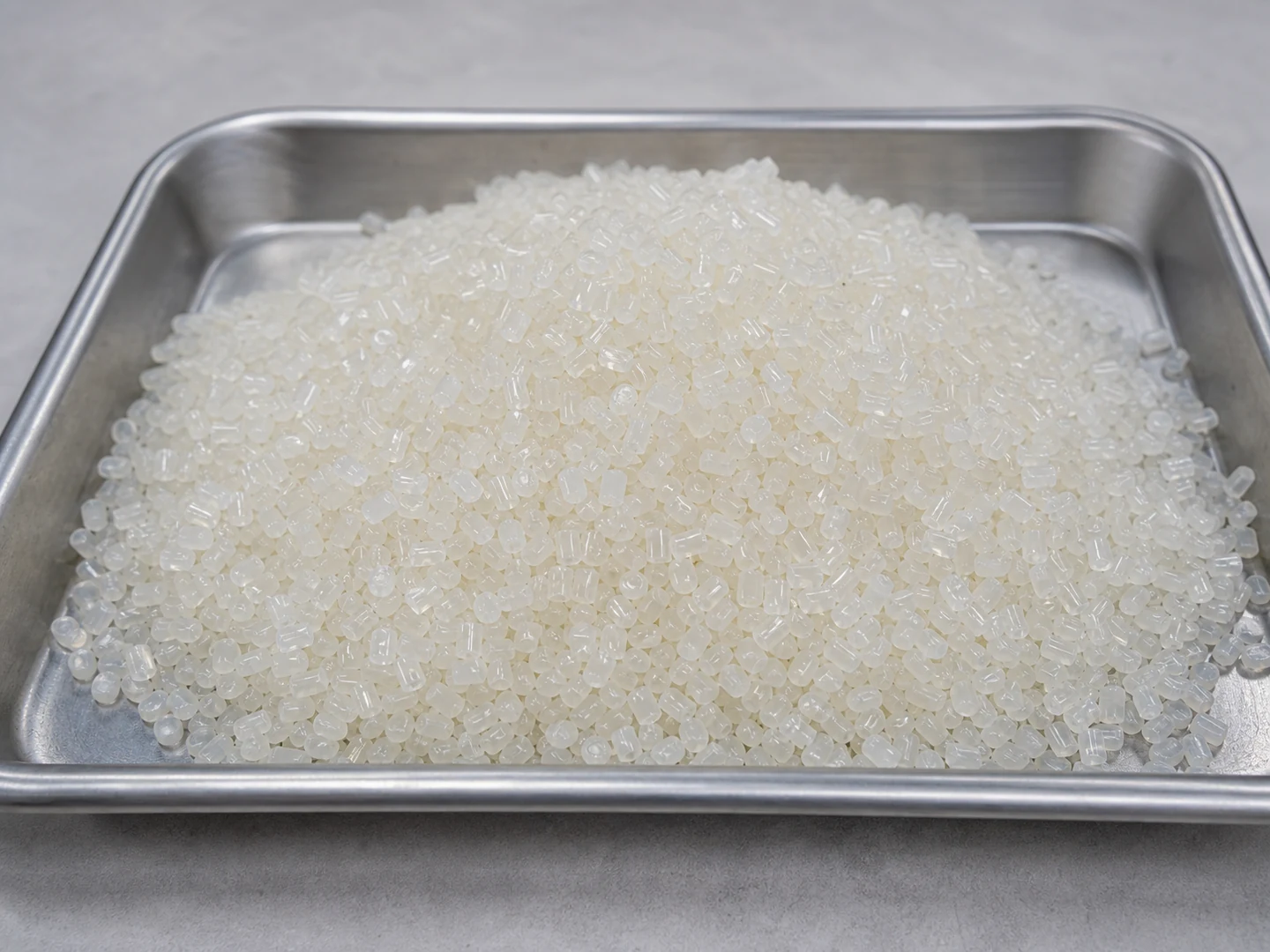
- Abrasive filament brushes – Nylon filaments loaded with aluminum oxide or silicon carbide grit. Best for light descaling and oxide removal without deep scratching.
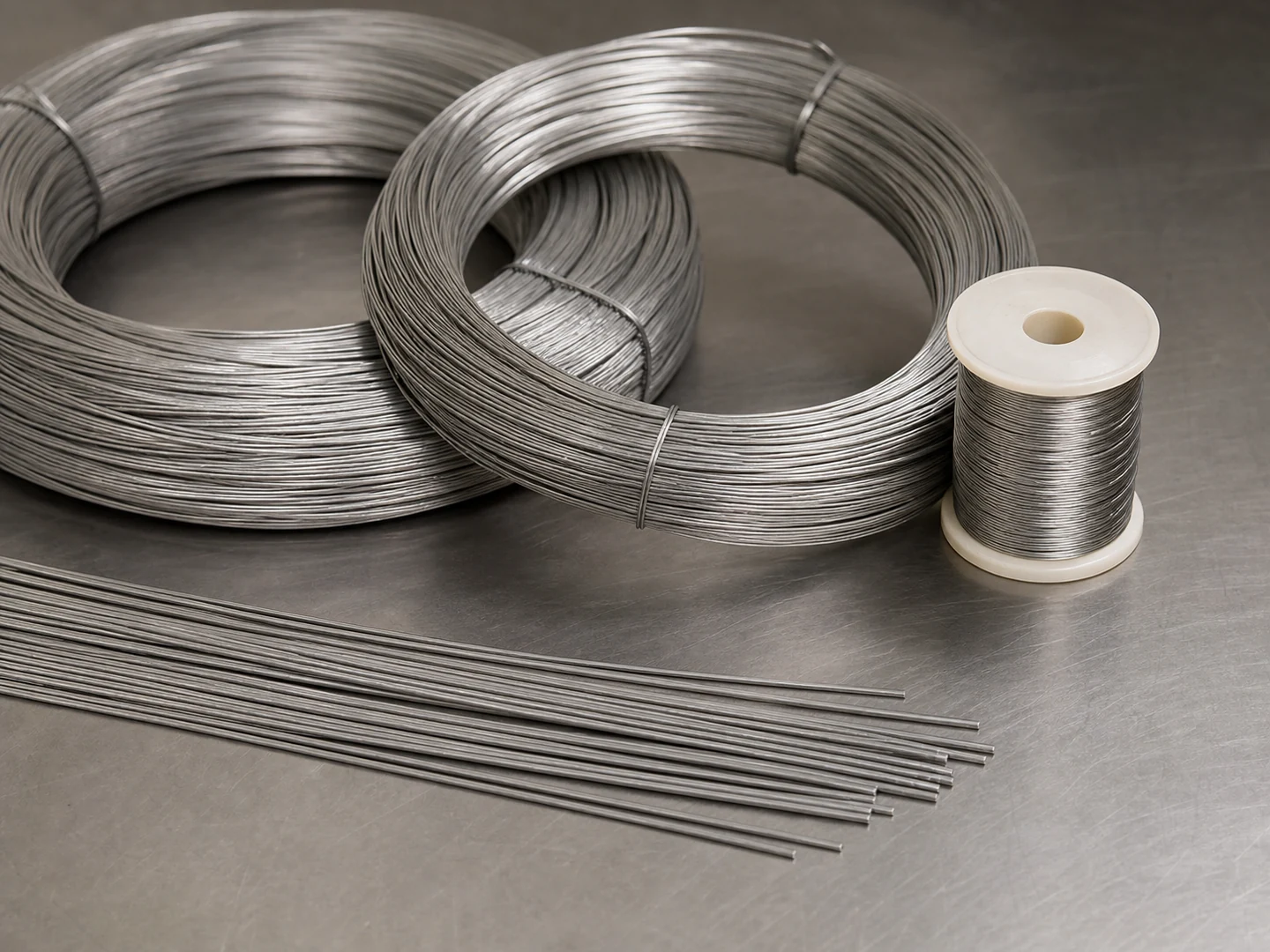
- Stainless steel wire brushes – Durable and chemically resistant. Used for heavy scale removal but can mark aluminum if wire diameter or crimp is wrong.
- Strip brushes in holders – Straight or coiled strip stock cut to length and mounted in metal or plastic channels. Common in wider lines.
- Custom molded coil brushes – Continuous brush wound on a core with specific density, trim length, and pattern. Often used for high-speed lines requiring precise contact.
Quick Comparison: Aluminum Coil Brush Fill Materials
| Brush Fill | Best For | Avoid When | Typical Life Factor |
|---|---|---|---|
| Nylon with aluminum oxide | Light surface cleaning, oxide haze | Heavy embedded scale | Moderate; grit wears over time |
| Nylon with silicon carbide | Moderate descaling, faster cut | Soft or polished finish requirements | Shorter than aluminum oxide |
| Stainless steel wire, crimped | Heavy scale, high durability | Delicate bright finish applications | Long; check for work hardening |
| Ceramic-filled nylon | Aggressive cleaning, long life | Thin gauge aluminum (distortion risk) | Very long; less filament breakage |
| Natural fiber (Tampico) | Polishing, final rinse | Acid contact; fiber degradation | Short in wet, chemical environments |
How to Choose the Right Aluminum Coil Brush
Selection must match line conditions, strip specifications, and cleaning objectives. Evaluate these factors before ordering:
- Residue type and thickness – Light oxide film can use fine grit; heavy scale demands aggressive wire or coarse ceramic.
- Surface sensitivity – Softer alloys or final finish applications need gentle filaments; hard alloys can tolerate more aggressive materials.
- Chemical environment – Acids, alkalis, and temperature affect filament and core material. Stainless steel wire and cores resist corrosion; molded nylon cores can swell or degrade.
- Equipment interface – Shaft diameter, keyway, mounting style, and available space must match the existing brush roll. Always verify core dimensions and drive engagement.
- Line speed and pressure – Higher speed demands denser fill or higher stiffness to maintain contact without excessive deflection.
- Maintenance and replacement intervals – Quick-change designs reduce downtime; longer-lasting filaments reduce changeover frequency.
- Custom size requirements – Off-the-shelf brushes rarely match exactly. Work from a drawing or sample to specify face length, overall length, diameter, and trim.
Common Mistakes When Selecting or Using Aluminum Coil Brushes
- Using the wrong filament material for the alloy – Brass or carbon steel wire can transfer copper or iron onto aluminum, causing galvanic corrosion spots. Always use stainless steel or abrasive nylon.
- Ignoring wet and chemical exposure – Plastic cores or non-stainless steel components can swell, corrode, or fail in pickling acid. Choose 316 stainless steel cores or encapsulated plastic that resists the specific acid.
- Choosing by diameter or cost drivers alone – Diameter must fit the machine, but density, wire diameter, and grit size determine cleaning action. low-cost brushes often use less filament, reducing life and increasing cost per ton.
- Overlooking brush balance at high RPM – Unbalanced brushes cause vibration, bearing wear, and uneven contact. Require balancing data for brushes operating above critical RPM.
- Skipping sample testing or drawing review – Assuming a standard part number works without verifying fit or performance leads to rapid failure or surface defects. Always provide a dimensioned drawing or send a reference sample.
- Neglecting brush break-in procedures – New abrasive brushes often require a short run-in period to expose grit and reach stable performance. Running at full load immediately may glaze or strip filaments.
- Storing brushes improperly – Damp environments can corrode wire or soften some nylon cores. Store upright in dry, temperature-controlled areas away from direct sunlight.
When an Aluminum Coil Brush Is the Wrong Choice
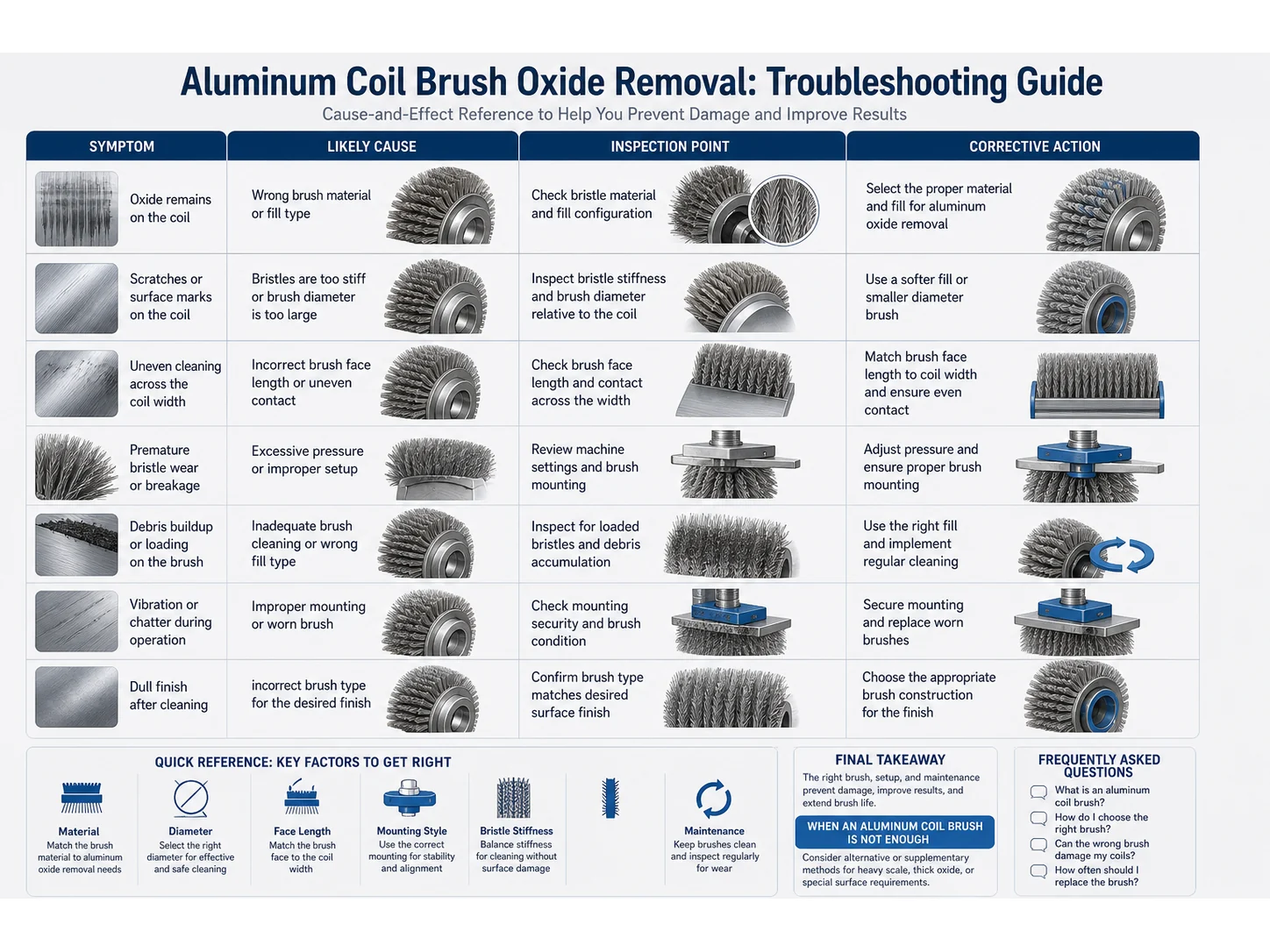
An aluminum coil brush alone cannot correct pre-existing strip shape defects, deep pits, or embedded metallic contamination from upstream processes. In such cases, the brush becomes part of a larger system that includes abrasive belts, flap wheels, or chemical pre-etch. If the strip surface shows severe pitting or alloying element segregation, consult a process engineer before changing brush specifications.
Similarly, if line modifications change speed, tension, or chemical concentration beyond the original brush design envelope, a review of the brush material and fill density is mandatory. In high-precision applications, request a supplier drawing review or sample test to validate the brush’s suitability under new conditions.
Final Takeaway
Avoiding aluminum coil brush mistakes starts with a clear definition of the cleaning task and a full understanding of the operating environment. Match filament material, core construction, and dimensions to the pickling line’s chemical, mechanical, and strip surface requirements. Validate through samples or drawings, and do not fall for the shortcut of buying by cost drivers or diameter alone. A properly specified brush reduces defects, extends run time, and lowers total cost per ton processed.
Frequently Asked Questions
What filament material is safest for aluminum surfaces?
Stainless steel wire and abrasive nylon with aluminum oxide or silicon carbide are the most common. Avoid brass or carbon steel to prevent galvanic contamination.
How do I measure an existing brush for replacement?
Record face length, overall length, core material, inner diameter with keyway dimensions, and outer diameter (OD) with filaments. Also note the filament type, density, and pattern if possible, and take a close-up photo.
How often should brushes be replaced in a pickling line?
There is no single answer. Replace when cleaning performance drops below specification, when filament length is worn beyond 30–40% of original trim, or when vibration increases. Track life per ton processed to establish your line’s pattern.
Can I use the same brush for different acid chemistries?
Not always. Hydrochloric, sulfuric, and nitric acid mixtures react differently with metals and plastics. Verify core and filament chemical resistance for your specific bath chemistry and temperature. When in doubt, request chemical compatibility data.
What causes rapid filament breakage?
Excessive pressure, wrong filament type for the scale, poor brush balance, or a sharp edge on the strip are common causes. Reduce set-down pressure, increase fill density, or upgrade to a more durable filament.
Is a custom drawing really necessary?
For pickling line brushes, yes. Even small differences in core geometry, drive style, or collar position can cause misalignment. A drawing or sample ensures the brush fits correctly and performs safely at line speed.
Do aluminum coil brushes need a break-in run?
Abrasive filament brushes often benefit from a short low-load run to expose fresh grit and stabilize contact. Without break-in, initial performance may be inconsistent. Check with your supplier for recommended break-in procedure.
Technical References
- OSHA — Hazard Communication
- OSHA — Chemical Hazards and Toxic Substances
- World Stainless — Corrosion Resistance of Stainless Steels
Which bristle material fits this job — AISI 304 Stainless Steel Wire, Nylon PA or Abrasive Nylon?
| Material | Continuous temperature (°C) | Peak temperature (°C) | Water absorption | Hardness |
|---|---|---|---|---|
| AISI 304 Stainless Steel Wire | 400 | 500 | 0% | Rockwell B 70–95 depending on temper and cold work |
| Nylon PA | 93 | 121 | 0.3–9% by PA grade and conditioning | Medium to firm; filament diameter and trim length control bending force. |
| Abrasive Nylon | 120 | 150 | 0.1–1.0% | Abrasive filament; stiffness and cutting level is controlled by PA base, grit type, grit size, filament diameter and trim height. |
| Carbon Steel Wire | 200–300 | 350–450 | 0% | Rockwell C 40–60 |
Figures as published by Alleima; Brushtec / DuPont; Perlon. Confirm the exact grade against the supplier datasheet before ordering.
What should replace AISI 304 Stainless Steel Wire when it stops working?
- AISI 304 Stainless Steel Wire — Use AISI 316 stainless steel wire for chloride, marine, dairy, beverage, chemical washdown, or higher pitting-resistance requirements. Use carbon steel for dry aggressive cutting and brass or abrasive nylon for lower marking risk.
- Nylon PA — Compare Nylon PA with PP, PBT, PET. Change material when wet stiffness, temperature, chemical resistance, conductivity, particle shedding, or surface marking becomes the limiting factor.
- Abrasive Nylon — Compare Abrasive Nylon with PP, PBT, PET. Change material when wet stiffness, temperature, chemical resistance, conductivity, particle shedding, or surface marking becomes the limiting factor.
- Carbon Steel Wire — Compare Carbon Steel Wire with Carbon steel wire, brass wire, abrasive nylon. Change material when wet stiffness, temperature, chemical resistance, conductivity, particle shedding, or surface marking becomes the limiting factor.