What Is a Tire Sidewall Brush?
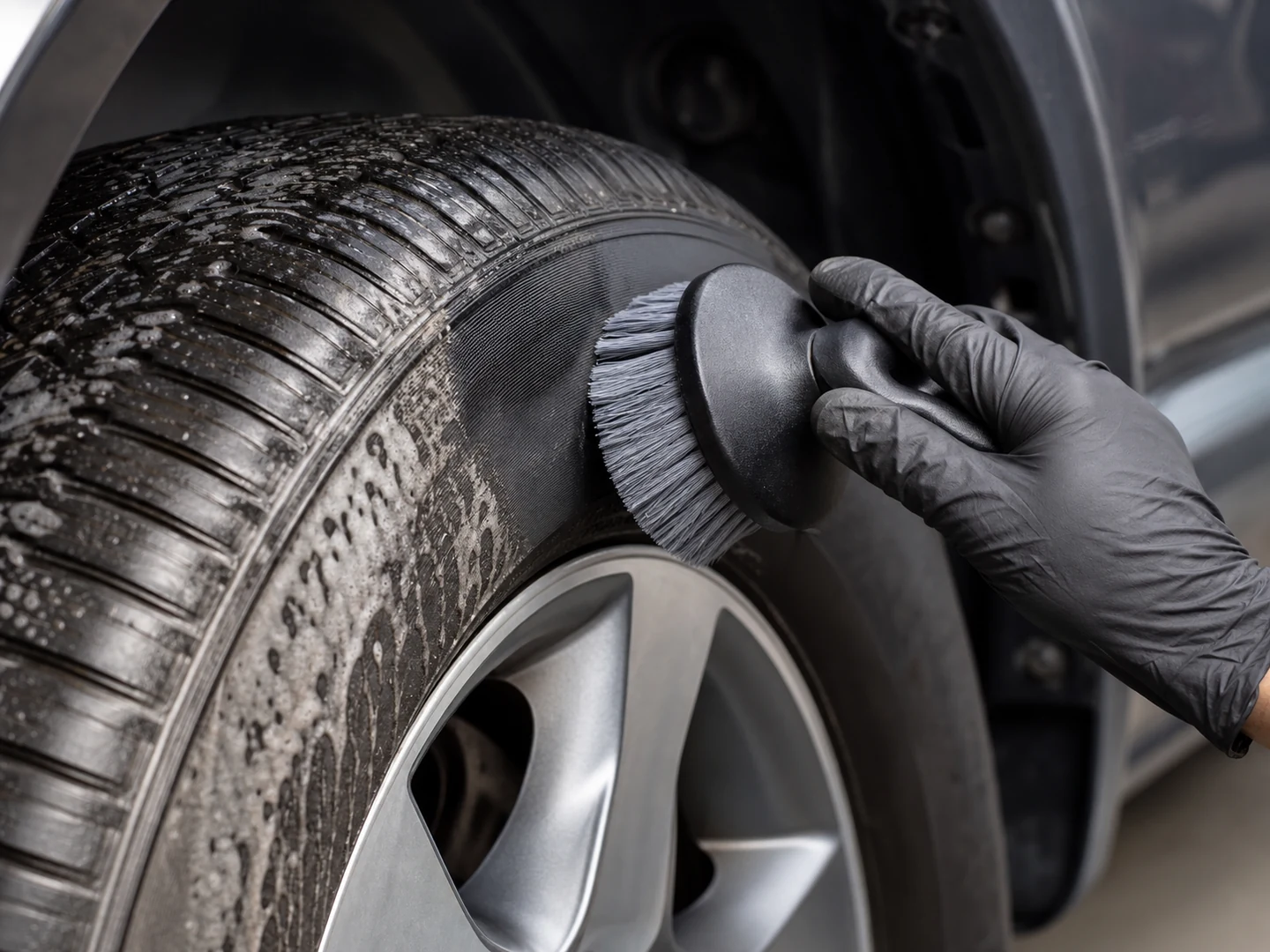
A tire sidewall brush is a small‑diameter, often custom‑shaped cleaning brush with bristles engineered to penetrate tight mold grooves without scratching the tooling surface. Its bristle material, stiffness, and overall profile are matched to the groove geometry rather than to broad surface scrubbing. The core purpose is to remove cured rubber particles, carbon residues, and mold release compounds from the sidewall cavities while preserving the fine etched detail of the mold.
Common Brush Options for Mold Groove Cleaning
Not all brushes used in tire mold cleaning are the same. Understanding the basic categories helps avoid mismatching the brush to the task.
- Standard cylindrical cleaning brushes: Often used for general mold surface cleaning. They have uniform bristle height and diameter, suitable for flat or gently curved areas but rarely reach into deep sidewall grooves.
- Tire sidewall contour brushes: Designed with a tapered, stepped, or profiled trim that follows the groove shape. Diameters are typically small (6–25 mm) and lengths match groove depth.
- Custom‑trimmed brush rolls: For automated mold cleaning stations, strip brushes or roller brushes are custom‑trimmed to specific groove profiles and widths, offering consistent coverage across production cycles.
- Miniature detail brushes (manual): Small handheld brushes, often with metal or plastic cores, used for touch‑up cleaning in hard‑to‑reach areas.
Tire Sidewall Brush vs Standard Cleaning Brushes
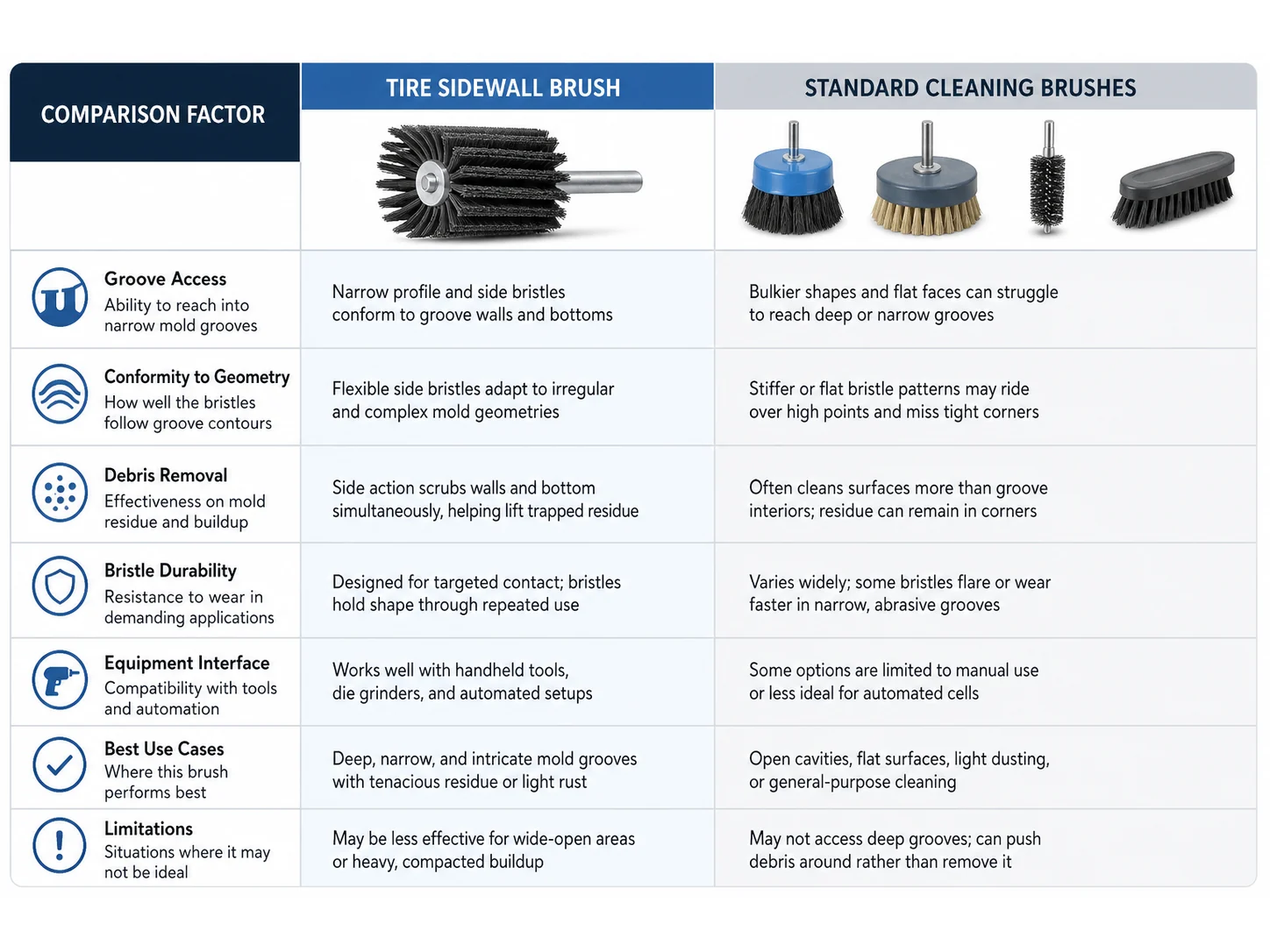
The table below compares key factors when choosing between a purpose‑built tire sidewall brush and a generic standard cleaning brush for mold groove tasks.
| Factor | Tire Sidewall Brush | Standard Cleaning Brush |
|---|---|---|
| Groove penetration | Excellent – trimmed to match groove depth and width; reaches tight contours | Poor – uniform bristle length cannot fully enter narrow, deep grooves |
| Surface protection | Bristle material and tip treatment selected to avoid scratching mold surfaces | Risk of surface damage if bristle is too stiff or cut ends are blunt |
| Residue removal | Targets baked‑on rubber and release agent inside the groove itself | Removes surface‑level debris but often leaves residue in groove bottoms |
| Durability in wet/chemical environments | Usually built with chemical‑resistant fibers (e.g., nylon 6.12, polypropylene) and stainless‑steel cores | May use lower‑grade materials that degrade faster with solvents or high‑pH cleaners |
| Mounting options | Available as manual handle, shank, or quick‑change adapter for rotary tools | Often limited to hand‑held or basic shank; fewer tool‑interface options |
| Customization | Can be custom‑trimmed to exact groove profile; diameter, length, and bristle density adjustable | Off‑the‑shelf sizes only; limited by standard stock |
| Typical cost per unit (relative) | Higher due to custom trim and low‑volume production | Lower for standard stock brushes |
How to Choose the Right Brush for Mold Grooves
Selecting a brush isn’t just about matching diameter to groove width. These factors determine long‑term performance and production consistency.
- Residue type: Soft, tacky rubber compounds may require softer, more flexible bristles to avoid pushing residue deeper. Hard, carbonized deposits need a stiffer fill material to break the bond without excessive force.
- Surface sensitivity: Aluminum molds demand non‑abrasive bristle materials (e.g., nylon with feathered tips). Steel molds can tolerate slightly more aggressive filaments but still require controlled stiffness to preserve groove edges.
- Equipment interface: For manual cleaning, a comfortable handle or precision shank is essential. For automated stations, check compatibility with rotary speed, brush roll housing, and user‑side drive system. Custom brush rolls often require a drawing review with the supplier to ensure proper winding, core diameter, and trim length.
- Wet or chemical exposure: Confirm that bristle, core, and adhesives resist the specific cleaning solvent, degreaser, or alkaline wash used in your process. Stainless‑steel cores (302 or 304) are common for corrosion resistance.
- Hygiene and contamination control: In facilities with strict cleanliness standards, avoid natural fibers that can shed or absorb moisture. Synthetic monofilaments are easier to clean and dry faster.
- Maintenance frequency: A brush that loads up quickly with rubber requires more frequent replacement or cleaning. Consider bristle density and chemical resistance if uptime is critical.
- Custom size requirements: Off‑the‑shelf brushes rarely match groove dimensions exactly. If a standard diameter is slightly too large, it can flatten mold details; if too small, it won’t clean the groove floor. Request a sample or supplier drawing to verify fit before committing to bulk orders.
Common Mistakes When Choosing a Mold Groove Brush
- Using wire or overly stiff bristles on aluminum molds: Even soft wire can erode anodized coating and leave permanent scratches, ruining sidewall detail.
- Selecting by diameter alone: Groove depth, bottom radius, and draft angle all affect bristle performance. A brush that fits the groove entrance may not reach the floor.
- Ignoring chemical compatibility: Some nylon grades swell in aggressive solvents, causing bristle distortion and loss of cleaning power.
- Skipping a sample test: Ordering production quantities without testing one or two prototypes on actual mold sections can lead to wasted inventory and production delays.
- Assuming all “sidewall brushes” are the same: Without a supplier drawing or detailed spec, you may receive a generic small‑diameter brush that lacks the correct trim shape.
- Overlooking handle fatigue in manual operations: An uncomfortable grip or excessive vibration from a poorly mounted shank can slow cleaning cycles and increase operator errors.
When a Tire Sidewall Brush Is the Wrong Choice
A tire sidewall brush excels at detailed groove cleaning, but it won’t replace every cleaning step in the mold shop.
- Automated high‑volume cleaning: If you clean dozens of molds per shift, a manual brush becomes a bottleneck. Consider custom brush rolls or strip brushes integrated into a wash booth or rotary cleaning station.
- Deep, blind holes or cross‑drilled vents: Sidewall grooves are open on one side. Vent holes or narrow, deep cavities may require a different brush style, such as a twisted‑in‑wire tube brush or micro‑drill brush, plus positive air or fluid flush.
- Heavy carbonized buildup requiring mechanical scrubbing: When chemical soaking alone isn’t enough and manual brushing risks surface damage, a programmed rotary brush with controlled pressure and speed may be necessary. Always validate through a drawing review and sample test before scaling.
- Non‑groove surfaces: The sidewall brush is not designed for large flat tread areas or inner liner surfaces. For those, broader standard brushes or automated spray/brush systems are more efficient.
Final Takeaway
A tire sidewall brush is the tool of choice when groove geometry, surface sensitivity, and residue type require a custom‑fit cleaning solution. Standard brushes serve general mold surfaces well but fall short inside the tight, contoured spaces that define sidewall lettering. Always verify fit through a drawing or sample, and build your selection around the actual cleaning environment—not just the groove diameter on paper.
Frequently Asked Questions
Can I use a standard wire brush to clean tire mold sidewalls?
Not recommended. Steel wire burs can scratch mold surfaces, remove anodized layers on aluminum, and round off sharp groove edges. Soft, non‑metallic filaments specifically trimmed to the groove profile are a safer choice.
What bristle material works best for sticky rubber residue?
Fine‑diameter nylon (e.g., 0.15–0.25 mm) with crimped or flagged tips often performs well. The flexibility helps wipe tacky residue without embedding it. For heavier deposits, a slightly stiffer polyester or polypropylene blend can add necessary scrubbing action.
How do I measure my mold groove to order the correct brush?
Measure groove width at its narrowest point, depth from the mold surface to the groove floor, and note any draft angles or radii. Provide a cross‑section sketch or photograph to your brush supplier so they can trim the bristle profile to match the actual cavity shape—not just the entrance width.
Are tire sidewall brushes available for automatic cleaning machines?
Yes. Many manufacturers offer custom brush rolls or strip brushes with integrated shafts and trim patterns that match specific groove layouts. A drawing review is typical to confirm core diameter, bristle length, density, and rotational direction.
How often should I replace a tire sidewall brush?
Replacement depends on usage frequency, chemical exposure, and bristle wear. Inspect regularly for flattened or splayed bristles, loss of trim shape, and core corrosion. A brush that no longer reaches the groove floor or removes residue consistently should be replaced—usually after several dozen cleaning cycles in heavy production environments.
Can a tire sidewall brush be used with solvent‑based cleaners?
Only if the bristle material and core are chemically resistant. Many nylon types are compatible with common solvents, but always verify with the manufacturer. Polypropylene or PTFE fibers may be needed for aggressive chemical baths. Stainless‑steel cores help prevent rust in wet applications.
What’s the difference between a brush “trim” and a “profile”?
In brush terminology, the trim refers to the overall bristle length measured from the core, while the profile describes the shape of the bristle tips viewed from the side (e.g., stepped, tapered, or contoured). A tire sidewall brush often has a stepped or tapered profile to match varying groove depths.
Do I need a sample before ordering a large quantity?
Strongly advised. A small sample lot lets you test fit, residue removal, and material compatibility on your actual mold segments. This step reduces the risk of ordering a full production run that doesn’t perform as expected.
Technical References
Which bristle material fits this job — Nylon PA, Rubber or AISI 304 Stainless Steel Wire?
| Material | Continuous temperature (°C) | Peak temperature (°C) | Water absorption | Hardness |
|---|---|---|---|---|
| Nylon PA | 93 | 121 | 0.3–9% by PA grade and conditioning | Medium to firm; filament diameter and trim length control bending force. |
| Rubber | 100 | 130 | very low | Specified by compound and Shore hardness; published TPE families can span roughly 50–80 Shore A, but that is a product-family example rather than a universal rubber range. |
| AISI 304 Stainless Steel Wire | 400 | 500 | 0% | Rockwell B 70–95 depending on temper and cold work |
Figures as published by Brushtec / DuPont; Alleima. Confirm the exact grade against the supplier datasheet before ordering.
What should replace Nylon PA for tire?
- Nylon PA — Compare Nylon PA with PP, PBT, PET. Change material when wet stiffness, temperature, chemical resistance, conductivity, particle shedding, or surface marking becomes the limiting factor.
- Rubber — Compare Rubber with Silicone elastomer, TPE, PVC profile, PVA sponge. Change material when wet stiffness, temperature, chemical resistance, conductivity, particle shedding, or surface marking becomes the limiting factor.
- AISI 304 Stainless Steel Wire — Use AISI 316 stainless steel wire for chloride, marine, dairy, beverage, chemical washdown, or higher pitting-resistance requirements. Use carbon steel for dry aggressive cutting and brass or abrasive nylon for lower marking risk.