What Is a Conveyor Brush?
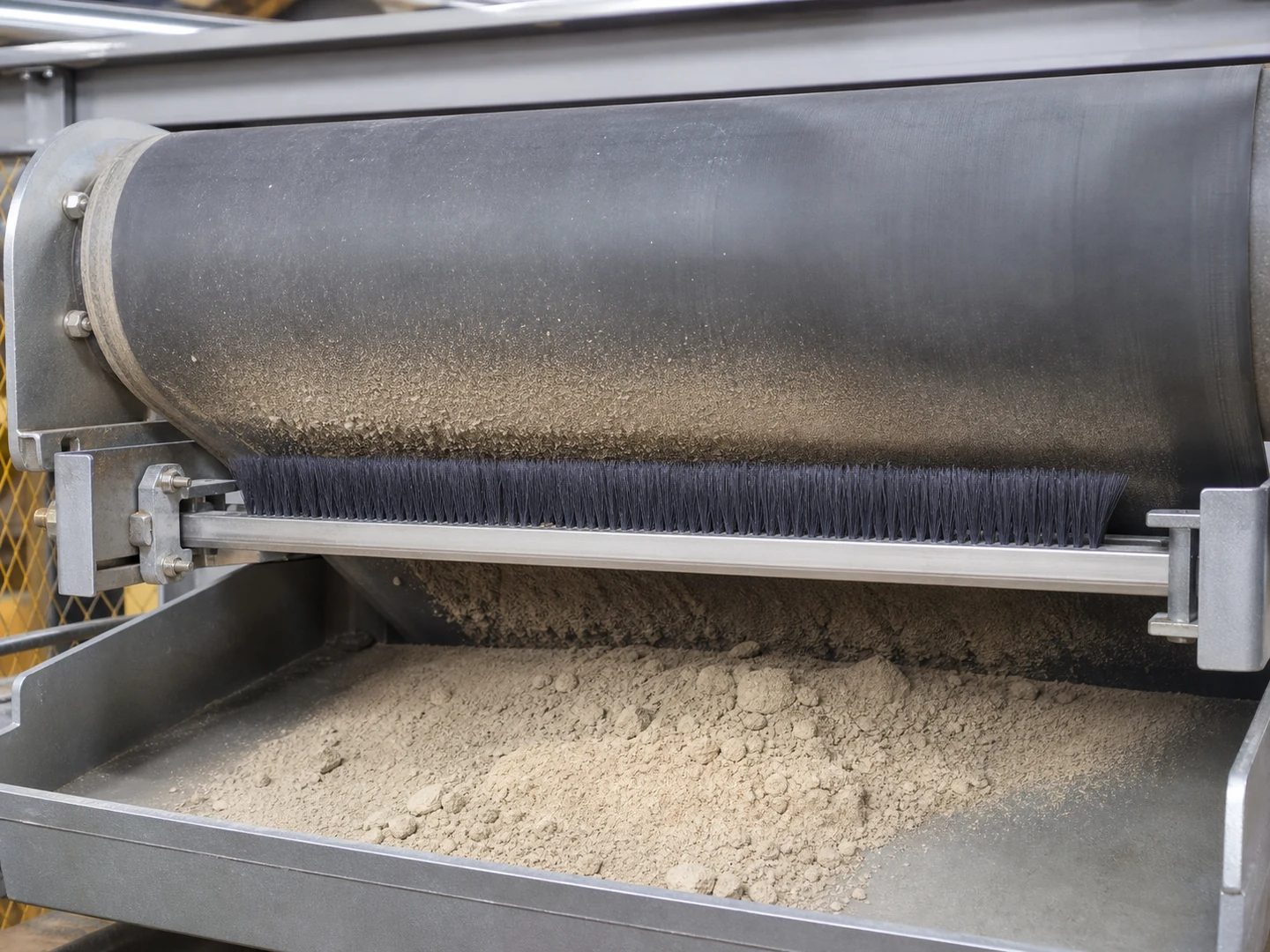
A conveyor brush is a rotating or stationary component with bristles that contact a conveyor belt to perform cleaning, sealing, or product handling tasks. It removes carryback, fines, and sticky materials, or gently positions products without damage. Conveyor brushes are found in industries such as food processing, packaging, mining, recycling, and manufacturing.
Common Types of Conveyor Brushes
Conveyor brushes come in several structural designs, each suited for specific applications:
- Conveyor brush roller – a cylindrical brush that rotates against the belt, often powered by its own motor or driven by belt friction. Used for aggressive cleaning or sweeping.
- Conveyor brush strip – a straight or profiled brush strip mounted in a holder, used for static wiping, sealing gaps, or light cleaning.
- Conveyor belt brush cleaner – a complete assembly that holds a brush against the belt at a fixed pressure, often with tension adjustments. Combines the brush with a mounting system for quick installation.
Conveyor Brush Bristle Materials Compared
Bristle material selection directly impacts cleaning effectiveness, belt wear, and brush lifespan. The table below compares the most common options.
| Bristle Material | Typical Use | Strength | Limitations |
|---|---|---|---|
| Nylon (standard) | General-purpose cleaning, food contact allowed with FDA grades | Good flexibility, chemical resistance | Absorbs moisture, can melt at high temperatures |
| Abrasive nylon | Removing stubborn residues, rust, or scale | Aggressive cleaning without metal contamination | May scratch soft belts, higher cost |
| Polypropylene | Wet environments, chemical resistance | Low moisture absorption, acid/alkali resistant | Lower heat tolerance than nylon |
| Brass wire | non-sparking cleaning, light deburring | Conductive, durable | Leaves metal traces, not for food unless specified |
| Stainless steel wire | Heavy-duty scraping, high-temperature applications | Extremely durable, heat resistant | Can damage belts, risk of sparking |
| Boar bristle (natural) | Delicate surface wiping, static dissipation | Soft, anti-static | Limited chemical resistance, higher cost |
How to Choose the Right Conveyor Brush
The best brush depends on a combination of factors. Evaluate these criteria before ordering:
- Equipment interface – Confirm the brush type matches your conveyor frame. Some brush cleaners bolt onto the structure, while brush rollers may need bearings and drive connections.
- Contact surface – Hard belts (PVC, rubber) can tolerate abrasive bristles; soft food-grade belts require softer materials to prevent damage.
- Residue type – Dry, dusty materials need a different bristle stiffness and density than sticky, wet residues. Abrasive nylon or wire may be needed for hardened deposits.
- Operating environment – High heat, chemicals, or washdown conditions dictate bristle material and hub construction (stainless steel hubs for corrosion resistance, for example).
- Replacement cycle – Consider brush wear characteristics. A low-cost brush that needs frequent changeouts may increase downtime, while a more durable option could lower total cost.
Mounting Methods and Size Factors
Conveyor brushes are mounted in different ways. The mounting method influences brush replacement ease and contact pressure.
- Clamp-on or bolt-on strips – Simple, fixed position; used for light-duty wiping and sealing.
- Spring-loaded or counterweighted assemblies – Maintain constant pressure as bristles wear; common in belt cleaners.
- Adjustable brackets – Allow manual tension and angle changes for optimal cleaning.
When specifying size, measure the belt width and determine the required brush length (usually equal to belt width or slightly oversize for edge coverage). Roller brush diameter and core size must match existing mounts or be designed into new equipment. Strip brush dimensions (width, height, backing) need to fit the holder profile.
When in doubt, asking what size roller brush should I use is a common practical question. The answer always starts with belt width, but also consider required interference (how far the bristles bend against the belt) and rotation speed if it’s a powered roller.
Common Mistakes When Selecting a Conveyor Brush
- Choosing by cost alone – The lowest-cost brush may wear out quickly and cause belt damage, leading to higher long-term costs.
- Ignoring belt compatibility – A stiff bristle on a soft belt can cut the belt surface or embed debris.
- Wrong bristle density – Too dense and material clogs between bristles; too sparse and cleaning is ineffective.
- Neglecting mounting adjustment – Even the best brush fails if pressure is set incorrectly or the brush isn’t aligned parallel to the belt.
- Using a “universal” brush for unique residues – Sticky materials like chocolate or clay may require special coated bristles or release agents not found in standard brushes.
When a Standard Conveyor Brush Is the Wrong Choice
Standard catalog brushes cover most general applications, but some situations demand a custom solution:
- Extreme belt widths or non-standard core sizes not available off-the-shelf.
- Unique residue that clogs standard bristle spacing; may need custom patterns or combinations of bristle types.
- Sanitary applications requiring one-piece molded hubs without crevices for bacterial growth.
- High-temperature environments beyond standard nylon or polypropylene limits; custom metal hubs and high-temp polymers may be needed.
- Strict FDA or EU food contact compliance that standard documentation cannot satisfy.
In these cases, requesting a custom drawing or sample from the manufacturer becomes necessary. Don’t force a standard part into a critical application—the cost of a custom brush is marginal compared to downtime or contamination risk.
Final Takeaway
Selecting a conveyor brush is about matching bristle material, structure, mounting, and size to your specific belt, material, and environment. Start by analyzing your residue type and belt surface, then shortlist compatible bristle materials. Confirm the mounting style and available space, and always consider total cost of ownership over purchase cost. When standard options fall short, a custom brush is a justified investment.
Frequently Asked Questions
How often should conveyor brushes be replaced?
Replacement timing depends on bristle wear and cleaning performance. Inspect frequent; if bristles are worn to less than half their original length or cleaning effectiveness drops, replace the brush. In abrasive environments, weekly checks may be needed.
Can the same brush work for wet and dry applications?
Some materials like polypropylene handle both, but bristle stiffness and density may need to change. Wet sticky residues often require wider spacing to prevent clogging, while dry dust benefits from denser bristle patterns. Confirm with your supplier.
Are conveyor brushes suitable for food-grade belts?
Yes, but bristles and hubs must meet FDA or EU regulations. Look for nylon or polypropylene grades with appropriate documentation. Avoid wire bristles unless explicitly documented for food contact.
What is the difference between a spiral-wound brush roller and a straight-set roller?
A spiral-wound roller has bristles arranged in a helical pattern, which provides more even contact and self-cleaning action. A straight-set roller has rows of bristles parallel to the axis, which can leave stripe-like cleaning patterns. Spiral is generally preferred for uniform cleaning.
How do I measure for a replacement conveyor brush strip?
Measure the overall length, width, and height of the existing strip, as well as the backing profile. The holder channel dimensions are critical—take a sample if possible to ensure the new strip fits snugly.
What causes a conveyor brush to wear unevenly?
Common causes include misalignment, uneven belt wear, buildup on one side, or pressure set too high. Check the mounting brackets and adjust so the brush sits parallel with uniform contact across the belt.
Can I shorten a conveyor brush strip myself?
Many strip brushes can be cut with a fine-tooth saw or heavy-duty scissors, but this may leave sharp edges or loosen bristles near the cut. It’s safer to order the exact length from the manufacturer, especially for high-speed or food applications.
Is it worth paying more for an abrasive nylon brush over standard nylon?
If you are removing hardened residues or need a more aggressive clean without risking belt damage from wire, abrasive nylon often reduces downtime and extends belt life, making it cost-effective in the long run.
Technical References
- OSHA — Machine Guarding
- OSHA — Control of Hazardous Energy
- OSHA — Combustible Dust
- EPA — Particulate Matter Basics
Which bristle material fits this job — Nylon PA, Abrasive Nylon or AISI 304 Stainless Steel Wire?
| Material | Continuous temperature (°C) | Peak temperature (°C) | Water absorption | Hardness |
|---|---|---|---|---|
| Nylon PA | 93 | 121 | 0.3–9% by PA grade and conditioning | Medium to firm; filament diameter and trim length control bending force. |
| Abrasive Nylon | 120 | 150 | 0.1–1.0% | Abrasive filament; stiffness and cutting level is controlled by PA base, grit type, grit size, filament diameter and trim height. |
| AISI 304 Stainless Steel Wire | 400 | 500 | 0% | Rockwell B 70–95 depending on temper and cold work |
| Boar Bristle | 60–80 | 100–120 | 10–18% | — |
Figures as published by Brushtec / DuPont; Perlon; Alleima. Confirm the exact grade against the supplier datasheet before ordering.
What should replace Nylon PA for conveyor belt?
- Nylon PA — Compare Nylon PA with PP, PBT, PET. Change material when wet stiffness, temperature, chemical resistance, conductivity, particle shedding, or surface marking becomes the limiting factor.
- Abrasive Nylon — Compare Abrasive Nylon with PP, PBT, PET. Change material when wet stiffness, temperature, chemical resistance, conductivity, particle shedding, or surface marking becomes the limiting factor.
- AISI 304 Stainless Steel Wire — Use AISI 316 stainless steel wire for chloride, marine, dairy, beverage, chemical washdown, or higher pitting-resistance requirements. Use carbon steel for dry aggressive cutting and brass or abrasive nylon for lower marking risk.
- Boar Bristle — Compare Boar Bristle with Horsehair, nylon, PBT. Change material when wet stiffness, temperature, chemical resistance, conductivity, particle shedding, or surface marking becomes the limiting factor.