
Custom Cleaning Brush
Cannula Cleaning Brush
Nylon cannula cleaning brushes for 1–6 mm instrument lumens. PA6/PA612 filaments, twisted wire or nylon core, 178–305 mm reach. Custom configurations.
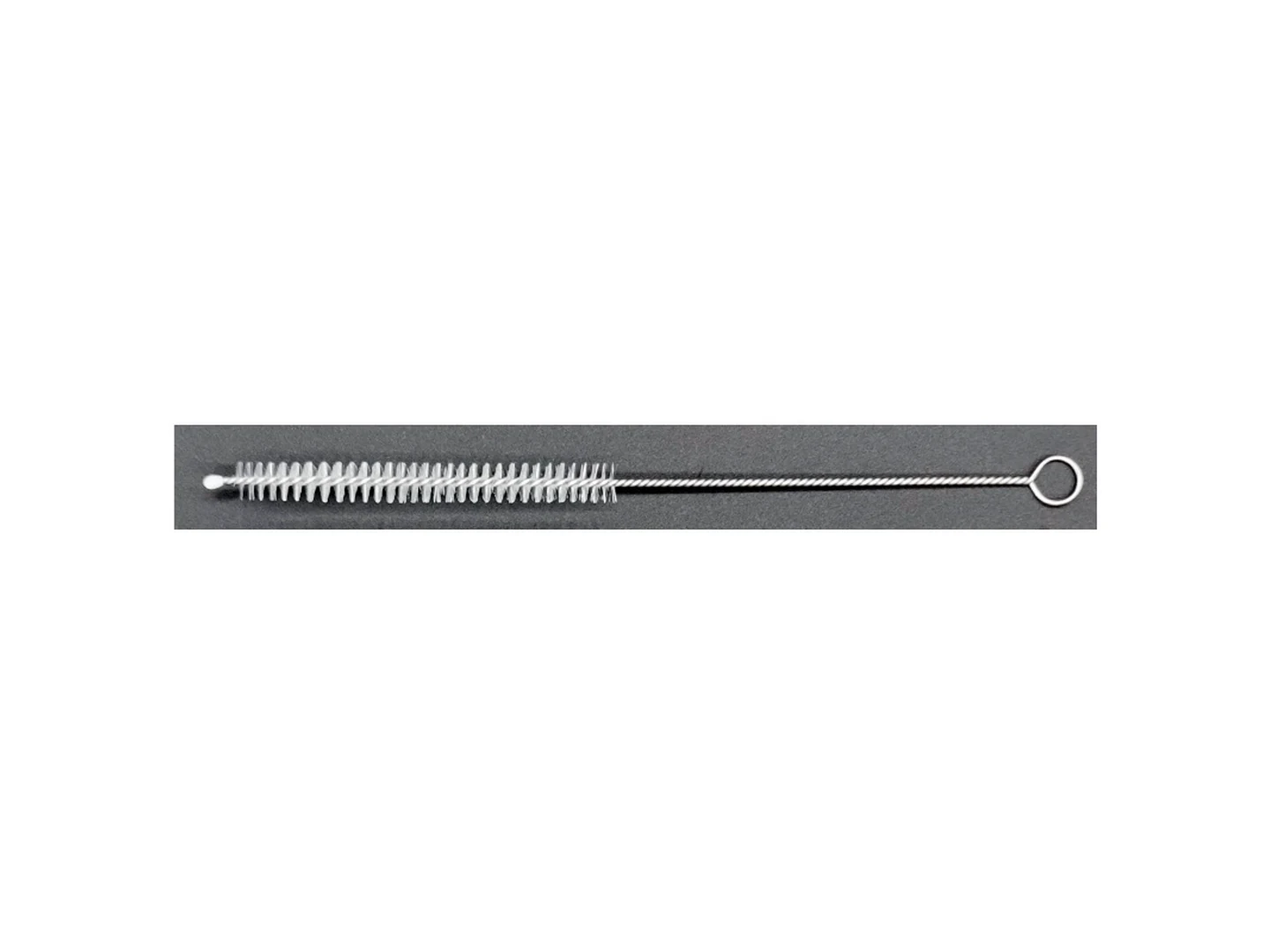
Small brush
500 pcs
Minimum order
Held in one hand: tube, bottle, detail and swab brushes — including long-handled ones with a small head.
Production lead time, once the specification is confirmed
- Up to 500 pcsWithin 7 days
- 501–50,000 pcsWithin 14 days
- Over 50,000 pcsWithin 21 days
Peak season can extend these times; the shipping date is confirmed in writing with your quotation. Sampling and shipping are quoted separately.
A small-diameter nylon cannula cleaning brush for manual cleaning of narrow instrument lumens, aspiration channels, and cannulated components. It removes protein residue, lubricant, and detergent film from internal passageways between 1 and 6 mm without metal-to-metal contact.
What can this brush do for you?
Reaches narrow lumens without blocking the passage
The stem and filament pack are sized to pass through cannula internal diameters as small as 1 mm. The flexible core follows the lumen path while the short filament section contacts the bore wall, so the brush cleans the inside of the cannula instead of jamming at the opening.
Removes protein and lubricant films after instrument use
Nylon PA6 or PA612 filaments scrub protein residue, lubricant, and detergent film from the internal surface during manual pre-cleaning. The filament section is short enough to work inside the cannula while still filling the full circumference of the lumen.
Lets you set the right contact pressure for the job
Filament diameter, density, and trim can be specified for near-size wiping contact or 5–20% oversize interference. Near-size contact removes thin films with low drag; oversize contact applies more scrubbing pressure to stubborn deposits without folding the brush over.
Withstands wet, chemical cleaning environments
Nylon PA6 and PA612 resist the detergent and disinfectant solutions used in instrument reprocessing. PA612 absorbs less moisture than PA6, so it keeps its dimensions and stiffness more consistently through repeated wet cycles.
Gives you a controlled reach into deep cannulas
Working lengths from 178 to 305 mm reach the full depth of most cannulated instruments while the loop or molded grip handle keeps the brush controllable during push and pull strokes.
What is a Cannula Cleaning Brush?
A Cannula Cleaning Brush is a manual cleaning tool built around a small-diameter core with a short nylon filament section at the working end. The operator inserts the brush into the cannula or lumen and moves it back and forth so the filaments scrub the full bore wall. It is used during manual pre-cleaning of cannulated medical instruments before automated washing, disinfection, or sterilization steps.
The brush removes visible soil and films mechanically. It is not a replacement for enzymatic soaking or a validated reprocessing protocol. The brush loosens and removes residue from the lumen wall so subsequent flushing and processing steps can work on a cleaner surface.
The core can be a twisted wire for straight, stiff cannulas or a nylon monofilament for curved or flexible passageways. Filament length, diameter, and density determine how much contact the brush makes with the bore. Keep pull strokes aligned with the cannula axis to avoid kinking a wire core in a curved section.
Technical Specifications
| Parameter | Value / Options |
|---|---|
| Lumen diameter compatibility | 1–6 mm (0.04–0.24 in); size selected to match cannula ID |
| Working reach | 178–305 mm (7–12 in); longer flexible versions on request |
| Brush section length | 10–35 mm (0.4–1.4 in) |
| Stem/core diameter | 0.6–2.0 mm (0.024–0.079 in) |
| Filament diameter | 0.05–0.20 mm (0.002–0.008 in) |
| Filament material | Nylon PA6 or PA612 |
| Core construction | Twisted stainless steel wire or nylon monofilament core; polymer sheath option for metal-free contact |
| Handle style | Wire loop, molded grip, or flexible polymer sheath |
| Contact setting | Near-size for wiping; 5–20% oversize for flexible polymer scrubbing; lower interference with wire core |
| Brush type | Custom Tube & Pipe Bore Brushes |
| How it is driven | Hand-guided |
| Cleaning target | suction and aspiration cannula, irrigation and aspiration lumen, and small-bore reusable instrument channel cleaning |
| Surface or part | instruments, lumens, channel, bores, walls, instrument channels, internal walls, and sheath |
| Residue or debris | protein, lubricant, detergent film, protein residue, and visible soil |
| Mounting / connection | Threaded Removable / Fixed |
Selecting a size begins with the smallest internal diameter along the full cannula path, not the hub opening. Choose a brush outside diameter that provides full wall contact without requiring excessive insertion force.
Where does this brush work best?
- Suction and aspiration cannulas in surgical instrument sets where protein and body fluid residue collect on internal walls.
- Irrigation and aspiration lumens on cannulated handpieces, shavers, and dental tips.
- Small-bore reusable instrument channels that require manual cleaning before automated washing.
- Trocar sleeves, obturator cannulas, and narrow tubular components with debris-trapping transitions.
- Cannulated orthopedic instruments such as reamers, guide sleeves, and taps with internal bores.
How do I choose the right one?
Start with the smallest internal diameter
Measure the narrowest internal point along the entire length of the cannula. The brush outside diameter should be near-size for wiping contact or 5–20% larger for scrubbing contact. A brush that is too large will jam or fold the filaments back; a brush that is too small will not contact the full bore wall.
Match filament stiffness to the residue and surface
Finer filaments down to 0.05 mm conform better in delicate or thin-walled lumens and create less drag. Thicker filaments up to 0.20 mm apply more scrubbing force for heavier lubricant or protein films. If the instrument surface is sensitive, select finer filaments and near-size contact first.
Choose the core by access path
Twisted stainless steel wire provides stiffness for straight cannulas and firm push force. A nylon monofilament core is more flexible for curved or tortuous paths. A polymer-sheathed wire avoids metal contact inside lumens with sensitive coatings or finishes.
Check the reach and handle
The working reach must extend through the full usable length of the cannula while the handle remains outside for control. A loop handle is convenient for hanging and drying; a molded grip improves comfort in high-volume reprocessing; a flexible sheath protects the core during storage and reuse.
Select PA6 or PA612 for the cleaning environment
PA6 is a general-purpose nylon for routine manual cleaning. PA612 absorbs less moisture and retains its stiffness better in repeated hot, wet cleaning and disinfectant exposure, which makes it a stronger choice for high-cycle reprocessing departments.
When a different tool is more suitable
- If the internal diameter is below 1 mm, a thinner monofilament wiper or wire-type cleaning tool may be required.
- If the cannula is very long and flexible past 305 mm, request a long flexible channel brush with a smaller core and extended filament section.
- If the instrument contains heavy dried, baked, or carbonized deposits, use validated enzymatic soaking or chemical pre-treatment before brushing.
- If the lumen must not be contacted mechanically at all, use flush-through cleaning or ultrasonic processing instead.
Can I customize this brush?
Cannula cleaning brushes are highly configurable because lumen size, length, and instrument design vary. To define the configuration, provide the minimum and maximum internal diameter, full lumen length, access points, curvature, residue type, cleaning solutions and temperatures, required handle, and expected use quantity. A sample instrument or drawing helps confirm the fit quickly.
We can adjust:
- Lumen match — brush outside diameter matched to any cannula ID in the supported range.
- Working length and brush section — reach and scrubbing zone set to the component depth.
- Core construction — twisted wire, nylon monofilament, or polymer-sheathed core for the required stiffness and flexibility.
- Filament configuration — PA6 or PA612, filament diameter, density, trim length, and contact interference.
- Handle and identification — loop size, molded grip shape and color, flexible sheath, hanging feature, laser marking, or color coding by size.
- Packaging — bulk, individually wrapped, tray-ready distribution, or project-specific packing.
For projects that require material declarations, inspection reports, or third-party testing to your specification, we can assist during the customization process.
Which filament lasts longest on a cannula cleaning brush?
How do I check whether a cannula brush is the right diameter for a lumen?
Measure the smallest internal diameter along the full path, not just the hub opening. The brush outside diameter should slide through with light resistance and recover its filament spread inside the bore. If it requires significant force or the filaments fold back completely, the size is too large. If it passes without any wall contact, it is too small.
Should the cannula be soaked before brushing?
For protein, blood, or dried debris, an enzymatic pre-soak or detergent immersion according to your reprocessing protocol will loosen the deposit and reduce the mechanical force needed. The brush then removes the loosened residue and film. Brushing alone does not replace validated pre-cleaning steps.
How do I inspect a reusable cannula brush before use?
Check that the core is straight with no kinks or corrosion, the filament pack is evenly distributed and not matted, and the handle is securely attached. Replace the brush if the filaments are worn flat, the core is bent, or the brush no longer provides even wall contact. A damaged brush can leave debris or damage the lumen.
Will nylon filaments shed or leave fibers inside the cannula?
Properly trimmed nylon filament brushes are designed to hold filaments tightly in the core, so shedding is minimal under normal use. Always rinse the cannula thoroughly after brushing and inspect the outflow for particles. If you see loose filaments, the brush is worn or oversized and should be replaced.
Can this brush be used in curved or long flexible cannulas?
For curved or long access paths, choose a nylon monofilament core or flexible polymer sheath rather than a rigid twisted wire. The working reach can be extended, but very long flexible channels may require a purpose-built channel brush with a smaller core and a longer filament section. Test the brush through the actual path before production use.
Does brushing replace the final rinse or disinfection step?
No. Brushing loosens and removes visible residue from the lumen wall. The loosened material must still be flushed out, and any required disinfection or sterilization must still be performed according to the validated reprocessing procedure for the instrument. The brush is one step in the sequence, not the entire process.
Guides that go deeper on this
We have not written a guide specific to this one yet. The material that covers selection, filament, dimensions, maintenance and sourcing is collected in the technical resources library.
Custom Manufacturing RFQ
Describe Your Application
To prepare the correct quotation, provide the dimensions, cleaning task, residue, material, mounting details, quantity, and a drawing or photo.
Drawing or photo optional — it speeds things up, it does not gate the enquiry.
Custom Brush RFQ
Send Your Brush Project
Upload a drawing, product photo, or sample photo and provide the core dimensions and cleaning conditions.
“We need a brush to remove wet residue from a stainless steel conveyor, about 800mm wide. The current brush wears quickly. We can send photos.”
“We sell drinkware and need a cleaning brush to include with the product. Quantity around 5,000 pieces.”