
Custom Cleaning Brush
Cobweb Cleaning Brush
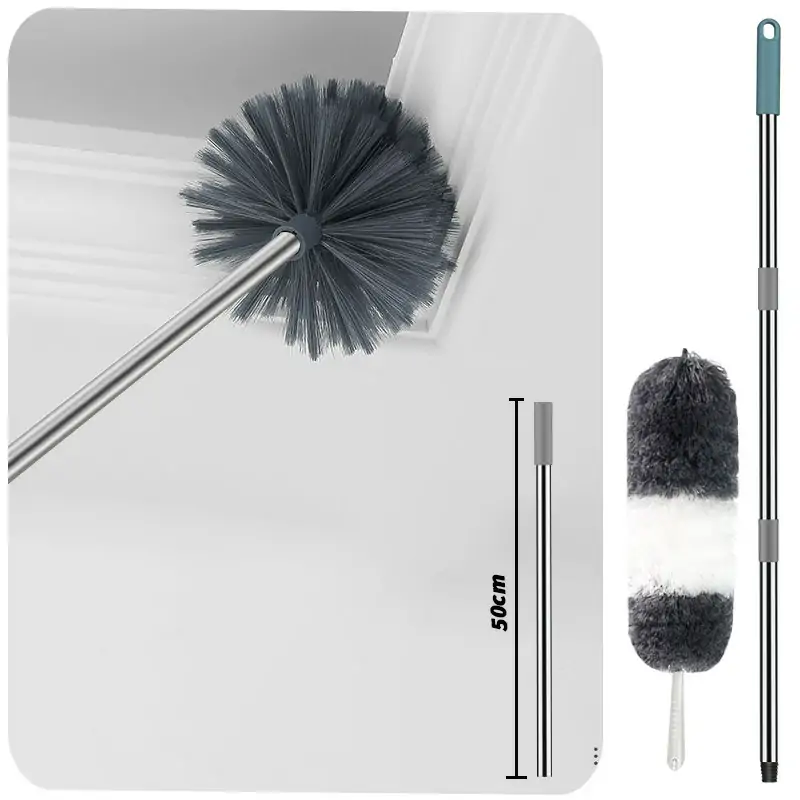
High-reach cobweb cleaning brush with flagged polyester filaments for ceilings, corners, beams, and high walls.
Medium brush
100 pcs
Minimum order
Worked with two hands or on a pole: chimney, gutter and pond-filter brushes, discs, cups and tank brushes.
Production lead time, once the specification is confirmed
- Up to 100 pcsWithin 7 days
- 101–5,000 pcsWithin 14 days
- 5,001–50,000 pcsWithin 21 days
- Over 50,000 pcsConfirmed with your quotation
Peak season can extend these times; the shipping date is confirmed in writing with your quotation. Sampling and shipping are quoted separately.
A high-reach dry-cleaning brush for ceilings, wall corners, beams, and other elevated surfaces where cobwebs, dust, and lint build up. Flagged polyester filaments trap fine web strands while fixed or telescoping handles from 750 mm to 2500 mm keep operators’ feet on the floor.
What can this brush do for you?
Catches Cobweb Strands Instead of Scattering Them
The split-tip flagging on each polyester filament creates hundreds of fine contact points that physically entangle silk threads and fine dust. A single forward pass lifts the web into the head instead of pushing it into the air, so the operator spends less time re-cleaning the same corner and less debris drifts onto furniture or product below.
Works the Wall-Ceiling Joint in One Movement
The 150–220 mm head width and flexible fill allow the brush to press into the right-angle junction between ceiling and wall. Filament ends reach into the corner instead of stopping at the outer edge, which means fewer passes and no visible web remnants left in the shadow line.
Reaches High Ceilings Without a Ladder or Lift
Standard handle lengths run from 750 mm to 2500 mm in fixed or telescoping configurations. For most operators, a 2.0–2.5 m handle covers ceilings up to 4 m without climbing, which shortens cleaning time, reduces ladder setup, and lowers the risk of falls in stairwells, atriums, and crowded retail areas.
Removes Dust Without Adding Cleanup Steps
The flagged polyester head works dry. There are no water drips, no chemical residue, and no wet surface to guard while it dries, so the brush can be used directly over furniture, fixtures, inventory, and finished flooring without moving them first.
Light Enough for Overhead Work All Day
The head mass is controlled and the 20–35 mm grip diameter supports a relaxed grip, which reduces shoulder and wrist fatigue when operators hold the brush above eye level for extended routes. A small loop or hanging hole can be added for cart storage between zones.
What is a Cobweb Cleaning Brush?
A Cobweb Cleaning Brush is a hand-guided dry-dusting tool that combines a wide, flagged-filament brush head with an extension handle to clean high corners, ceilings, exposed beams, and other overhead surfaces where spider webs and light dust accumulate. It is a janitorial and facility-maintenance tool, not a scrub brush and not a wet-cleaning tool.
The brush is used by sliding or lightly sweeping the head along the wall-ceiling joint, around beams, under eaves, or across open ceiling areas. The working head length of 160–280 mm provides enough filament coverage to collect material over a stroke, while the handle length positions the operator from the floor. Flagged polyester is the standard contact material because its split fiber tips catch silk strands and fine particulate far better than a solid cloth or a smooth unflagged filament; unflagged PET or nylon PA can be specified when the same brush must also move heavier, grittier dust.
Operation is dry. The brush is designed for loose, unattached debris on finished or unfinished overhead surfaces. It will not remove baked-on grime, mold staining, sticky residues, or accumulated dust that has hardened into a crust, and it should not be used on hot, energized, or chemically treated surfaces unless the handle and head materials are specifically selected for those conditions.
Technical Specifications
The values below are standard production ranges for this product. Each dimension can be fixed to your ceiling height, access width, and facility layout at the time of order.
| Parameter | Value / Options |
|---|---|
| Brush head width | 150–220 mm, selected by corner width and obstruction spacing |
| Working head length | 160–280 mm, measured from head backing to filament tip |
| Overall handle / reach | 750–2500 mm; fixed one-piece, two-piece threaded, or telescoping lock sections |
| Grip / body diameter | 20–35 mm, with or without soft overmolding |
| Primary filament materials | Flagged polyester (PET), unflagged PET polyester, nylon PA6 / PA66 |
| Filament tip treatment | Flagged split tip, unflagged smooth tip, or mixed flagging density |
| Head core / backing | Plastic, plywood, or aluminum core depending on target head weight |
| Handle material | Aluminum, steel, fiberglass, or project-specified; fiberglass option for nonconductive handling |
| Head-to-handle connection | Threaded socket, press fit, quick-release button, or angle-adjustable joint |
| Working environment | Dry indoor or sheltered outdoor use; polyester service up to approx. 70°C, nylon PA for higher-heat routes |
| Brush type | Custom Handheld Detail Brushes |
| How it is driven | Hand-guided |
| Cleaning target | public building, distribution center, and retail store cleaning |
| Surface or part | ceilings, corners, webs, floors, walls, joints, panels, and wall corners |
| Residue or debris | dust, cobwebs, fine dust, lint, mold, and fiber |
| Mounting / connection | Threaded socket, press fit, quick-release button, or angle-adjustable joint |
Where does this brush work best?
- Offices, schools, hospital corridors, and public buildings where wall-ceiling corners are above standard reach and ladders are awkward or blocked by furniture.
- Warehouses, industrial plants, and distribution centers with exposed trusses, steel beams, conduit runs, pipe racks, and overhead duct surfaces that collect webs and fine dust.
- Hotels, restaurants, theatres, and retail stores with decorative ceilings, crown molding, coffered panels, and light coves that need gentle dry dusting between deeper cleanings.
- Atriums, lobbies, stairwells, and places of worship where high voids and sloped ceilings make lift equipment difficult to position.
- Covered walkways, porch ceilings, pergolas, and building eaves where webs form quickly and outdoor moisture requires a wash-resistant handle option.
How do I choose the right one?
Start with the maximum height you need to contact. Measure from the floor to the highest corner, subtract the operator’s natural grip height, and allow a 300–500 mm control margin. A fixed one-piece handle is more rigid and durable for a single recurring ceiling height. A telescoping handle covers multiple heights with one tool, but adds joints, weight, and a lock that must be checked during use.
Match the head width to the space. The 150 mm end of the range moves more easily around beams, ducts, and closely spaced light fixtures. The 220 mm end clears large open ceilings faster. If most of the route follows a tight wall-ceiling joint, an angled or flexible head backing is usually worth specifying so the filaments stay square to the corner without forcing the operator to tilt the handle excessively.
Choose filament material by what else the brush will touch. Flagged polyester is the best default for cobweb-only and fine-dust routes. Unflagged PET is stiffer and pushes heavier loose debris, while nylon PA adds water tolerance and longer wear for outdoor or rough-surface use. If the route includes normal surfaces plus occasional gritty dust, a mixed flagged and unflagged fill can be built.
Select the handle material for the environment, not just for weight. Aluminum is light but conductive; fiberglass is the safer choice near electrical panels, light tracks, or other exposed conductors when the circuit cannot be isolated. Steel handles add strength for very long extensions but increase operator fatigue. Never use a conductive handle around energized equipment.
Step away from this product when the surface needs wet cleaning, scrubbing, mold treatment, or removal of hardened, sticky, or oily residue. In those cases choose a wash pad, squeegee, wet mop, or a stiff scrub brush matched to the surface. This brush is for lifting loose webs and dry dust; it is not a substitute for disinfection or mechanical cleaning.
Can I customize this brush?
Yes. Most cobweb cleaning brushes are built to a building’s specific ceiling height, corner profile, and operator route. To configure your brush, provide the highest contact point, the narrowest passage width between fixtures, the surface finish, the type of debris, whether the handle must be nonconductive, and whether operators need one tool for multiple heights. A photo or drawing of the worst corner speeds up the sample process.
We can adjust:
- Head geometry — width, working length, angle, flat or curved backing, double-sided fill, and edge profile
- Filament package — polyester or nylon type, filament diameter, flagging depth, flag density, mixed flagged/unflagged zones, and color
- Handle — fixed or telescoping, number of sections, lock type, material, wall thickness, and exact reach
- Grip and storage — grip diameter, overmolding, texture, hanging loop, end cap, or wall-mount clip
- Connection — replaceable head system, threaded joint, quick release, or fixed construction
- Marking and packaging — company color, molded or pad-printed logo, individual bag, bulk pack, or retail-ready sleeve
If your project requires material declarations, incoming inspection plans, or third-party testing to support facility or export requirements, we can assist with those elements as part of the customization scope.
Which filament survives the cleaning and still lasts on a cobweb cleaning brush?
How should the brush head be cleaned between routes?
Knock loose dust and webs out of the fill outdoors or over a waste container. For heavy loading, wash the head in lukewarm water with mild detergent, rinse, and air-dry completely before storage. Do not store the head damp or compressed, or the flagging will mat together and lose its grabbing ability.
Can the brush be used wet?
No. This is a dry-use tool. Water mats the flagged tips, spreads wet webs into streaks, and may damage painted or textured ceiling surfaces. If the area requires wet cleaning, use a dedicated wash pad or mop and let the surface dry before returning with the cobweb brush.
How do I confirm the reach is long enough for my ceilings?
Stand where the operator will stand and measure from the floor to your raised grip height, then subtract that from the ceiling height. Add about 500 mm for comfortable control. The brush handle length should be at least that value when fully extended and locked. If a telescoping model is used, always check the locked position length, not the collapsed length.
Is this brush safe around electrical fixtures?
Only when equipped with a nonconductive fiberglass handle and non-metallic head core, and only after the circuit is de-energized or proper lockout/tagout procedures are followed. Standard aluminum and steel handles conduct electricity and must never contact live parts. Specify the nonconductive configuration at order time if the route passes near electrical panels, light tracks, or open wiring.
What is the practical difference between flagged and unflagged filament?
Flagged filament ends are split into many fine tips that capture silk strands and airborne dust. Unflagged filament has a smooth end and is better suited to pushing heavier, coarser debris. Most cobweb-priority brushes use flagged polyester; mixed fills are chosen when the route includes both fine dust and heavier particles.
How do I know when the head should be replaced?
Replace the head when the flagging is visibly matted, when filaments remain bent after a route, when the brush no longer lifts webs on the first pass, or when the fill has thinned enough to expose the backing. For scheduled maintenance contracts, set an inspection interval by route frequency — weekly in heavily affected facilities, monthly in light-use buildings — and replace before performance drops, not after.
Guides that go deeper on this
We have not written a guide specific to this one yet. The material that covers selection, filament, dimensions, maintenance and sourcing is collected in the technical resources library.
Custom Manufacturing RFQ
Describe Your Application
Please include the main sizes, application, residue, preferred material, interface, quantity, and any drawing or sample available.
Drawing or photo optional — it speeds things up, it does not gate the enquiry.
Custom Brush RFQ
Send Your Brush Project
Upload a drawing, product photo, or sample photo and provide the core dimensions and cleaning conditions.
“We need a brush to remove wet residue from a stainless steel conveyor, about 800mm wide. The current brush wears quickly. We can send photos.”
“We sell drinkware and need a cleaning brush to include with the product. Quantity around 5,000 pieces.”