
Custom Cleaning Brush
Ferrite Core Cleaning Brush
Nylon PA ferrite core cleaning brush for removing dust, abrasive residue, and loose particles after grinding.
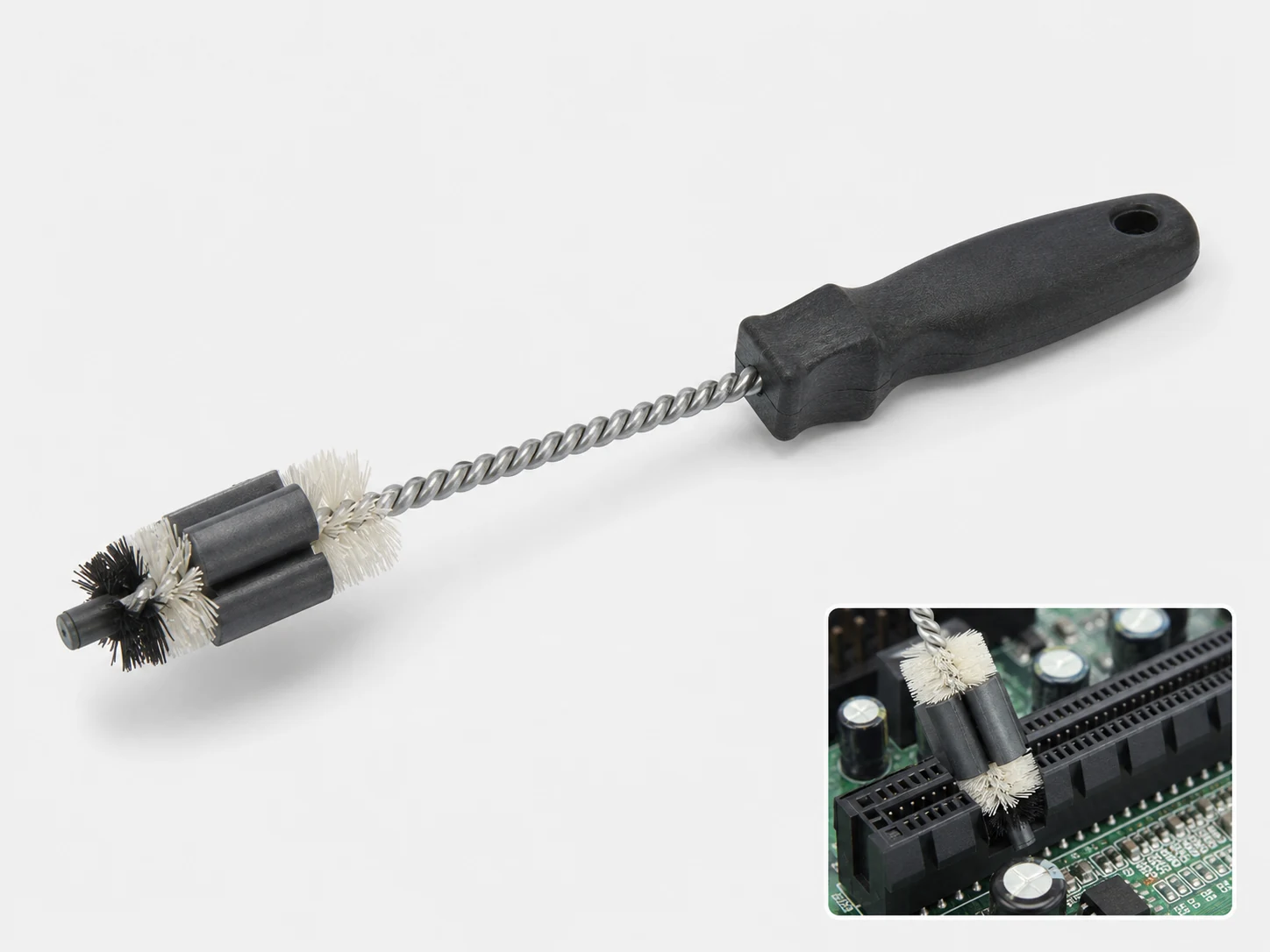
Small brush
500 pcs
Minimum order
Held in one hand: tube, bottle, detail and swab brushes — including long-handled ones with a small head.
Production lead time, once the specification is confirmed
- Up to 500 pcsWithin 7 days
- 501–50,000 pcsWithin 14 days
- Over 50,000 pcsWithin 21 days
Peak season can extend these times; the shipping date is confirmed in writing with your quotation. Sampling and shipping are quoted separately.
A hand-guided Nylon PA brush for removing loose ferrite dust, abrasive residue, and surface debris from ferrite cores after grinding, slicing, or machining. The soft non-metallic fill cleans brittle core surfaces and narrow gaps without scratching edges or leaving metal contamination.
What can this brush do for you?
Lift fine ferrite dust and abrasive residue without scratching the core
After grinding, ferrite cores carry a layer of fine dust mixed with abrasive particles from the grinding media. Nylon PA filaments in the 0.10–0.50 mm diameter range dislodge this loose material from the surface and edges. The filaments flex under pressure instead of gouging, so the hard but brittle ferrite surface stays intact. The result is a core ready for coating, winding, or assembly without micro-chipping from aggressive brushing.
Reach into core gaps and recesses that cloths and general brushes cannot enter
E-cores, pot cores, and RM cores have narrow air gaps, center posts, and inner wall areas where loose powder collects. With head widths from 10–50 mm and trim lengths from 10–40 mm, the brush can be sized to enter those spaces and sweep out residue. The tuft pattern and trim profile can be shaped to match the specific gap geometry, so no dead zone is left at the base of the gap.
Leave no metal or abrasive contamination on the component
Ferrite cores are used in inductors, transformers, and EMI suppression components where surface cleanliness affects electrical performance. A metal brush can shed tiny ferrous particles or score the core surface. A brush with abrasive fill can embed grit that later contaminates windings or potting compounds. This brush uses only non-metallic Nylon PA filament in its standard configuration, so the cleaning contact itself does not introduce conductive or abrasive contamination.
Work with common electronics cleaning solvents
Many production lines use isopropyl alcohol, ethanol, or mild detergent solutions to help lift fine ferrite powder. Nylon PA filament is compatible with alcohols and most non-acidic solvents, so the same brush can be used dry or lightly wetted without the fill breaking down or shedding. This keeps the cleaning step flexible without switching tools.
Provide a controlled, low-cost manual step for small batches and rework
For prototype builds, batch production before automated cleaning is installed, or rework stations, this brush gives operators a simple way to remove visible residue from a core without investing in equipment. The compact size and short trim keep the action localized, so an operator can clean one specific face or gap without disturbing already-cleaned areas.
What is a Ferrite Core Cleaning Brush?
A Ferrite Core Cleaning Brush is a small hand brush built specifically for ferrite magnetic components. Its working end is filled with Nylon PA filament — not metal, not abrasive — set into a handle that gives the operator a controlled grip for cleaning core surfaces, edges, and gaps. The tool is used after the core has been ground, cut, lapped, or otherwise machined to final dimensions and before the next process step such as coating, winding, or assembly.
During use, the operator draws the brush across the core face, into the gap between legs, or around the inner circumference of a toroid. The filaments flick loose ferrite powder, grinding swarf, and light dust from the surface while conforming to the brittle ceramic material. Because ferrite is hard but can chip at sharp edges, the brush is not intended for aggressive scrubbing or removal of bonded, sintered-on, or heavy contamination. It is a finishing and preparation tool, not a deburring or material-removal tool.
The brush is normally used dry, but it can also be lightly moistened with alcohol to suppress dust and improve pickup of fine particles. The fill material is selected to withstand those solvents, and the handle is sized so the operator can hold the brush comfortably while working close to the core without touching the cleaned surface with bare fingers.
Technical Specifications
The table below shows the standard configuration range for this brush. Every dimension can be adjusted to the exact ferrite geometry and workstation layout.
| Parameter | Value / Options |
|---|---|
| Brush form | Small handheld/detail brush; rectangular, paddle, or pen style to match operator handling |
| Head width | 10–50 mm, selected to span the core face or enter the gap |
| Overall length | 100–300 mm, matched to operator reach and workstation access |
| Trim length | 10–40 mm, short for gap entry, longer for flat face sweeping |
| Filament diameter | 0.10–0.50 mm, finer for light dust, thicker for slightly heavier residue |
| Fill material | Nylon PA (PA6 or PA66), non-abrasive, non-metallic |
| Filament retention | Stapled set (standard) or epoxy set for low-particle or cleanroom use |
| Handle material | Wood, PP, ABS, or static-dissipative plastic as project requires |
| Solvent compatibility | Alcohols (IPA, ethanol) and mild non-acidic solvents; not for strong acids or alkalis |
| Operating temperature | Up to 80°C continuous for dry use; lower for wet use depending on solvent |
| Critical dimensions | Head width, trim length, and reach follow the core/gap geometry; do not use metal or abrasive fill unless the component process explicitly qualifies it |
| Brush type | Custom Handheld Detail Brushes |
| How it is driven | Hand-guided |
| Cleaning target | e-core and i-core ferrite shape, toroidal core, and pre-winding preparation cleaning |
| Surface or part | gaps, edges, metal, pots, walls, traps, recesses, and profiles |
| Residue or debris | dust, particles, powder, loose particles, fine particles, and sharp edges |
| Mounting / connection | Shaft-Mounted / Flange |
Where does this brush work best?
- E-core and I-core ferrite shapes: cleaning the cut faces, leg edges, and air gaps after grinding or slicing.
- Toroidal cores: removing powder and loose particles from the outer surface and inner circumference after machining or coating.
- Pot cores and RM cores: sweeping the center post, outer wall, and recessed areas that trap ferrite dust.
- Pre-winding preparation: clearing dust and residue from core surfaces before copper wire winding to prevent contamination in the finished inductor or transformer.
- Post-coating or tumbling stations: removing loose coating particles, tumbling media residue, or light surface powder before final inspection.
How do I choose the right one?
Start with the core geometry you need to reach
Measure the narrowest gap, recess, or inner diameter that must be cleaned. The head width must be narrow enough to enter that space without excessive splaying, and the trim length must be long enough to touch the bottom of the gap or the back of the recess. If the brush head is too wide, the filaments fold and only the tips contact; if it is too narrow, cleaning takes more strokes and may leave residue behind.
Match filament diameter to the residue and surface condition
For fine ferrite powder and light dust after dry grinding, a filament diameter of 0.10–0.20 mm gives soft, conforming contact that lifts particles without scratching. For heavier residue, slightly caked powder, or light machining swarf that is still loose, a diameter of 0.30–0.50 mm provides more scrubbing action while still being non-abrasive. Always test on scrap cores first: inspect under magnification after brushing to confirm there is no edge chipping or surface marking.
Define dry or wet use
If the process uses alcohol or a mild solvent to suppress dust, verify that the solvent is compatible with Nylon PA. Strong acids, strong alkalis, and chlorinated solvents can degrade the filament. Continuous wet use may cause nylon to absorb moisture and become slightly softer; if the process is constantly wet, specify this so the filament diameter and density can be adjusted accordingly.
Consider ESD and cleanroom requirements
Standard Nylon PA is insulative and can generate static charge during rapid brushing. If cores are handled in an ESD-protected area or near sensitive electronics, request conductive or static-dissipative nylon fill and a static-dissipative handle. For cleanroom use, choose epoxy-set filament retention instead of staples, and specify a handle material that does not shed particles.
When this brush is not the right tool
If the residue is baked-on, sintered, or bonded to the core surface, a nylon hand brush will not remove it efficiently. In that case, ultrasonic cleaning, air blow-off, or a chemical cleaning step is more appropriate. If the core has deep internal channels smaller than a few millimeters, a tube brush or swab may be necessary. Do not use a metal or abrasive fill brush on ferrite unless the specific component process has qualified that contact because ferrite is brittle and contamination-sensitive.
Can I customize this brush?
Ferrite core cleaning brushes are configured to the core shape and the production environment. To define a custom brush, we need the core drawing or sample, the specific areas to be cleaned, the type of residue, whether cleaning is dry or solvent-assisted, any ESD or cleanroom requirements, and the preferred handle style.
We can adjust:
- Filament: PA6 or PA66, diameter from 0.10–0.50 mm, color, trim length, tuft pattern, and density; conductive or static-dissipative nylon options for ESD-sensitive areas.
- Head geometry: width, length, trim profile (flat, angled, V-shaped for gap entry, or custom shaped to the core contour), and tuft arrangement.
- Handle: material (wood, PP, ABS, static-dissipative plastic), length, ergonomic shape, hanging hole, color coding, and printed part number or logo.
- Ferrule / retention: stapled set or epoxy set; stainless steel ferrule or all-plastic construction for metal-free requirements.
- Overall dimensions: overall length and head width adjusted to operator reach, workstation access, or automated brushing fixtures.
- Packaging: bulk, individually bagged, cleanroom double-bagged, or labeled per customer specification.
If your project requires material certifications, RoHS/REACH compliance documentation, inspection reports, or third-party testing for the filament or handle materials, we can assist with those requirements during the customization process.
Which filament survives the cleaning and still lasts on a ferrite core cleaning brush?
Does this brush replace air blow-off or ultrasonic cleaning after ferrite grinding?
No. Brushing removes loose, visible particles mechanically, but microscopic dust can remain in microscopic surface pores or in areas the filaments cannot reach. Air blow-off or ultrasonic cleaning may still be required as part of the complete cleaning sequence. Use the brush as the manual step that removes the bulk of loose residue and prepares the core for subsequent cleaning or processing.
How can I verify that the filament stiffness is appropriate for my ferrite core?
Test on a scrap core of the same material and surface finish. Brush a small area with normal operator pressure, then inspect the area under a microscope or magnifier. Look for scratches, edge chipping, or filament marks. If the surface is clean and unmarked, the stiffness is suitable. If residue remains, try a slightly larger filament diameter; if marks appear, go finer.
Can I use this brush with isopropyl alcohol or other solvents?
Yes, Nylon PA is compatible with isopropyl alcohol, ethanol, and most mild non-acidic solvents. Avoid strong acids, strong alkalis, and chlorinated solvents, which can attack the filament and cause it to become brittle or soft. If you are unsure about a specific solvent, provide its name or SDS during the inquiry so we can confirm compatibility for the exact nylon grade.
What if my ferrite cores are handled in an ESD-protected area?
Standard nylon is insulative and can build up static charge during fast brushing. For ESD-controlled environments, request conductive or static-dissipative nylon filament and a static-dissipative handle. We can provide the surface resistivity data for the selected material so you can verify it meets your ESD control plan.
How often should I replace the brush?
Replace the brush when the filaments show permanent bending, splaying, or breakage; when the brush no longer reaches into the required gaps; or when contamination risk increases because the filament ends have become contaminated with residue that cannot be cleaned off. A simple inspection under a magnifier every shift or every batch can help determine when replacement is needed.
Can this brush be used on coated or sintered ferrite cores?
Yes, if the coating is fully cured and stable. Use a softer filament diameter and light strokes to avoid damaging the coating. For uncured or powder-coated cores, test first on a sample; if the coating lifts or scratches, switch to a dry soft brush or air blow-off. Sintered ferrite surfaces are more robust, but the same rule applies: avoid aggressive scrubbing on edges where chipping can occur.
Guides that go deeper on this
Custom Manufacturing RFQ
Describe Your Application
To prepare the correct quotation, provide the dimensions, cleaning task, residue, material, mounting details, quantity, and a drawing or photo.
Drawing or photo optional — it speeds things up, it does not gate the enquiry.
Custom Brush RFQ
Send Your Brush Project
Upload a drawing, product photo, or sample photo and provide the core dimensions and cleaning conditions.
“We need a brush to remove wet residue from a stainless steel conveyor, about 800mm wide. The current brush wears quickly. We can send photos.”
“We sell drinkware and need a cleaning brush to include with the product. Quantity around 5,000 pieces.”