
Custom Cleaning Brush
Lug Nut Brush
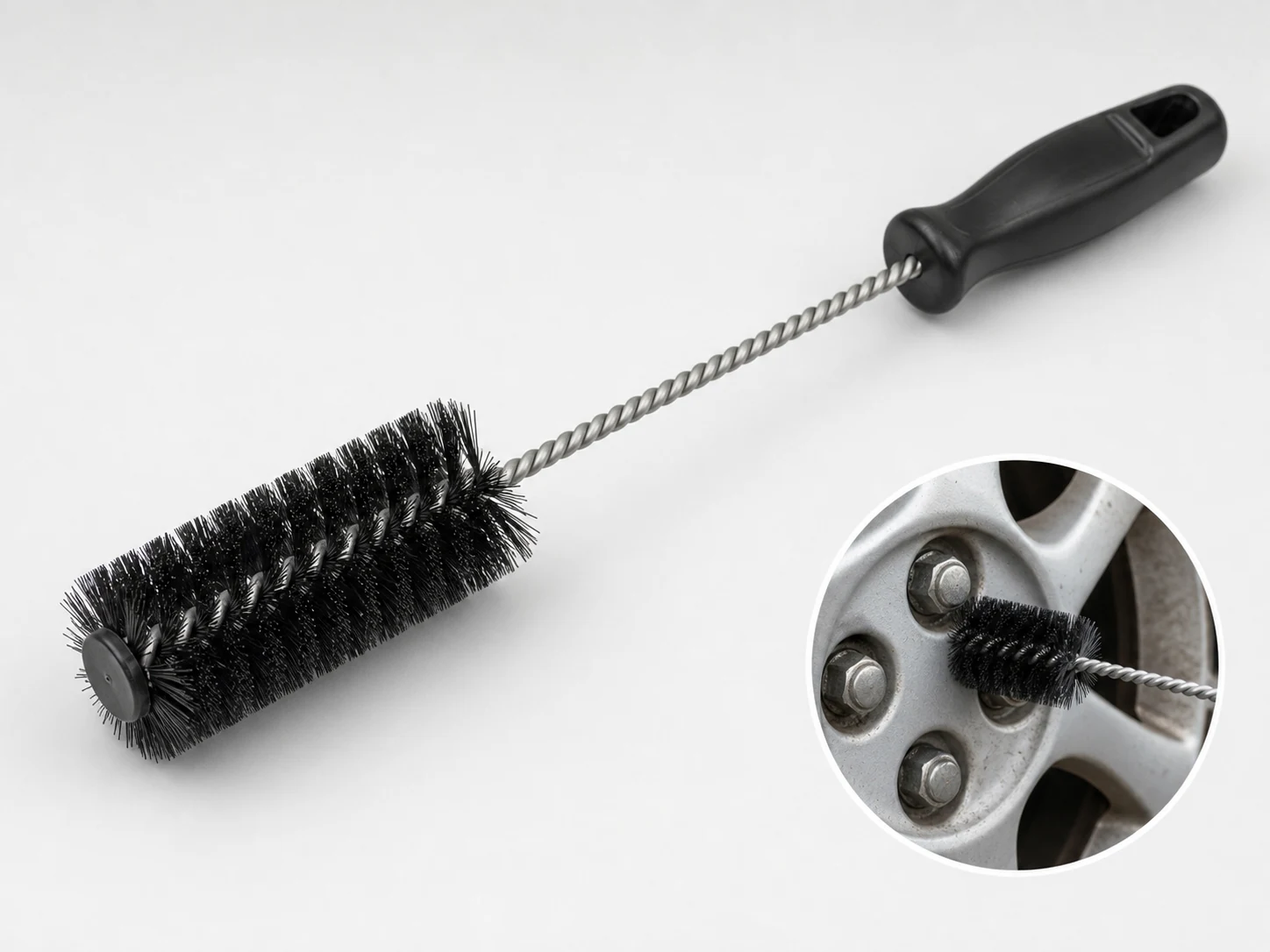
Custom lug nut brush with PA/PBT filaments for cleaning brake dust, grease, and road film from lug recesses, wheel spokes, and rims.
Small brush
500 pcs
Minimum order
Held in one hand: tube, bottle, detail and swab brushes — including long-handled ones with a small head.
Production lead time, once the specification is confirmed
- Up to 500 pcsWithin 7 days
- 501–50,000 pcsWithin 14 days
- Over 50,000 pcsWithin 21 days
Peak season can extend these times; the shipping date is confirmed in writing with your quotation. Sampling and shipping are quoted separately.
Purpose-built brush for cleaning lug nut recesses, wheel holes, spokes, and rim contours. Medium-firm PA/PBT filaments lift brake dust, road film, grease, and embedded dirt while 35–55 mm head geometry reaches around hex fasteners and into countersunk wheel openings.
What can this brush do for you?
Reaches the recess, not just the wheel face
As the brush rotates or scrubs, tapered trim and graduated filament lengths allow the bristle tips to work under the lip of the lug recess and around the hex shoulders of lug nuts and bolts. Flat wheel brushes skip this area; this brush makes the recess the main contact zone.
Firm enough for brake dust, compliant enough for painted wheels
PA/PBT filaments from 0.15–0.45 mm with a 15–40 mm trim create a controlled scrub. On painted and clear-coated wheels the intended filament deflection is 1–5 mm, so it removes caked dust without pushing the filament ends through the finish. On tires, chains, and textured plastics, 3–10 mm deflection gives the extra bite for embedded residues.
Handles wheel cleaners and degreasers without losing shape
Nylon PA and PBT resist common wheel-cleaning chemicals, degreasers, and mild acid or alkaline products. The chemical-resistant grip prevents the handle from softening or becoming slippery during wet use.
Covers the hardware zone in one pass
The working head is narrow enough to clean around each lug nut, inside the seat, and along the surrounding spoke recess. Operators can move from wheel face to tire sidewall without changing tools.
Recovers after repeated contact with metal edges
PA and PBT filaments spring back after contact with lug threads and alloy edges, so the brush keeps its reach through repeated wheel services instead of flattening like natural bristle.
What is a Lug Nut Brush?
A Lug Nut Brush is a hand-guided wheel detail brush whose working head is sized and shaped to clean the area immediately around lug nuts, lug bolts, and wheel hub hardware. It is not a general car-wash brush or a tire brush; its purpose is the fastener recess and the adjacent curved rim surface where brake dust, road film, and old wheel-weight adhesive accumulate.
The head typically has a rounded or tapered profile so the longest filaments enter the recess first, while shorter trim around the perimeter keeps the brush stable over the wheel face. During use, the operator pushes, rotates, or angles the head around each lug, letting the filament tips scrub the hex faces, the seat taper, and the inside wall of the recess. The residue released by the filament action is rinsed away by the cleaning solution.
Two filament materials are common: Nylon PA for controlled stiffness and good abrasion resistance, and PBT for better stiffness retention in wet chemical conditions. Both are non-metallic, which is the key difference between this brush and a wire brush: they scrub without producing metal filings or scratching the wheel’s clear coat when used at the right deflection.
Technical Specifications
Standard configuration ranges below; dimensions can be set to your lug recess and wheel geometry.
| Parameter | Value / Options |
|---|---|
| Head diameter | 35–55 mm, matched to lug recess ID and fastener head size |
| Working length | 50–150 mm from handle face to filament-trim tip |
| Overall length | 180–250 mm, adjusted for reach and operator control |
| Trim length | 15–40 mm, longer for deep recesses, shorter for stability on the face |
| Filament diameter | 0.15–0.45 mm; thinner for softer painted contact, thicker for stubborn deposits |
| Filament materials | Nylon PA, PBT, or PA/PBT blend selected for chemical and wear conditions |
| Head profile | Tapered nose, rounded end, contoured face, or custom recess-specific shape |
| Handle | Chemical-resistant grip; PP, TPE overmold, or project-specified material; straight, ergonomic, or extended configurations |
| Recommended filament deflection | 1–5 mm on painted or clear-coated surfaces; 3–10 mm on tires, chains, and textured plastics |
| Brush type | Custom Handheld Detail Brushes |
| How it is driven | Hand-guided |
| Cleaning target | wheel detailing, tire shop and wheel service bay, and fleet and commercial vehicle maintenance cleaning |
| Surface or part | recesses, rims, roads, holes, spokes, lug recesses, metal, and hubs |
| Residue or debris | dust, brake dust, road film, grease, embedded dirt, dressing residue, lubricant, and adhesive |
| Mounting / connection | Fixed |
Where does this brush work best?
- Wheel detailing before coating, sealing, or ceramic application: removes brake dust, road film, and old dressing residue from lug recesses, barrel edges, and spoke pockets where coating adhesion depends on clean metal.
- Tire shops and wheel service bays: cleans lug nuts, bolts, hub bores, and seats during rotation, balancing, and alignment; removes grease and old lubricant before re-torque.
- Fleet and commercial vehicle maintenance: handles caked brake dust and road contaminants on steel and alloy wheels of trucks, buses, and trailers before inspection.
- Detail shops and car care product lines: as a hand tool for wheel faces, spokes, lug holes, and fender-side rim edges after wheel removal.
- Wheel refurbishing and rim refinishing prep: cleans lug pockets, wheel-weight residue, and tape lines before sanding or coating.
How do I choose the right one?
- Measure the lug recess first. Head diameter must enter the recess with the filaments flexing but not folding over. For a recess ID of 40 mm, choose about 35–40 mm head diameter; for an open lug face, up to 55 mm works. Too large a head bends against the wall; too small leaves contact gaps.
- Check the depth and reach. Working length and trim length determine whether tips reach the recess floor and hex shoulder. Deep socket-style lug holes need longer trim, typically 25–40 mm, while flat wheel faces need shorter trim for stability.
- Select filament material and diameter. 0.15–0.25 mm PA for clear-coated or soft finishes and normal dust; 0.30–0.45 mm PBT or PA/PBT blend for heavy, caked brake dust on painted or textured wheels where wet stiffness matters. PBT keeps its spring in wheel cleaner baths better than PA.
- Match handle length to access. 200–250 mm overall for deep-dish, recessed wheels or brake rotor areas; shorter 180 mm for hand control and intricate wheel arches.
- Set deflection by surface. On painted or clear-coated wheels, keep deflection under 5 mm; on tires, textured plastic trim, or chains, 3–10 mm is appropriate. If the brush bottoms out before achieving deflection, choose a longer trim or higher filament density.
If the recess is smaller than 35 mm or the fastener area only needs a tiny touch-up, a miniature detail brush or small wire brush may fit better. If you need to remove heavy corrosion or seized thread contamination, a brass or steel wire brush or thread chaser should do that job first — this brush is for regular wheel cleaning and service prep, not rust removal. For broad wheel-face work, pair it with a wide rim brush; for sub-20 mm holes, use a small bottle-style or pipe cleaner brush.
Can I customize this brush?
Most lug nut brushes are configured to a specific wheel platform or service environment. We can adjust:
- Head shape and size: head diameter, tapered profile, hex-shaped cavity, chamfered tip, or split head to fit around lugs.
- Filament pack: filament diameter, trim length, stiffness grade, color, mixed material layers (for example, PA core with PBT outer ring), or flagged tips.
- Handle: length, ergonomic contour, chemical-resistant TPE overmold, hanging hole, magnetic tip, or extension compatible with power tools.
- Connection or interface: fixed handle, hex shaft for drill use, quick-change collar, or replacement head system.
- Marking and packaging: logo print, molded branding, color coding, individual polybag, retail card, or bulk carton.
To define a custom lug nut brush, provide the lug recess ID and depth, lug nut or bolt size, wheel finish, typical residue and cleaning chemical, operating temperature, and any handle or branding preferences. A sample wheel, drawing, or photos of the recess speeds up the process. If your project requires material declarations, inspection reports, or third-party testing for a customer program, we can support those requirements during customization.
Which size and filament should a lug nut brush be built with?
Will this brush leave scratches on alloy or painted wheels?
With PA/PBT filaments and the recommended 1–5 mm deflection on painted surfaces, the filament ends flex rather than dig into the clear coat. Test on an inconspicuous area first, and avoid brass or steel wire brushes on any coated wheel. If you see fine marks, reduce filament diameter, increase bristle count, or use a softer trim.
How do I keep the brush in good condition between jobs?
Rinse the filament pack with clean water after wheel cleaners or degreasers, shake out excess, and hang the brush to dry with the bristles down. Do not store it in solvent or in direct sunlight for long periods. If the bristles become curled or permanently flattened, it is time to replace the head.
Can this brush reach into bolt-style wheel hubs as well as lug nut recesses?
Yes, when the working length and trim are matched to the hub depth. For bolt-style hubs the head should be tapered so the leading filaments enter the bolt bore while the perimeter filaments scrub the face. Specify the bore ID and the bolt length so the brush does not bottom out before reaching the base.
What is the difference between Nylon PA and PBT in a lug nut brush?
Nylon PA is more compliant and slightly better at holding a fine tip for scratch-sensitive paint, but it can absorb water and lose some stiffness during prolonged wet use. PBT stays firmer in wet chemicals and degreasers, so it is often the better choice for heavy brake dust and wheel cleaner immersion. A PA/PBT blend gives a middle balance.
How can I tell when the brush is no longer effective?
Hold the brush over a clean white surface and press the filaments lightly; if they do not spring back to the original trim height, or if the tips are curled into hooks, the brush has lost working action. Also check whether the head still reaches the recess floor by inserting it dry; if it bottoms on filaments before the recess base, the trim is worn or the pack has matted down.
Can I use the lug nut brush on brake calipers or rotors?
The filament contact is safe for caliper bodies and rotor hats when the surface has cooled, but do not brush brake pads, friction surfaces, or hot components. For brake friction surfaces, use a dedicated non-filament cleaning method. This brush is for surrounding wheel hardware and cosmetic cleaning.
Guides that go deeper on this
Custom Manufacturing RFQ
Describe Your Application
To quote this brush accurately, send the size, material, cleaning target, residue, quantity, and any available drawing or sample photo.
Drawing or photo optional — it speeds things up, it does not gate the enquiry.
Custom Brush RFQ
Send Your Brush Project
Upload a drawing, product photo, or sample photo and provide the core dimensions and cleaning conditions.
“We need a brush to remove wet residue from a stainless steel conveyor, about 800mm wide. The current brush wears quickly. We can send photos.”
“We sell drinkware and need a cleaning brush to include with the product. Quantity around 5,000 pieces.”