
Custom Cleaning Brush
PVC Brush
Custom PVC brush with nylon PA bristles for wiping, dust control, and gap sealing on machine panels and equipment.
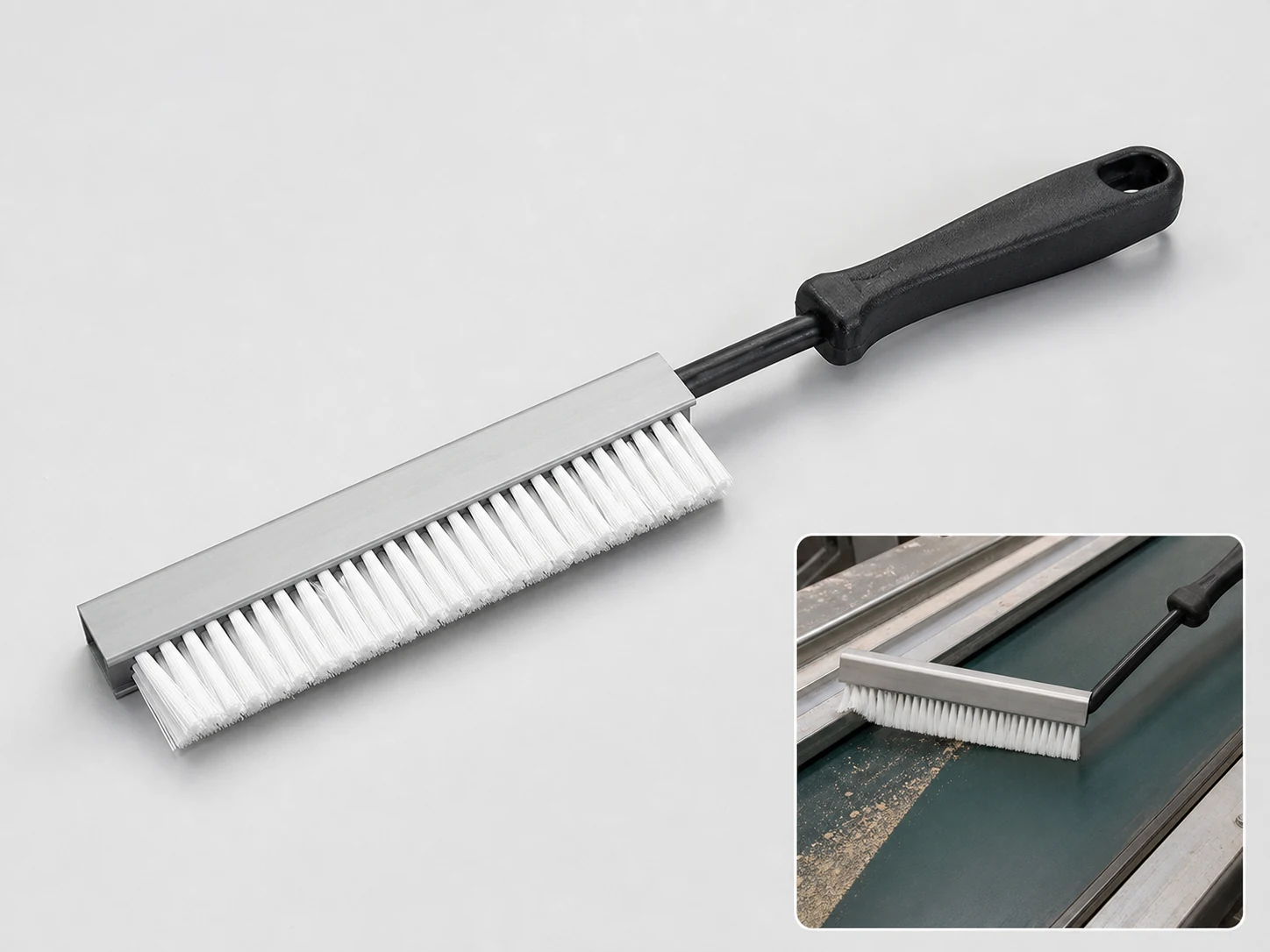
Medium brush
100 pcs
Minimum order
Worked with two hands or on a pole: chimney, gutter and pond-filter brushes, discs, cups and tank brushes.
Production lead time, once the specification is confirmed
- Up to 100 pcsWithin 7 days
- 101–5,000 pcsWithin 14 days
- 5,001–50,000 pcsWithin 21 days
- Over 50,000 pcsConfirmed with your quotation
Peak season can extend these times; the shipping date is confirmed in writing with your quotation. Sampling and shipping are quoted separately.
A light-duty industrial brush built with a PVC base and nylon PA bristles for wiping, dust control, and gap sealing on machine panels, equipment edges, and open machine surfaces. It removes loose dust, light oil, and process residue while remaining configurable in width, trim length, filament gauge, and mounting interface.
What can this brush do for you?
Grabs dust and loose particles without scratching equipment surfaces
The fine nylon filaments create a dense, flexible contact face that lifts dry dust and loose particles from painted panels, coated housings, and machined surfaces. Unlike stiff abrasive brushes, the filament ends flex rather than cut, so surface finishes and markings stay intact during routine machine cleaning.
Seals panel gaps and contains process dust
With fill densities up to 200 tufts per 100 cm², the brush face can be made dense enough to function as a flexible barrier along door edges, access panels, and conveyor side seams. The PVC base remains straight and stable, holding the filament wall in position against air movement and particle drift.
Wipes light oil and process residue from open surfaces
Medium filament diameters and a consistent trim line spread contact pressure evenly across flat panels, rails, and housings, lifting light oil and fresh process residue without leaving bristle marks. This works well for shift-end wipe-downs and in-line wiper applications.
Fits narrow gaps and offset edges
Head widths from 10 mm and trim lengths from 5 mm let the brush enter shallow channels, panel seams, and gaps that larger cleaning tools cannot reach. Trim profiles can be angled or offset to follow the contour of a specific machine edge.
Mounts the way your machine or operator needs it
The PVC base can be configured as a handled brush, a ferrule-mounted tool, a channel strip, a wheel brush, a plate-mounted block, or a shaft/stem interface. One cleaning action can be installed directly into the equipment rather than carried around it.
What is a PVC Brush?
A PVC Brush is a brush in which the bristle tufts are anchored into a base, block, or channel made from PVC, with nylon PA filaments doing the contact work. It is a light-duty industrial cleaning component: small enough for hand use, but often sized and mounted into machines for continuous or repeatable wiping.
The PVC base gives the brush a lightweight, dimensionally stable body that resists moisture and many dilute cleaning solutions. The nylon PA filaments provide spring-back, wear resistance, and controlled stiffness across the working face. During operation the brush moves across a surface in a linear stroke or rotates against it; the bristle tips loosen and carry away dust, loose particles, light oil, or process residue without grinding the substrate.
This is not a heavy scrubbing brush. It is intended for loose or lightly attached contamination on accessible surfaces. Baked-on carbon, heavy grease, weld spatter, and hardened scale should be handled by a wire, abrasive, or high-stiffness PBT brush. The PVC body also limits high-temperature use; continuous frictional heat or hot surfaces can soften the base and should be reviewed before specifying.
Technical Specifications
The following parameters can be selected to match a specific machine interface or cleaning reach. All dimensions are project-configurable.
| Parameter | Typical Range / Options |
|---|---|
| Base material | PVC (rigid or semi-flexible grade), machined or molded |
| Bristle material | Nylon PA (PA6 / PA6.6), straight or flagged filament |
| Head / base width | 10–400 mm |
| Trim length | 5–100 mm |
| Overall length | 100–800 mm, depending on mounting configuration |
| Filament diameter | 0.05–1.20 mm; finer for dust, heavier for light scrubbing |
| Fill density | 20–200 tufts per 100 cm² |
| Mounting interface | Handle, ferrule, strip channel, wheel core, plate, stem, or shaft |
| Operating temperature | Avoid continuous contact above 60°C (140°F); nylon itself tolerates more, but the PVC base limits the working range |
| Chemical exposure | Water, dilute neutral cleaners, light mineral and process oils; not strong acids, ketones, or chlorinated solvents |
| Brush type | Custom Handheld Detail Brushes |
| How it is driven | Hand-guided |
| Cleaning target | machine panel and housing wiping, gap sealing and dust containment, and light oil and residue removal cleaning |
| Surface or part | pvc, panels, gaps, edges, channel, seams, rails, and equipment edges |
| Residue or debris | dust, oil, light oil, process residue, particles, loose dust, loose fibers, and loose particles |
| Mounting / connection | Handle, ferrule, strip channel, wheel core, plate, stem, or shaft |
Finer filament at 0.05–0.30 mm favors soft wiping and dust pickup on sensitive finishes. Heavier filament at 0.70–1.20 mm adds scrub force for thicker process films. Dense fills create a more continuous sealing face; lower fills release dust more easily.
Where does this brush work best?
- Machine panel and housing wiping: removes dust from CNC enclosures, control cabinets, printer and plotter covers, and inspection station panels between cycles.
- Gap sealing and dust containment: strip configurations block particle drift along conveyor side edges, machine door seams, and access panel joints.
- Light oil and residue removal: cleans guide rails, sheet metal edges, and accessible machine surfaces after light machining, assembly, or handling.
- In-line wiping applications: fixed strip or wheel brushes run against moving parts to continuously remove loose fibers, chips, or process dust.
- Manual shift-end cleaning: handled PVC brushes allow operators to dust panels and wipe accessible surfaces without carrying solvents or disposable wipes.
How do I choose the right one?
Start with the job the brush performs—dust pickup, surface wiping, or gap sealing. Each job points to a different filament gauge and density.
- Dust pickup: choose 0.05–0.30 mm filament at 20–80 tufts per 100 cm². Fine bristles lift powder without scratching coatings and release trapped dust easily.
- Light oil and residue wiping: move to 0.30–0.70 mm filament at 50–120 tufts per 100 cm² for more contact stiffness and better oil release.
- Gap sealing and dust control: specify 100–200 tufts per 100 cm² and trim length 10–20% longer than the gap depth so the bristles flex without permanent bending. The PVC base must be supported along its full length.
Next, define the geometry. Measure the widest contact area, the deepest reach required, and the available mounting space. A narrow base at 10–50 mm suits seams and shallow channels; wider bases at 100–400 mm cover panels and broad rails. Longer trim reaches into recesses but reduces stiffness at the tip, so keep trim length proportional to filament diameter for the pressure needed.
Match the mounting to operation. For manual cleaning, select a handle or ferrule and match overall length to operator reach. For machine integration, use a strip channel, bolt-on plate, or wheel core designed to fit the existing bracket or shaft. The mounting interface should carry the full working load without letting the PVC body flex excessively.
Finally, check the environment. PVC and nylon PA work with water, mild detergents, and light oils. If the process reaches sustained temperatures above 60°C (140°F), if strong solvents or concentrated acids are present, or if the residue is hardened, stamped, or heat-cured, choose a different system: an aluminum or stainless steel base with PBT, abrasive, or wire filament, or a completely different cleaning method such as solvent wash, ultrasonic, or mechanical scraping. This brush is the right selection when contact must stay gentle and surfaces must not be marked.
Can I customize this brush?
Nearly every dimensional and material parameter can be matched to your machine or cleaning process. We will need the contact surface, gap or panel dimensions, residue type, mounting interface, stroke direction or rotation, and any temperature or chemical exposure. A drawing, CAD file, or clear photos of the installation area shorten the specification step.
We can adjust:
- Base geometry: width, length, thickness, cutouts, notches, mounting holes, curves, or channel extrusion profile
- Filament array: trim length, filament diameter, fill density, tuft spacing, row count, angled rows, offset patterns, or staged zones in one brush
- Materials: nylon PA6 or PA6.6 bristles in natural, black, or custom color; rigid or semi-flexible PVC base; anti-static or conductive filament variants when dust control requires it
- Mounting: handle, ferrule, strip channel, wheel hub, plate, stem, or shaft, sized to your attachment points
- Marking: custom color, pad printing, laser marking, or identification coding on the base or handle
- Packaging: bulk, individually packed, or project-specific packaging for JIT delivery
If your project requires material declarations, inspection documentation, or third-party testing support, we can assist during the customization process so the brush arrives with the paperwork your purchasing and quality teams need.
When is a PVC brush worn out rather than just dirty?
Can this brush damage painted or coated machine panels?
The nylon PA filaments are non-abrasive and will not scratch most painted, powder-coated, or anodized surfaces under normal light-duty pressure. For high-gloss or critical finishes, select the finest filament diameter and lowest fill density, then test a sample on a scrap or hidden area. Dirt trapped in the bristles can act like grit over time, so clean the brush face periodically.
How do I know if the fill density is right for gap sealing?
Install the strip and close the panel or move the mating part through its normal travel. Look along the full seam for visible light passing through the bristle face. If you can see clear gaps or the bristles are permanently flattened, the density is too low or the trim is too short. The bristles should flex against the opposing surface and recover when it moves away.
Will this brush work on a continuously moving surface?
Yes, for light-duty wiping when contact pressure stays low. Nylon PA tolerates continuous flexing, but frictional heat builds quickly at high speed and high pressure. If the brush face or base becomes warm to the touch during operation, reduce contact pressure, shorten trim length, or move to a different body material before the PVC base softens.
Does the brush replace solvent wiping on oiled surfaces?
No. The brush lifts loose or lightly attached oil, dust, and process films. Cured, thickened, or residue that has dried over time still needs solvent or detergent treatment. Use the brush first to remove loose contamination, then apply the chemical step so the solvent works on the remaining film rather than just floating dirt.
What should be checked before each production shift?
Inspect the base for cracks or separation around the mounting points, check that tufts are not matted or packed with debris, and confirm the trim line is even along the contact area. If the brush face no longer reaches the surface it was specified for, it has worn past the working range and should be replaced.
When should I choose a different brush or cleaning method?
Switch to a PBT, abrasive, or wire brush if the residue is baked on, cured, or requires aggressive mechanical force. Switch to a metal-body brush if the process runs continuously above 60°C (140°F) or involves strong solvents that attack PVC. For precision cleaning, optics, or sterile environments where particle control is tighter than a brush can achieve, use an appropriate wash, ultrasonic, or disposable wipe process.
Guides that go deeper on this
Custom Manufacturing RFQ
Describe Your Application
To quote this brush accurately, send the size, material, cleaning target, residue, quantity, and any available drawing or sample photo.
Drawing or photo optional — it speeds things up, it does not gate the enquiry.
Custom Brush RFQ
Send Your Brush Project
Upload a drawing, product photo, or sample photo and provide the core dimensions and cleaning conditions.
“We need a brush to remove wet residue from a stainless steel conveyor, about 800mm wide. The current brush wears quickly. We can send photos.”
“We sell drinkware and need a cleaning brush to include with the product. Quantity around 5,000 pieces.”