
Custom Cleaning Brush
Roof Cleaning Brush
Wide-head roof cleaning brush with PP or nylon filament, 100–300 mm head width, and M18/ACME pole fitting. For shingle, tile and metal roof debris.
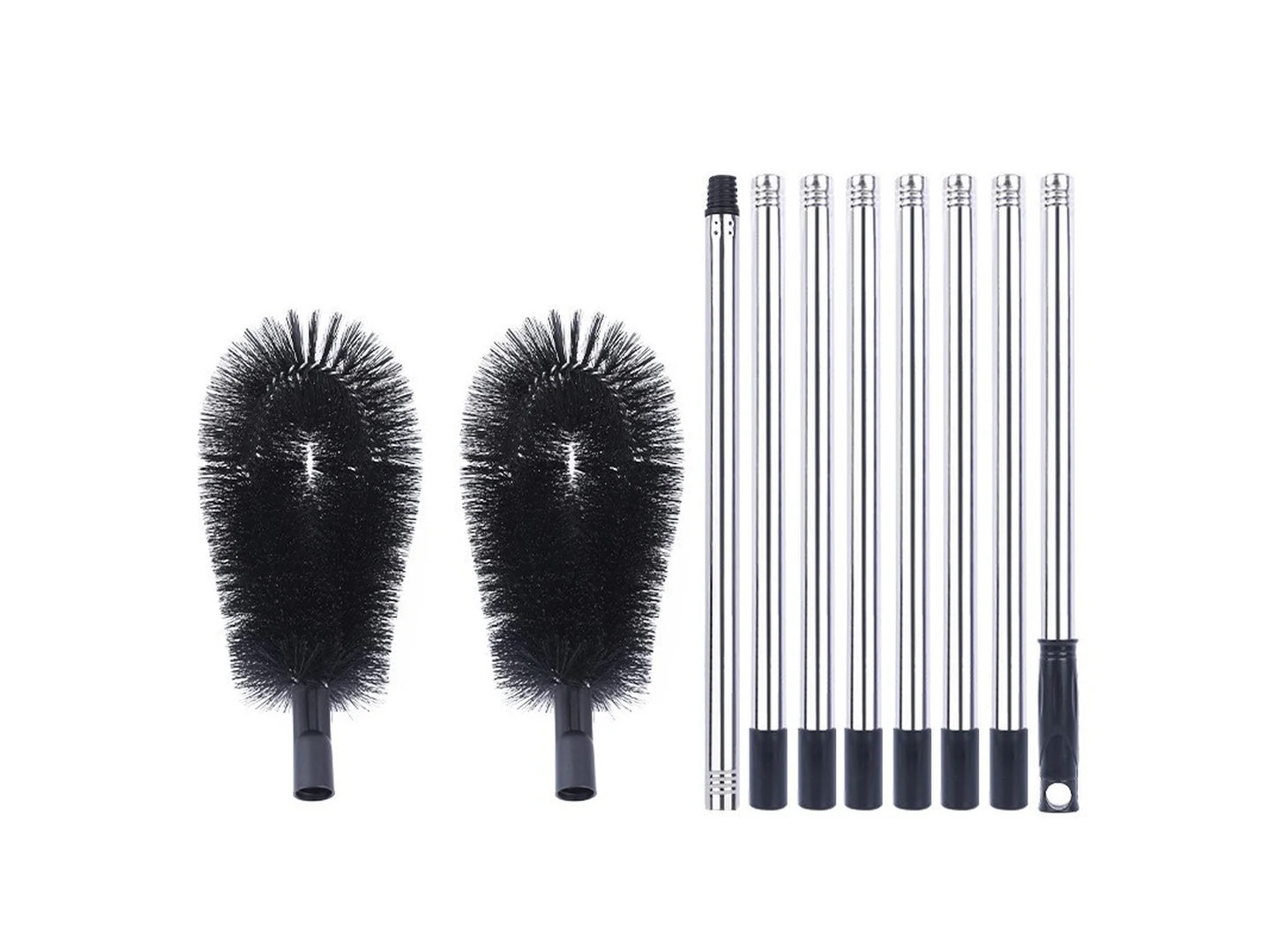
Medium brush
100 pcs
Minimum order
Worked with two hands or on a pole: chimney, gutter and pond-filter brushes, discs, cups and tank brushes.
Production lead time, once the specification is confirmed
- Up to 100 pcsWithin 7 days
- 101–5,000 pcsWithin 14 days
- 5,001–50,000 pcsWithin 21 days
- Over 50,000 pcsConfirmed with your quotation
Peak season can extend these times; the shipping date is confirmed in writing with your quotation. Sampling and shipping are quoted separately.
A pole-mounted, wide-head roof cleaning brush with polypropylene or nylon filament for sweeping leaves, pine needles, moss and algae from shingle, tile, metal and low-slope roof surfaces. The filament face is designed to clear organic debris without the granule loss, scratching or substrate disturbance that aggressive scraping and high-pressure washing can cause.
What can this brush do for you?
Clears a wide contact band with fewer passes
Head widths range from 100 mm to 300 mm, so the brush covers a larger working band than a hand broom or narrow deck brush. On an open roof plane, a 250–300 mm head finishes each section in fewer strokes. That is a real time and motion saving when the operator is working from a ladder, lift, scaffold or safety harness.
Protects shingle granules and coated surfaces
Polypropylene and nylon filaments can be specified in fine to medium gauges with trim lengths from 25 mm to 100 mm. A finer polypropylene or nylon face sweeps wet moss, leaves and needles away instead of raking mineral granules off an asphalt shingle. The same brush platform can be built with stiffer nylon or zoned trim for tile and metal roofs that tolerate more mechanical contact.
Mounts directly on standard extension poles
The head accepts M18, 3/4-inch, ACME or custom threaded connections. The brush attaches to the extension poles a maintenance crew already carries, with reach from 1 m to 4 m. The operator can work from a stable ladder position or roof edge instead of walking wet roof sections.
Works well in wet, clumping conditions
Roof cleaning usually happens after rain, after a moss treatment has loosened growth, or while the surface is damp. The open bristle rows and angled filament face allow wet moss, needle mats and leaf mush to release from the head, so the brush does not load up and become heavy after the first few meters of a slope.
Stays light enough for long-reach use
The brush block is molded from polypropylene or glass-filled polypropylene, which keeps head weight lower than a comparable wooden block with metal bristles. Lighter head weight reduces pole flex, shoulder fatigue and loss of contact pressure when the brush is extended to its full reach.
What is a Roof Cleaning Brush?
A Roof Cleaning Brush is a wide filament block mounted on a threaded pole interface and pushed or dragged across the roof plane to loosen and move organic debris. The bristle face lies nearly flat against the shingle, tile or metal panel surface while the operator works in the direction of the slope.
The brush is intended to disturb moss cushions, algae film, leaves, pine needles, twigs and loose mineral debris without cutting into the roof substrate. On asphalt shingles, the filament contact is deliberately softer than the surface. On concrete tile, clay tile and metal roofs, stiffer nylon or mixed-trim layouts can work material out of channels, overlaps, ribs and seams.
The tool is used wet or dry, before or after moss-killing or algae treatments. It clears loose material so a chemical treatment can reach the surface, and it removes dead growth once that growth has released from the roof. It is not a high-pressure washer, not a wire brush and not a structural scraper.
Technical Specifications
Dimensions, filament grades and the pole interface are project-configurable. The table shows the standard working ranges for this brush platform.
| Parameter | Standard Range / Options |
|---|---|
| Head width | 100–300 mm, selected for open roof planes, valleys or detail work |
| Overall reach | 1–4 m, depending on extension pole length and head weight |
| Trim length | 25–100 mm; shorter for stiffer contact, longer for deep tile profiles and uneven surfaces |
| Filament diameter | 0.25–1.20 mm; finer filaments for shingle protection, heavier filaments for tile and metal |
| Fill material | Polypropylene PP, nylon PA, or zoned PP/PA mix |
| Block material | PP, glass-filled PP, or recycled PP |
| Pole thread | M18, 3/4 in, ACME, or custom threaded insert |
| Bristle layout | Straight rows, staggered rows, or zoned soft/stiff trim pattern |
| Operating temperature | -20 to 100°C; filament grade selected so the face remains workable in cold conditions |
| Head weight | Approx. 0.4–1.8 kg depending on width, block and filament fill |
| Brush type | Custom Handheld Detail Brushes |
| How it is driven | Hand-guided |
| Cleaning target | asphalt shingle roof, and roof detail and transition cleaning |
| Surface or part | tile, metal, asphalt, channel, panels, seams, substrates, and edges |
| Residue or debris | moss, leaves, granules, algae, clay, and algae film |
| Mounting / connection | M18, 3/4 in, ACME, or custom threaded insert |
Where does this brush work best?
- Asphalt shingle roofs — clearing leaves, pine needles, twigs and dead moss after treatment while keeping the mineral granule layer intact.
- Concrete and clay tile roofs — working moss and debris out of tile channels, overlaps and eave edges without metal-on-surface contact.
- Metal roofs — removing needles, leaves and biological film from panel flats, ribs and seams without scratching painted or coated steel.
- Low-slope and membrane roofs — sweeping small debris and loose organic growth from walkable areas and around penetrations before inspection or recoating.
- Roof details and transitions — valleys, skylight curbs, chimney bases, dormer lines and areas behind HVAC equipment where wide machinery cannot fit.
How do I choose the right one?
Start from the roof surface, not from the brush width. Asphalt shingles need a finer polypropylene or nylon face with a longer trim so the bristles bend instead of digging into the granule layer. Tile and metal roofs can take a stiffer nylon or mixed PP/PA face that scrubs seams, ribs and channels.
Then choose width for the working area. A 100–150 mm head is easier to control in valleys and around penetrations. A 200–300 mm head clears open roof planes faster. Match trim length to the surface profile: longer trim follows deep tile channels, while shorter trim applies more direct pressure to matted growth on flat panels.
Confirm the pole system at the same time. Check whether the pole uses M18, 3/4-inch or ACME threading and how much the head will weigh at full extension. A heavier, wider head on a long flexing pole loses contact pressure and forces the operator to over-press to compensate.
If the crew uses moss-killing or oxidation-based cleaners, specify that in the configuration. Polypropylene is the safer default for extended chemical exposure. Nylon can be used for shorter contact periods but should be rinsed after work. Filament diameter, trim and material should be selected as one package, not as separate component choices.
| Roof Surface | Typical Filament Choice | Typical Trim Length | Reason |
|---|---|---|---|
| Asphalt shingle | Fine PP or fine nylon | 50–100 mm | Protect granules while sweeping wet moss and leaf litter |
| Flat tile or metal panel | Medium nylon or PP/PA mix | 35–60 mm | Reach seams and ribs without scratching the coating |
| Deep-profile tile | Long-trim PP or nylon | 60–100 mm | Follow channels and overlaps without snagging |
This brush is not a replacement for chemical growth control. If moss is deeply rooted or exists in thick mats, the first step is treatment and dwell time; the brush then removes the loosened material. For heavy mineral scale, ice dams or rock-hard buildup, use a roof rake, scraper or a wire brush on surfaces that can tolerate metal contact. High-pressure washing should be avoided where the roof structure or coating cannot handle the force.
Can I customize this brush?
Yes. To configure the brush correctly, provide the roof material, slope, debris type, working method, pole thread, chemical exposure and required reach. A drawing or photo of the roof detail helps define the head geometry.
We can adjust:
- Head geometry — width, block length, curvature, edge shape, or a narrow detail head for valleys and penetrations
- Filament package — PP, nylon, mixed PP/PA, filament diameter, trim length, color and crimping
- Bristle layout — straight rows, staggered rows, or zoned layouts with one trim at the leading edge and another at the trailing edge
- Block material — virgin PP, glass-filled PP or recycled PP with the required rigidity and UV behavior
- Pole interface — M18, 3/4 in, ACME, reinforced insert, or a custom thread matching the customer’s extension pole
- Color and marking — custom block color, molded logo, pad print or identification coding
- Packaging — bulk, individual bag, retail display, private-label kit or project-specific packing
If the project requires material declarations, inspection support or third-party testing, we can assist with those requirements during the customization process.
How long does a roof cleaning brush last, and how is it cleaned between runs?
Can I use this brush on asphalt shingle roofs without damaging the granules?
Yes, if the filament package is selected for shingle work. Use fine polypropylene or fine nylon with a longer trim so the bristles flex under hand pressure instead of raking the granule layer. Wet the surface first and test a small out-of-sight area. If granules visibly collect in the runoff or the broom leaves scratch lines, the filament is too stiff or too short for that roof.
Does the brush replace a moss-killing chemical treatment?
No. Brushing removes moss that is already loosened, damp or dead, but it does not kill rooted growth. Thick moss mats should be treated and allowed to dwell first. The brush then clears the released material before the next treatment or before the surface is inspected. Using the brush alone on tenacious rooted moss usually leaves the base of the growth behind.
Is the brush compatible with chlorine-based roof cleaners?
Polypropylene filament is the safer choice when the roof is cleaned with chlorine, sodium hypochlorite or oxidation-based cleaners. Nylon can tolerate limited contact but should be rinsed after use and should not be left soaking in a chemical solution. Specify the cleaner type when configuring the brush so the block, filament and any insert are matched to the exposure.
What direction should I brush on a sloped roof?
Work from ridge toward eave, moving with the slope. Pushing downward lets debris leave the roof instead of being driven up under shingle laps or tile overlaps. Dragging the brush back up the slope against the lap direction can catch edges and lift material. On steep sections, use an extension pole from a secure position rather than reaching upward across your body.
How do I know when the brush head should be replaced?
Inspect before each job. Replace the head if the block is cracked, the thread insert is loose or stripped, or the bristles are permanently bent so the face no longer contacts the roof evenly. A head that rocks on the pole or leaves a visibly untouched center band is worn past reliable use.
How should I store the brush between jobs?
Rinse out moss, grit and chemical residue, shake off excess water and hang the head away from direct ground contact. Store off prolonged direct sunlight when practical and keep nylon heads dry. Polypropylene and nylon both perform better and last longer when they are not left sitting under heavy equipment or on a wet concrete floor.
Guides that go deeper on this
We have not written a guide specific to this one yet. The material that covers selection, filament, dimensions, maintenance and sourcing is collected in the technical resources library.
Custom Manufacturing RFQ
Describe Your Application
For an accurate quotation, please provide the main dimensions, material preference, working surface, residue, quantity, and a drawing or photo.
Drawing or photo optional — it speeds things up, it does not gate the enquiry.
Custom Brush RFQ
Send Your Brush Project
Upload a drawing, product photo, or sample photo and provide the core dimensions and cleaning conditions.
“We need a brush to remove wet residue from a stainless steel conveyor, about 800mm wide. The current brush wears quickly. We can send photos.”
“We sell drinkware and need a cleaning brush to include with the product. Quantity around 5,000 pieces.”