
Custom Cleaning Brush
Automotive Snow Cleaning Brush
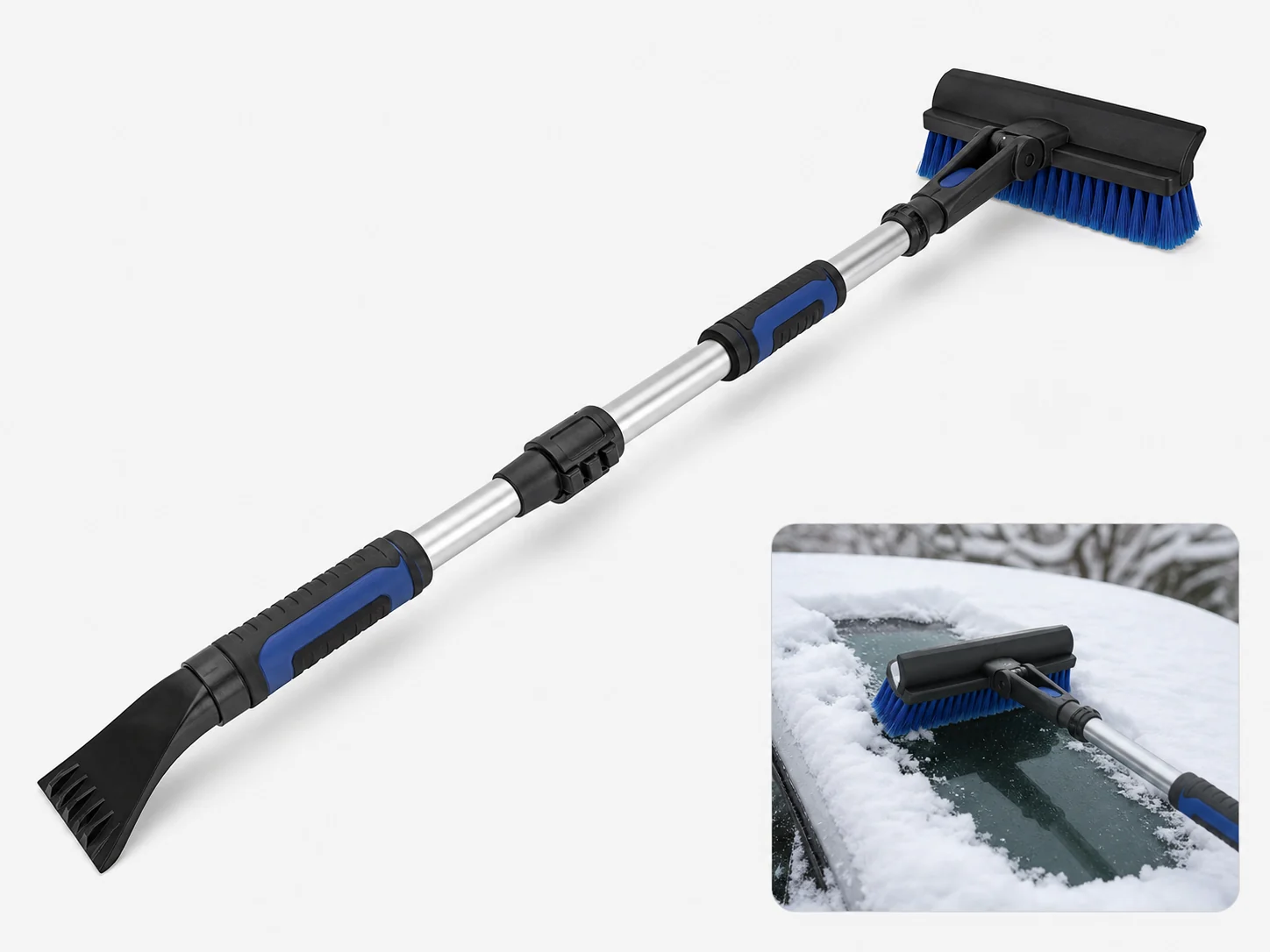
Extendable automotive snow cleaning brush with non-scratch PET or PP fill and ABS ice scraper for windshields, roofs and body panels. Custom built.
Small brush
500 pcs
Minimum order
Held in one hand: tube, bottle, detail and swab brushes — including long-handled ones with a small head.
Production lead time, once the specification is confirmed
- Up to 500 pcsWithin 7 days
- 501–50,000 pcsWithin 14 days
- Over 50,000 pcsWithin 21 days
Peak season can extend these times; the shipping date is confirmed in writing with your quotation. Sampling and shipping are quoted separately.
A paint-safe automotive snow cleaning brush with a telescoping handle and integrated ABS ice scraper, built to clear snow from windshields, roofs, hoods and side glass on cars, SUVs, vans and light trucks without scratching painted surfaces.
What can this brush do for you?
Soft brush side removes snow while the scraper stays off paint
The wide head is filled with non-absorbent PET or PP filaments whose rounded tips lift loose snow from glass and clearcoat. The ABS scraper is positioned at the opposite end and shaped for windshield ice only. This physical separation lets an operator clear snow from the entire vehicle contact area without dragging a hard edge across the hood, roof or door skin. If the vehicle has dark paint, ceramic coating or vinyl graphics, the brush side remains the appropriate contact surface.
Full extension reaches SUV and van roofs without climbing
The handle extends from roughly 600 to 1200 mm depending on the configuration, letting one operator stand flat and push snow across the roof of a taller vehicle. Shorter fixed positions remain available for door glass and windshield work. The upper extension lock holds the section in place during repeated pushing strokes, so the tube does not collapse mid-pass, which is a common failure on lighter seasonal brushes.
Pivoting head follows curved glass and panel crowns
The brush head rotates on the handle mount to maintain flat contact on curved windshields, hood creases and roof crowns. A center detent or multiple locking positions can be specified so the same brush shifts from a flat push across the windshield to an angled pass along the A-pillar. This prevents the operator from using only the edge of the bristles, which leaves snow streaks and forces uneven filament wear.
Fill sheds water instead of freezing into a block
PET and PP filaments do not absorb meltwater the way natural fiber or open-cell foam can. After clearing wet snow, the head can be knocked against a tire or mat to release trapped slush, and it will stay flexible the next morning. A waterlogged brush stored in a cold trunk or truck bed is a real winter problem; this fill type is selected to avoid it.
Integrated ABS scraper clears windshield ice without a second tool
The scraper edge is molded into the handle end with a working width matched to windshield clearing. The ABS grade stays rigid in sub-freezing conditions without becoming brittle enough to snap at the corners, and the operator can clear frost and thin ice from the glass while the brush side remains ready for the loose snow above it.
Cold-weather grip and hang-loop detail
The handle grip is overmolded or wrapped in a foam or TPE sleeve that stays softer in low temperatures than bare metal or hard plastic tube. A molded hang loop at the butt end lets the brush store in a trunk organizer, garage hook or truck seat-back pocket without the head resting on dirt or grit, which later gets dragged across paint.
What is an Automotive Snow Cleaning Brush?
An automotive snow cleaning brush is a handheld winter-clearing tool that combines a soft-filament brush head with a rigid synthetic ice scraper on the same assembly. On this product, the head is filled with non-absorbent PET or PP filaments and mounted on a telescoping handle; the scraper is formed from ABS and shaped for windshield ice.
In use, the operator clears the roof first, then the hood, windshield, side glass and rear window, moving loose snow away from weather seals, cowl vents and the wiper linkage. The brush side is used with push, pull and sweeping strokes. Once loose material is removed, the scraper is applied only to glass, usually after the defroster has started, using flat even passes.
The right configuration depends less on the vehicle length than on roof height, glass curvature, paint type and the type of snow or ice the driver normally faces. A dry powder in a cold climate needs different fill density and stroke than wet heavy snow or mixed freezing rain.
This product is not a pavement, sidewalk or roadside maintenance brush. It is dimensioned for vehicle body panels and glass, and the filament stiffness is selected for loose snow and light bonded frost rather than digging into gravel, ice pack or road mud. Using the scraper on a painted panel, wheel, wheel well or undercarriage part is misapplication and can cause damage that the soft-filament brush side cannot.
Technical Specifications
The table shows the standard range; each value can be revised for a specific vehicle line, fleet program or retail SKU. Head width and fill density have the largest effect on clearing speed versus paint contact pressure.
| Parameter | Value / Options |
|---|---|
| Product form | Extendable vehicle snow brush with integrated ice scraper |
| Head width | 80–120 mm, selected for windshield span and roof reach |
| Fill material | PET or PP, non-absorbent, rounded soft tips |
| Scraper material | ABS, molded blade for glass use only |
| Overall length | 600–1200 mm telescoping, lock positions set to vehicle height |
| Handle material | Aluminum alloy or fiberglass tube, external lock |
| Grip | EVA foam or TPE sleeve, molded hang end |
| Head motion | Fixed or pivoting with detent locks; multiple stop angles optional |
| Operating temperature | -30°C to 60°C / -22°F to 140°F |
| Weight | 0.45–0.85 kg depending on handle length and fill |
| Surface contact rule | Brush side for painted and glass surfaces; scraper side for glass only |
| Brush type | Custom Handheld Detail Brushes |
| How it is driven | Hand-guided |
| Cleaning target | rear window and side mirror, roof snow removal, and trunk lid and tailgate clearcoat clearing cleaning |
| Surface or part | glass, panels, edges, and vehicle body panels |
| Residue or debris | snow, paint, powder, gravel, and mud |
| Mounting / connection | Fixed |
Where does this brush work best?
- Windshields, side glass, rear windows and side mirrors on passenger cars, SUVs, crossovers, vans and light trucks.
- Roof snow removal on taller SUVs, vans and truck cabs where roof snow can slide forward onto the windshield or fly onto following traffic.
- Hood, roof, trunk lid and tailgate clearcoat clearing before automated car wash entry or before driving.
- Rental, fleet, dealership and roadside assistance winter kits where one durable tool is issued per vehicle and used by multiple operators.
- Light frost and thin bonded ice on glass after the defroster starts. Thick ice, ice on paint, wheels, or undercarriage parts is outside the intended use.
How do I choose the right one?
Start with full extension length
Measure the highest roof point from the ground, then add the operator’s comfortable downward reach. The brush should reach the roof center with the operator standing flat. A brush that requires standing on a door sill or tire is unsafe, and one that is too long loses push control at the head. For most passenger cars 700–900 mm is enough; for tall SUVs, vans and truck cabs, 1000–1200 mm is more practical.
Match fill material and density to the snow and paint
Soft PET tips provide the most defensive contact on dark paint, ceramic coating or vinyl wrap. PP filaments can be specified slightly stiffer and denser for repeated heavy wet snow. If the fleet almost always sees dry powder, a lower-density fill removes more snow per stroke; if it sees wet snow that compresses, a denser fill holds its shape and pushes a cleaner line. A foam blade or combo head may be more effective for deep accumulations, while a filament head is better for close glass and panel edges.
Match scraper width and shape to the glass
A wide scraper clears the main windshield faster, but a narrower scraper is easier to control around wiper arcs and on side glass. If the operator deals with thick ice, choose a reinforced ABS blade with a chunky grip and wider working edge. If the main job is frost, a standard edge will clear it faster with less fatigue.
Decide between fixed and pivoting head
A fixed head with a wide brush face is stable and simple for flat hoods and SUV roofs. A pivoting head with two or three detents is better on strongly curved windshields and when the operator needs to follow the A-pillar or roof rail. For mixed vehicle fleets, a pivoting head with a center lock gives the most useful compromise.
Check full-extension rigidity and grip
Extend the sample brush fully and load the handle in the middle with light hand pressure. A thin fiberglass or under-sized tube will flex enough to make the head bounce across the glass, which increases the chance of missed snow or hard edge contact. Aluminum with external locks is the most common rigid option; fiberglass is lighter and less cold to the touch but needs more wall thickness for the same stiffness.
When this brush is the wrong tool
If the job is thick bonded ice or frozen rain on body panels, use de-icing spray, a heated garage or the vehicle defroster first; no soft-filament snow brush should be forced against bonded ice on paint. If the target is road salt, lower body grime or wheel wells, use a wash mitt, detergent and water rather than a dry snow brush. If you need to clear sidewalks, curbs, ditches, pavement or rooftop snow on buildings, choose a push broom, snow shovel or long-handle snow rake instead. This product is sized and tuned for vehicle surfaces.
Can I customize this brush?
We build this brush around the vehicles, operators and distribution channel rather than forcing one stock configuration. To start a project, send the vehicle list or class, the snow and ice conditions, the required roof reach, the storage location, and whether you need retail packaging or bulk fleet packing. A sample photo or existing brush that works poorly can speed up the design review.
Typical adjustable items:
- Handle and reach — fixed or telescoping length, tube material, lock type, number of stops, foam sleeve and hang feature
- Head and fill — width, PET or PP filament, stiffness, density, trim length, row pattern, or added foam blade face
- Scraper — ABS blade width, thickness, edge angle, corner radius, detachable or replaceable scraper insert
- Head motion — fixed orientation, pivoting head with detent angles, or smooth rotation with a center lock
- Color and branding — custom filament color, molded logo, pad print, colored handle, package insert or sleeve
- Packaging — retail hang card, polybag with header, bulk fleet carton, or project-specific packing layering
We can also provide dimensional drawings, pre-production samples, material data and inspection support for project approval. If your program requires specific documentation, material declarations, third-party testing or export paperwork, we can assist with those requirements during the customization process.
How do you tell when an automotive snow cleaning brush is worn out?
Can I use the brush side on a ceramic coated, PPF protected or vinyl-wrapped vehicle?
Yes, with soft PET or PP fill and moderate pressure the brush side is appropriate for the clearcoat, ceramic coat, film and vinyl surfaces. Do not use the scraper on film, wrap or painted panels. Knock out trapped grit before each use and brush in one direction rather than scrubbing back and forth over the same area.
What is the safest stroke pattern for clearing snow without scratching?
Push snow off the nearest panel edge in long flat passes, and lift the head at the end of each pass. Avoid pressing hard enough to fold the filaments completely over, and avoid digging the scraper side into the surface. On glass, clear loose snow away from the wiper park area before lifting the wipers or running the defroster.
How can I test the extension lock before relying on it in cold weather?
Extend the handle to the position you will use, hold the grip in one hand and the head in the other, then apply about 2–3 kg of twisting and pulling force. The section should not slide, rotate or develop visible play. If the lock moves more than a few millimeters, test in below-freezing conditions or choose a different lock design, because aluminum and plastic locks can behave differently in cold temperatures.
Does this brush remove thick ice from body panels?
No. The brush side is for loose snow and light frost on painted surfaces. Thick bonded ice on the hood, roof or doors should be softened with de-icing fluid, a heated garage or the vehicle defroster before removal. Forcing a soft-filament head against thick ice will not clear it and may trap grit against the paint. The scraper is intended only for glass.
What signs show the brush should be replaced?
Check the filaments for flattening, permanent splay or broken tips. Check the scraper edge for nicks, rounded corners or visible white stress lines. Check the extend handle for loose locks, cracks near the lock mechanism or excessive flex, and check the grip for tears or loss of adhesion. If the head no longer springs back after a stroke or the scraper skips across glass, it is time to replace the unit.
Can a single brush serve a mixed fleet of cars, SUVs and trucks?
Yes, if you specify the right telescoping length and a pivoting head with detents. A 700–1200 mm handle with a 90–110 mm head and a mid-width scraper will cover most passenger cars, SUVs and vans. Very tall box trucks or buses may need a fixed long-handle foam snow rake instead of a hand brush, because the operator cannot safely reach the roof center even with full extension.
Guides that go deeper on this
We have not written a guide specific to this one yet. The material that covers selection, filament, dimensions, maintenance and sourcing is collected in the technical resources library.
Custom Manufacturing RFQ
Describe Your Application
Please share the brush dimensions, working area, residue type, material direction, quantity, and a drawing or photo for quotation.
Drawing or photo optional — it speeds things up, it does not gate the enquiry.
Custom Brush RFQ
Send Your Brush Project
Upload a drawing, product photo, or sample photo and provide the core dimensions and cleaning conditions.
“We need a brush to remove wet residue from a stainless steel conveyor, about 800mm wide. The current brush wears quickly. We can send photos.”
“We sell drinkware and need a cleaning brush to include with the product. Quantity around 5,000 pieces.”