
Custom Cleaning Brush
Cleaning Brush Jewelry
Soft goat hair and nylon jewelry brushes for removing polishing compound, tarnish, skin oils and fine debris from rings, chains, settings and recesses.
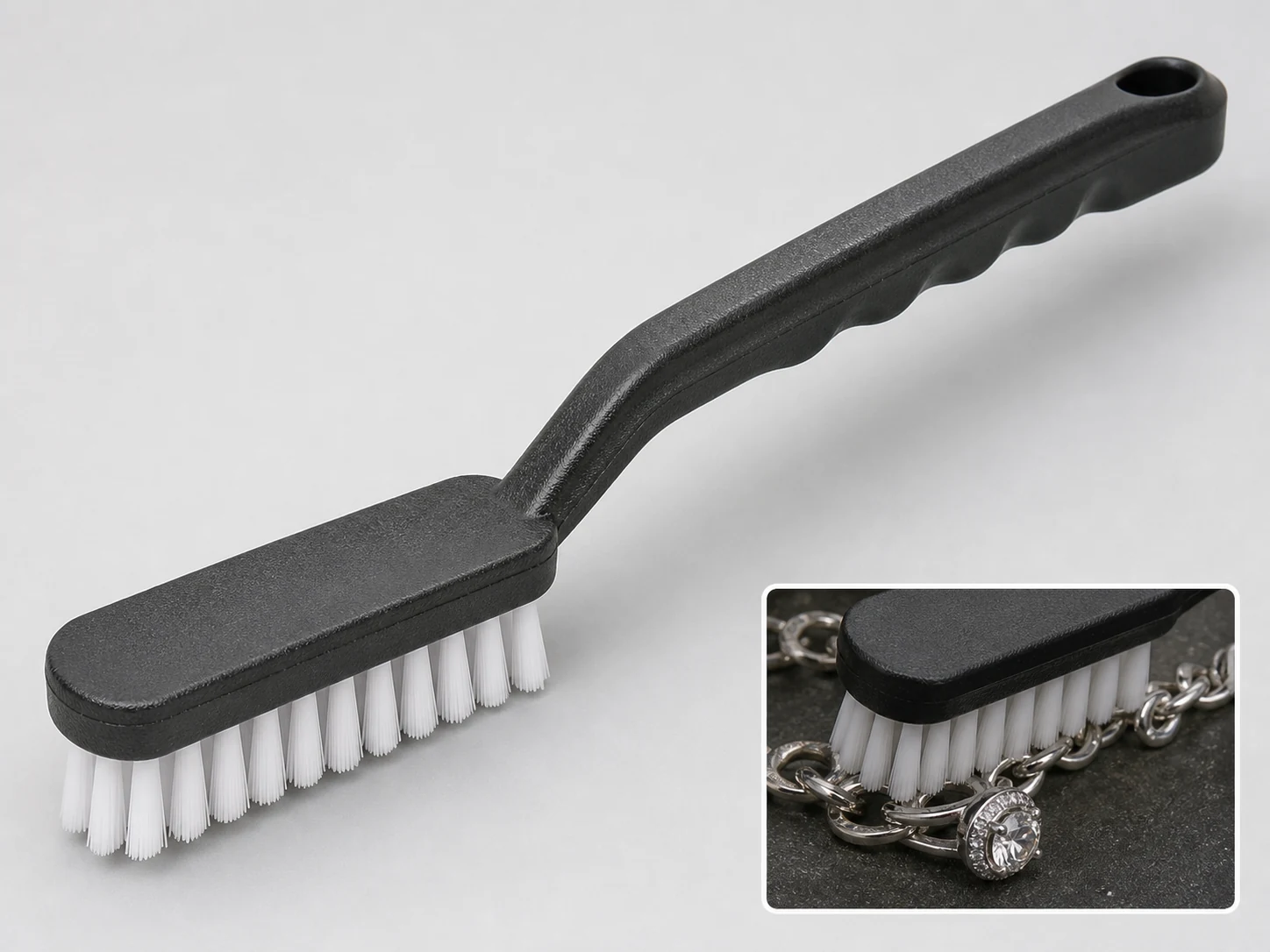
Small brush
500 pcs
Minimum order
Held in one hand: tube, bottle, detail and swab brushes — including long-handled ones with a small head.
Production lead time, once the specification is confirmed
- Up to 500 pcsWithin 7 days
- 501–50,000 pcsWithin 14 days
- Over 50,000 pcsWithin 21 days
Peak season can extend these times; the shipping date is confirmed in writing with your quotation. Sampling and shipping are quoted separately.
This Cleaning Brush Jewelry is a fine-filament hand brush for controlled application and removal of polishing compound, tarnish, skin oils and loose debris from ring settings, chain links, clasps and recessed detail areas. Available with soft goat hair or resilient nylon PA filaments in a compact bench format matched to jeweler workholding and finishing steps.
What can this brush do for you?
Reaches Into Prongs, Under-Gallery Spaces and Fine Chain Links
The narrow head width and short trim length let filament tips enter the tightest working areas around stone settings, under gallery rails and between chain links without the handle or ferrule blocking the approach. A 25–50 mm working head covers small detail zones instead of flooding the whole work surface with compound or cleaning solution.
Carries Enough Compound and Releases It Gradually
Goat hair picks up and holds a measured amount of polishing compound, then releases it evenly as the operator works. This reduces over-application and keeps excess compound from packing into engraving lines, under settings or around prongs where it becomes difficult to remove later.
Lifts Residue Without Cutting Into the Finish
The fine, flexible filament tips move over polished gold, silver, rhodium plate and plated findings rather than scoring them. They remove loose rouge, Tripoli, skin oil and fine dust while preserving the mirror or satin finish. For plated and porous surfaces, goat hair is normally the safer starting point than stiff synthetic or wire fill.
Handles Both Dry Compound Work and Wet Cleaning Steps
Nylon PA filaments hold their shape and stiffness in water, isopropyl alcohol and mild detergent solutions, so the same brush format can be specified for wet residue removal or repeated washdown. Goat hair is preferred for dry compound pickup and solvent-dampened work where a softer contact path is required.
Standardizes Operator Technique Across a Bench
Because head dimensions, trim profile, filament material and handle length can be fixed to a single specification, every operator receives the same contact area and stiffness. Replacement pieces behave the same way, which reduces variation in finishing results and makes inspection easier.
What is a Cleaning Brush Jewelry?
A Cleaning Brush Jewelry is a small, hand-guided brush built around a short, dense head of fine natural or synthetic filaments. It is used on the finishing bench after polishing, before plating, or during final inspection to remove polishing compound, tarnish, skin oils, dirt and fine particles from areas a cloth or ultrasonic tank cannot reach reliably.
Most configurations use one to four rows of crimped or staple-set filaments held in a narrow ferrule mounted on a plastic or sealed wood handle. The working end is trimmed flat, pointed, chiseled or angled so the tip profile matches the recess, link, or setting the operator is cleaning. The brush is manipulated by hand with short strokes or gentle rotation; it is not a machine-driven wheel and not a heavy scrub brush.
This brush is one step in a cleaning sequence. It loosens and removes visible or touch-detectable residue, but it does not replace ultrasonic, steam, or drying steps where those are part of the specified process. Its purpose is controlled access and surface-safe contact, not abrasive force.
Technical Specifications
The ranges below represent the standard build envelope for this product. Every parameter can be fixed to your project; treat these values as decision inputs rather than fixed stock dimensions.
| Parameter | Standard range / options |
|---|---|
| Overall length | 130–180 mm |
| Brush head length | 25–50 mm |
| Head width | 8–25 mm |
| Trim length | 8–20 mm |
| Bristle rows | 1–4 rows |
| Fill material | Goat hair, horsehair, or nylon PA (selected by residue and surface) |
| Bristle diameter | 0.05–0.25 mm, material-dependent; finer natural hair for delicate finishes, coarser nylon for durability |
| Trim profile | Flat, chisel/angled, pointed, or stepped |
| Handle | Plastic (PP/ABS) or sealed wood, with flat, round, or contoured grip |
| Ferrule | Aluminum, brass, stainless steel, or molded plastic |
| Operating temperature | -20 to 100 °C for filament materials; verify handle and ferrule for sustained exposure |
| Chemical exposure | Fill and handle materials matched to solvent, alcohol, mild alkaline detergent, or dry process |
| Brush type | Custom Handheld Detail Brushes |
| How it is driven | Hand-guided |
| Cleaning target | fine jewelry finishing and repair, bracelet and clasp work, and stone-set piece cleaning |
| Surface or part | chains, recesses, stone, profiles, chain links, plastic, gaps, and wood |
| Residue or debris | polishing compound, skin oil, hair, tarnish, loose debris, dust, loose dust, and particles |
| Mounting / connection | Fixed |
Head mounting can be staple-set, crimped, or epoxy-set depending on filament type and operating conditions.
Where does this brush work best?
- Fine jewelry finishing and repair: removing red, green or white polishing compound from filigree, under-gallery areas, engraved patterns, and around claw prongs after bench polishing.
- Chain, bracelet and clasp work: cleaning inside open-link chains, hinge joints, lobster-claw interiors and the gaps where skin oil and compound collect and harden.
- Stone-set pieces: controlled cleaning around pavé, bezel and channel settings where a wider brush would catch or push stones; filament choice matters around porous or soft stones.
- Watch and precision components: cleaning small recesses, engravings and pivots on cases, findings and movement plates during finishing or inspection.
- Pre-display and pre-packaging cleanup: removing fingerprints and loose dust from polished surfaces before photography, plating, coating or client delivery.
How do I choose the right one?
Start With the Smallest Gap, Not the Overall Piece
Measure the tightest recess the brush needs to enter. Head width and trim length should fit that opening without forcing, especially around settings where a wedged brush can push prongs open or catch a stone. A pointed or chisel trim generally reaches individual prong gaps and link interiors; a flat trim covers a broad flat surface with fewer strokes.
Select Filament by Residue and Surface Risk
Goat hair is the softest starting point for plated, polished or porous surfaces. It carries polishing compound well, flexes around contours and is less likely to leave visible micro-scratches. Nylon PA is the better choice for repeated wet cleaning, stronger solvent exposure and higher mechanical action; it keeps its shape and is easier to rinse between compound colors. Horsehair sits between the two when a little more body is needed but the surface still cannot accept stiff synthetic bristles.
Match Trim Profile and Row Count to the Job
One or two rows with a pointed tip reach into link interiors and under-gallery work. Three or four rows with a flat or angled trim cover more area per stroke, which suits broad polished surfaces and faster compound application. Many finishing departments run two or three configurations rather than one all-purpose brush because access profiles change from ring to chain to finding.
Confirm Handle and Ferrule for the Real Process
Bench processes expose the handle and ferrule to the same solvents, compounds and wash water as the filament. Sealed wood offers a traditional grip and good control in dry work; plastic handles are easier to rinse and color-code by department. Confirm the ferrule and handle materials against any heated wash or solvent before standardizing, because the fill material can be right while the handle fails first.
When a different tool is the better choice: use a wire or fiberglass brush for hard scale, corrosion or heavy mechanical tarnish removal. Use ultrasonic or steam cleaning for particles trapped in blind recesses after brushing. Use lint-free swabs or applicators for final touch on optical or high-polish surfaces where any fiber transfer is unacceptable.
Can I customize this brush?
Jewelry cleaning brushes are normally specified around the work, not picked from a generic stock list. The following can be adjusted for your project:
- Filament — goat hair, horsehair, nylon PA, or a mixed fill; diameter, length, density, and flagging can be set to the application.
- Head geometry — head length, width, row count, trim length, and trim profile including flat, chisel, pointed, stepped, or angled.
- Handle — overall length, shape, material (plastic or sealed wood), surface texture, color, hanging loop or hole, and brand marking.
- Ferrule — aluminum, brass, stainless steel, or molded plastic; crimped, seamless, or plastic-bonded construction.
- Identification and packaging — color-coded handles, printed marks, individual sleeves, bulk packing, or job-specific kits.
To define a custom jewelry cleaning brush, provide the narrowest recess width, required reach depth, preferred overall length, residue type, cleaning chemicals or solvents, surface finish, and whether the brush is used dry or wet. A drawing, photo of the work, or a worn reference brush shortens the sampling loop. If your project requires material documentation, inspection, or third-party testing, list those requirements up front so they can be included in the specification.
When is a cleaning brush jewelry worn out rather than just dirty?
How can I verify the brush will not scratch a plated or high-polish piece?
Test on an inconspicuous area or a scrap piece first, using the same pressure and stroke as production. Inspect the surface under 10x magnification or a loupe. If you see micro-scratches or a change in plating color, change to finer goat hair, reduce pressure, or switch to a flagged tip. For porous or soft stones, prefer natural hair and stop immediately if the filament catches in surface pits.
What indicates that a brush should be replaced?
Replace the brush when filament tips become bent or splayed, when the head starts shedding, when the ferrule is loose, or when the handle shows cracks or chemical damage. A brush that sheds into a setting costs more time than the brush itself; inspection should happen before the tool reaches the customer’s piece, not after a stone or prong has been disturbed.
Can the same brush be used for dry compound and wet cleaning?
It is not good practice. Dry compound use leaves wax and abrasive residue in the fill, which can then be transferred into cleaning solution. If both steps are required, keep a dry set of goat hair brushes for compound application and a separate nylon PA set for wet cleaning, and clean each group according to its own procedure.
Should the brush head be wider than the recess being cleaned?
No. The head and trim should pass through the narrowest access gap without forcing. A head that is too wide either bends around the opening or fails to enter the recess. Use the narrowest measurement as the design limit, and choose a pointed or chisel trim when the gap is smaller than a practical flat trim.
Does brushing remove all debris from a closed setting?
No. The brush removes compound, oil and loose particles from accessible surfaces. Debris packed into blind cavities, trapped under gallery rails, or wedged behind stones may remain. After brushing, inspect with magnification; ultrasonic, steam, or swab cleaning may still be needed for the inaccessible areas.
How should brushes be cleaned and stored between jobs?
Remove excess compound with a soft cloth, then clean the fill with the solvent or mild detergent appropriate to the filament. Do not soak wooden handles, and allow brushes to dry with the filament tips pointing down. Store dry and wet sets separately, and keep different compound colors separated to prevent cross-contamination.
Guides that go deeper on this
Custom Manufacturing RFQ
Describe Your Application
Send the key measurements, cleaning requirement, residue, material direction, mounting method, quantity, and drawing or photo.
Drawing or photo optional — it speeds things up, it does not gate the enquiry.
Custom Brush RFQ
Send Your Brush Project
Upload a drawing, product photo, or sample photo and provide the core dimensions and cleaning conditions.
“We need a brush to remove wet residue from a stainless steel conveyor, about 800mm wide. The current brush wears quickly. We can send photos.”
“We sell drinkware and need a cleaning brush to include with the product. Quantity around 5,000 pieces.”