
Custom Cleaning Brush
Cooling Tower Brush
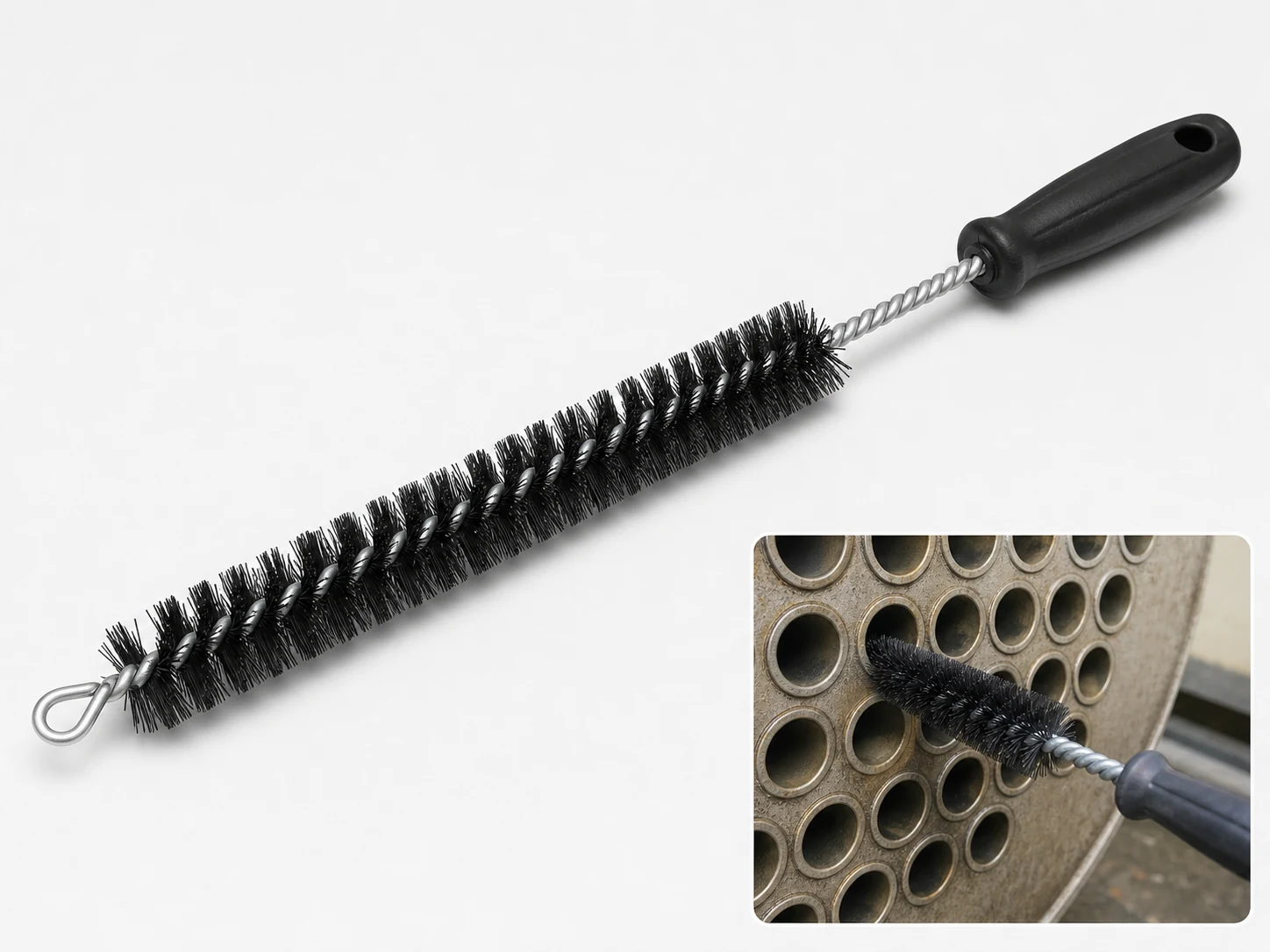
Clean condenser and heat exchanger tubes in cooling towers with a nylon PA cooling tower brush. Customize diameter, length, filament, and stem.
Small brush
500 pcs
Minimum order
Held in one hand: tube, bottle, detail and swab brushes — including long-handled ones with a small head.
Production lead time, once the specification is confirmed
- Up to 500 pcsWithin 7 days
- 501–50,000 pcsWithin 14 days
- Over 50,000 pcsWithin 21 days
Peak season can extend these times; the shipping date is confirmed in writing with your quotation. Sampling and shipping are quoted separately.
A rotary tube brush built with nylon PA filaments on a flexible twisted-wire stem, sized for the internal bores of cooling tower condenser tubes and heat exchanger tubes. It reaches into long or curved tube runs to dislodge scale, sludge, biofilm, and airborne residue while protecting the tube wall from scoring.
What can this brush do for you?
Reaches the full length of condenser tubes without binding
The twisted-wire stem flexes enough to follow gentle bends and tube curves, letting the brush section travel through elbows, U-bends, and straight runs without jamming. For deep bundles, the overall length can be extended so the filled section reaches the far end, not just the first few inches.
Scrubs deposits without cutting the tube wall
Nylon PA filaments are much softer than copper, brass, stainless steel, or titanium tube materials. They remove biological film, silt, and soft mineral scale with a wiping and scrubbing action that does not gall or score the metal surface. This protects the tube from pitting and extends the time between re-tubing projects.
Restores thermal efficiency
Fouling layers on the water side act as insulation, forcing the chiller or heat exchanger to work harder. Breaking and removing that layer with a correctly sized brush returns the tube surface closer to its design heat transfer condition, which lowers energy consumption and reduces the frequency of chemical cleanings.
Works with manual or powered operation
Stem ends can be formed as single stems, threaded studs, loops, or rings to match hand operation, a drill chuck, or a flexible shaft coupling. Powered rotation at controlled speed produces even filament wear and faster cleaning than manual push-pull, especially on long tube runs.
Clears debris instead of packing it deeper
The open filament layout between the twisted wire coils lets loosened material move outward and exit with flush water. When the brush is paired with a water flush during use, it removes deposits rather than pushing them into a plug at the tube end.
What is a Cooling Tower Brush?
A Cooling Tower Brush is a specialized tube brush used to clean the water-side surfaces of condenser tubes, heat exchanger tubes, and small-diameter cooling water piping in cooling towers, chillers, and auxiliary cooling systems. It is built around a double-twisted steel wire stem that retains a row of nylon PA monofilaments in a radial or spiral pattern. The operator inserts the brush into a tube and either reciprocates it by hand or rotates it with a driver. The filaments sweep the full inside circumference, breaking the bond between the fouling layer and the metal wall so that flushing water can carry the loosened material out.
This brush targets the typical deposits found in open and closed cooling water systems: biofilm, algae, sludge, silt, loose rust, airborne debris such as leaves and insects, and soft mineral scale. It is not a chipping tool for hard, crystalline scale, and it does not replace chemical treatment for severe mineralization. For tubes that are completely plugged or heavily scaled, rodding or chemical softening should be performed first, after which this brush finishes the mechanical cleaning.
The brush is supplied in diameters from about 6 mm up to 100 mm, which covers most condenser and heat exchanger tube schedules. Every dimension can be adjusted to match the actual tube ID and length in your equipment.
Technical Specifications
| Parameter | Value / Options |
|---|---|
| Brush diameter | 6–100 mm (nominal OD, selected to tube ID and desired contact) |
| Brush section length | 25–127 mm (length of filament-filled zone; custom lengths available) |
| Overall length | 152–406 mm (includes stem and handle; extendable for deep tubes) |
| Filament diameter | 0.08–0.25 mm (nylon PA monofilament; finer for wiping, coarser for scrubbing) |
| Stem style | Single stem, double stem, threaded, loop, ring, or flexible extension |
| Fill material | Nylon PA (PA6, PA66, PA612; heat-stabilized and abrasive-filled options) |
| Stem material | Galvanized steel wire, 304 stainless steel, or 316 stainless steel |
| Contact setting | Near-size for wiping; 5–20% oversize for flexible polymer scrubbing; lower interference for wire fills |
| Operating temperature | Continuous to 100°C (212°F); heat-stabilized grades extend to approximately 120°C |
| Drive compatibility | Manual pull-through, drill chuck, or flexible shaft with matching coupling |
| Brush type | Custom Tube & Pipe Bore Brushes |
| How it is driven | Hand-guided |
| Cleaning target | air-conditioning chiller condenser tube, industrial cooling tower heat exchanger bundle, and process cooling water line cleaning |
| Surface or part | tubes, walls, tube walls, metal, bores, bends, and long tubes |
| Residue or debris | scale, biofilm, sludge, silt, mineral scale, oil, sediment, and algae |
| Mounting / connection | Manual pull-through, drill chuck, or flexible shaft with matching coupling |
All values are standard reference ranges. We adjust the brush to your tube ID, tube length, fouling type, and operating method. Provide your exact dimensions for a fitted configuration.
Where does this brush work best?
- Air-conditioning chiller condenser tubes: Removes biofilm, silt, and soft scale from copper and cupro-nickel tubes in packaged and central chillers.
- Industrial cooling tower heat exchanger bundles: Cleans shell-and-tube exchangers that use cooling water on the tube side, restoring flow and thermal performance.
- Process cooling water lines: Small-diameter piping from 6 mm to 50 mm that accumulates biological growth and sediment.
- Power plant auxiliary cooling circuits: Condensers, oil coolers, and auxiliary heat exchangers cleaned during scheduled maintenance windows.
- Post-chemical cleaning follow-up: After descaling chemicals soften deposits, the brush mechanically strips the loosened material from the wall.
How do I choose the right one?
Selection starts with the tube geometry and the type of fouling, then moves to the stem configuration and operating method.
Start with the tube ID
Measure the internal diameter at several points, especially at any flared or rolled tube ends. The brush OD must be slightly larger than the tube ID to guarantee filament contact, but small enough to pass through restrictions without excessive force. For nylon PA, a 5–10% oversize works for light wiping and soft biofilm removal. Increase to 15–20% oversize when the tube carries sludge or thicker soft deposits that need firmer scrubbing.
Match the filament to the fouling
Soft biological film and loose silt require fine filaments (0.08–0.15 mm) and light interference. Sticky sludge or slightly hardened deposits respond better to coarser filaments (0.15–0.25 mm) and higher oversize. If the fouling includes mineral scale that is still removable by hand, an abrasive-filled nylon may be specified. Hard, crystalline scale is beyond what nylon can remove; pre-treat chemically or use a metal brush.
Choose the stem for the tube path
Straight tubes work with a single stem or threaded stem for drill attachment. Tubes with bends, U-bends, or difficult access need a flexible extension or a double stem that can be pulled from both ends. The overall length must allow the filled section to reach the far end of the tube. For long tubes, multiple brush sections can be assembled on one stem.
Select the stem material for the water chemistry
Galvanized steel is sufficient for fresh water and light duty. Use 304 stainless for mildly corrosive or chemically treated water. 316 stainless is required for brackish water, seawater, or high-chloride environments. Match the stem material to the tube material to avoid galvanic corrosion, especially with titanium or high-alloy tubes.
Decide on manual or powered operation
Manual push-pull works for short runs and occasional maintenance. Powered rotation at speeds under 500 RPM produces faster cleaning and more uniform wear, but requires a stem end that fits the driver and a flexible shaft if the tube is curved. Always flush with water during powered brushing to remove loosened debris and control heat.
When to use a different tool
Use a wire brush or mechanical descaling tool if the tube contains hard, rock-like scale or corrosion products that nylon cannot penetrate. Use a rodding tool first if the tube is completely plugged. For tubes smaller than 6 mm ID, consider a smaller brush design or another method such as chemical circulation. Nylon cooling tower brushes are the right choice when the deposit is soft to medium and the tube surface needs to be preserved.
Can I customize this brush?
Cooling tower brushes are made to order. We adjust the brush to your tube dimensions, fouling type, and operating method rather than forcing a stock size. To start, provide the tube inside diameter, tube length and bend geometry, tube material, type of fouling, cleaning method (manual or powered), water chemistry, and preferred stem end.
We can customize:
- Brush diameter and section length: Built to your exact tube ID and the length of the cleaning zone you need to cover.
- Filament material, diameter, and trim: Nylon PA6, PA66, PA612, heat-stabilized, or abrasive-impregnated nylon; filament diameter and trim length adjusted for your deposit.
- Stem style and material: Single stem, double stem, threaded end, loop, ring, or flexible extension; galvanized, 304 SS, or 316 SS wire.
- Overall length and connection: Cut to reach the far end of your tubes and fitted with the coupling, chuck end, or handle you use.
- Color and marking: Custom filament color, lasered stem marking, or pad-printed identification for size coding.
- Packaging: Bulk, individually bagged, labeled, or barcoded for distribution and maintenance kits.
If your project requires material declarations, dimensional inspection reports, or third-party testing, we can support those requirements during the customization process.
How do you tell when a cooling tower brush is worn out?
How do I confirm the brush will fit my tube?
Measure the tube ID at several points, including the flared or rolled ends. The brush OD should be 0.1–0.5 mm larger than the smallest ID for light contact, or up to 20% larger for aggressive scrubbing, but it must pass through any restriction. Test-fit a sample brush in a scrap tube or a short section before ordering in volume.
Can I use this brush with a power drill?
Yes, if the stem end is threaded or formed to fit a drill chuck. Keep rotational speed below 500 RPM and use a flexible shaft or universal joint if the tube has bends. High speed can cause wire stem whip, premature filament wear, and loss of contact.
What is the difference between single stem and double stem?
A single stem extends from one end and is used for hand-held operation, drill attachment, or pushing through a straight tube. A double stem provides a wire end on both sides, allowing the brush to be pulled from either direction or connected end-to-end for long runs. Loop and ring stems are primarily for tethering or storing the brush between uses.
How do I know when to replace the brush?
Measure the brush OD with a caliper after each major cleaning campaign. When the OD has worn down to less than the tube ID, the brush no longer makes full circumferential contact. Also replace the brush if the stem is kinked, corroded, or if filaments are missing or splayed to one side.
Does brushing remove biofilm completely?
Brushing physically dislodges biofilm and exposes the tube surface, but it does not disinfect or sterilize. For systems where biological control is critical, follow brushing with a biocide treatment and thorough flushing. Brushing is the mechanical step in a complete cleaning and disinfection program, not the entire program.
Can this brush be used in plastic or coated tubes?
Nylon PA is safe on most metals and plastics. For coated or lined tubes, test on a small area first and avoid abrasive-filled nylon unless the coating can tolerate it. Choose softer filaments and lower interference to prevent scratching the lining.
Guides that go deeper on this
Custom Manufacturing RFQ
Describe Your Application
Please share the brush dimensions, working area, residue type, material direction, quantity, and a drawing or photo for quotation.
Drawing or photo optional — it speeds things up, it does not gate the enquiry.
Custom Brush RFQ
Send Your Brush Project
Upload a drawing, product photo, or sample photo and provide the core dimensions and cleaning conditions.
“We need a brush to remove wet residue from a stainless steel conveyor, about 800mm wide. The current brush wears quickly. We can send photos.”
“We sell drinkware and need a cleaning brush to include with the product. Quantity around 5,000 pieces.”