
Custom Cleaning Brush
Dental Instrument Cleaning Brush
Order dental instrument cleaning brushes with 0.05–0.35 mm PBT/nylon filaments for hinged, serrated, and lumen access.
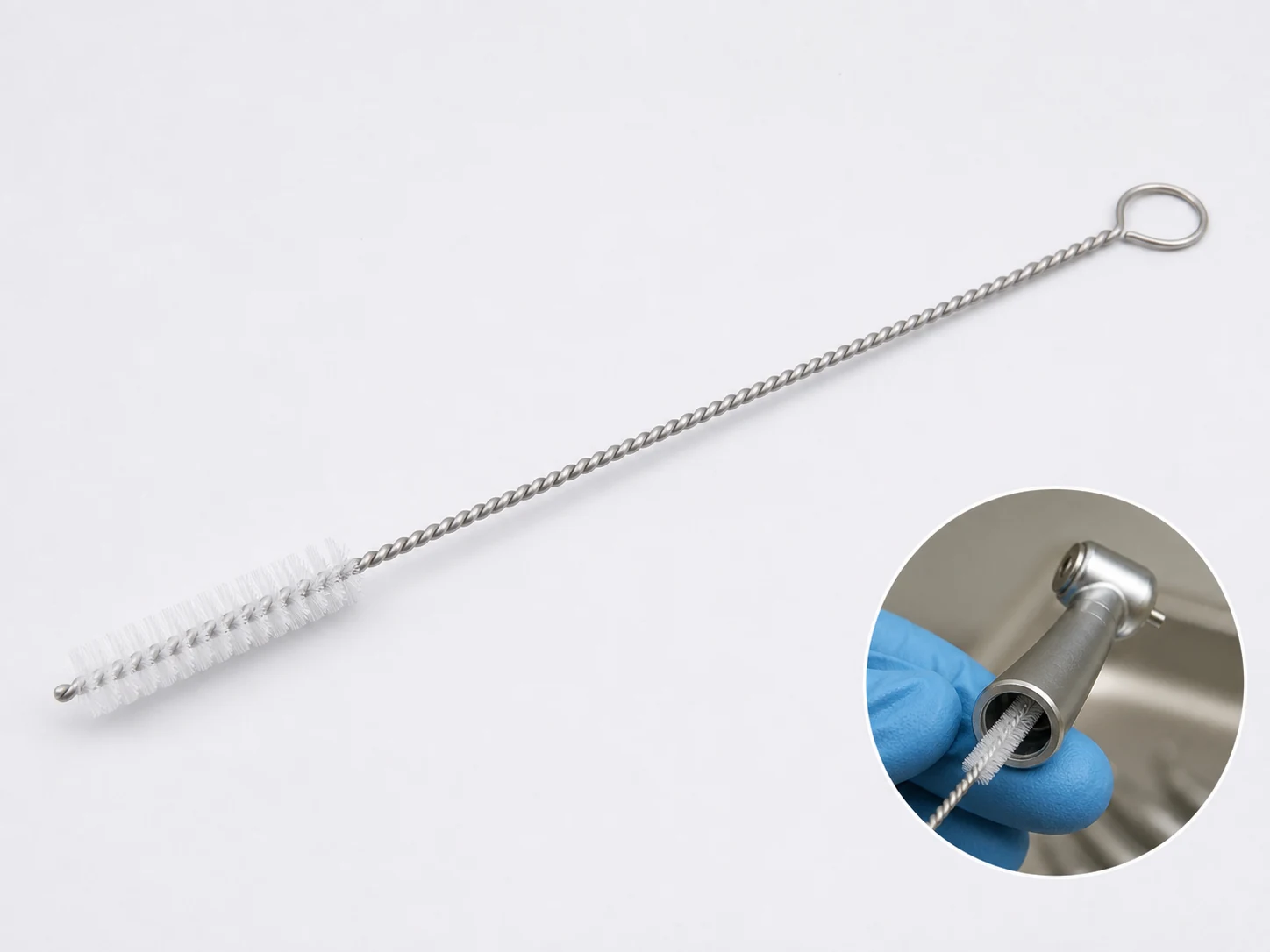
Small brush
500 pcs
Minimum order
Held in one hand: tube, bottle, detail and swab brushes — including long-handled ones with a small head.
Production lead time, once the specification is confirmed
- Up to 500 pcsWithin 7 days
- 501–50,000 pcsWithin 14 days
- Over 50,000 pcsWithin 21 days
Peak season can extend these times; the shipping date is confirmed in writing with your quotation. Sampling and shipping are quoted separately.
A fine-filament dental instrument cleaning brush for manual reprocessing of hinged, serrated, and narrow-channel dental instruments. Its small-diameter PBT or nylon PA filaments reach box locks, grooves, and lumen walls where general brushes and spray washers leave residue behind.
What can this brush do for you?
Thin filaments enter box locks, serration roots, and instrument grooves
Most hinged dental instruments fail inspection because debris remains in the hinge pin area and at the bottom of each serration. Filament diameters from 0.05 mm to 0.35 mm allow the brush to enter those spaces and disrupt protein residue, lubricant film, and fine particles that passive soaking cannot lift. The result is a cleaner surface going into the next reprocessing stage.
Fine nylon and PBT contact protects passivated surfaces and markings
Because the filaments are PBT or nylon PA rather than metal, they scrub without scratching passivated stainless steel, etched markings, or polished surfaces. That protection matters for forceps, elevators, and other dental instruments that must remain traceable and corrosion-resistant across many reprocessing cycles.
Stem and head configurations reach open joints and internal passages
Hand, angled, end-tuft, double-ended, and tube configurations let one product family cover hinge joints, fine serrations, and the internal channels of suction tips, saliva ejectors, and irrigation cannulas. The configuration is selected from the instrument geometry, not from a generic cleaning routine.
PBT and nylon PA maintain shape through detergent exposure
These filament materials are chosen to keep stiffness and springback through repeated contact with enzymatic detergents, neutral or mildly alkaline manual cleaners, and rinse water. They do not soften quickly in warm soak solutions; if the cleaning chemistry is stronger, the filament grade can be matched to the process.
Disposable variants remove the brush-cleaning step
For instruments where protein or lubricant residue can remain trapped inside a reusable brush, single-use configurations are available. The brush is discarded after each reprocessing cycle, so the tool itself does not become a carryover risk between patient sets.
What is a Dental Instrument Cleaning Brush?
A Dental Instrument Cleaning Brush is a fine-filament, hand-guided cleaning tool designed for the manual cleaning stage of dental instrument reprocessing. It is built around the gaps and passages that are difficult to clean: box locks, hinge pins, serrated jaws, grooves, and narrow lumens.
In a typical process, used instruments are pre-soaked and then brushed at the sink before ultrasonic cleaning, washer-disinfector cycles, or steam sterilization. The operator scrubs visible soil from open surfaces, then works the tips into joints and channels, opening and closing hinged instruments so both surfaces of the box lock are contacted. The brush dislodges protein residue, lubricant, detergent film, and fine particles before the instrument enters the validated disinfection and sterilization stages.
This brush is a mechanical cleaning tool, not a polishing, sharpening, or rust-removal device. It prepares instruments for downstream reprocessing but does not replace ultrasonic action, thermal disinfection, or sterilization. Reusable brushes also need to be cleaned and dried after use; disposable versions avoid that step entirely.
Technical Specifications
| Parameter | Value / Options |
|---|---|
| Head width or diameter | 1–30 mm, selected to the joint, slot, or lumen being cleaned |
| Working length | 5–100 mm, adjusted to the required reach into the instrument or channel |
| Overall length | 100–600 mm, matched to operator control and the depth of access |
| Filament diameter | 0.05–0.35 mm; finer for thin serrations and smooth surfaces, thicker for heavier residue |
| Stem diameter | 0.5–3.0 mm; slim enough to enter narrow lumens without damaging internal walls |
| Stem / back design | Straight, angled, flexible wire, or rigid; wire stems suit curved channels, rigid stems suit open joints |
| Filament material | PBT or Nylon PA, selected for stiffness retention and detergent compatibility |
| Handle material | Stainless steel or molded plastic, chosen by whether the brush is reprocessed or disposed |
| Configuration | Hand brush, tube brush, double-ended, end-tuft, wire-stem, or disposable |
| Brush type | Custom Handheld Detail Brushes |
| How it is driven | Hand-guided |
| Cleaning target | hinged instrument, serrated and grooved, and narrow lumen and channel cleaning |
| Surface or part | instruments, lumens, hinges, grooves, gaps, channel, walls, and serrations |
| Residue or debris | lubricant, protein, fine particles, protein residue, detergent film, and visible soil |
| Mounting / connection | Fixed |
All dimensions are adjustable. The instrument family and the narrowest access dimension define each value before production.
Where does this brush work best?
- Hinged instruments — forceps, needle holders, orthodontic pliers, and extraction forceps: the small head reaches box locks and hinge pins where dried protein and lubricant collect.
- Serrated and grooved working ends — elevators, scalers, and curettes: fine filaments work into the base of serrations without burnishing the cutting edge.
- Narrow lumens and channels — suction tips, saliva ejectors, air/water syringe tips, and irrigation cannulas: tube and wire-stem configurations pass through the internal diameter and contact the wall.
- Manual pre-cleaning at the reprocessing sink: used after pre-soak and before ultrasonic, washer-disinfector, or autoclave stages.
- Instrument kits with mixed geometries: double-ended or two-size configurations cover fine and coarse gaps in one tool.
How do I choose the right one?
Start from the access requirement, not from the instrument name alone. The same hinged forceps can need one brush for the box lock and another for the jaw serrations.
| Situation | Recommended configuration |
|---|---|
| Box lock, hinge joint, or tight pivot | Small hand or end-tuft brush with filament diameter ≤0.20 mm |
| Straight lumen with accessible entry | Tube brush sized to the lumen internal diameter |
| Curved or flexible instrument channel | Flexible wire-stem brush that follows the bend |
| Two gap sizes in one instrument kit | Double-ended brush with a different head on each end |
| Single-use or high cross-contamination concern | Disposable brush, individually packaged if required |
Filament diameter and material
Thin filaments from about 0.05 mm to 0.15 mm reach fine serrations and smooth surfaces. Thicker filaments from about 0.20 mm to 0.35 mm scrub heavier lubricant and protein films from joints and grooves. PBT usually keeps its stiffness longer in warm detergent and humid storage; nylon PA is more flexible and conforms around curved surfaces. Match the filament to how much scrubbing pressure the instrument requires.
Stem and handle environment
If the brush itself will be reprocessed in a washer or autoclave after use, choose stainless steel stem and handle materials built for those conditions. If the brush will be disposed after each set or used in a limited area, molded plastic handles and wire stems are typically lighter and less expensive to replace. Specify the detergent type and wash temperature so the correct plastic grade can be selected when plastic is required.
When this brush is not the right tool
If an instrument has fused hinges, heavy corrosion, or hardened cement residue, soaking and ultrasonic processing should come first; aggressive brushing can damage the instrument or drive debris deeper. If a lumen is too narrow for any filament to enter without deflection, use a flush adapter or a single-use lumen cleaning device instead. A metal filament brush should not be used on dental instrument working surfaces because it can scratch passivation and leave wire fragments behind.
Can I customize this brush?
A dental instrument cleaning brush is built to the gaps and access paths in the customer’s instrument inventory. We will ask for the types of instruments, the minimum gap between hinge surfaces or serrations, the lumen internal diameters and lengths, the cleaning chemicals and temperature, and whether the brush itself must be reprocessed or disposed after use. A sample instrument or drawing shortens the configuration process.
We can adjust:
- Head and fill geometry — head diameter or width, working length, trim profile, tuft density, and spiral or straight fill pattern.
- Filament — PBT or nylon PA, diameter, stiffness, color, and tip shape for penetrating or gentle contact.
- Stem / back — rigid, angled, flexible wire, double-ended, end-tuft, or tube configuration; stem diameter and length.
- Handle — stainless steel or molded plastic, with straight, loop, or knurled grip forms; length and hanging or racking features.
- Color and marking — color coding by instrument set or reprocessing area, plus pad printing, laser marking, or molded identification when needed.
- Packaging — bulk, individually wrapped for disposable use, tray pack, or project-specific unit-of-use packaging.
If your project requires material documentation, residue testing support, or third-party evaluation for your cleaning process, we can assist with those requirements during the customization project.
Which filament survives the cleaning chemicals a dental instrument cleaning brush meets?
Should I use this brush before or after the ultrasonic bath?
Use it before ultrasonic cleaning or the washer-disinfector to remove gross debris that would otherwise load the bath or block machine jets. A light second brush pass can help remove particles released by cavitation, but brushing does not replace the ultrasonic, thermal disinfection, or sterilization step. Follow the sequence defined in the facility’s reprocessing protocol.
What should I inspect on a reusable brush before each use?
Check for loose, bent, or splayed filaments and for cracks in the handle or stem. If any filament is missing or ready to detach, do not use the brush, because a detached filament can remain inside an instrument or lumen. For wire-stem brushes, look for kinks, corrosion, or broken wire ends. Replace the brush when filaments no longer spring back to their original shape.
How can I tell if a lumen is clean after brushing?
After rinsing, pass a white lint-free wipe or cotton swab through the lumen and inspect it under good light. Visible protein film, lubricant, discoloration, or particles indicate that the brush size, filament reach, or number of passes is not sufficient. Some facilities also use protein residue tests according to their internal protocol.
Does brushing remove rust, corrosion, or pitting?
No. Brushing removes adhered soil and residue. It cannot restore corroded, pitted, or damaged surfaces, and aggressive brushing on corroded areas can worsen the damage. Instruments with corrosion or pitting need inspection, repair, or retirement through the facility’s instrument management process.
Can this brush be autoclaved or cleaned in a washer-disinfector?
That depends on the configuration. Versions with stainless steel stems and handles can often be thermally reprocessed, but plastic components may be single-use or limited to lower temperatures. Define the brush’s own reprocessing method during ordering so the handle, stem, and filament materials are matched to it.
Is this a wire brush?
No. The stem may contain wire for flexibility in a lumen brush, but the filament that contacts the instrument is PBT or nylon PA. A metal filament brush would damage dental instrument surfaces and should not be used for this cleaning task.
Guides that go deeper on this
We have not written a guide specific to this one yet. The material that covers selection, filament, dimensions, maintenance and sourcing is collected in the technical resources library.
Custom Manufacturing RFQ
Describe Your Application
An accurate custom quote starts with the dimensions, working surface, residue, material choice, connection, quantity, and reference files.
Drawing or photo optional — it speeds things up, it does not gate the enquiry.
Custom Brush RFQ
Send Your Brush Project
Upload a drawing, product photo, or sample photo and provide the core dimensions and cleaning conditions.
“We need a brush to remove wet residue from a stainless steel conveyor, about 800mm wide. The current brush wears quickly. We can send photos.”
“We sell drinkware and need a cleaning brush to include with the product. Quantity around 5,000 pieces.”