
Custom Cleaning Brush
Drill Brush Set
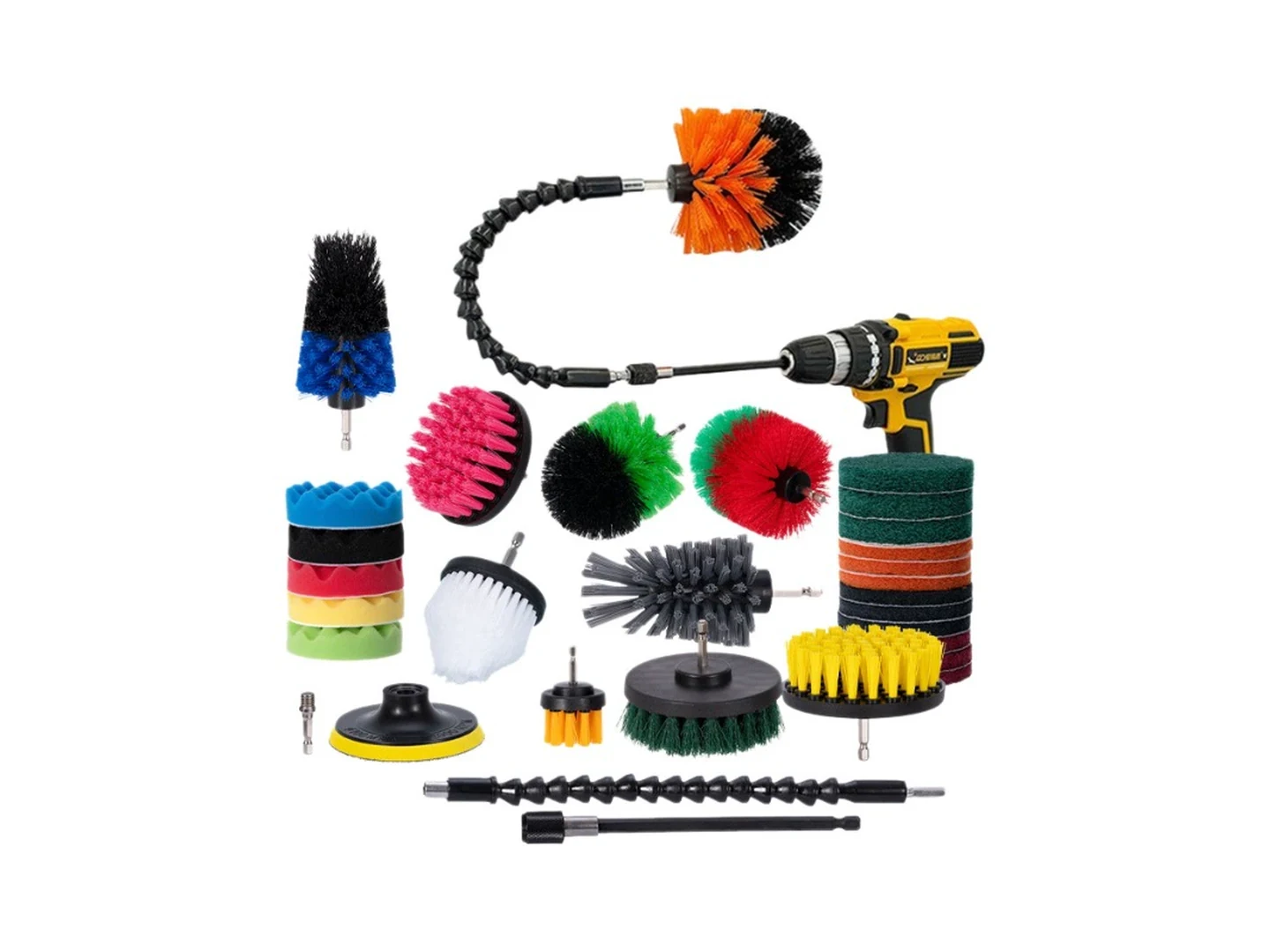
Drill brush set with nylon PA and PP fill, 50–150 mm heads, and 6.35 mm hex shanks for grout, tile, floor, tub, wheel, and equipment cleaning.
Medium brush
100 pcs
Minimum order
Worked with two hands or on a pole: chimney, gutter and pond-filter brushes, discs, cups and tank brushes.
Production lead time, once the specification is confirmed
- Up to 100 pcsWithin 7 days
- 101–5,000 pcsWithin 14 days
- 5,001–50,000 pcsWithin 21 days
- Over 50,000 pcsConfirmed with your quotation
Peak season can extend these times; the shipping date is confirmed in writing with your quotation. Sampling and shipping are quoted separately.
A power-cleaning brush set that turns a standard cordless or corded drill into a high-speed scrubber for grout, tile, floors, tubs, stainless sinks, wheels, and textured equipment surfaces. Available with nylon PA or PP fill in multiple diameters, trim lengths, and stiffness grades, all on a common 6.35 mm hex shank.
What can this brush do for you?
Moves grout and tile cleaning from hand speed to drill speed
The set pairs small 50–90 mm heads with 0.30–0.45 mm medium fill for grout joints and edges, and larger 100–150 mm heads for field tile and shower walls. A cordless drill at 600–1,200 RPM delivers continuous rotary scrubbing, so the operator guides the head instead of wearing out a hand brush in the same joint.
Puts bristle tips into corners and sink edges that a flat pad cannot touch
Dome and detail profiles carry trim to the outer radius, letting the brush follow a corner radius, wall-to-floor transition, faucet base, or anti-slip tread profile. The 20–30 mm trim on smaller heads holds the filament tips upright under moderate pressure, which is what actually clears soap film out of a grout line.
Soft, medium, and stiff heads on one shank standard
Filament diameters from 0.20 mm to 0.60 mm cover light film on polished surfaces up through heavy grease on stainless and quarry tile. Because all heads in the set share the 6.35 mm hex shank, the operator changes from a soft 50 mm detail head to a stiff 150 mm floor brush without touching a collet or adapter.
Wet scrubbing without the brush body failing
Nylon PA fill and PP hubs are selected for continuous use with water and common alkaline cleaners. The head does not absorb water the way a natural fiber or wooden block brush will, so it keeps its shape and stiffness through a full cleaning cycle rather than going limp after the first rinse.
Drill-side control for sensitive surfaces
The brush is balanced to run without wobble in the recommended 600–1,800 RPM working band. This keeps the tips, not the hub edge, on the surface, which matters on porcelain, sealed stone, vinyl, and coated metal where uncontrolled corner contact leaves marks.
What is a Drill Brush Set?
A Drill Brush Set is a matched collection of circular power-scrub brushes that mount directly into the chuck of a cordless or corded drill and convert rotary motion into bristle work on hard surfaces. Each head is a nylon PA or PP fill molded around or into a polypropylene hub with an integral 6.35 mm (1/4 in) steel hex shank.
A typical set is built around several working shapes: a small dome or detail head for grout lines and recesses, one or two medium round heads for tubs, sinks, and tile, and a larger flat or radial head for floors and open panels. The mix is configurable, so a maintenance crew can carry one set that covers the whole room instead of a bucket of separate hand brushes.
In operation, the brush should stay roughly perpendicular to the surface and be moved slowly; the drill supplies the speed, not the operator’s arm. The bristle tips perform the cleaning. Pushing the head down until the trim flattens does not make the brush more effective and shortens the fill life. Work wet or dry with a suitable detergent or degreaser, then rinse the head and hang by the shank.
It is not a wire brush, not an abrasive pad, and not an impact accessory. If the job is rust removal, paint stripping, metal conditioning, or surface profiling, this set is the wrong tool and will wear out quickly before doing the work.
Technical Specifications
Values below are the standard production range for the Drill Brush Set. Set composition, head diameters, trim lengths, filament grades, and shank options are adjusted to the customer’s tool platform and cleaning task.
| Parameter | Standard options |
|---|---|
| Set size | 3, 4, 5, or 6 heads standard; up to 12 heads per set on request |
| Head diameter | 50–150 mm; common steps 50, 70, 90, 100, 120, 150 mm |
| Head profile | Flat round, radial, dome/cone, and detail point |
| Fill material | Nylon PA6 or PA6.6; polypropylene PP |
| Hub material | PP or glass-filled PP; custom colors |
| Shank | 6.35 mm (1/4 in) hex, zinc-plated steel standard; stainless or coated option for wet areas |
| Shank length | 25–40 mm standard; extended length for deep clearance |
| Filament diameter | 0.20–0.60 mm; light, medium, and stiff grades |
| Trim length | 20–50 mm; shorter for detail and direct pressure, longer for flex and contour following |
| Max rated speed | 4,000 RPM; recommended working range 600–1,800 RPM |
| Mounting | Standard 3-jaw chuck or 1/4 in hex extension; rotary drill mode only, not hammer/impact |
| Working conditions | Wet or dry with water, neutral/alkaline cleaners, common degreasers; rinse and dry after use |
| Brush type | Custom Floor Scrubber Sweeper Brushes |
| How it is driven | Machine-driven, mounted in the equipment |
| Cleaning target | bathroom surface, floor and edge, and automotive and equipment cleaning |
| Surface or part | floors, tile, metal, corners, plastic, edges, hubs, and grout lines |
| Residue or debris | grease, oil, soap scum, coolant residue, road film, paint, rust, and dust |
| Mounting / connection | 6.35 mm (1/4 in) hex, zinc-plated steel standard; stainless or coated option for wet areas; Standard 3-jaw chuck or 1/4 in hex extension; rotary drill mode only, not hammer/impact |
When an OEM or distributor changes a head diameter or filament grade, Jiansheng checks the balance and maximum speed for that specific configuration before release. Specify maximum drill RPM and cleaning chemicals in the RFQ so the fill material and hub plastic can be matched accordingly.
Where does this brush work best?
The set is built for hand-guided power scrubbing where the operator can put a drill head flat against the surface. Typical jobs include:
- Tile, grout, and bathroom surfaces: shower floors and walls, thresholds, sink decks, toilet bases, and epoxy or cement grout joints carrying soap scum, body oil, hard-water film, and mildew.
- Floors and edges: sealed vinyl, quarry tile, textured epoxy, anti-slip tread, stair nosings, and baseboard corners where a 100–150 mm flat head can cover the open field and smaller heads finish the edges.
- Kitchen and foodservice hard surfaces: stainless sinks, backsplashes, floor drains, appliance housings, and range hood exteriors with grease accumulations that hand wiping does not remove.
- Automotive and equipment: wheels, wheel wells, floor mats, textured plastic liners, engine bay cowlings, and similar parts where medium fill and moderate speed remove road film without metal contact.
- Plant and shop maintenance: safety treads, stair plates, machinery guards, and textured painted housings that collect grinding dust, oil mist, or dried coolant residue.
For large open floor areas, a walk-behind or ride-on floor scrubber brush remains the efficient choice; this set is the edge-and-detail complement to those machines.
How do I choose the right one?
Start with contact geometry. Measure the narrowest recess and the largest open area; a set should include a small detail head that enters the tight area plus a large flat or round head that covers field area efficiently. A 50 mm head cannot keep up on a 100 m² floor, and a 150 mm head cannot enter the corner behind a toilet.
Then match filament stiffness to the residue and surface:
| Surface and residue | Suggested configuration | Operating note |
|---|---|---|
| Light film, soap haze, polished porcelain | 0.20–0.30 mm soft fill, dome/round head, 50–90 mm | 600–1,000 RPM; test on hidden area |
| Soap scum, body oil, mildew in grout | 0.30–0.45 mm medium fill, detail and round heads | 1,000–1,500 RPM; use detergent/water |
| Grease, carbon, dried food soil on stainless or quarry tile | 0.45–0.60 mm stiff fill, flat/radial head, 90–150 mm | 1,200–1,800 RPM; degreaser compatible with fill |
| Open floor field and anti-slip tread | 100–150 mm flat head, medium or stiff fill | 1,000–1,500 RPM; keep head flat |
| Automotive wheel, liner, textured plastic | 70–100 mm round/radial, medium fill | 1,000–1,500 RPM; avoid painted clear coat |
Trim length is the next decision. 20–25 mm gives a firm, direct tip action for grout lines and flat surfaces; 35–50 mm offers more flex and a lighter touch on curved or uneven surfaces. Do not compensate for a too-soft filament by increasing trim length and pushing down; the correct lever is the next stiffer filament diameter.
Check the drill interface before ordering. The 6.35 mm hex shank fits most 3-jaw chucks and quick-change extensions, but high-RPM drills above the rated speed, hammer modes, or bent shanks from misuse will destroy the head. Variable-speed drills are preferred because surface sensitivity and residue type often call for different RPM levels within the same set.
When to choose something else:
- Use a drill wire brush set or twisted wire brush for rust, mill scale, weld cleaning, or paint removal.
- Use a tube brush set or bore brush when the cleaning surface is inside a pipe or cylinder.
- Use a non-abrasive pad or foam attachment for polished cultured marble, soft automotive clear coat, or mirror-finished metal.
- Use a floor scrubber brush on a floor machine for very large open areas where hand-guided drilling is not productive.
Can I customize this brush?
Yes. The set is assembled around your surface list, tool platform, and pack-out. Provide the application, surface materials, residue, cleaning chemicals, drill model or RPM, and the set composition you want; a sample head or GA drawing speeds the first article.
Standard customization points:
- Set composition — number of heads, diameter mix, profile mix, and color-coded stiffness groups
- Head geometry — round, flat-face, dome, cone, detail point, or custom molded form; diameter and trim length at each position
- Fill material and grade — Nylon PA6, PA6.6, PP, or project-specified polymer; filament diameter from 0.20 mm to 0.60 mm or outside that range with validation
- Hub and shank — PP or glass-filled hub, custom hub color, laser-marked or molded logo, stainless or coated shank, extended shank length, or special hex geometry
- Packaging and identification — bulk poly bag, individual hang tag, retail card, display box, private-label sleeve, or set blister pack
- Project support — material declarations, wear-cycle data, torque and shank retention checks, chemical exposure testing, and third-party inspection coordination for your order requirements
Tell us which cleaning chemicals and temperatures the brushes will see so we can select or modify fill and hub plastic before tooling instead of discovering the mismatch in the field.
When is a drill brush set worn out rather than just dirty?
Can I run these brush heads on an impact driver?
No. Impact drivers deliver hammer pulses that can crack the hub, loosen the shank, or shatter filament tips. Use a standard drill or driver in rotary mode with a variable-speed trigger and keep the speed within the rated band.
How do I prevent swirl marks or brush scuffs on tile and coated metal?
Start with the softest fill that removes the residue, keep the head flat against the surface, stay in the 600–1,000 RPM range, and always run a small test patch in a hidden area. If the surface looks milky or shows fine circular marks, drop the filament diameter or move to a soft dome head.
What maintenance does the set need between jobs?
Rinse the heads with clean water after chemical use, shake out excess water, and hang the brushes by the shank so the fill does not dry in a bent position. Inspect for melted or glazed filament tips, loose tufts, cracked hubs, and shank runout before the next shift.
When should a head be replaced instead of kept in service?
Replace when the filament no longer springs back after bending, the tips are glazed or welded together, the trim length is noticeably shorter than the other heads in the set, or the hub shows cracks or shank play. Continuing with a worn head just increases pressure and surface damage without better cleaning.
Can this set strip rust, paint, or old sealant?
No. Nylon PA and PP fill remove attached residues, not corrosion or bonded coatings. For rust, paint stripping, mill scale, or weld spatter, choose a wire brush for drill; for old caulk or adhesive, use a scraper. Attempting those jobs with this set will consume the fill quickly and can mark the surrounding surface.
How can I verify that the brush is actually cleaning the surface and not just pushing residue around?
After the first pass, rinse the area and wipe it with a clean white cloth. Dark or oily pick-up means loosened residue is still present; switch to a stiffer head, a smaller detail profile, or a longer dwell before adding downward force. On grout, inspect the joint under side light after drying—residue left in the bottom of the joint is a reach problem, not a pressure problem.
Guides that go deeper on this
Custom Manufacturing RFQ
Describe Your Application
An accurate custom quote starts with the dimensions, working surface, residue, material choice, connection, quantity, and reference files.
Drawing or photo optional — it speeds things up, it does not gate the enquiry.
Custom Brush RFQ
Send Your Brush Project
Upload a drawing, product photo, or sample photo and provide the core dimensions and cleaning conditions.
“We need a brush to remove wet residue from a stainless steel conveyor, about 800mm wide. The current brush wears quickly. We can send photos.”
“We sell drinkware and need a cleaning brush to include with the product. Quantity around 5,000 pieces.”