
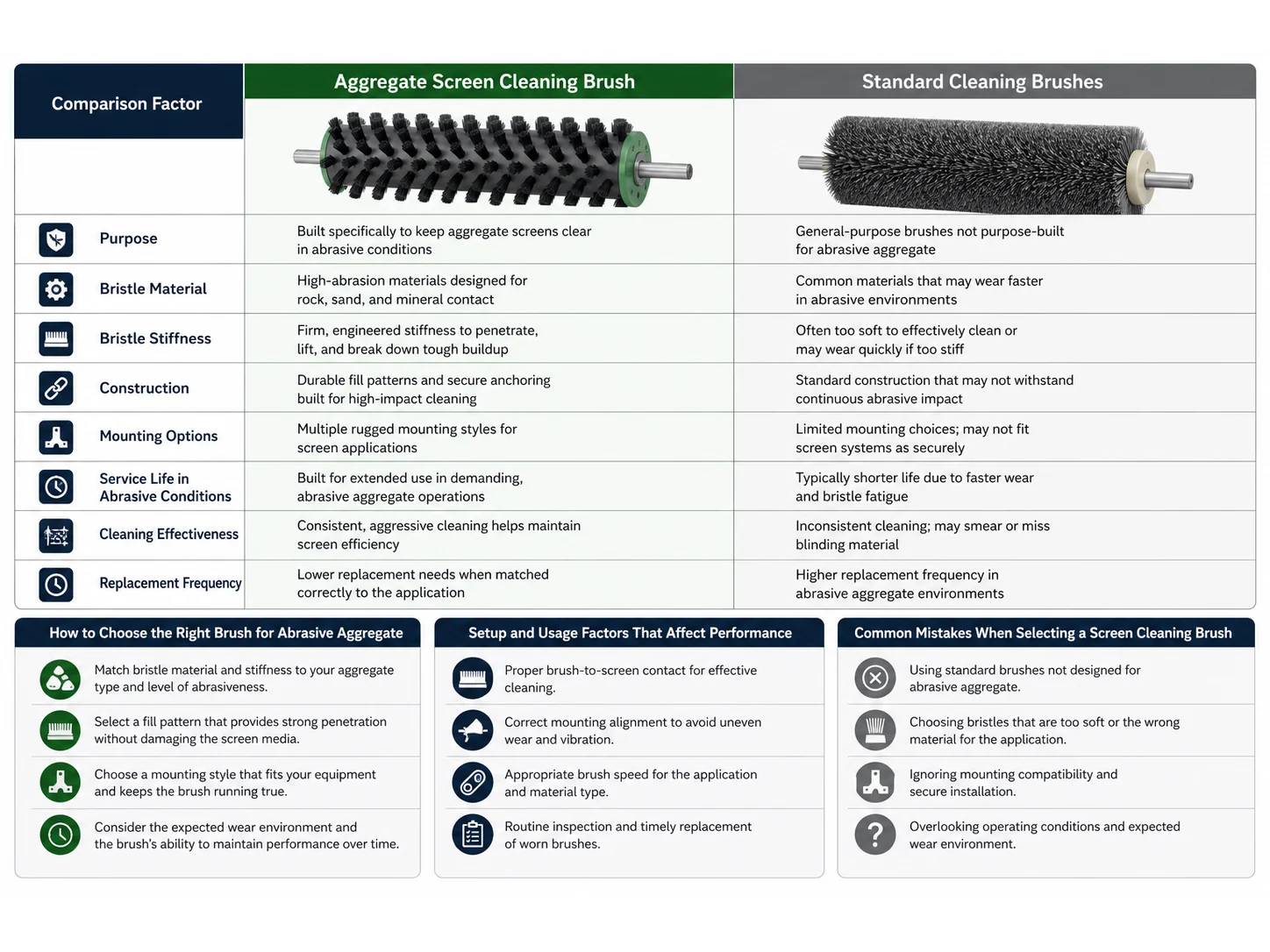
What Is an Aggregate Screen Cleaning Brush?
An aggregate screen cleaning brush is a wear-resistant brush built with tough filament materials—typically abrasive-impregnated nylon, polypropylene blends, or hardened steel wire—and mounted on a core or shaft that interfaces with screen cleaning systems. Its primary job is to remove lodged particles from screen apertures, reduce blinding, and maintain throughput. Unlike general-purpose brushes, these are designed to survive constant friction against sharp, high-silica aggregates without rapid bristle breakage or deformation.
Common Types of Aggregate Screen Cleaning Brushes
Aggregate screen brushes come in several configurations depending on how they interact with the screen surface. Understanding these options helps you compare them against standard cleaning brushes.
- Rotary/Spiral Brushes: A continuous spiral of bristles around a central shaft. Common in trommel and vibrating screen cleaners; effective for high-speed, continuous operation.
- Cylinder/Sleeve Brushes: Full‑width brush sleeves that slide over a mandrel. Provides uniform contact across wide screens.
- Strip/Brush Segments: Flat or profiled brush strips bolted or clamped into a holder. Allows easy replacement of worn sections without replacing the entire brush.
- Static/Bar Mount Brushes: Fixed-position brushes used in static screen applications or as wipers. Often found where aggregate passes under a stationary brush.
- Standard Cleaning Brushes: General-purpose wire brushes, soft nylon brushes, or hand brushes not engineered for sustained abrasive contact. Usually have lower fill density and softer filaments.
Aggregate Screen Cleaning Brush vs. Standard Cleaning Brushes – Comparison Table
| Factor | Aggregate Screen Cleaning Brush | Standard Cleaning Brush |
|---|---|---|
| Filament Material | Abrasive nylon (silicon carbide or aluminum oxide filled), polypropylene, hardened steel wire | Generic nylon, polyester, soft wire, or natural fibers |
| Abrasion Resistance | High – designed for sharp, heavy aggregates | Low to moderate – wears quickly against abrasive minerals |
| Stiffness Options | Range from medium-stiff to extra-stiff; often selectable by grit loading and filament diameter | Typically limited to soft or medium stiffness |
| Diameter Options | Commonly 4″ to 12″ OD, with custom diameters up to 24″ for large screens | Often limited to off-the-shelf diameters of 2″ to 6″ |
| Mounting Compatibility | Engineered for specific screen cleaners (shaft ends, tensioned cores, quick‑release hubs) | Handles or generic fittings; not always compatible with mechanical screen cleaning assemblies |
| Residue Removal | Clears tightly wedged particles, sticky clay, and moist fines without matting | May smear or push residue around; bristles can fold over |
| Surface Sensitivity | Can be matched to screen media (polyurethane, rubber, wire mesh) to prevent damage | Often too aggressive or too soft; risk of scoring delicate screen surfaces |
| Wet/Chemical Resistance | Many filaments resist water, common process chemicals, and pH extremes | Varies; can degrade in wet, acidic, or high-alkaline environments |
| Maintenance Frequency | Lower – filament retention and backing materials are designed for long run life | Higher – bristle loss, bending, and core corrosion are common |
| Cost Factor | Higher initial investment, lower long‑term cost due to durability | Lower upfront cost, but frequent replacement increases total cost of ownership |
How to Choose the Right Brush for Abrasive Aggregate
Making the right choice starts with your specific process conditions. Use these factors to guide the decision:
- Residue Type: Dry, dusty material usually requires a stiffer, abrasive-filled brush to scrape effectively. Sticky clay or high‑moisture fines may need a more open filament pattern to avoid matting.
- Screen Surface Material: Match bristle aggressiveness to the screen media. Wire screens can tolerate steel or heavy nylon; polyurethane or rubber screens need less aggressive filaments to prevent premature wear.
- Equipment Interface: Determine whether the brush mounts on a rotary shaft, reciprocating arm, or fixed bracket. Check core diameter, drive connection, and length.
- Wet or Chemical Exposure: If the screen is washed or treated with chemicals, choose filaments that resist water absorption, swelling, and chemical attack. Polypropylene or specially treated nylon often works well.
- Hygiene/Contamination Sensitivity: In some recycling or food‑grade aggregate applications, metal wire may be prohibited. Abrasive nylon can be a non‑sparking, non‑contaminating alternative.
- Maintenance Access and Frequency: Hard‑to‑reach screen decks benefit from brushes with long service intervals and segmental designs that allow quick change‑out without removing the entire assembly.
- Custom Size Requirements: Off‑the‑shelf brushes rarely fit every screen. A custom‑built aggregate screen cleaning brush can match exact diameters, lengths, and end connections. Always provide a drawing or sample when ordering.
Setup and Usage Factors That Affect Performance
Even the best brush underperforms if installed or operated incorrectly. Pay attention to these real‑world conditions:
- Brush-to-Screen Contact Pressure: Too much pressure accelerates wear and can damage screen media; too little leaves particles in the apertures. Follow manufacturer instructions recommended pressure settings or start light and adjust.
- Rotation Speed: High-speed rotary brushes generate centrifugal force that helps clear debris, but excessive speed can cause bristle fatigue. Match RPM to brush diameter and filament type.
- Alignment: Misalignment causes uneven wear and reduces effective cleaning width. Use adjustable brush holders and regularly check tracking.
- Environment: Temperature extremes can affect filament stiffness. Very high heat may soften nylon; freezing conditions can make some materials brittle. Verify filament temperature ratings.
- Cleaning Direction: For rotary screens, brushes should counter‑rotate or co‑rotate depending on screen movement. Fixed screens typically use a perpendicular or angled brush path.
Common Mistakes When Selecting a Screen Cleaning Brush
Avoid these frequent errors:
- Assuming any brush will work: Standard cleaning brushes quickly fail against angular, abrasive particles, leading to frequent downtime and damaged screens.
- Ignoring filament material vs. aggregate hardness: Using a soft nylon brush on granite or quartz results in almost immediate bristle wear. Match filament abrasive content to the Mohs hardness of your aggregate.
- Choosing diameter based on cost alone: An undersized brush leaves a larger gap between bristle tips and screen, reducing cleaning effectiveness. Always specify diameter based on screen opening size and desired interference.
- Neglecting mounting compatibility: Off‑the‑shelf brush hubs may not fit your shaft or drive system. Verify bore size, keyway, and locking mechanism before ordering.
- Overlooking chemical resistance: Process water with high pH or additives can corrode metal wire brushes or degrade binder materials in standard nylon brushes. Choose chemically inert filaments when needed.
- Prioritizing upfront cost drivers over life‑cycle cost: A low-cost brush that must be replaced weekly costs far more in parts, labor, and lost production than a proper aggregate-duty brush lasting months.
When an Aggregate Screen Cleaning Brush Is the Wrong Choice
Even a robust aggregate screen brush has limits. Recognize when you need to step beyond a standard brush solution:
- Extremely Hard or Resilient Buildups: Some materials—like hot mix asphalt or heavily calcified mineral deposits—may require additional cleaning methods such as high‑pressure water sprays, ultrasonic systems, or chemical dissolution. A brush alone may not suffice.
- High‑Temperature Applications: Continuous exposure above 250°F (121°C) can degrade many nylon and polypropylene filaments. In such environments, steel wire brushes or specialized high‑heat polymers become necessary, but those may still wear quickly.
- Full Automation Requirements: If your process demands sensor‑based, self‑adjusting cleaning cycles, a simple brush assembly may need to be integrated into a broader system with PLC controls and auto‑tensioning.
- Complex Screen Geometries: Non‑standard aperture shapes, stepped decks, or multi‑layer screens may require custom‑engineered brush profiles and testing. A standard catalog brush is unlikely to provide even coverage.
- Unexpected Wear Patterns: If brushes are failing prematurely despite correct material and sizing, conduct a sample test under actual conditions or ask the supplier for a drawing review to identify interference, vibration, or chemical attack issues.
Final Takeaway
Aggregate screen cleaning brushes are purpose‑built for the punishing world of abrasive materials. They outperform standard brushes in durability, cleaning efficiency, and overall process reliability. Base your choice on residue type, screen media, mounting interface, and environmental conditions, and always weigh initial cost against projected service life. When conditions push beyond normal abrasion, consider supplementary cleaning methods or custom engineering support.
Frequently Asked Questions
What bristle material works best for extremely abrasive aggregate like granite or slag?
Abrasive‑filled nylon (e.g., nylon with silicon carbide or aluminum oxide grit) is often the best balance of wear life and cost. For the most severe conditions, hardened steel wire may be used if the screen media can tolerate it. Always match filament abrasive content to the rock hardness.
Can I use a standard nylon brush temporarily until I get the right brush?
It is not recommended. Standard nylon brushes lack the abrasive filler and stiffness needed for aggregate, leading to rapid bristle collapse and potential screen damage. Even a short period of use can leave screen openings clogged, reducing production and increasing wear on the screen itself.
How do I determine the correct brush diameter for my screen openings?
Measure the aperture size and the desired bristle tip penetration. A rule of thumb is to select a brush diameter that allows bristle tips to reach slightly below the screen surface (typically 1/8″ to 1/4″ interference) without excessive bending. Share screen specifications with the brush manufacturer for precise sizing.
What information should I include in an RFQ for a custom aggregate screen cleaning brush?
Provide the screen mesh size and material, brush mounting type (shaft diameter, keyway, fastening method), overall length, desired OD, aggregate material and moisture content, operating speed, environmental exposures (water, chemicals, temperature), and expected life target. A dimensional drawing of the existing brush or holder is very helpful.
How often should aggregate screen brushes be replaced?
Replacement intervals depend on aggregate abrasiveness, production hours, and filament quality. Inspect weekly for visible bristle wear, flattening, or missing tufts. A well‑specified brush may last 4 to 12 months in moderate conditions; harsh applications may require changes every 1 to 3 months.
Are there non‑metallic aggregate screen brushes for magnetic separation or food‑grade applications?
Yes, abrasive nylon brushes can be made completely non‑metallic. They are suitable for environments where metal contamination must be avoided, such as in some recycling processes or food‑grade material handling. Specify stainless‑steel‑free construction and FDA‑compliant filament materials when needed.
What is the difference between abrasive nylon and polypropylene for wet screening?
Abrasive nylon offers higher stiffness and temperature resistance but can absorb some moisture, which may cause slight swelling. Polypropylene is naturally hydrophobic, resists most chemicals, and works well in continuously wet applications, though it may have lower abrasion resistance than filled nylon. Choose based on moisture exposure and required stiffness.
Can I cut a long brush to size on site?
It depends on the core material. Some brush sleeves with polypropylene or PVC cores can be cut with a fine‑tooth saw, but cutting a brush with a metal core or abrasive‑impregnated filaments may damage tools and expose untreated ends that can fray. Always consult the supplier’s instructions; many brushes are best ordered at the exact length needed.
Technical References
Which bristle material fits this job — Nylon PA, Abrasive Nylon or Rubber?
| Material | Continuous temperature (°C) | Peak temperature (°C) | Water absorption | Hardness |
|---|---|---|---|---|
| Nylon PA | 93 | 121 | 0.3–9% by PA grade and conditioning | Medium to firm; filament diameter and trim length control bending force. |
| Abrasive Nylon | 120 | 150 | 0.1–1.0% | Abrasive filament; stiffness and cutting level is controlled by PA base, grit type, grit size, filament diameter and trim height. |
| Rubber | 100 | 130 | very low | Specified by compound and Shore hardness; published TPE families can span roughly 50–80 Shore A, but that is a product-family example rather than a universal rubber range. |
| AISI 304 Stainless Steel Wire | 400 | 500 | 0% | Rockwell B 70–95 depending on temper and cold work |
| Polypropylene PP | 80–100 | 120–140 | ≤0.03% | Shore D 65–75 |
Figures as published by Brushtec / DuPont; Perlon; Alleima. Confirm the exact grade against the supplier datasheet before ordering.
What should replace Roller and Conveyor Brushes for aggregate screen cleaning brush?
- Roller and Conveyor Brushes — Roller and conveyor brushes hold cylindrical line contact across a working width, including helix-wound builds where the filament path is set to move loosened material toward one side; a strip brush holds the same line without rotating, so it seals or wipes but cannot carry residue along the width.
- Nylon PA — Compare Nylon PA with PP, PBT, PET. Change material when wet stiffness, temperature, chemical resistance, conductivity, particle shedding, or surface marking becomes the limiting factor.
- Abrasive Nylon — Compare Abrasive Nylon with PP, PBT, PET. Change material when wet stiffness, temperature, chemical resistance, conductivity, particle shedding, or surface marking becomes the limiting factor.
- Rubber — Compare Rubber with Silicone elastomer, TPE, PVC profile, PVA sponge. Change material when wet stiffness, temperature, chemical resistance, conductivity, particle shedding, or surface marking becomes the limiting factor.