
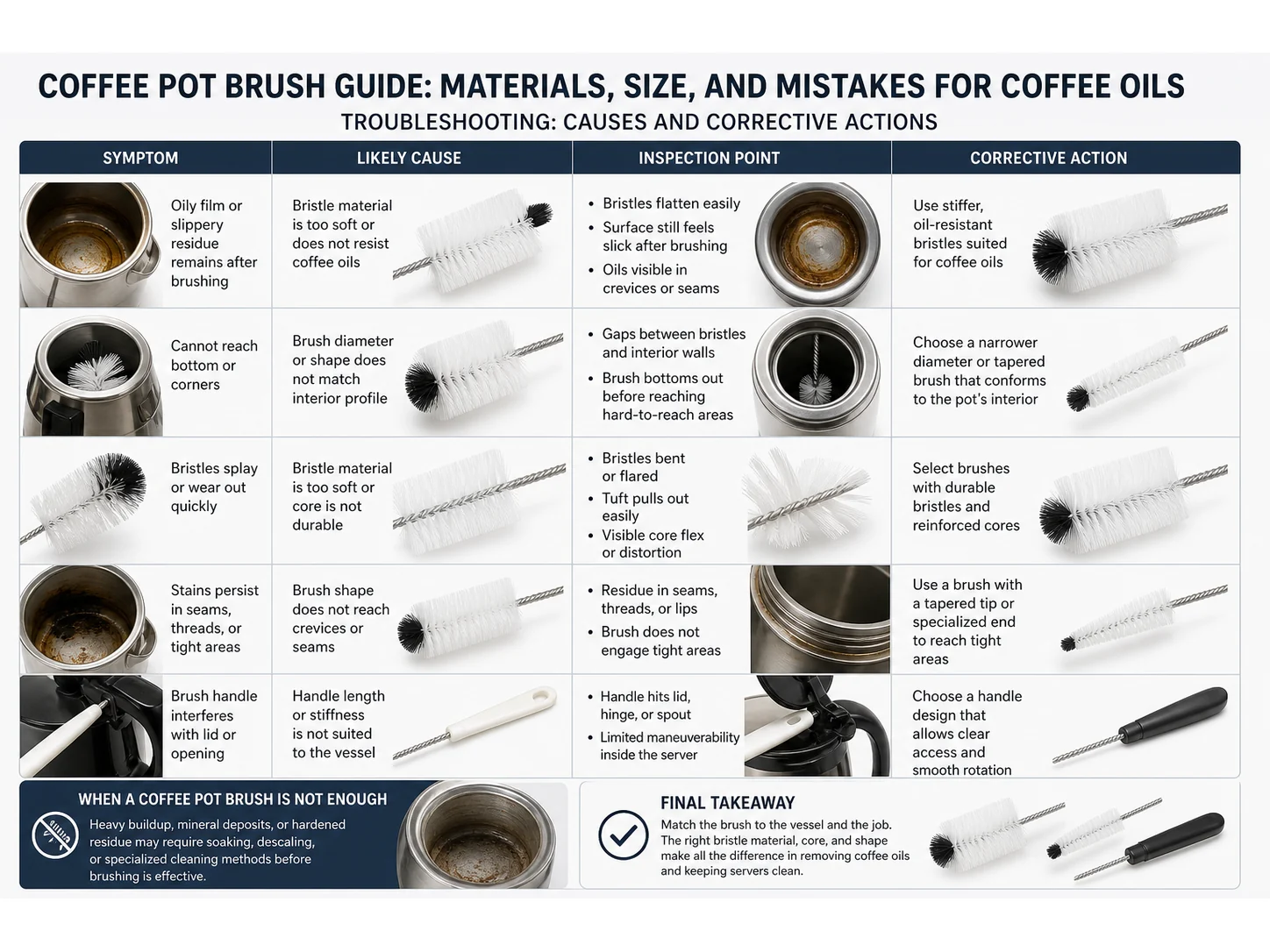
What Is a Coffee Pot Brush?
A coffee pot brush is a long-handled, narrow cleaning tool with bristles shaped to conform to the interior profiles of coffee servers, airpots, satellite brewers, and urn liners. Unlike general bottle brushes or kitchen scrubbers, a coffee pot brush is selected specifically to handle coffee oils—polymerized fats and aromatic compounds that build up as a brown, odor-trapping film when left untreated. The brush must combine gentle but sufficient scrubbing action with full surface contact to prevent oil buildup without introducing micro-scratches that can harbor bacteria or degrade glass and stainless steel finishes.
Common Types of Coffee Pot Brushes
Coffee pot brushes generally fall into a few categories based on construction and intended equipment:
- Standard straight-handle brushes – simple rod or twisted-wire core with bristles arranged radially; best for open-top glass decanters and straightforward pot shapes.
- Flexible or bendable brushes – wire core that can be bent to follow curved spouts or sidewalls; useful for airpots and vacuum-insulated servers.
- Detail brushes / mini brushes – small head, often angled or short-bristled, for spray heads, shower screens, and portafilter gasket grooves.
- Mounted or machine-integrated brushes – brushes built into cleaning stations, automated wash systems, or CIP (clean-in-place) setups for large brewing installations.
Material Comparison: Bristles and Cores
Choosing the right materials is the most critical decision for effective and safe cleaning. Below is a comparison of common bristle and core options for coffee pot brushes.
| Material / Feature | Best For | Pros | Cons | Typical Use Case |
|---|---|---|---|---|
| Nylon bristles (soft to medium) | Glass decanters, delicate liners | Non-scratch, good chemical resistance, cost-effective | May not scrub heavy baked-on oils; can mat or deform in very hot water over time | Daily cleaning of standard glass coffee pots |
| Polyester bristles (medium to stiff) | Stainless steel urns, heavier residue | Better stiffness retention in hot water, durable, good chemical resistance | Too stiff for some fragile glass; slightly higher cost | Stainless steel shuttle brewers, back-of-house urns |
| Natural tampico fiber | Gentle scrubbing of glass and fine finishes | Soft, absorbent, won’t scratch; biodegradable | Absorbs water, slower to dry, less durable in industrial use | Manual cleaning of high-end glass serving vessels |
| Abrasive-impregnated nylon | Heavy carbonized oil removal | Aggressive cleaning power for stubborn buildup | Risk of scratching if overused; not for everyday use on fine surfaces | Periodic deep cleaning of stainless steel urns and boilers |
| Stainless steel wire bristles | Metal parts only, extreme buildup | Maximum scrubbing power, long life | Will scratch glass and soft metals; not food-contact safe without thorough rinsing | Boiler plates, burner rings, non-food-contact surfaces (use with extreme caution) |
| Twisted galvanized wire core | General use with standard handles | Strong, inexpensive, holds bristles well | Can rust if coating wears; not for acidic or continuous wet environments | Most common core for replacement brushes |
| Stainless steel wire core | Wet, acidic, or sanitary environments | Corrosion-resistant, long-lasting, hygienic | Higher cost; less flexible than galvanized wire | Food processing, high-humidity washdown areas |
How to Choose the Right Coffee Pot Brush
Selection should be based on four practical factors:
- Surface sensitivity: If the pot is glass or has a special coating, stick with soft nylon or tampico. For stainless steel, polyester or abrasive nylon may be acceptable.
- Residue type: Fresh coffee oils wipe away easily with soft bristles. Baked-on, polymerized oil from high-heat holding may require stiffer material or occasional abrasive brushes.
- Equipment geometry: Measure the pot opening diameter, the narrowest neck, and the farthest interior corner. The brush head diameter should be slightly larger than the body cavity but able to pass through the neck without jamming. Length must reach all surfaces.
- Cleaning chemical exposure: Brushes used with commercial detergents, sanitizers, or high-temperature wash cycles need bristles and cores that resist chemical degradation and heat. Polyester and stainless cores often outperform nylon and galvanized wire in aggressive environments.
- Maintenance frequency and hygiene expectations: High-volume operations may benefit from durable, quick-drying materials to prevent bacterial growth. Brushes with sealed ends or plastic-coated handles are easier to sanitize.
Common Mistakes When Selecting a Coffee Pot Brush
- Choosing by size alone: A brush that fits the overall pot body may not fit through the neck. Always compare the brush head diameter to the narrowest opening.
- Ignoring material compatibility: Using a stainless steel wire brush on glass can cause irreparable scratches. Using a galvanized core in a wet, acidic environment can lead to rust contamination.
- Assuming all nylon is the same: Standard nylon softens in boiling water, reducing effective cleaning. For hot coffee urns, specify heat-resistant nylon or polyester.
- Overlooking handle length and grip: Too short a handle forces fingers into hot water or chemicals. Too thick a handle may not fit through dishwasher rack slots or mounting brackets.
- Buying based on cost drivers without checking core durability: Low-cost twisted-wire brushes can unwind or shed bristles quickly, increasing replacement frequency and potential foreign object risk.
- Skipping the trial or sample test: Before large orders, test a sample brush on the actual equipment with the real cleaning protocol. Surface contact, wear, and operator comfort can only be verified in practice.
When a Coffee Pot Brush Is the Wrong Choice
A coffee pot brush solves routine manual cleaning. It is not a substitute for:
- Automated clean-in-place (CIP) systems – In large breweries or cafeterias with multiple urns, CIP is more consistent and less labor-intensive.
- Chemical soak or descaling – Heavy mineral buildup (lime scale) often requires acid-based descalers; a brush alone cannot dissolve scale, and using an abrasive brush on scale can damage surfaces.
- Ultrasonic cleaning – For parts with intricate channels, ultrasonic tanks can remove oils without bristle contact, reaching areas a brush cannot.
- Specialized brush designs – If the coffee pot has a complex spout angle or a non-standard liner, an off-the-shelf coffee pot brush may leave dead spots. A custom brush design, developed with a supplier using a drawing or sample pot, may be required.
Final Takeaway
Choosing a coffee pot brush starts with understanding the exact surface you are cleaning, the type of coffee oil residue you face, and the physical access limitations of your equipment. Match the bristle material to surface sensitivity and chemical exposure, verify the dimensions with a sample test, and avoid the trap of buying generic brushes that fit “most” pots but not yours. A well-chosen brush improves hygiene, extends equipment life, and reduces the labor of manual cleaning.
Frequently Asked Questions
Can I use a regular bottle brush to clean my coffee pot?
It might work for a basic glass carafe, but bottle brushes often lack the right bristle stiffness, density, or shape to remove coffee oils effectively from the curved bottom and shoulder areas typical in coffee pots. They may also have metal parts that scratch glass.
What bristle material is safest for glass coffee decanters?
Soft to medium nylon or natural tampico fiber is generally safe and effective. Avoid any brush with metal bristles or abrasive particles on glass.
How often should a coffee pot brush be replaced?
Replace the brush when bristles show visible wear, matting, or loss of stiffness; when the core bends permanently; or when there are signs of rust or corrosion. In high-volume commercial settings, this might be monthly; in lighter use, quarterly.
Does a coffee pot brush need to be heat-resistant?
Yes, if you clean pots immediately after brewing or use hot water or steam. Nylon bristles can deform above 180°F (82°C). Polyester and certain engineered nylons retain stiffness better at higher temperatures.
Can a coffee pot brush remove hard water stains?
A brush alone typically cannot remove mineral scale. You need a descaling solution first. After descaling, the brush can help remove loosened residue. Do not use a metal brush on glass even during descaling; stick with nylon.
What is the ideal brush diameter for a standard 12-cup glass carafe?
There is no universal standard, as carafe shapes vary. Measure the interior diameter at its widest point, then choose a brush head about 0.25–0.5 inch (6–12 mm) larger to ensure good wall contact. Always check that it passes through the neck opening.
How do I sanitize a coffee pot brush between uses?
Rinse thoroughly in hot water, remove any visible debris, and soak or spray with a food-safe sanitizer according to local health code. Hang to dry completely. Brushes with plastic-coated handles or sealed ends are easier to keep sanitary.
What should I do if my coffee pot has a very narrow spout that a brush can’t reach?
Look for a flexible brush with a thin, bendable wire core, or consider a specialty spout brush. In extreme cases, a custom design based on a drawing of the pot may be needed, but always check if a combination of chemical soak and a standard brush can do the job before ordering a custom tool.
Technical References
- CDC — Preventing Food Poisoning
- eCFR — 21 CFR 177.1500 Nylon Resins
- eCFR — 21 CFR 177.1630 Polyethylene Phthalate Polymers
- FDA — Food Safety in Your Kitchen
- NIST — Metric SI
Which bristle material fits this job — Nylon PA, AISI 304 Stainless Steel Wire or Tampico Fiber?
| Material | Continuous temperature (°C) | Peak temperature (°C) | Water absorption | Hardness |
|---|---|---|---|---|
| Nylon PA | 93 | 121 | 0.3–9% by PA grade and conditioning | Medium to firm; filament diameter and trim length control bending force. |
| AISI 304 Stainless Steel Wire | 400 | 500 | 0% | Rockwell B 70–95 depending on temper and cold work |
| Tampico Fiber | 70–90 | 110–130 | 10–18% | — |
| Abrasive Nylon | 120 | 150 | 0.1–1.0% | Abrasive filament; stiffness and cutting level is controlled by PA base, grit type, grit size, filament diameter and trim height. |
Figures as published by Brushtec / DuPont; Alleima; Perlon. Confirm the exact grade against the supplier datasheet before ordering.
What should replace Nylon PA for coffee oils?
- Nylon PA — Compare Nylon PA with PP, PBT, PET. Change material when wet stiffness, temperature, chemical resistance, conductivity, particle shedding, or surface marking becomes the limiting factor.
- AISI 304 Stainless Steel Wire — Use AISI 316 stainless steel wire for chloride, marine, dairy, beverage, chemical washdown, or higher pitting-resistance requirements. Use carbon steel for dry aggressive cutting and brass or abrasive nylon for lower marking risk.
- Tampico Fiber — Compare Tampico Fiber with Compare with horsehair for softer dry contact, sisal for firmer plant-fiber scrubbing and nylon for more uniform recovery. Change material when wet stiffness, temperature, chemical resistance, conductivity, particle shedding, or surface marking becomes the limiting factor.
- Abrasive Nylon — Compare Abrasive Nylon with PP, PBT, PET. Change material when wet stiffness, temperature, chemical resistance, conductivity, particle shedding, or surface marking becomes the limiting factor.