
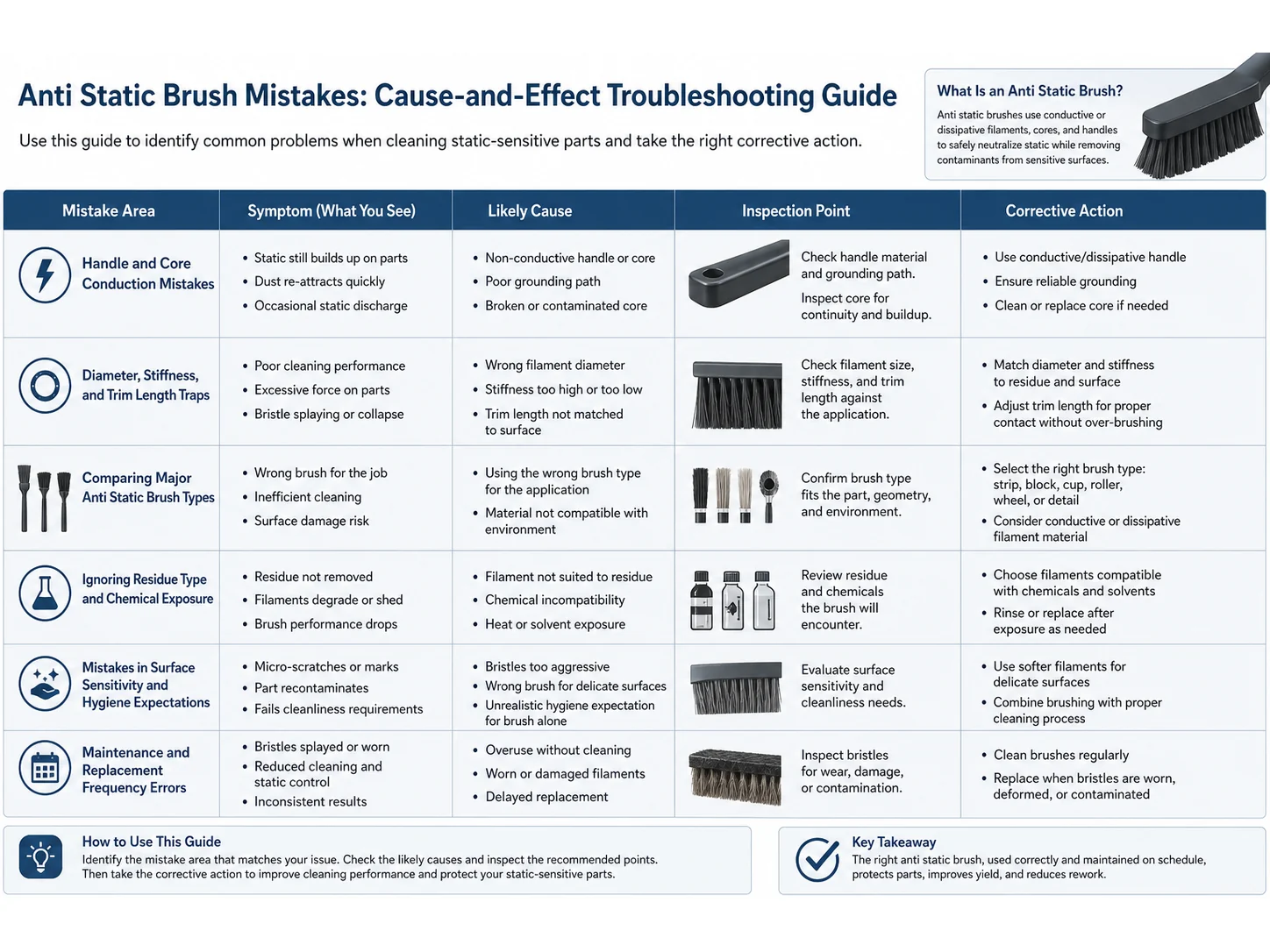
What Is an Anti Static Brush?
An anti static brush is a hand-held or machine-mounted tool that combines conductive or dissipative bristles with a grounded or low-charge-generating handle. Its primary function is to remove loose particles from static-sensitive surfaces without building up a damaging potential difference. Unlike standard cleaning brushes, a properly designed anti static brush safely channels stray charges away from sensitive traces, contacts, and films.
Common Bristle Material Mistakes
Selecting the wrong bristle material is the most frequent cause of brush failure in static-sensitive applications. Many buyers default to natural animal hair or standard nylon, assuming “soft” equals “safe.” In reality, natural hair can generate and hold triboelectric charges, while unfilled nylons easily accumulate static. The safest choices are conductive carbon fiber, static-dissipative synthetic blends, or metal wire where surface abrasion is not a concern. Always match the bristle material to the acceptable surface resistivity range for your process (typically 10³ to 10⁹ ohms).
Handle and Core Conduction Mistakes
Even with static-safe bristles, the brush fails if the handle or core is insulating. A common oversight is using a wooden or painted handle that prevents charge dissipation. In hand-held applications, the operator must be linked to a ground path—typically through a conductive handle and a grounding cord or wrist strap. In machine-mounted applications, the brush holder must be metallic and grounded. Verify that the entire tool, from bristle tip to ground point, provides a continuous electrical path.
Diameter, Stiffness, and Trim Length Traps
Too often, buyers order by “small, medium, large” without specifying the filament diameter, fill density, and trim length. A 0.05 mm carbon fiber filament feels soft but can reach between closely spaced pins, while a 0.15 mm filament provides stiffness for scrubbing flux residues but risks bending fine leads. Stiffness also changes with trim length: a shorter trim creates a firmer brush face. Define the exact filament diameter, overall brush width, and trim length required for your component geometry. For through-hole PCB work, a 0.07–0.10 mm diameter and 10–15 mm trim are common starting points.
Comparing Major Anti Static Brush Types
The table below compares common anti static brush construction types for use in electronics, film, and vinyl record applications. Use it to narrow options based on your surface sensitivity and cleaning task.
| Brush Type | Bristle Material | Typical Resistivity | Best For | Watch Out For |
|---|---|---|---|---|
| Carbon Fiber Hand Brush | Conductive carbon fiber | 10³–10⁶ Ω | PCB dust removal, flux brushing | Fiber shedding, stiffness control |
| Static-Dissipative Synthetic | Filled nylon or PBT | 10⁶–10⁹ Ω | Optical surfaces, film cleaning | Solvent resistance, abrasion |
| Conductive Metal Wire | Brass, stainless, or copper alloy | <10³ Ω | Heavy residue, EMI grounding | Surface scratching, spark risk |
| Goat Hair Anti-Static | Natural hair with conductive treatment | Varies, often >10⁹ Ω | Vinyl records, delicate optics | Charge retention, moisture sensitivity |
| Strip/Block Brush | Conductive filaments in aluminum holder | 10³–10⁶ Ω | Machine mounting, web cleaning | Custom sizing, grounding path integrity |
Ignoring Residue Type and Chemical Exposure
Static control matters, but chemical compatibility matters just as much. A brush that works for dry dust may degrade when exposed to IPA, flux removers, or acidic residues. Carbon fiber bristles are generally resistant to common solvents, but the epoxy binder in some strip brushes can soften. When wet cleaning is part of the process, specify solvent-resistant bristle binders and conductive handle materials that won’t swell or corrode. Also note: some anti static brushes shed carbon particles when wetted—this may be unacceptable for optical or medical surfaces.
Mistakes in Surface Sensitivity and Hygiene Expectations
Not every “anti static” brush is cleanroom rated. A common mistake is using a standard conductive brush in an ISO Class 5 environment, where bristle shedding and outgassing become contamination risks. If you have strict particle shedding limits, ask for bristle retention test data or request laser-sealed filament tips. Similarly, for food-grade or medical applications, verify that all wetted materials meet FDA or USP requirements. Do not assume that an electronics-grade brush is automatically safe for indirect food contact.
Maintenance and Replacement Frequency Errors
Anti static brushes do not last forever. Bent filaments create uneven pressure and can transfer charges unpredictably. Wear also reduces bristle conductivity over time as coatings or fibers break. A common maintenance mistake is storing brushes bristle-down, which deforms the trim and traps contaminants. Store brushes hanging or in protective tubes. Replace when visual inspection shows more than 10% bent, missing, or discolored filaments—or when surface resistance measurements drift out of spec.
How to Choose the Right Anti Static Brush
Instead of searching for a “best” brush, build a requirement checklist:
- Surface type: bare PCB, conformal coated, film, vinyl, optical glass?
- Residue: dry dust, flux, toner, biological, or oil?
- Geometry: fine-pitch SMD, through-hole, connectors, flat media?
- Environment: cleanroom, bench top, wet bench, inline machine?
- ESD requirements: acceptable surface resistivity range per ANSI/ESD S20.20 or internal spec.
- Chemical exposure: solvent contact, frequency, duration.
- Custom dimensions: width, filament diameter, trim length, holder design.
- Hygiene/outgassing: cleanroom class, VOC limits, FDA/USP needs.
Share this checklist with potential suppliers, and always request a sample for in-house testing before committing to a production order. A brush that works in a supplier’s lab can fail on your actual component mix.
When an Anti Static Brush Is the Wrong Choice
An anti static brush is a contact cleaning tool. It cannot replace ionization, tacky rollers, ultrasonic cleaning, or CO₂ snow cleaning when the risk demands non-contact charge neutralization or sub-visible particle removal. If your process requires absolute charge elimination below 50 V, you may need ionized air in parallel with brushing. If contamination is adhesive or oily, a dry brush will only smear it. Recognize the boundary: when cleanroom wipes, solvents, or automated cleaning systems are specified in your control plan, the brush alone is insufficient. Similarly, if you are cleaning exposed semiconductor wafers or delicate MEMS structures, a standard conductive brush is likely too aggressive—consult an applications engineer for ultra-fine, ultra-clean alternatives.
Final Takeaway
The most expensive anti static brush mistake is selecting a tool by appearance or brand name instead of defining it by measurable electrical, mechanical, and chemical requirements. Start with your surface resistivity target, consider real-world operating conditions, and validate thoroughly. A low-cost brush that causes one field failure costs far more than a properly specified tool.
Frequently Asked Questions
What makes a brush “anti static” instead of just conductive?
A true anti static brush balances conductivity and mechanical properties to dissipate charge without generating sparks or attracting dust. Pure conductors can cause rapid discharges that damage sensitive components; a dissipative range (10⁶–10⁹ Ω) is often safer for delicate electronics.
Can I use an anti static brush for cleaning vinyl records?
Yes, but choose a brush specifically designed for vinyl—typically carbon fiber or treated goat hair—to avoid scratching. Ensure the brush handle is conductive or grounded to remove static, and use light, sweeping motions without back-and-forth scrubbing.
How do I test if my anti static brush is still working?
Use a surface resistance meter to measure the resistance from the bristle tips to the handle contact point. Compare against the manufacturer’s specification. If the reading is significantly higher, the filaments may be worn or coated with contamination. Visual inspection for bent or missing fibers is also critical.
Is a carbon fiber brush safe for optical lenses?
Not universally. Carbon fiber can be abrasive on soft optical coatings. For lenses and filters, consider static-dissipative synthetic brushes with a soft, non-abrasive filament and verify linting characteristics. Always test on a reject part first.
What trim length should I choose for cleaning between IC leads?
For fine-pitch components (0.5 mm or less), a shorter trim (6–10 mm) with a filament diameter under 0.07 mm provides better control and reduces lead bending. Longer trims can work but may require a stiffer filament to prevent splaying.
Can I mount an anti static brush on a machine for automated cleaning?
Yes, strip or block brushes with conductive aluminum holders are common for inline web cleaning, PCB conveyors, and panel cleaning. Ensure the mounting bracket is grounded and that the brush width matches your media. Custom lengths and hole patterns can usually be accommodated by the manufacturer.
Why does my anti static brush shed fibers after contact with IPA?
Isopropyl alcohol and other solvents can attack the epoxy binder used to hold bristles in some strip brushes. If wet cleaning is required, specify a solvent-resistant brush or request a sample for compatibility testing. Shedding in a cleanroom is a serious contamination risk.
Technical References
Which bristle material fits this job — Carbon Fiber, Goat Hair or Nylon PA?
| Material | Continuous temperature (°C) | Peak temperature (°C) | Water absorption |
|---|---|---|---|
| Carbon Fiber | 200–350 | 400–500 | ≤0.10% |
| Goat Hair | 50–70 | 90–110 | 12–20% |
| Nylon PA | 93 | 121 | 0.3–9% by PA grade and conditioning |
Figures as published by Brushtec / DuPont. Confirm the exact grade against the supplier datasheet before ordering.
What should replace Carbon Fiber when it stops working?
- Carbon Fiber — Compare Carbon Fiber with Conductive nylon, anti-static filament, stainless micro-wire, standard nylon. Change material when wet stiffness, temperature, chemical resistance, conductivity, particle shedding, or surface marking becomes the limiting factor.
- Goat Hair — Compare Goat Hair with Boar bristle, goat hair, microfiber. Change material when wet stiffness, temperature, chemical resistance, conductivity, particle shedding, or surface marking becomes the limiting factor.
- Nylon PA — Compare Nylon PA with PP, PBT, PET. Change material when wet stiffness, temperature, chemical resistance, conductivity, particle shedding, or surface marking becomes the limiting factor.
- Aluminum Holder — Compare Aluminum Holder with Stainless holder, PVC holder, flexible polymer backing. Change material when wet stiffness, temperature, chemical resistance, conductivity, particle shedding, or surface marking becomes the limiting factor.