
What Is a Bottle Brush Set?
A bottle brush set typically includes one or more brushes with long handles and bristled heads sized for internal cleaning. The set may contain interchangeable brushes for different diameters, stiffnesses, and residue types. For glass cups, the right set must combine effective cleaning with enough softness to avoid micro-scratches that harbor bacteria and weaken the material over time.
Common Bottle Brush Set Materials and Designs
The heart of any bottle brush set is the bristle material and the handle. Knowing the basics helps you spot mismatches before they ruin glassware.
- Silicone bristles: Non-porous, heat-resistant, and gentle on glass. Ideal for delicate crystal and daily use. Less effective on stuck-on residues unless combined with soaking.
- Nylon bristles: Versatile and moderately stiff. Works well for general cleaning but can be too abrasive if the filament is thick and ends are cut flat.
- Natural bristles (tampico, horsehair): Often softer, good for fine glassware, but may degrade faster with harsh chemicals.
- Handle and core: Stainless steel cores with plastic or silicone coatings prevent scratches at the neck. Bare metal can chip glass rims.
Quick-Comparison Table: Bottle Brush Set Options for Glass Cups
| Option Type | Best For | Bristle Material | Typical Stiffness | Handle Design | Risk to Glass | Key Consideration |
|---|---|---|---|---|---|---|
| Soft silicone brush | Delicate crystal, daily rinse | Silicone | Low | Flexible plastic or coated wire | Minor scuff if grit present | Excellent hygiene; may need soaking for fats |
| Medium nylon brush | General glass, smoothie residue | Nylon | Medium | Rigid stainless with plastic coating | Scratches if too coarse | Check filament end type (flagged vs. cut) |
| Stiff natural bristle | Heavy buildup, barware | Tampico/horsehair | Medium–firm | Uncoated wire or wood | Wire can scratch neck | Requires thorough drying |
| Adjustable/angled brush | Curved glass, carafes | Nylon or silicone | Variable | Bendable wire frame | Low if coated | Confirm angle lock mechanism |
| Mini bottle brush set | Narrow stems, tasting glasses | Nylon or micro-silicone | Low–medium | Thin flexible wire | Minimal if used gently | Check smallest diameter needed |
How to Match a Bottle Brush Set to Your Glass Cup Cleaning Task
Choosing the right brush isn’t about brand—it’s about the residue, the glass sensitivity, and how you clean.
- Residue type: Protein-based films (milk, smoothies) need soft, flagged nylon bristles that lift without scraping. Oily residues suit silicone because it releases fats easily in hot water. Tannins (wine, tea) often require a mild abrasive like a medium nylon brush.
- Surface sensitivity: Thin-walled crystal or antique glass demands low stiffness. Use a silicone brush or an ultra-soft flagged nylon brush. Thick commercial glass can tolerate medium stiffness.
- Cleaning agent compatibility: Some nylons degrade with strong alkaline detergents. Silicone withstands broad pH ranges and high temperatures. Check if the brush set is rated for your sanitizer or dishwasher (many small brushes are hand-wash only).
- Hygiene expectations: In food service or healthcare settings, non-porous materials like silicone reduce bacterial harborage. Sets must allow disassembly for sanitizing.
- Diameter and reach: The brush head should fill about 75% of the cup’s inner diameter for proper contact. A set with multiple sizes lets you clean everything from narrow stemware to wide tumblers.
- Handle flex and neck protection: A flexible handle helps navigate curved interiors, but a wire core must be fully coated. Bare metal at the neck will chip glass rims over time.
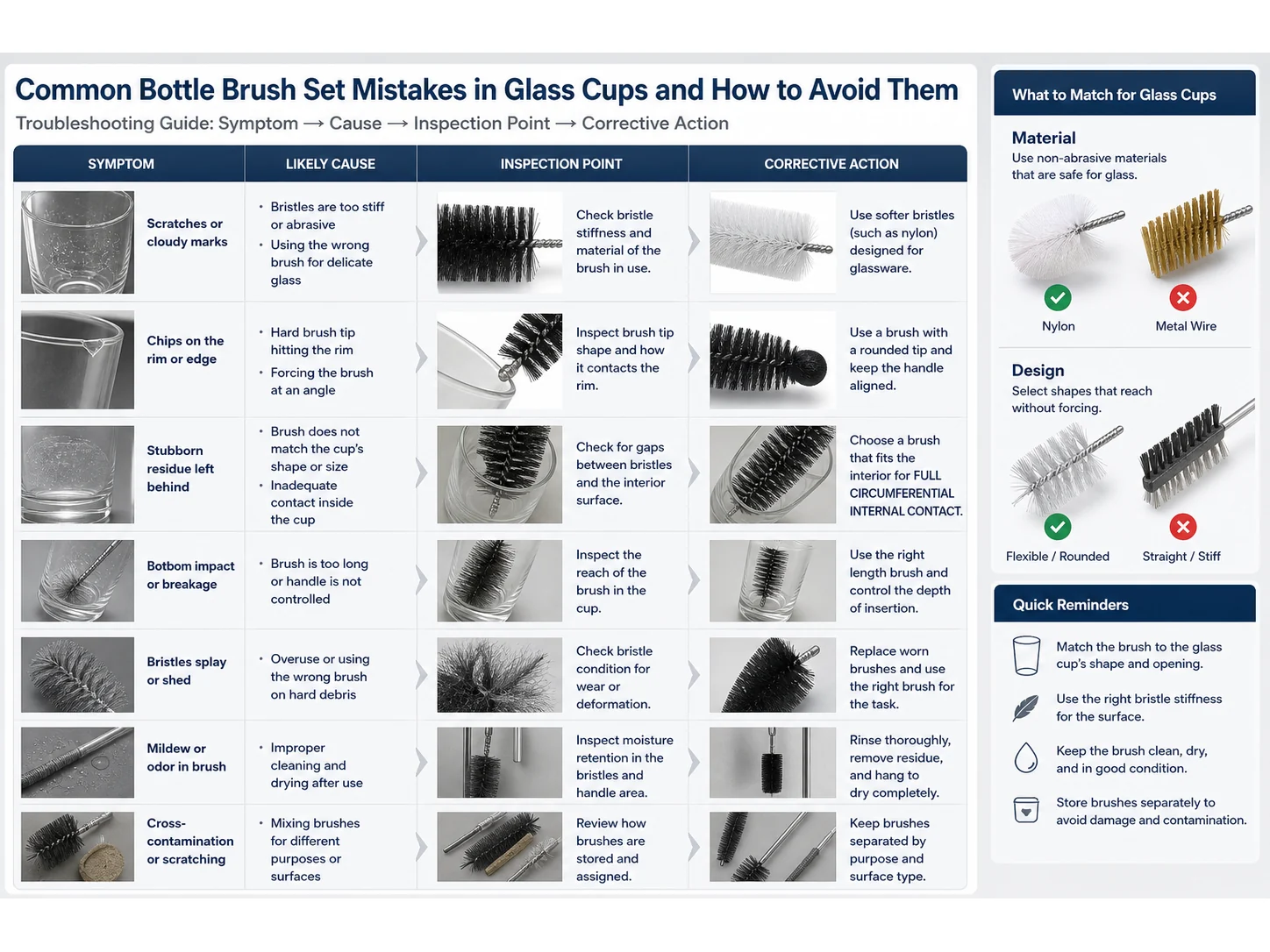
Top 7 Bottle Brush Set Mistakes That Damage Glass Cups
- 1. Choosing a brush too stiff for the glass. Stiff bristles etch micro-scratches that dull clarity and become hygiene traps. For glass cups, always start with the softest brush that still cleans effectively.
- 2. Ignoring brush head shape. Flat-ended bristle bundles can’t clean the curved bottom of a glass. Dome-shaped or rounded heads match the internal contour and prevent missed residue.
- 3. Using a straight handle for curved vessels. A rigid, straight brush won’t reach the shoulder of a curved carafe or wine glass. An angled or flexible brush solves this without extra force.
- 4. Picking the wrong diameter. An oversized brush applies uneven pressure and risks jamming; an undersized brush misses the wall contact. Measure the narrowest point and select a brush head diameter about 10–20% smaller than that inside diameter.
- 5. Exposing bristles to incompatible chemicals. Some nylon brushes swell or become brittle with strong solvents. Check the brush material’s chemical resistance table, especially if using quaternary ammonium sanitizers.
- 6. Using a contaminated or worn brush. Frayed bristles lose cleaning power and can harbor mold. Replace brushes at the first sign of deformation or odor.
- 7. Applying excessive pressure. A common reflex is to scrub harder, but that forces bristle tips sideways into the glass, multiplying scratch risk. Let the bristles do the work with gentle rotation.
When a Bottle Brush Set Isn’t Enough: Know Its Limits
A bottle brush set handles mechanical cleaning, but some situations demand more. Heavily calcified glass, deeply baked-on deposits, or sanitary environments with strict log-reduction requirements may need ultrasonic cleaning, high-pressure spray systems, or thermal disinfection. If the brush cannot consistently remove residue after two gentle passes, consider increasing soak time, switching to a chemical pre-treatment, or consulting cleaning equipment specialists. For custom glassware with extremely narrow or off‑axis openings, a supplier drawing review ensures the brush design matches the actual internal geometry.
Final Takeaway: Cleaning Glass Cups Without Regret
Match the brush stiffness to your glass’s sensitivity, pick a head shape that mirrors the cup’s interior, and always use a coated handle to protect the rim. The most common mistakes boil down to forcing the wrong brush to do the job. A well-chosen bottle brush set extends the life of your glassware and maintains hygiene without extra work.
Frequently Asked Questions
Can I use a metal-wire brush for cleaning glass cups?
No. Metal bristles or an uncoated metal core will scratch and chip glass almost instantly. Even a coated wire core should be inspected regularly for coating damage.
How do I measure the right brush diameter for irregularly shaped glasses?
Measure the narrowest internal diameter (often the neck). Choose a brush head diameter that is 10–20% smaller. For flared glasses, a tapered brush may be better than a uniform cylinder.
Is silicone always safer than nylon for glass?
Silicone is generally safer for delicate glass because it is smooth and non-porous. However, its cleaning action is mild. For tough, stuck-on residues, a soft flagged nylon brush (with split tips) can be both gentle and effective.
How often should I replace a bottle brush from a set?
Replace any brush when bristles show visible wear, splay, or loss of shape; when odors persist after cleaning; or at least every three to six months in frequent use, whichever comes first.
Can I clean my bottle brush set in the dishwasher?
Some silicone and nylon brushes are dishwasher-safe (top rack), but frequent high‑heat cycles can warp plastics. Always check the manufacturer’s care instructions. Wire-core brushes are best hand‑washed and dried immediately to prevent rust.
What’s the best way to dry a bottle brush set after cleaning glass cups?
Rinse thoroughly with hot water to remove chemical residue, shake off excess water, and hang or stand the brushes with bristles facing down. Ensure good airflow; storing wet brushes in a closed container promotes microbial growth.
Technical References
- CDC — Preventing Food Poisoning
- eCFR — 21 CFR 177.1500 Nylon Resins
- EPA — Safer Choice
- FDA — Food Safety in Your Kitchen
Which bristle material fits this job — Nylon PA, Silicone or Horsehair?
| Material | Continuous temperature (°C) | Peak temperature (°C) | Water absorption | Hardness |
|---|---|---|---|---|
| Nylon PA | 93 | 121 | 0.3–9% by PA grade and conditioning | Medium to firm; filament diameter and trim length control bending force. |
| Silicone | 200–250 | 280–300 | 0.1–1.0% | Shore A 20–80 |
| Horsehair | 60–80 | 100–120 | 8–15% | — |
| AISI 304 Stainless Steel Wire | 400 | 500 | 0% | Rockwell B 70–95 depending on temper and cold work |
| Polypropylene PP | 80–100 | 120–140 | ≤0.03% | Shore D 65–75 |
Figures as published by Brushtec / DuPont; Alleima; Perlon. Confirm the exact grade against the supplier datasheet before ordering.
When are Bottle & Container Brushes the wrong choice for bottle brush?
- Bottle & Container Brushes — Use a tube or bore brush for a long narrow passage with little vessel-body geometry, or use a non-brush method when the surface or residue cannot tolerate brushing.
- Nylon PA — The nylon family spans several grades, so heat, moisture and chemical limits should follow the selected PA resin rather than a generic nylon value.
- Silicone — Not for aggressive scraping, rust removal or metal deburring.
- Horsehair — Not for aggressive scrubbing or wet chemical process cleaning.
What should replace Bottle & Container Brushes for bottle brush?
- Bottle & Container Brushes — Bottle and container brushes are selected around an opening plus a larger vessel body and bottom geometry; tube and bore brushes are selected mainly around a long diameter-controlled passage. Closest alternative: Tube & Pipe Bore Brushes.
- Nylon PA — Compare Nylon PA with PP, PBT, PET. Change material when wet stiffness, temperature, chemical resistance, conductivity, particle shedding, or surface marking becomes the limiting factor.
- Silicone — Compare Silicone with PP, TPE, Nylon. Change material when wet stiffness, temperature, chemical resistance, conductivity, particle shedding, or surface marking becomes the limiting factor.
- Horsehair — Compare Horsehair with Boar bristle, goat hair, microfiber. Change material when wet stiffness, temperature, chemical resistance, conductivity, particle shedding, or surface marking becomes the limiting factor.