
What Is a Filter Tube Cleaning Brush?
A filter tube cleaning brush is a brush with a slender core wire and bristles arranged radially or spirally to reach into cylindrical openings. Its main function is to dislodge and remove debris, scale, biofilm, or chemical residue from the inner surface of a tube. For small internal diameters, the brush must balance stiffness, core flexibility, and tip safety to clean effectively without jamming or damaging the wall.
Common Types and Materials for Small-Diameter Filter Tube Brushes
Brushes for small IDs come in several material and construction variations. The most common options include:
- Nylon bristle brushes: Soft to medium stiffness; safe for plastic, glass, and soft metals; good for routine debris and light biofilm.
- Brass bristle brushes: Medium stiffness; effective on scale and corrosion in metal tubes; can scratch softer materials.
- Stainless steel bristle brushes: Aggressive; used for heavy rust, scale, or weld cleaning in steel or iron tubes; not for delicate surfaces.
- Abrasive nylon brushes: Nylon impregnated with silicon carbide or aluminum oxide; provide aggressive cleaning with less risk of deep scratching than wire.
- Pipe cleaner or cotton‑tip style brushes: Flexible, absorbent; best for light dust, swabbing, or hygienic applications.
- Twisted‑wire stem vs. coiled wire vs. plastic handle: Twisted wire provides flexibility and allows the brush to follow bends; coiled wire is stiffer for straight tubes; plastic handles are used for short lightweight brushes.
Filter Tube Cleaning Brush Comparison Table for Small IDs
| Brush Material | Bristle Stiffness | Best for Residue | Surface Sensitivity | Typical ID Range (mm) | Notes |
|---|---|---|---|---|---|
| Nylon | Low–medium | Dust, biofilm, light soiling | Safe on most plastics, glass, soft metals | 3–25+ | Available in many colors/diameters; chemical resistant |
| Brass | Medium | Scale, light rust, carbon | Not for soft plastics or aluminum | 6–25+ | Good heat conductivity; may discolor |
| Stainless Steel | High | Heavy scale, rust, weld spatter | Only for hard metals (steel, iron) | 12–25+ | Can be power‑driven in straight tubes |
| Abrasive Nylon | Medium–high | Adherent deposits, surface prep | Moderate; may scratch soft metals | 6–25+ | Combines scrubbing with less metal contamination |
| Cotton/Pipe Cleaner | Very low | Dust, moisture, light swabbing | Extremely safe | 2–15 | Absorbent; often disposable |
How to Choose the Right Filter Tube Cleaning Brush
Follow these decision steps to avoid mistakes:
- Measure the tube’s internal diameter accurately. Use calipers or a pin gauge. The brush should be slightly larger than the ID (typically 0.5–1 mm oversize) to ensure bristle contact, but never so large that it forces insertion.
- Identify the residue type. Soft biofilm needs a soft nylon brush; hard scale may need brass or abrasive nylon; heavy rust demands stainless steel.
- Assess the tube material. For delicate surfaces (polycarbonate, acrylic, anodized aluminum), stick with nylon or cotton. Brass or steel will gouge them.
- Check the tube’s depth and bends. A twisted‑wire stem can navigate gentle curves; a coiled wire core is rigid and better for straight, short tubes.
- Consider operating conditions. Will the brush be used wet, with chemicals, or in a food‑grade environment? Nylon, polypropylene, and certified food‑grade brushes exist; brass and steel may corrode in certain chemicals.
- Determine hygiene requirements. For pharmaceutical or food applications, choose an FDA‑compliant material and a design that can be sterilized (e.g., autoclavable nylon).
- If sizes are non‑standard, request a sample or provide a drawing. Many brush suppliers can fabricate custom diameters, bristle patterns, and handle lengths.
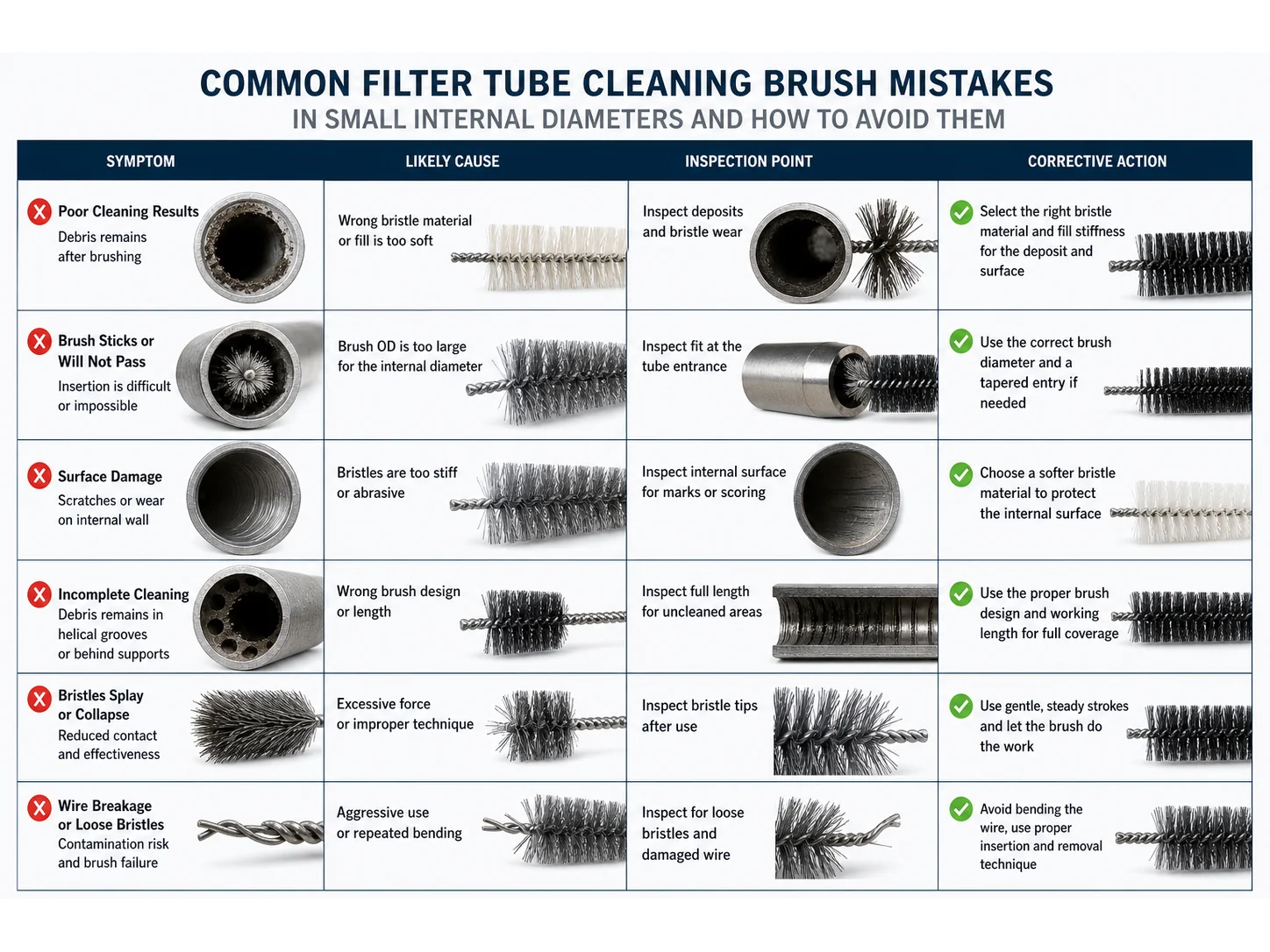
Common Mistakes When Using Filter Tube Cleaning Brushes in Small Internal Diameters
Mistake 1: Ignoring core wire diameter. For thin tubes, the core wire must be small enough to fit while still having enough tensile strength. A core that is too thin kinks and breaks easily; too thick may not enter the tube. Check the brush’s stem wire gauge.
Mistake 2: Using an oversized brush. A brush that is too large in diameter will jam, fray bristles, or even snap the core inside the tube. Always match the brush OD to the tube ID with a slight oversize (0.5–1 mm) for bristle contact, and test fit first.
Mistake 3: Wrong bristle material for the surface. Steel bristles on a polycarbonate filter housing will scratch and create light‑scattering damage or weak points. On stainless steel filter mesh, nylon may not remove mineral deposits effectively. Match bristle hardness to the tube material.
Mistake 4: Neglecting chemical compatibility. Nylon bristles can swell or degrade in strong acids or solvents. Brass may react with alkaline cleaners. Always verify the brush material resistance to your cleaning chemicals.
Mistake 5: Forgetting to account for tube depth and stem length. If the brush handle or stem is too short, the far end of the tube remains dirty. For deep tubes, use a brush with an extended stem or a flexible extension.
Mistake 6: Overlooking hygiene standards. In food, medical, or laboratory settings, a non‑certified brush can introduce contamination. Look for brushes designated as food‑grade, anti‑microbial, or autoclavable where required.
Mistake 7: Buying only by cost drivers or generic description. “Small tube cleaning brush” listings may not specify precise dimensions. Always request or confirm actual OD, bristle length, and overall brush length.
When a Filter Tube Cleaning Brush Is the Wrong Choice
While a filter tube cleaning brush is effective for routine maintenance and light to moderate fouling, there are limits:
- Blind holes with bottom contamination: A brush cannot push debris past a closed end. Use a vacuum, spray nozzle, or ultrasonic cleaning.
- Severe scaling or baked‑on deposits: For heat exchanger tubes with heavy mineral scale, a power‑driven tube cleaner (water‑powered or motorized) with a rotating brush or scraper may be required.
- Extremely small diameters (< 3 mm): Even micro‑brushes have limits. Consider chemical flushing, ultrasonic baths, or specialized micro‑cleaning tools.
- Critical surface finishes (e.g., mirror‑finished stainless steel, optical tubes): Any bristle contact may cause micro‑scratches. In these cases, a sample test is mandatory before full deployment, or a non‑contact method (e.g., solvent flush, CO₂ pellet cleaning) should be evaluated.
- When the tube has sharp bends or complex geometries: A straight brush cannot reach all surfaces. Flexible shaft brushes or chemical circulation are alternatives.
Final Takeaway
Avoid filter tube cleaning brush mistakes by first defining the tube ID, residue, and material sensitivity. Choose a brush with a compatible bristle and core, confirm stem length, and never assume a generic “small brush” will fit. When in doubt, provide a drawing or sample to a reputable supplier and test on a scrap tube before production use.
Frequently Asked Questions
What is the smallest internal diameter a filter tube cleaning brush can clean?
Most standard twisted‑wire brushes start at about 3–4 mm OD. Micro‑brushes and pipe cleaners can go down to 2 mm, but bristle density decreases. For diameters below 3 mm, non‑brush methods like chemical cleaning or ultrasonic baths are often more effective.
Can I use a brass brush inside a plastic filter tube?
Generally no. Brass bristles are harder than most plastics and will scratch or gouge the surface, creating areas where biofilm can take hold. For plastic tubes, always use nylon, abrasive nylon (if more aggressive cleaning is needed), or cotton.
How do I know if my brush handle is long enough?
Measure the total depth of the tube you need to clean. The brush’s working length (from tip to the point where bristles end) plus stem should exceed that depth by at least 50 mm to allow a comfortable grip. For deep tubes, look for brushes with extended stems or those that can be connected to a flexible rod.
Are nylon brushes safe for use with food‑grade filters?
Yes, provided the nylon is FDA‑compliant and the brush construction uses a stainless steel wire core that is food‑safe. Always request documentation from the supplier. For high‑purity applications, you may also need a certified cleanroom manufacturing process.
What should I do if a brush breaks inside the tube?
Stop all flow immediately. Do not push the broken piece further. Attempt retrieval carefully with a smaller retrieval hook, forceps, or a vacuum tool. If the broken piece is stuck or the tube is critical, disassemble the section if possible. Inspect the tube for internal scratches after removal.
Can I custom‑order a brush for a non‑standard tube size?
Absolutely. Most industrial brush suppliers accept custom orders. Provide the exact internal diameter, tube length, material of construction, and residue type. A dimensional drawing or a sample tube can help ensure a precise fit. This is especially recommended for low‑volume special applications.
How often should I replace my filter tube cleaning brush?
Replace the brush when bristles appear flattened, frayed, or noticeably shortened. A kinked or worn core wire is another sign of impending breakage. In high‑frequency use (e.g., daily filter cleaning), inspect at least monthly. Brushes used on abrasive residues like scale may need replacement every few weeks.
Do I need a different brush for wet vs. dry cleaning?
Not necessarily, but some materials perform better when wet. Nylon absorbs little moisture and works well in both conditions. Cotton pipe cleaners are more effective wet because they swell. Avoid using brass or steel brushes in standing water if corrosion is a concern; rinse and dry them after use.
Which bristle material fits this job — Nylon PA, AISI 304 Stainless Steel Wire or Abrasive Nylon?
| Material | Continuous temperature (°C) | Peak temperature (°C) | Water absorption | Hardness |
|---|---|---|---|---|
| Nylon PA | 93 | 121 | 0.3–9% by PA grade and conditioning | Medium to firm; filament diameter and trim length control bending force. |
| AISI 304 Stainless Steel Wire | 400 | 500 | 0% | Rockwell B 70–95 depending on temper and cold work |
| Abrasive Nylon | 120 | 150 | 0.1–1.0% | Abrasive filament; stiffness and cutting level is controlled by PA base, grit type, grit size, filament diameter and trim height. |
| Carbon Steel Wire | 200–300 | 350–450 | 0% | Rockwell C 40–60 |
| Brass Wire | 150–200 | 250–300 | 0% | Rockwell B 40–90 |
Figures as published by Brushtec / DuPont; Alleima; Perlon. Confirm the exact grade against the supplier datasheet before ordering.
What should replace Tube & Pipe Bore Brushes for tube cleaning brush?
- Tube & Pipe Bore Brushes — Tube and bore brushes work by radial contact inside a confined diameter; wire wheels and cups work mainly on external edges, profiles, welds, and broad surfaces.
- Nylon PA — Compare Nylon PA with PP, PBT, PET. Change material when wet stiffness, temperature, chemical resistance, conductivity, particle shedding, or surface marking becomes the limiting factor.
- AISI 304 Stainless Steel Wire — Use AISI 316 stainless steel wire for chloride, marine, dairy, beverage, chemical washdown, or higher pitting-resistance requirements. Use carbon steel for dry aggressive cutting and brass or abrasive nylon for lower marking risk.
- Abrasive Nylon — Compare Abrasive Nylon with PP, PBT, PET. Change material when wet stiffness, temperature, chemical resistance, conductivity, particle shedding, or surface marking becomes the limiting factor.