
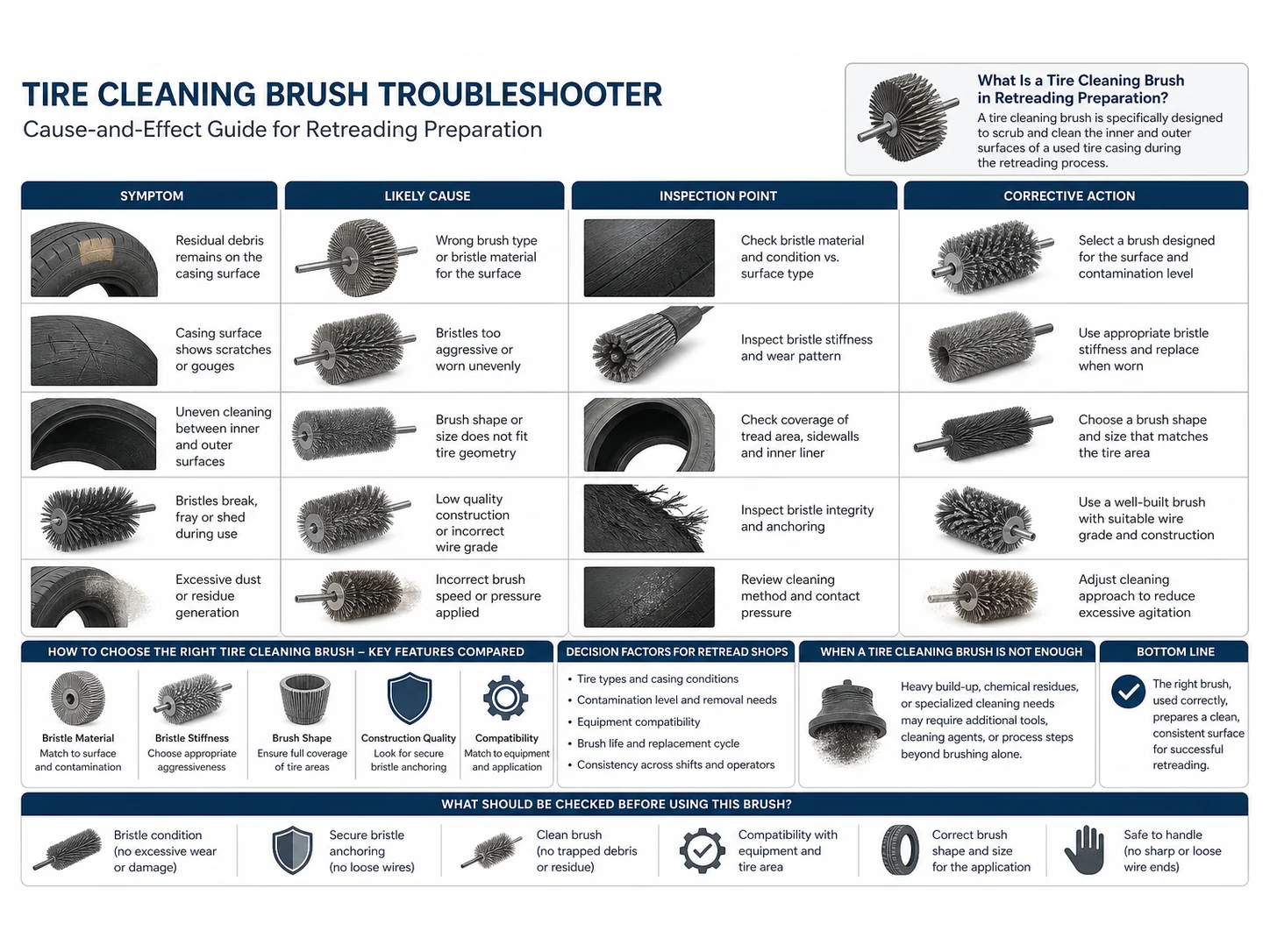
What Is a Tire Cleaning Brush in Retreading Preparation?
A tire cleaning brush is specifically designed to scrub and clean the inner and outer surfaces of a used tire casing during the retreading process. Unlike generic workshop brushes, these brushes must cope with hardened road grime, cured rubber dust, and often oil or chemical residues without scratching the surface excessively or degrading quickly. They can be found as strip brushes that wrap around a wheel, spiral brush rolls fitted to a shaft, or hand brushes with a sturdy handle. The goal is a uniformly clean substrate that ensures strong bonding when the retread rubber and cushion gum are applied.
Because the cleaning step directly affects adhesion, even small errors in brush selection can cause invisible problems that only appear after the tire is back on the road. Understanding the common mistakes helps you avoid costly rework.
Common Mistakes When Selecting and Using Tire Cleaning Brushes
Retreading teams often focus on buffing quality and overlook the cleaning stage. Here are the most frequent mistakes we see – and how to avoid each one.
- Mistake 1: Choosing the wrong filament material. Some shops default to a low-cost nylon brush designed for light dusting, but heavy rubber residue and road tar require more aggressive materials like crimped steel wire or abrasive-impregnated filaments. Solution: Match the filament material to the type of residue. Nylon or polypropylene works for light powder but fails on sticky contaminants. Wire brushes – either steel or brass-coated – handle tough build-up but must be used carefully to avoid scratching the tire surface.
- Mistake 2: Overlooking filament stiffness and diameter. A brush that is too stiff can gouge the rubber casing, reducing air-retention properties and creating weak spots. Too soft, and it won’t remove embedded dirt. Solution: Select a stiffness that matches your casing condition. For delicate casings, use a medium-stiff nylon brush with filament diameters between 0.30–0.50 mm. For heavy-duty cleaning, a 0.30 mm stainless steel wire brush offers effective scrubbing without deep scoring.
- Mistake 3: Ignoring mounting compatibility. Many brush rolls are sold by outside diameter and length, but the shaft diameter, keyway size, and flange attachment vary between buffing machine brands. Ordering the wrong mounting results in downtime and improvisations. Solution: Always specify your machine model and gather the shaft diameter, keyway dimensions, and the required brush face width before ordering a replacement. Custom brush rolls may be needed for older or foreign machines.
- Mistake 4: Underestimating chemical and temperature resistance. Some retreading processes use hot water, steam, or solvent-based cleaners. Standard nylon 6 bristles absorb moisture and soften above 80°C, losing their scrubbing power quickly. Solution: If your cleaning stage involves heat or harsh solvents, choose a brush with nylon 6/12, polyester, or polypropylene filaments that offer better chemical resistance and maintain stiffness at higher temperatures.
- Mistake 5: Sacrificing brush quality for the lowest cost drivers. Buyers may treat cleaning brushes as consumables and buy the lowest-cost roll available, but poor tufting, uneven trim, and substandard backing lead to rapid filament breakage and uneven cleaning. Solution: Evaluate brush quality by requesting a sample, checking tuft density, backing integrity, and filament retention. A more durable brush reduces changeover frequency and labor, offsetting the higher unit cost.
How to Choose the Right Tire Cleaning Brush – Key Features Compared
The table below highlights the most important characteristics to compare when selecting a tire cleaning brush for your retreading line. Use it as a quick reference to match brush types to your cleaning challenge.
| Feature | Option 1: Nylon Power Brush Roll | Option 2: Crimped Steel Wire Brush Roll | Option 3: Abrasive Filament Strip Brush |
|---|---|---|---|
| Typical filament material | Nylon 6 or 6/12 | Carbon steel or brass-coated steel wire | Nylon with silicon carbide or aluminum oxide grit |
| Stiffness level | Medium | High | Medium to high (depends on grit) |
| Best for residue type | Loose rubber dust, light powder, post-buff swarf | Heavy cured rubber, tar, rust, scale | Stubborn rubber deposits, old tread compound, combination contamination |
| Surface sensitivity | Safe on most casings with correct density | Risk of scratching if pressure is too high; can be used on truck tires with care | Good for aggressive cleaning on thick casings but not for thin sidewalls |
| Mounting style | Strip brush wrapped on a wheel, or complete roll with flanged hub | Typically wired or clamped onto a metallic hub; available in full rolls | Usually strip profiles; can be wound onto existing core or supplied as a roll |
| Wet / solvent use | Nylon 6/12 performs well with mild chemicals; avoid hot alkali | Steel may rust if not dried properly; brass-coated offers some corrosion resistance | Grit nylon holds up in wet conditions; verify bond integrity with solvent exposure |
| Service life | Good with regular use; may wear down after 3–6 months in heavy use | Longest lasting for tough cleaning; may wear unevenly if improperly balanced | Grit wears off over time; replace when cleaning effectiveness drops |
| Common mistake to avoid | Using in hot wash systems above 90°C | Allowing rust formation; failing to dry between shifts | Applying excessive pressure that can tear bristles |
Decision Factors for Retread Shops
When selecting a tire cleaning brush, consider these factors beyond just size and filament material:
- Type and age of residue. Older tires with baked-on dirt may need a wire brush first followed by a less aggressive nylon brush to avoid surface damage.
- Cleaning method. Will the brush be used dry, with water, or with chemical cleaners? This determines the required filament and backing material.
- Machine interface. Check whether your machine uses a through-shaft, flange mount, or a custom hub. Brush suppliers often require a drawing or exact measurements for a proper fit.
- Operating speed. High-speed buffing stations need balanced brush rolls to avoid vibration. Specify your RPM range when ordering replacements.
- Casing variety. If your retread shop processes multiple tire sizes and ply ratings, having a couple of different brush types (e.g., one medium and one aggressive) may optimize cleaning without reordering each time.
- Cleanliness standards. Shops producing retreads for premium commercial fleets may require a more refined finish, making filament density and material choice even more critical.
When a Tire Cleaning Brush Is the Wrong Choice
A tire cleaning brush plays a vital role, but it cannot correct every surface preparation problem. In the following situations, relying solely on a brush – even the best one – will lead to poor results:
- Severe casing corrosion or rust. If the steel belts or bead area show heavy rust, a tire cleaning brush will not remove deep corrosion. Mechanical blasting or a specialized rust removal process is needed before cleaning.
- Oil and grease penetration. When oil or diesel has soaked into the rubber, a surface brush simply spreads the contamination. The casing may need a solvent wipe-down and drying time before mechanical cleaning.
- Extreme uneven wear or damage. Tires with bulges, cuts, or exposed cords need inspection and possibly rejection, not aggressive brushing.
- Adhesive residue from previous repairs. Some old repair materials may require chemical softeners before brushing, as vigorous brushing can embed contaminants deeper.
Bottom Line
The best result comes from matching tire cleaning brush mistakes in retreading preparation and how to avoid them to the real cleaning task rather than forcing one brush to solve every condition. Confirm access, residue, surface limits, and replacement routine first; then use a small trial or inspection step before scaling the method into daily work.
What should be checked before using this brush?
Check access, residue type, surface sensitivity, bristle condition, and whether loosened debris can be removed safely after brushing.
Frequently Asked Questions
Does brushing replace buffing in the preparation sequence?
No. Brushing removes release agents, road dirt and loose rubber so that the buffing and cementing steps meet a clean casing; it does not create the bonding surface itself. Treating the brush as a preparation step in its own right is how contamination reaches the cement line, because a buffed surface over a dirty one looks correct and bonds poorly.
What type of tire cleaning brush is best for removing heavy rubber residue before retreading?
For heavy rubber residue, a crimped steel wire brush roll is often most effective. However, care must be taken to avoid scoring the casing. An abrasive filament brush with silicon carbide grit can also provide aggressive cleaning while being more forgiving on the rubber surface.
Can I use the same tire cleaning brush for all casing sizes?
While a single brush type may work for a range, optimal cleaning requires matching the brush diameter, face width, and filament stiffness to the casing dimensions. Truck tire casings typically need larger, stiffer brushes than light truck or passenger tires. Using the wrong size may result in incomplete cleaning or surface damage.
How often should tire cleaning brushes be replaced in a retread shop?
Replacement frequency depends on production volume, filament material, and the type of residue. Nylon brushes may last 3–6 months under moderate use, while wire brushes last longer but require monitoring for rust and uneven wear. A visual inspection and cleaning effectiveness test can indicate when replacement is needed.
What is the best way to prevent filament breakage on tire cleaning brushes?
To minimize breakage, ensure the correct operating speed and pressure. Overheating from excessive RPM or soaking in harsh chemicals can weaken filaments. Choose brushes with high tuft density and secure filament retention, and avoid dry-running the brush at high speeds.
Technical References
- OSHA — 1910.177 Servicing Multi-Piece and Single Piece Rim Wheels
- NHTSA — Tire Safety Ratings and Awareness
Which bristle material fits this job — Nylon PA, Rubber or AISI 304 Stainless Steel Wire?
| Material | Continuous temperature (°C) | Peak temperature (°C) | Water absorption | Hardness |
|---|---|---|---|---|
| Nylon PA | 93 | 121 | 0.3–9% by PA grade and conditioning | Medium to firm; filament diameter and trim length control bending force. |
| Rubber | 100 | 130 | very low | Specified by compound and Shore hardness; published TPE families can span roughly 50–80 Shore A, but that is a product-family example rather than a universal rubber range. |
| AISI 304 Stainless Steel Wire | 400 | 500 | 0% | Rockwell B 70–95 depending on temper and cold work |
| Polypropylene PP | 80–100 | 120–140 | ≤0.03% | Shore D 65–75 |
| Wool | 100 | 130 | 5–20% | Soft and springy; compaction into felt or a dense wheel increases firmness and pressure transfer. |
Figures as published by Brushtec / DuPont; Alleima; Perlon. Confirm the exact grade against the supplier datasheet before ordering.
What should replace Handheld Detail Brushes for tire cleaning?
- Handheld Detail Brushes — Handheld detail brushes cover general precision cleaning; auto-detailing brushes impose tighter controls for painted, polished, leather, display, and trim surfaces.
- Nylon PA — Compare Nylon PA with PP, PBT, PET. Change material when wet stiffness, temperature, chemical resistance, conductivity, particle shedding, or surface marking becomes the limiting factor.
- Rubber — Compare Rubber with Silicone elastomer, TPE, PVC profile, PVA sponge. Change material when wet stiffness, temperature, chemical resistance, conductivity, particle shedding, or surface marking becomes the limiting factor.
- AISI 304 Stainless Steel Wire — Use AISI 316 stainless steel wire for chloride, marine, dairy, beverage, chemical washdown, or higher pitting-resistance requirements. Use carbon steel for dry aggressive cutting and brass or abrasive nylon for lower marking risk.