What Is an Industrial Tire Brush?
An industrial tire brush is a rotating or fixed brushing tool designed to clean, scrub, or condition tire surfaces during manufacturing, retreading, or maintenance. These brushes remove mold release agents, dirt, dust, rubber crumbs, lubricants, and other process residues from the tread, sidewall, or bead area. They can be configured as roller brushes, cup brushes, strip brushes, or custom-shaped fill units, and are typically driven by an electric motor or pneumatic drive on the production line.
Common Types of Tire Brushes
For tire, wheel, and vehicle-safety context, the relevant source is NHTSA — Tire Safety Ratings and Awareness.
For the safety point in this section, the relevant OSHA reference is OSHA — 1910.177 Servicing Multi-Piece and Single Piece Rim Wheels.
For brush terminology and construction language, this section references American Brush Manufacturers Association — Brush Lingo.
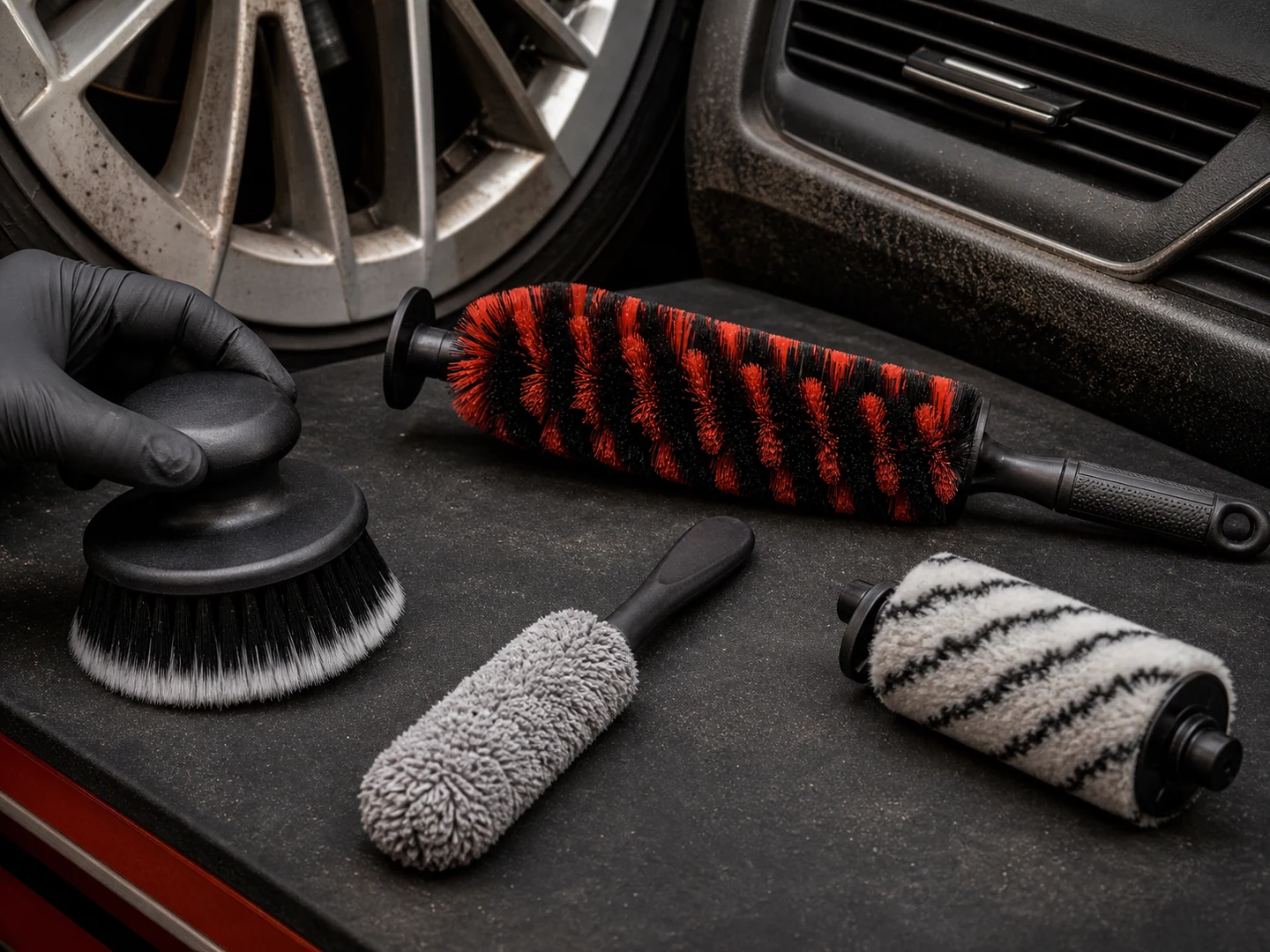
Although the core task is cleaning, the brush form factor must match the machine layout and the tire area being cleaned. The most common types include:
- Rotary Roller Brushes: A cylindrical core with bristles extending radially. These are used for full-tread or sidewall scrubbing in conveyorized systems.
- Conveyor Strip Brushes: Straight or formed channels holding a strip of bristles. They can be mounted in a frame to clean specific tread grooves or edges.
- Cup Brushes and End Brushes: For confined areas like bead seats, mold cavities, or inner rim surfaces.
- Custom Profile Brushes: Designed to match the contour of a specific tire tread pattern, often built from a drawing or tire profile sample.
Bristle Materials and Their Suitability
The bristle material determines the brush’s aggressiveness, chemical resistance, temperature tolerance, and part life. The table below compares the most common synthetic and metal filaments used in tire brush applications.
| Bristle Material | Surface Sensitivity | Wet/Dry Suitability | Temperature Tolerance | Chemical Resistance | Line Speed | Maintenance Access |
|---|---|---|---|---|---|---|
| Nylon (standard PA6/PA6.6) | Low scratch risk, non-marking | Excellent in wet and dry | Moderate (verify for high-heat processes) | Good against oils, greases; avoid strong acids | High | Flexible, easy to trim; replaceable strips available |
| Polypropylene | Slightly firmer, may polish | Best in wet applications | Lower than nylon; not for hot tires | Excellent resistance to acids and alkalis | Moderate | Stiffer; may require more mounting support |
| Abrasive Nylon (silicon carbide or aluminum oxide impregnated) | Medium; embeds grit for deburring or texture | Wet or dry; dust management needed in dry | Similar to nylon | Similar to nylon | Low to moderate (to control wear) | Self-sharpening but may wear faster |
| Steel Wire (carbon steel) | Aggressive; can scratch rubber | Dry preferred; rusts in wet unless coated | High | Sensitive to corrosion; avoid acids | High | Very durable in dry; may need rust protection |
| Stainless Steel Wire | Aggressive, no rust | Wet or dry | High | Excellent; food-grade possible | High | Longer service life in moist environments |
| Horsehair / Tampico | Very gentle, absorbs water | Wet only; not for oil-heavy residues | Low; avoid heat | Limited; natural fiber | Low to moderate | Softer, conforms well to curvatures |
Note: Temperature and chemical compatibility figures are general guidelines. Always share your process details with the brush supplier to confirm filament grade and construction.
How to Choose the Right Tire Brush
Narrowing down the options requires you to answer these questions:
- What exactly needs to be removed? Loose dust, sticky mold release agent, rubber flash, curing bladder release, or road debris. Define the residue type, particle size, and how strongly it adheres.
- How delicate is the surface? Green (uncured) rubber, finished sidewalls, white lettering, or bead area can be scratched by wire or coarse abrasives. Use softer synthetics or hair for sensitive surfaces.
- Is the line wet or dry? Wet systems help flush debris and reduce heat, but they demand bristles that retain stiffness when wet and resist chemical breakdown from the washing solution.
- What line speed and pressure are expected? High-speed lines may require finer, more flexible filaments to avoid bouncing. Heavier pressure favors stiffer bristles or wire.
- How much space is available? Measure the mounting envelope. A compact brush holder might need a cup or end brush instead of a full-width roller.
- What is the maintenance schedule? In hard-to-reach positions, choose a brush with long filament life and quick-change mounts.
What to Confirm Before Ordering
Use this checklist to avoid communication gaps with your brush supplier:
- Overall dimensions: Brush outer diameter, face width, core diameter, shaft size, and keyway dimensions.
- Mounting style: Direct shaft mount, adapter plate, split hub, or custom flange. Indicate the drive type and motor interface.
- Bristle specification: Material grade, filament diameter, trim length, and density (fill pattern).
- Drawing or sample reference: Provide a profile drawing, a tire scan, or a used brush sample if matching an existing installation.
- Target cleaning result: Quantify the expected cleanliness—e.g., “no visible mold release residue,” “particle removal down to 50 µm,” or “uniform matte surface finish.” This helps define the right bristle and speed ratio.
- Process environment: Describe chemicals, pH, temperature range, and humidity to confirm filament compatibility.
- Life expectation: Ask for estimated service intervals under your conditions so you can plan spares and preventive maintenance.
Common Mistakes When Selecting Tire Brushes
Even experienced engineers can fall into these traps:
- Picking by cost alone: A low-cost nylon brush may degrade quickly in a hot, caustic wash, leading to higher total cost of ownership.
- Ignoring chemical compatibility: Standard nylon swells and loses stiffness in strong acids. Skipping material data can shut down a line.
- Using wire bristles on premium finishes: Wire can scratch or mar finished tire surfaces, hurting aesthetics and potentially weakening the rubber if cuts occur.
- Overlooking maintenance accessibility: Hard-to-reach brush mounts can lead to extended downtime during replacements.
- Not matching the brush profile to the tire contour: Generic shapes may miss critical cleaning areas or cause uneven wear.
Practical Use Note
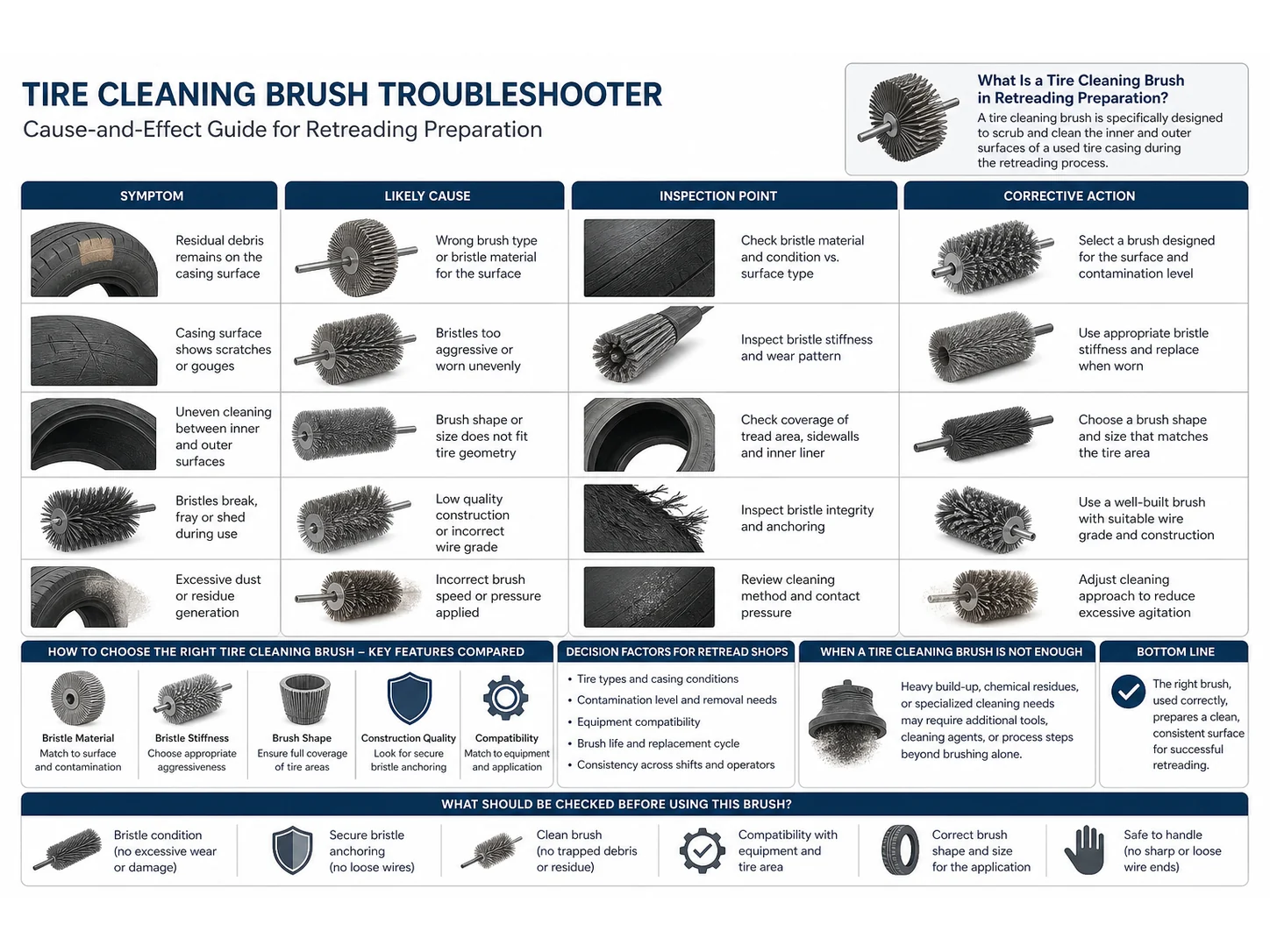
In daily use, the practical test is simple: check whether the brush reaches the full contact area, removes the target residue, and leaves the surface in the required condition. Record what changes when surface finish, solvent exposure, access angle, scratch tolerance, and soil severity changes, because many brush failures are caused by the working condition shifting rather than by the brush body alone.
When This Brush Is Not Enough
This brush is not enough when the main problem is blocked access, unsafe working conditions, damaged equipment, incompatible chemicals, or a process setting that keeps recreating the residue. In those cases, review surface finish, solvent exposure, access angle, scratch tolerance, and soil severity and confirm the surrounding cleaning method before increasing brush stiffness or contact pressure.
Bottom Line
The best result comes from matching tire cleaning brushes for washing, scrubbing, or retreading prep to the real cleaning task rather than forcing one brush to solve every condition. Confirm access, residue, surface limits, and replacement routine first; then use a small trial or inspection step before scaling the method into daily work.
Frequently Asked Questions
What bristle material works best for cleaning tire surfaces?
It depends on whether the brush is used for washing, mold residue removal, sidewall scrubbing, or retreading preparation. Soft nylon or natural bristle can be useful for gentle cleaning, while abrasive nylon or wire may be considered where controlled surface preparation is needed. The final choice should match the rubber condition, residue type, and surface-damage risk.
Can one tire brush handle washing and retreading preparation?
Sometimes, but it is safer to separate the tasks. A washing brush usually focuses on removing dirt, soap, or road film, while retreading preparation may need more controlled surface texture. Using one aggressive brush for every step can damage areas that only need cleaning.
How should I avoid damaging tire surfaces?
Start with the least aggressive brush that can remove the residue. Test on a non-critical area, check for rubber tearing or uneven abrasion, and adjust filament stiffness, brush speed, contact pressure, or cleaning chemistry before increasing aggressiveness.
Can stainless steel brushes be used in wet tire washing systems?
Stainless steel may be used in some wet systems, but the grade, cleaning chemicals, corrosion conditions, and rubber-contact risk should be checked first. Nylon, abrasive nylon, or other synthetic filaments may be better where surface protection matters more than heavy cutting action.
What should I provide when ordering a tire cleaning brush?
Provide the tire size range, brush position, wet or dry use, residue type, machine speed if known, existing brush photos, mounting dimensions, and whether the task is washing, mold cleaning, buffing support, or retreading preparation.
When is a custom tire brush useful?
A custom brush is useful when the tire profile, tread area, sidewall shape, machine holder, or cleaning task does not match a standard brush. Profile drawings, samples, or clear photos help avoid a brush that fits the machine but misses the actual contact area.