
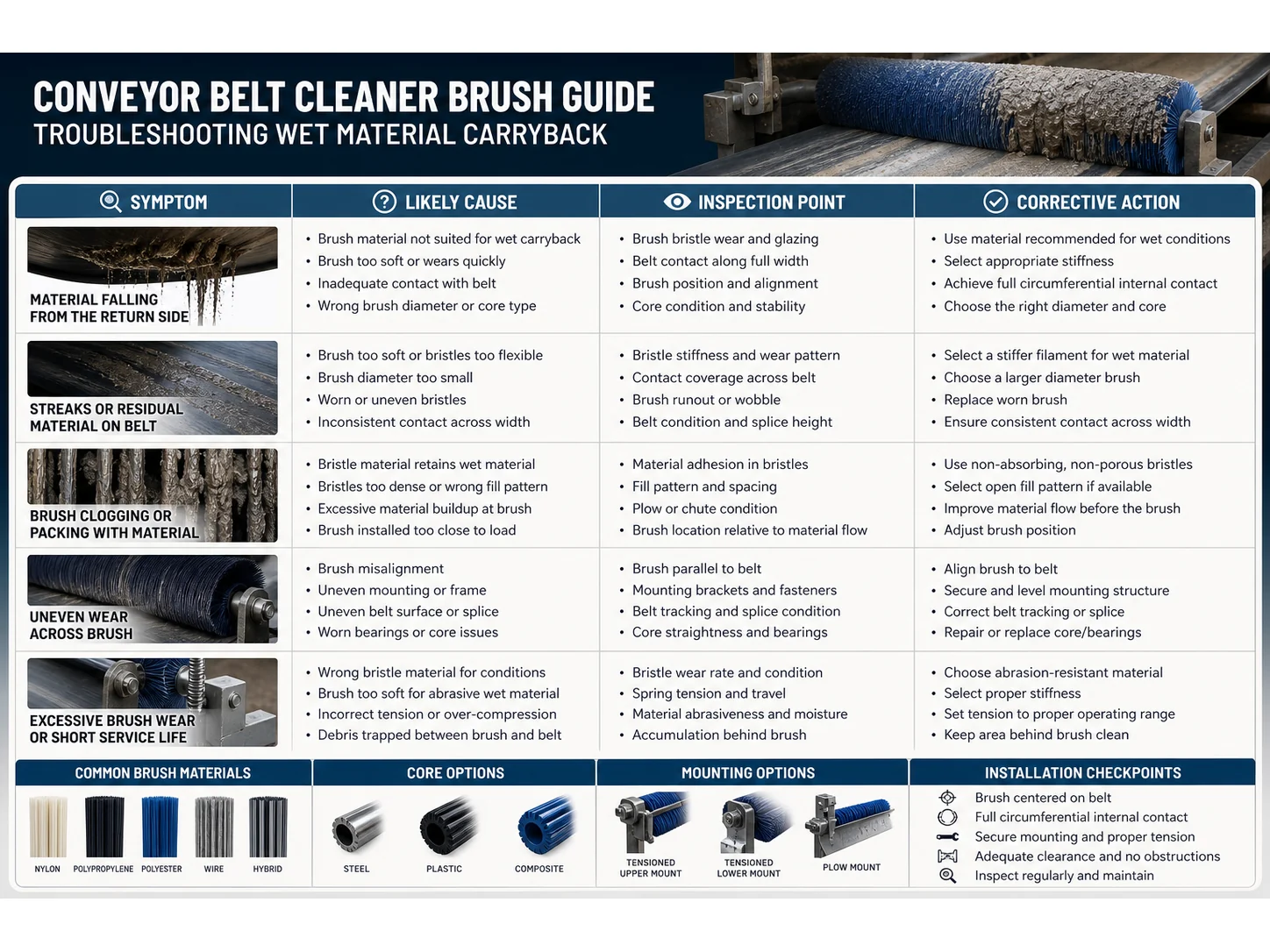
What Is a Conveyor Belt Cleaner Brush?
A conveyor belt cleaner brush is a rotary or static brush assembly designed to scrape, sweep, or agitate material off the conveyor belt return side. Unlike blade-type cleaners, brushes provide conformable, multi-point contact that can reach into the belt’s profile and remove moist or sticky residues that hard-blade scrapers often leave behind. Brushes are especially useful when the belt surface is textured, chevroned, or when hygiene and gentle cleaning are required.
How Wet Material Carryback Affects Cleaning
Wet carryback sticks to the belt differently than dry dust. Moisture creates adhesion forces that can pack material into the belt’s top cover impressions and around splices. A successful brush cleaner for wet applications must:
- Resist moisture absorption and swelling.
- Shed sticky material instead of becoming loaded.
- Maintain stiffness when wet.
- Operate without creating excess friction or heat that could harden the residue.
Common Brush Materials and Their Applications
Selecting the right filament or bristle material is the most critical choice. Each material offers a different balance of abrasion resistance, chemical tolerance, and flexibility:
- Polypropylene (PP): Economical, good chemical resistance, absorbs very little water. Suitable for light to medium wet applications but may wear quickly against abrasive carryback.
- Nylon (PA6, PA6.6): Strong, flexible, and abrasion-resistant. Nylon absorbs some moisture and can swell slightly, so it is best used where moisture exposure is intermittent or where a trade-off in wet stiffness is acceptable.
- Polyester (PET, PBT): Excellent stiffness retention when wet, very low moisture absorption, and good chemical resistance. Ideal for continuous wet carryback removal, even with mildly acidic or alkaline materials.
- Aramid / Nomex: High heat resistance and very low moisture pickup, but more expensive. Used in extreme-temperature wet applications or where chemical attack from hot, sticky residues is severe.
- Stainless Steel Wire: For aggressive cleaning of compacted, sticky, or abrasive wet material where filament brushes lack the needed scraping force. Risk of belt damage if not properly set up.
Brush Diameter, Stiffness, and Core Options
Brush diameter and bristle stiffness directly affect cleaning pressure and belt contact area. Common considerations:
- Diameter: Larger diameters (200–300 mm) provide longer bristle length, more conformability, and slower wear. Smaller diameters (100–150 mm) fit tight spaces but wear faster.
- Stiffness: Measured as bristle diameter (e.g., 0.3 mm, 0.5 mm) or fill density. Wet, sticky material often requires a stiffer brush to prevent bristle matting, but too stiff can damage belt covers or splices.
- Core/Handle: Brushes may have solid shafts, keyed shafts, or split-hub designs. Split-hub cores allow for easier replacement without removing the entire shaft.
- Mounting: Bearings, drive couplings, adjustment slides, and take-up frames must be robust enough to hold the brush in consistent contact under wet, corrosive conditions. Stainless steel or sealed bearing housings are common.
Material Comparison for Wet Carryback
| Material | Moisture Absorption | Wet Stiffness Retention | Abrasion Resistance | Chemical Tolerance | Best For |
|---|---|---|---|---|---|
| Polypropylene | Very low | Moderate | Low | Good | Light wet residue, food-grade washdown |
| Nylon | High | Low | High | Fair | Intermittent moisture, high wear |
| Polyester | Very low | High | High | Good | Continuous wet or chemical exposure |
| Aramid | Very low | Very high | Very high | Excellent | Hot, sticky, aggressive carryback |
| Stainless Steel | None | Rigid | Extreme | Excellent | Heavy, compacted wet material; must monitor belt wear |
How to Choose the Right Brush for Your Conveyor
Start by characterizing the carryback problem, not just the belt width:
- Residue Type: Is it sticky, abrasive, fibrous, or chemically active? This determines material and stiffness.
- Belt Surface: Smooth fabric belts tolerate softer bristles; chevron or rough top belts need deeper, more flexible filament penetration.
- Operating Environment: Continuous water spray, high humidity, or chemical cleaners will eliminate moisture-absorbing materials like nylon.
- Speed and Load: High-speed belts usually need a motorized brush that rotates against the belt direction to throw carryback away.
- Maintenance Access: If brush changes are difficult, choose longer-wearing materials (polyester) and split cores for faster replacement.
- Custom Sizing: Many suppliers offer brushes cut to exact face length, diameter, and shaft configuration. Never assume a stock brush will match your conveyor’s cross-section without confirming end-clearance, shaft engagement, and bearing spacing.
Mounting and Installation Considerations
Even the best brush material fails without correct placement. Key installation factors for wet carryback control:
- Position: Mount the brush after the head pulley and primary scraper, on the return run, where the belt is flat and carryback has not yet been compressed by return rollers.
- Contact Angle: Typically 15–30° of overlap between brush tip and belt surface. Too little pressure = ineffective cleaning; too much = accelerated wear and motor overload.
- Direction and Speed: A power-driven brush rotating against the belt direction maximizes material removal. Free-wheeling brushes are common for lighter applications but may be less effective on sticky residues.
- Washdown and Collection: In wet environments, incorporate a spray bar or drip tray to wash the brush and capture removed material; otherwise, the brush itself becomes a carryback source.
Common Mistakes When Selecting a Cleaner Brush
- Mistake 1: Choosing by cost drivers or belt width alone, ignoring the specific carryback characteristics. A low-cost nylon brush can swell and lose cleaning ability within days if exposed to continuous moisture.
- Mistake 2: Using a brush too stiff for the belt surface, leading to cover damage, premature splice wear, or motor overload.
- Mistake 3: Oversizing the brush diameter without checking frame clearance, causing interference with belt edges, stringers, or return idlers.
- Mistake 4: Forgetting to account for chemical exposure. Acidic or alkaline slurries can rapidly degrade nylon or standard polypropylene, while polyester or aramid would last much longer.
- Mistake 5: Ignoring mounting rigidity. A flexible frame allows the brush to bounce or lift away from the belt under varying load, rendering it ineffective.
- Mistake 6: Assuming all brushes are plug-and-play. Each installation should include a brief trial run with adjustment checks; otherwise, uneven wear and poor cleaning result.
When a Standard Cleaner Brush Is the Wrong Choice
A conveyor belt cleaner brush has limits. If carryback remains excessive, consider these scenarios where a brush alone is insufficient:
- Extremely sticky or viscous material: Combined systems using a pre-scraper, brush, and water washbox may be necessary.
- High belt speed with heavy carryback: A single brush may not remove everything; dual brush stations or brush-belt combinations are sometimes used.
- Belt damage or deep gouges: Brushes cannot clean inside deep holes or cracks. The belt itself may need repair or replacement.
- Sanitary or food-grade requirements: If hygiene regulations require CIP (Clean-in-Place) systems or specific microbial limits, a standard industrial brush may not meet the standard. Look for FDA-compliant materials and sealed, washdown-ready designs.
- Special contours or cleats: Belts with high cleats or sidewalls may need custom-profiled brushes or segmented designs that follow the profile. A standard straight brush will leave material in the valleys.
In any of these cases, request a supplier drawing review and, if possible, a sample test on your actual material before committing to a full order.
Final Takeaway
Selecting the right conveyor belt cleaner brush for wet material carryback comes down to matching the filament material to the moisture and chemical environment, choosing a diameter and stiffness that protects the belt while effectively removing residue, and verifying the mounting integration. Avoid the temptation to buy an off-the-shelf brush based solely on belt width; instead, define your carryback problem in terms of residue type, belt surface, and access constraints, then work backward to the brush specification that fits those conditions.
Frequently Asked Questions
What is the difference between a conveyor belt brush cleaner and a scraper?
A scraper uses a hard blade to peel material off, which works well for dry, non-sticky carryback. A brush uses flexible bristles that can conform to the belt surface and remove moist, sticky, or textured residues without damaging the belt cover.
Can one brush handle both dry and wet carryback?
It depends on the material. Polyester brushes often handle both moderate dry dust and wet carryback because they resist moisture and abrasion. But a brush optimised for sticky wet material may be too stiff for light dust, causing excessive belt wear.
How do I know if my brush is too stiff for the belt?
Signs include belt cover abrasion marks, increased motor current draw, bristle breakage at the root, and excessive heat build-up at the contact point. If you see any of these, reduce contact pressure or switch to a softer bristle material.
Is a powered brush always necessary for wet carryback?
Not always, but it often helps. Passive, free-wheeling brushes rely on belt movement to spin and can stall when carryback is heavy. A motorised brush rotates against the belt direction and provides consistent cleaning force.
How often should I replace a conveyor belt cleaner brush?
Replacement intervals vary widely. Monitor the brush face length and bristle tip condition. When bristles are worn to half their original length, or if they become permanently matted and no longer spring back, replacement is due. Keep a maintenance log to track hours vs. wear.
What about stainless steel wire brushes for wet carryback?
Stainless steel wire brushes are aggressive and can damage belt covers if not carefully adjusted. They are best for heavy, compacted, highly abrasive wet material where filament brushes fail quickly. Always test on a small section first.
Can I cut a brush to size myself?
It is not recommended unless you have the proper fixture and supplier guidance. Uneven cutting can unbalance the brush, reduce cleaning effectiveness, and cause vibration. Always order a brush cut to exact face length and shaft configuration by the manufacturer.
What is the most common mistake when ordering a custom brush?
Underspecifying the mounting and drive interface. Even if the bristle material and diameter are perfect, a brush with the wrong shaft diameter, keyway, or bearing arrangement will not fit existing hardware and can delay installation.
Technical References
- OSHA — Machine Guarding
- OSHA — Control of Hazardous Energy
- OSHA — Combustible Dust
- EPA — Particulate Matter Basics
- British Plastics Federation — Thermoplastics
Which bristle material fits this job — Nylon PA, AISI 304 Stainless Steel Wire or Polypropylene PP?
| Material | Continuous temperature (°C) | Peak temperature (°C) | Water absorption | Hardness |
|---|---|---|---|---|
| Nylon PA | 93 | 121 | 0.3–9% by PA grade and conditioning | Medium to firm; filament diameter and trim length control bending force. |
| AISI 304 Stainless Steel Wire | 400 | 500 | 0% | Rockwell B 70–95 depending on temper and cold work |
| Polypropylene PP | 80–100 | 120–140 | ≤0.03% | Shore D 65–75 |
| PBT | 120–140 | 160–180 | 0.05–0.20% | Shore D 80–90 |
Figures as published by Brushtec / DuPont; Alleima; Perlon. Confirm the exact grade against the supplier datasheet before ordering.
What should replace Nylon PA for conveyor belt?
- Nylon PA — Compare Nylon PA with PP, PBT, PET. Change material when wet stiffness, temperature, chemical resistance, conductivity, particle shedding, or surface marking becomes the limiting factor.
- AISI 304 Stainless Steel Wire — Use AISI 316 stainless steel wire for chloride, marine, dairy, beverage, chemical washdown, or higher pitting-resistance requirements. Use carbon steel for dry aggressive cutting and brass or abrasive nylon for lower marking risk.
- Polypropylene PP — Compare Polypropylene PP with Nylon, PBT, PET. Change material when wet stiffness, temperature, chemical resistance, conductivity, particle shedding, or surface marking becomes the limiting factor.
- PBT — Compare PBT with Nylon, PP, PET. Change material when wet stiffness, temperature, chemical resistance, conductivity, particle shedding, or surface marking becomes the limiting factor.