
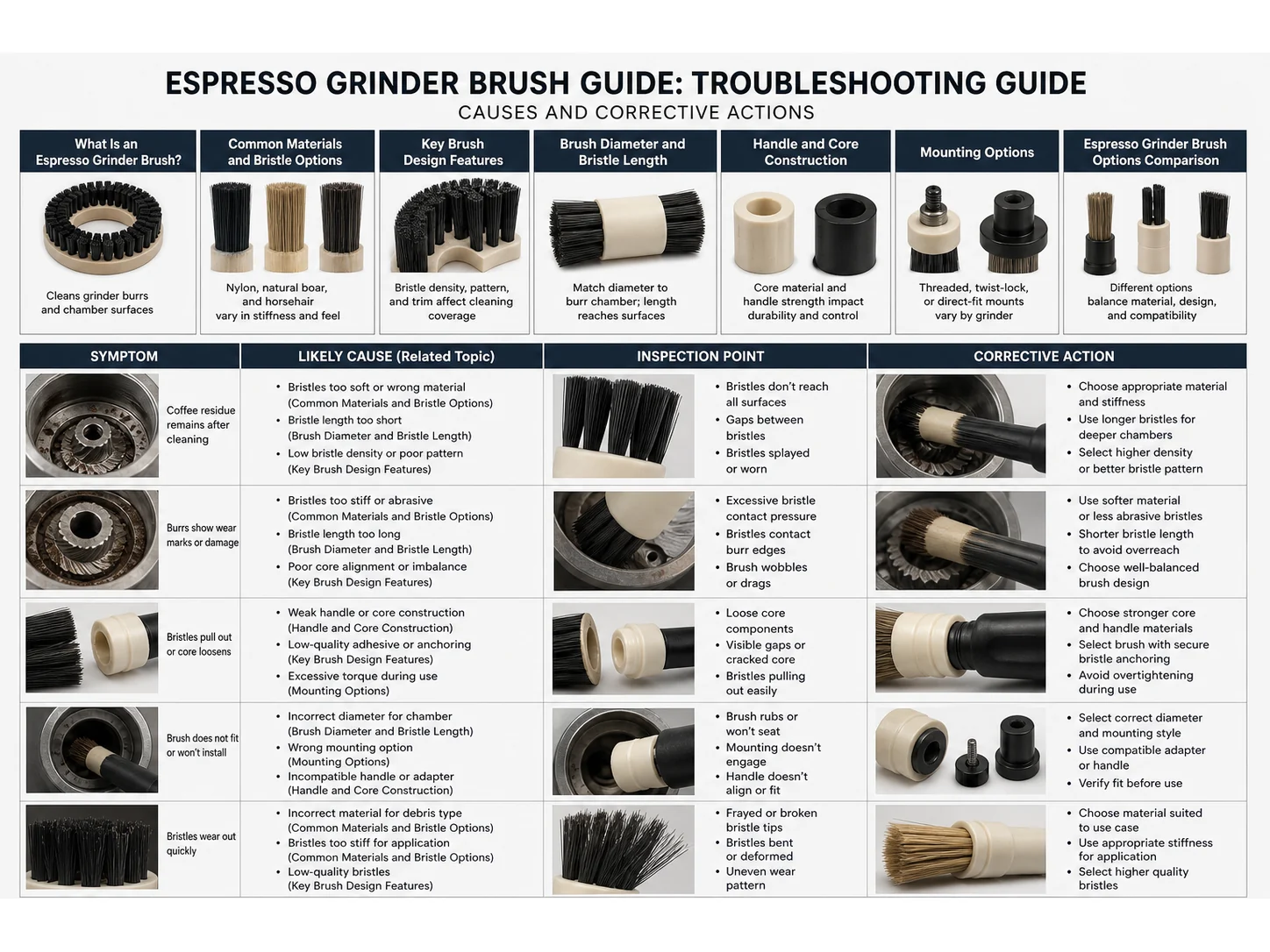
What Is an Espresso Grinder Brush?
An espresso grinder brush is a small, purpose-built brush used to sweep away ground coffee and oily deposits from the grinding mechanism of an espresso machine. Unlike generic cleaning brushes, it is sized to access tight spaces around burrs, chutes, and doser compartments without damaging precision-ground metal or ceramic surfaces.
Because espresso grinders retain a thin film of coffee oils and fine particles after each use, routine brushing reduces the risk of stale flavors, clogging, and burr corrosion. The right brush makes this task faster and safer than wiping with cloths or using improvised tools that may leave behind fibers or scratches.
Common Materials and Bristle Options
Espresso grinder brushes are available in several bristle materials, each with different surface compatibility, stiffness, and moisture tolerance.
- Nylon: Synthetic, non-absorbent, and available in a wide range of stiffness. Good for general dry cleaning and light oily residues. Avoid very stiff nylon on coated burrs.
- Horsehair or Tampico: Natural fibers that are soft, flexible, and less likely to scratch. Ideal for delicate surfaces and final polishing passes. Tampico resists moderate moisture better than horsehair.
- Brass: Softer than steel but harder than nylon, brass bristles can remove stubborn, caked-on residues without harming hardened steel burrs. Not recommended for soft metals or plastic components.
- Stainless Steel: Very stiff and aggressive; reserved for heavy buildup on hard, uncoated metal only. Can scratch ceramic, coated burrs, or aluminum chute walls. Use with extreme caution.
- Combination Brushes: Some brushes mix nylon with natural fibers or have a brass row flanked by softer bristles for dual-purpose cleaning.
Key Brush Design Features
Beyond bristle material, the following dimensions and construction details determine whether a brush fits your equipment and workflow.
Brush Diameter and Bristle Length
The working diameter must match the burr chamber, chute, or portafilter rest area. A brush that is too wide cannot reach corners; one too narrow takes more passes. Bristle length influences reach into deep cavities such as doser vanes.
Handle and Core Construction
Handles may be wood, plastic, or ergonomically shaped for prolonged use. The core wire (twisted or single stem) affects durability and brush stiffness. Twisted-wire cores hold bristles firmly and work well with brass or steel, while stapled or plastic-set blocks are common for luxury natural-bristle models.
Mounting Options
Most espresso grinder brushes are handheld. Some high-volume cafés use motorized spindle brushes that attach to a low-speed drill or grinder motor for batch cleaning, but these require careful speed and pressure control to avoid burr damage.
Espresso Grinder Brush Options Comparison
| Bristle Type | Typical Use Case | Surface Compatibility | Moisture Tolerance | Stiffness | Common Applications |
|---|---|---|---|---|---|
| Soft nylon | Daily dry brushing | All burr types, plastic, coated surfaces | Excellent | Low-medium | Home and light commercial grinders |
| Medium nylon | Weekly deep cleaning | Uncoated steel, ceramic, hard plastic | Excellent | Medium | Commercial espresso grinders |
| Horsehair/Tampico | Polishing after chemical clean | All surfaces, especially delicate | Moderate (Tampico better) | Soft | High-end grinders, ornate dosing chambers |
| Brass | Heavy residue removal | Hardened steel burrs only | Good | Medium-hard | Periodic deep cleans in busy cafés |
| Stainless steel | Baked-on carbon or rust | Uncoated hardened steel only | Excellent | Hard | Recovery cleaning, not routine maintenance |
How to Choose the Right Espresso Grinder Brush
Match the brush to the specific cleaning task by evaluating these factors:
- Residue type: Dry grounds require only soft nylon; sticky oils may need medium stiffness or brass. If you use cleaning tablets (like Grindz), a soft brush to sweep out the residue is enough.
- Surface sensitivity: Ceramic burrs and coated steel burrs scratch more easily than uncoated hardened steel. Check the manufacturer’s recommendation; if in doubt, start with the softest effective bristle.
- Equipment interface: Measure the smallest gap the brush must enter. Electronic dosers, chute flaps, and narrow throat tubes often demand a slender brush (6–10 mm diameter).
- Wet or chemical exposure: If you use water or detergent sprays, choose nylon or stainless steel; natural fibers may swell or degrade. Brass can oxidize if left wet.
- Maintenance frequency: Busy cafés that brush multiple times daily benefit from ergonomic handles and durable synthetic bristles. Less frequent home users can prioritize bristle softness.
- Custom size requirements: For non-standard grinder designs, a supplier drawing review may be necessary to confirm that brush diameter, length, and handle clearance fit without forcing.
Common Mistakes When Selecting a Grinder Brush
- Choosing by size or cost drivers alone: A low-cost brush with hard bristles can score burrs, leading to poor grind quality. Verify bristle material and stiffness first.
- Using a wire brush by default: Steel or even brass brushes can ruin ceramic or coated burrs. Reserve wire bristles for only the toughest deposits on uncoated hardened steel.
- Ignoring handle ergonomics: A short, thin handle becomes painful during repetitive cleaning of large commercial grinders, increasing the risk of slipping and damaging burr edges.
- Assuming one brush fits all machines: A brush that works perfectly in a flat-burr grinder may not reach the nooks of a conical burr set or a doser chamber. Keep a small set for different geometries.
- Overlooking bristle retention: Poorly finished core wires can shed bristles into the grind path. Inspect the brush for loose fibers before first use.
- Using the same brush for dry and wet cleaning: Moisture trapped in natural bristles can promote mold or transfer water to the burrs, causing flash rust. Dedicate brushes or ensure thorough drying.
When an Espresso Grinder Brush Is the Wrong Choice
A brush removes loose particles but cannot replace:
- Chemical cleaning: Heavy carbonized oil buildup on burrs may require a soak in espresso machine cleaner or run-through with grinder cleaning pellets.
- Burr replacement: Worn or damaged burrs produce inconsistent grinds regardless of cleanliness. Brush cleaning will not restore sharp edges.
- Ultrasonic or disassembly cleaning: Metal dosing chambers with complex vanes or hidden chute dead spots often need complete disassembly or an ultrasonic bath to remove all rancid oils.
- Air purging: Fine coffee dust that a brush misses can be blown out with compressed air (if safe for the environment) or a vacuum before brushing.
If you experience persistent stale taste even after regular brushing, evaluate whether the brush reaches all surfaces and whether a deeper cleaning method is required.
Final Takeaway
The best espresso grinder brush matches the burr material, the type of residue, and the mechanical layout of your specific machine. Start with a soft to medium nylon brush for routine maintenance, add a brass or horsehair option for deeper cleaning, and always avoid steel bristles unless you are absolutely certain the burrs and chamber are uncoated hardened steel and heavily soiled. When in doubt, consult the grinder manufacturer’s cleaning guidelines or request a brush sample to test fit and surface safety before committing to a bulk order.
Frequently Asked Questions
Can I use a regular paintbrush or pastry brush to clean my espresso grinder?
Not recommended. Paintbrushes may shed fine hairs that end up in coffee grounds, and pastry brushes often have bristles that are too soft to sweep oily residue effectively. A purpose-designed espresso grinder brush has a compact shape and controlled stiffness to reach tight grinder spaces without damaging surfaces.
How often should I replace my espresso grinder brush?
Replace the brush when bristles become matted, bent, or start falling out. For a busy café, this might be every 3–6 months. Home users may get a year or more. Inspect the brush weekly for signs of wear, especially if using brass bristles that can deform with heavy pressure.
What bristle stiffness is safe for ceramic burrs?
Soft to medium nylon or natural bristle (horsehair/Tampico) is safest. Avoid brass or steel, which can chip or scratch ceramic surfaces. Even stiff nylon can potentially wear ceramic over time, so use the softest effective brush.
Is it okay to use a wet brush on espresso grinder burrs?
Only if the bristle material is non-absorbent like nylon and you dry the burrs immediately after. Moisture left on steel burrs can cause rust. Water-based cleaning should be part of a scheduled deep clean, not daily brushing.
What size brush do I need for a typical commercial espresso grinder?
Most commercial grinders accept a brush with a working diameter between 8 mm and 15 mm and a bristle length of 15–30 mm. Measure the narrowest gap you need to clean—often between the upper burr carrier and the chamber wall—and choose a brush 1–2 mm narrower to avoid forcing.
Can one brush handle both coffee grounds and oil removal?
Yes, a medium nylon brush can handle light oils, but for heavy, sticky residue a dedicated brass brush followed by a soft nylon sweep works better. Some technicians keep two brushes: one for dry grounds and a stiffer one for deep cleaning sessions.
What should I check before buying brushes in bulk for different grinder models?
Request a drawing or sample to verify brush diameter, overall length, handle shape, and core wire finish. Confirm the bristle material is compatible with all burr types in your fleet. Check that the brush can withstand your cleaning chemicals if you use them.
Why does my brush leave behind bristles in the grinder?
Bristle shedding usually indicates a low-quality twisted-wire core or a stapled brush that wasn’t properly secured. Before using a new brush, tug gently on the bristle tufts; if any come out easily, discard the brush and source from a supplier that Help confirms bristle retention for food-zone applications.
Technical References
- CDC — Preventing Food Poisoning
- eCFR — 21 CFR 177.1500 Nylon Resins
- eCFR — 21 CFR Part 117 Human Food CGMP and Preventive Controls
- FDA — Food Safety in Your Kitchen
- NIST — Metric SI
Which bristle material fits this job — Nylon PA, Horsehair or AISI 304 Stainless Steel Wire?
| Material | Continuous temperature (°C) | Peak temperature (°C) | Water absorption | Hardness |
|---|---|---|---|---|
| Nylon PA | 93 | 121 | 0.3–9% by PA grade and conditioning | Medium to firm; filament diameter and trim length control bending force. |
| Horsehair | 60–80 | 100–120 | 8–15% | — |
| AISI 304 Stainless Steel Wire | 400 | 500 | 0% | Rockwell B 70–95 depending on temper and cold work |
Figures as published by Brushtec / DuPont; Alleima. Confirm the exact grade against the supplier datasheet before ordering.
What should replace Nylon PA for grinders?
- Nylon PA — Compare Nylon PA with PP, PBT, PET. Change material when wet stiffness, temperature, chemical resistance, conductivity, particle shedding, or surface marking becomes the limiting factor.
- Horsehair — Compare Horsehair with Boar bristle, goat hair, microfiber. Change material when wet stiffness, temperature, chemical resistance, conductivity, particle shedding, or surface marking becomes the limiting factor.
- AISI 304 Stainless Steel Wire — Use AISI 316 stainless steel wire for chloride, marine, dairy, beverage, chemical washdown, or higher pitting-resistance requirements. Use carbon steel for dry aggressive cutting and brass or abrasive nylon for lower marking risk.