
What Are Lithium Coating Line Brushes?
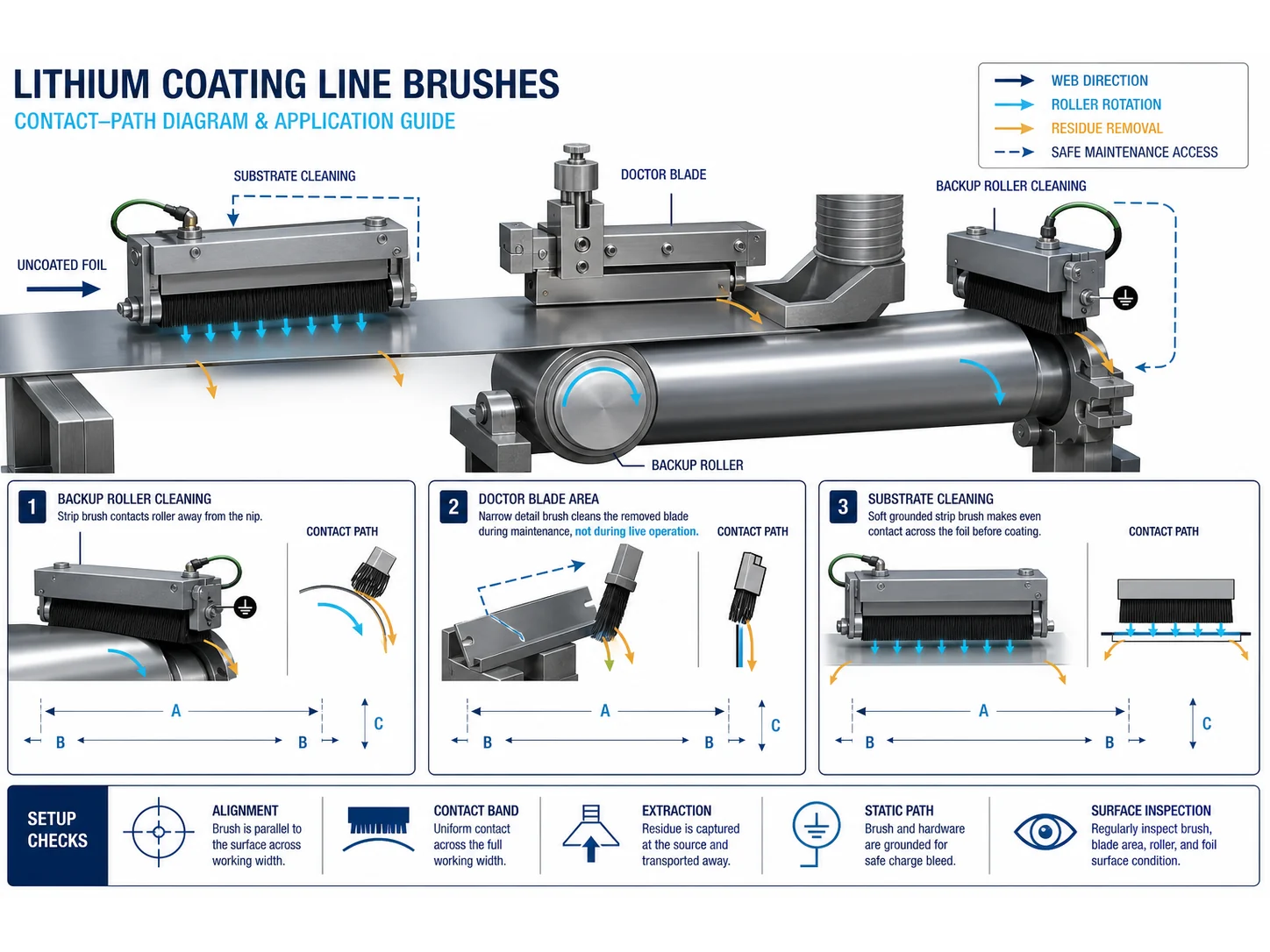
A lithium coating line brush is typically a strip roller, cylindrical roller, or doctor blade style brush used to remove particle contamination, coating residue, or dust from critical surfaces in a battery electrode production line. Unlike general industrial brushes, these are selected for compatibility with NMP or aqueous solvents, low shedding on sensitive foil substrates, and static dissipation where ESD control matters.
Where Do These Brushes Appear in a Coating Line?
Backup Roller Doctor Blade Cleaning
A brush may be mounted as a doctor blade against the backup roller to continuously wipe away coating slurry, preventing buildup that could cause caliper variation or transfer defects.
Web Support Roller Cleaning
Web support rollers are often cleaned with rotating brush rolls or stationary strip brushes to remove coating mist and dried particles before they re-deposit onto the electrode surface.
Edge Dust Removal
After slitting or drying, electrode edges can generate conductive dust. Edge roller brushes and vacuum-assisted dust cleaning brush rollers capture this material without scratching the coating.
Substrate Surface Cleaning
Before coating, bare aluminum or copper foil may run through a pre-cleaning station where soft, anti-static brush rolls remove loose particles and residual oils without damaging the thin metal web.
Comparing Common Brush Structures and Materials
| Brush Style | Common Materials | Particle Control | Static Control | Coating Residue Handling | Solvent Resistance | Line Speed Fit | Contact Pressure |
|---|---|---|---|---|---|---|---|
| Flat Stock Strip Brush | Nylon, PBT, horsehair | Good for large flakes; may pack with wet slurry | Limited (add conductive fibers if needed) | Effective as scraper; manual cleaning often required | Good to excellent (check NMP/water) | Slow to medium | Adjustable; risk of high point load |
| Cylindrical Roller Brush | Nylon, conductive PP, Tampico, blended filaments | Excellent with vacuum assist; dense filament packs capture fines | Better when static-dissipative fibers are used | Continuous rotation sheds residue; easy washdown | Good to excellent | Medium to high | Uniform across face; delicate films need low density |
| Doctor Blade Style Brush | Abrasion-resistant nylon, carbon fiber blend | Good physical scraping; limited dust capture | Often uses conductive backing | Best for hard buildup; may require solvent flush | Excellent | Low to medium | Precise adjustment critical; avoid flexing foil |
| Static-Dissipative Brush | Carbon-filled nylon, conductive acrylic fiber | Prevents particle attraction; often paired with ionization | Primary purpose: bleed static charge | Not for heavy residue; keep clean to retain conductivity | Good, but check carbon bloom in solvents | Any | Light contact; aggressive pressure defeats purpose |
| Plush / Soft Dusting Brush | Natural goat hair, fine PBT, microfiber | Excellent for light dust; fragile with wet coating | Poor unless treated | Not suited for coating slurry; use in dry sections | Poor in strong solvents | Medium | Very light; test for fiber transfer |
How to Choose the Right Brush Design
Focus on four operating conditions:
- Contamination type and load: dry dust needs gentle fiber density and vacuum; wet slurry needs solvent-resistant filaments and easy-release surfaces.
- Substrate sensitivity: thin aluminum or copper foil (<12 µm) demands uniform, light contact pressure to avoid deformation.
- Solvent exposure: verify filament and core material compatibility with NMP, water, or blended solvents used in your line.
- Static discharge risk: if particles cling due to static, choose conductive or dissipative filaments and ground the brush core.
Common Mistakes to Avoid
- Using natural fibers that shed: horsehair and goat hair can break off, leaving organic contamination on the electrode surface. Prefer synthetic filaments validated for low particle release.
- Applying excessive contact pressure: on thin current collectors, high pressure can wrinkle the web, stretch the foil, or cause coating cracks downstream.
- Ignoring solvent compatibility: standard nylon absorbs moisture and may swell in aqueous systems, changing brush stiffness and contact geometry over time.
- Overlooking static generation: a fast-spinning non-conductive brush can tribocharge the web, attracting more particles instead of removing them.
- Assuming one brush fits all zones: a doctor blade brush for a backup roller may shed too much in a cleanroom substrate cleaning stage.
When a Standard Cleaning Brush Is the Wrong Choice
Even a well-chosen brush cannot replace systematic contamination control. Escalate to process validation and contamination testing when:
- Particle counts exceed internal limits despite daily brush maintenance.
- A new electrode formulation, solvent, or line speed is introduced, requiring re-evaluation of brush material compatibility and contact force.
- Visible coating defects appear only in downstream calendar or slitting steps, suggesting hidden web handling issues.
- Equipment modifications (e.g., adding a belt, changing roller covering) alter the cleaning interface.
In these cases, work with the coating equipment maker or a contamination control specialist to run controlled trials and validate the cleaning system.
Final Takeaway
Lithium coating line brushes are small components with a large impact on process stability. Match the brush structure to the specific cleaning task, confirm material compatibility, and control contact pressure to protect the delicate electrode web. When in doubt, test the brush in a pilot or offline environment before committing to full production.
Frequently Asked Questions
Can I use the same brush type on both anode and cathode coating lines?
Possibly, but you must check solvent compatibility and contamination risk separately. Anode slurries are often water-based, which can swell certain filaments, while cathode slurries use NMP with different chemical demands. Cross-contamination of copper and aluminum particles is also a risk; many facilities dedicate brushes to each electrode type.
How often should cleaning brushes be replaced?
There is no universal interval. Replace when the brush shows uneven wear, filament breakage, stiffness loss, or when particle test results trend upward despite regular cleaning. Run a brush life study under your line conditions to define a preventive replacement schedule.
Is an anti-static brush always needed in a lithium coating line?
Not always, but it is highly recommended in dry, high-speed areas where tribocharging can cause dust attraction. If you notice particles “jumping” onto the web or static discharge marks on the film, consider integrating static-dissipative brushes or active ionizers with the brush assembly.
How do I tell if brush contact pressure is too high?
Look for visual web deformation like wrinkling or a clear wear mark on the brush filament tips after short use. In pilot runs, measure tension and web steering before and after the brush station; an increase suggests excessive drag.
What cleaning solvent should I use on the brush itself?
Match the solvent to the coating chemistry you are removing. For NMP-based cathode slurries, use NMP or a compatible cleaning solvent. For water-based anodes, warm water or a mild aqueous solution often works. Always check brush material compatibility first.
How can I prevent brush shedding on a drying section?
Select brush filaments that retain mechanical properties at elevated temperatures. Heat-stabilized nylon and PBT are common choices. Also ensure the brush is not operating too close to the heater edge where thermal expansion could increase friction and shedding.
Should I rotate or shuffle cleaning brushes periodically?
Rotating or shifting the brush position can even out wear and extend life, but only if the brush geometry and mounting design allow it. Some facilities swap upstream and downstream brushes to balance abrasive dust loading.
Technical References
Which bristle material fits this job — Nylon PA, PBT or Goat Hair?
| Material | Continuous temperature (°C) | Peak temperature (°C) | Water absorption | Hardness |
|---|---|---|---|---|
| Nylon PA | 93 | 121 | 0.3–9% by PA grade and conditioning | Medium to firm; filament diameter and trim length control bending force. |
| PBT | 120–140 | 160–180 | 0.05–0.20% | Shore D 80–90 |
| Goat Hair | 50–70 | 90–110 | 12–20% | — |
| Horsehair | 60–80 | 100–120 | 8–15% | — |
Figures as published by Brushtec / DuPont; Perlon. Confirm the exact grade against the supplier datasheet before ordering.
What should replace Nylon PA when it stops working?
- Nylon PA — Compare Nylon PA with PP, PBT, PET. Change material when wet stiffness, temperature, chemical resistance, conductivity, particle shedding, or surface marking becomes the limiting factor.
- PBT — Compare PBT with Nylon, PP, PET. Change material when wet stiffness, temperature, chemical resistance, conductivity, particle shedding, or surface marking becomes the limiting factor.
- Goat Hair — Compare Goat Hair with Boar bristle, goat hair, microfiber. Change material when wet stiffness, temperature, chemical resistance, conductivity, particle shedding, or surface marking becomes the limiting factor.
- Horsehair — Compare Horsehair with Boar bristle, goat hair, microfiber. Change material when wet stiffness, temperature, chemical resistance, conductivity, particle shedding, or surface marking becomes the limiting factor.