
What Is a Metal Coating Line Cleaning Brush?
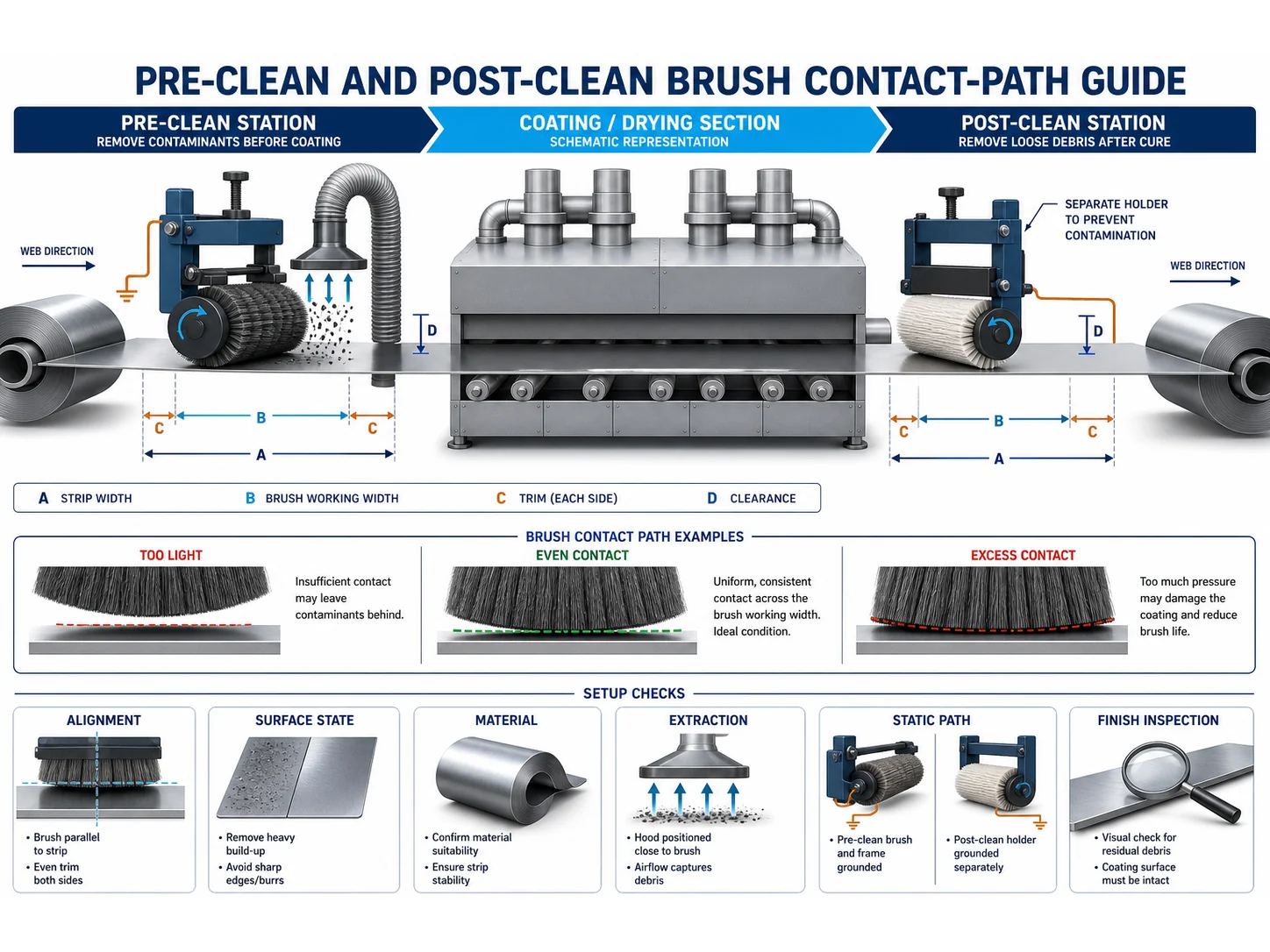
A metal coating line cleaning brush is a rotary or stationary brush mounted inline to remove contaminants from metal strip, sheet, or parts. In pre-clean applications, it removes oil, mill scale, dust, and debris before the coating is applied. In post-clean applications, it removes overspray, powder fallout, or dry coating residue after the application zone. These brushes are typically bristle or filament-based, selected for abrasive requirement, chemical compatibility, and operating speed.
Common Types of Coating Line Brushes
Coating lines typically use three main brush configurations. Each suits a different cleaning task and line speed.
- Cylinder brushes (roller brushes): Rotating brushes that span the full strip width. Used for continuous strip cleaning at high speed.
- Disc brushes: Round, face-working brushes for spot cleaning, edge deburring, or localized overspray removal.
- Strip brushes (channel brushes): Mounted in holders as wipers or static cleaners. Often used in post-clean for wiping loose powder.
Pre-Clean vs. Post-Clean: Key Differences
Pre-clean and post-clean brushes serve different purposes and are placed at different points in the line. The table below compares the main operational and design differences.
| Factor | Pre-Clean Brush | Post-Clean Brush |
|---|---|---|
| Primary goal | Remove surface contaminants before coating | Remove excess coating or overspray after application |
| Typical contaminants | Oil, grease, dust, mill scale, light rust | Wet or dry overspray, powder fallout, paint drips |
| Brush location | Before pretreatment/coating booth | After coating booth, before cure oven (or after) |
| Bristle material common choices | Abrasive nylon, silicon carbide filaments, brass-coated steel, Tampico | Soft nylon, polypropylene, horsehair, antistatic filaments |
| Aggressiveness | Medium to high; may need abrasive action | Low; must not scratch new coating |
| Operating speed compatibility | Must match line speed; higher RPM possible | Often slower; may run intermittent/demand |
| Maintenance pattern | Frequent cleaning to prevent loading | Periodic replacement; coating buildup common |
How to Choose the Right Brush Based on Coating Type and Line Speed
Selecting a metal coating line cleaning brush requires matching the brush to the coating chemistry and the line’s speed. Use the decision points below.
Coating type:
- Liquid paint (wet coating): Pre-clean brushes must aggressively remove oils and fines without scratching. Post-clean brushes must handle wet overspray without smearing. Solvent-resistant filaments (polyester, nylon) are often needed.
- Powder coating: Pre-clean brushes must remove residual dust and oxidation; static-dissipative filaments help prevent re-attraction of dust. Post-clean brushes should be soft enough to knock off unbonded powder without damaging the fresh layer.
- E-coat and other dip coatings: Pre-clean brushes may need to tolerate wet conditions or cleaning chemical residues.
Line speed:
- Low speed (below 30 fpm): Brushes can be softer, with larger diameter for dwell time.
- Medium speed (30–100 fpm): Requires balanced filament stiffness and RPM control.
- High speed (above 100 fpm): Dense, stiff bristle patterns and high-speed bearings are essential; abrasive filaments often needed for short contact time.
Always verify chemical compatibility: the bristle material must not degrade when exposed to the line’s cleaning chemicals, solvents, or the coating itself.
Common Defects Prevented by Proper Brush Selection
A well-chosen cleaning brush directly reduces coating defects on the final product. Here are typical defects and how brush selection helps.
- Orange peel / poor adhesion: Caused by oil or dust on substrate. Effective pre-clean brushing removes these.
- Cratering / fisheyes: Often due to silicone or oil residues. Abrasive pre-clean brushes with correct filament material can eliminate the contaminant.
- Inclusions / dirt nibs: Dust or particles trapped under the coating. Pre-clean brushes and anti-static post-clean brushes reduce this.
- Overspray roughness: Dry spray or powder fallout on already-coated areas. Post-clean brushes gently remove loose particles before curing.
- Streaks / brush marks on fresh coating: Too-stiff post-clean brushes scratch wet paint. Choosing a softer filament or adjusting contact pressure prevents this.
Common Mistakes When Selecting Coating Line Brushes
Avoid these frequent selection errors to prevent line downtime and quality issues.
- Choosing a brush by cost alone without checking filament chemical resistance.
- Using the same brush for pre-clean and post-clean without considering aggressiveness.
- Ignoring static buildup on dry powder lines, leading to dust re-adhesion.
- Overspecifying abrasive filaments for post-clean, causing micro-scratches.
- Undersizing brush diameter or bristle density for high line speeds, resulting in incomplete cleaning.
When Chemical Pre-Treatment Changes the Brush Requirements
Chemical pre-treatment (alkaline wash, phosphate, or conversion coating) significantly reduces the pre-clean burden on brushes. In lines with a multistage chemical pretreatment system, pre-clean brushes may only need to remove loose debris or light oil. The chemical bath handles degreasing and etching. In this scenario, choose a less aggressive brush—often Tampico or soft nylon—to avoid damaging the metal before it enters the chemical stages. However, if the line lacks chemical pretreatment, pre-clean brushes become the primary cleaning mechanism and must be more aggressive (abrasive filaments, higher RPM, scrubber design). The boundary is clear: when a chemical stage is present, brushes shift from heavy cleaning to mechanical assistance.
Final Takeaway
To choose the right metal coating line cleaning brush: identify whether the brush is for pre-clean or post-clean, match filament material to the coating type and chemical exposure, and size bristle stiffness and brush diameter to your line speed. Pre-clean brushes prevent adhesion defects; post-clean brushes prevent overspray roughness. Always verify filament chemical resistance and avoid using overly aggressive brushes on fresh coatings. When chemical pretreatment is active, the pre-clean brush can be less aggressive. Use this logic to help reduce defect risk after validation and extend brush life.
When a Metal Coating Line Brush Is the Wrong Choice
This brush is not enough when the main problem is blocked access, unsafe working conditions, damaged equipment, incompatible chemicals, or a process setting that keeps recreating the residue. In those cases, review base material, burr or oxide level, target finish, brush speed, pressure, and acceptable surface change and confirm the surrounding cleaning method before increasing brush stiffness or contact pressure.
Frequently Asked Questions
Can I use the same brush type for both pre-clean and post-clean?
It is not recommended. Pre-clean brushes are normally more aggressive to remove oils and debris, while post-clean brushes must be gentle to avoid damaging fresh coating. Using one brush for both risks contamination of the coated surface or insufficient cleaning.
What bristle material works best for high-speed powder coating lines?
For pre-clean, abrasive nylon with silicon carbide is common. For post-clean, static-dissipative nylon or soft polypropylene helps remove loose powder without scratching. At high line speeds, dense bristle packing and larger brush diameter are needed to ensure contact time.
How often should coating line brushes be replaced?
Replacement depends on line speed, abrasive loading, and contaminant type. Pre-clean brushes typically wear faster if they are aggressively scrubbing scale or rust. Post-clean brushes may be replaced when they become loaded with cured coating or lose filament stiffness. Visual inspection and quality checks determine the exact interval.
Do I need an anti-static brush if the line already uses ionizing bars?
Ionizing bars neutralize static on the strip, but an anti-static brush can provide additional mechanical removal of charged dust particles. They work together; the brush dislodges particles while the ionizer prevents re-attraction. It is not a replacement but a complementary tool.
Can a metal coating line cleaning brush remove weld spatter or heavy mill scale?
No. A standard cleaning brush is not designed for heavy stock removal. Weld spatter or thick mill scale requires abrasive blasting, grinding, or pickling prior to the coating line. Using a brush for such tasks will destroy the brush and may not achieve the required surface profile.
What is the main difference between a roll brush and a strip brush in post-clean applications?
A roll brush (cylinder) rotates and covers the full width, suitable for high-speed continuous removal of overspray. A strip brush is stationary and often used as a wiper or for edge cleaning. Roll brushes provide more uniform cleaning action; strip brushes are simpler and can be placed in tighter spaces.
How do I know if the brush filament is chemically compatible with my liquid paint line?
Check the chemical resistance data from the brush manufacturer, focusing on the solvents and carriers used in your paint. Common compatible materials: polyester for most solvents, nylon for alkaline cleaners, and polypropylene for acidic environments. If unsure, request a sample for immersion testing.
Is it normal for post-clean brushes to leave marks on wet coating?
No. Marks indicate the brush is too stiff, the filament type is too abrasive, or the contact pressure is too high. Switch to a softer filament (e.g., flagged nylon or horsehair) or adjust the brush height/pressure to just skim the surface without dragging.
Technical References
Which bristle material fits this job — Nylon PA, Abrasive Nylon or Horsehair?
| Material | Continuous temperature (°C) | Peak temperature (°C) | Water absorption | Hardness |
|---|---|---|---|---|
| Nylon PA | 93 | 121 | 0.3–9% by PA grade and conditioning | Medium to firm; filament diameter and trim length control bending force. |
| Abrasive Nylon | 120 | 150 | 0.1–1.0% | Abrasive filament; stiffness and cutting level is controlled by PA base, grit type, grit size, filament diameter and trim height. |
| Horsehair | 60–80 | 100–120 | 8–15% | — |
| Silicone | 200–250 | 280–300 | 0.1–1.0% | Shore A 20–80 |
Figures as published by Brushtec / DuPont; Perlon. Confirm the exact grade against the supplier datasheet before ordering.
What should replace Nylon PA when it stops working?
- Nylon PA — Compare Nylon PA with PP, PBT, PET. Change material when wet stiffness, temperature, chemical resistance, conductivity, particle shedding, or surface marking becomes the limiting factor.
- Abrasive Nylon — Compare Abrasive Nylon with PP, PBT, PET. Change material when wet stiffness, temperature, chemical resistance, conductivity, particle shedding, or surface marking becomes the limiting factor.
- Horsehair — Compare Horsehair with Boar bristle, goat hair, microfiber. Change material when wet stiffness, temperature, chemical resistance, conductivity, particle shedding, or surface marking becomes the limiting factor.
- Silicone — Compare Silicone with PP, TPE, Nylon. Change material when wet stiffness, temperature, chemical resistance, conductivity, particle shedding, or surface marking becomes the limiting factor.