
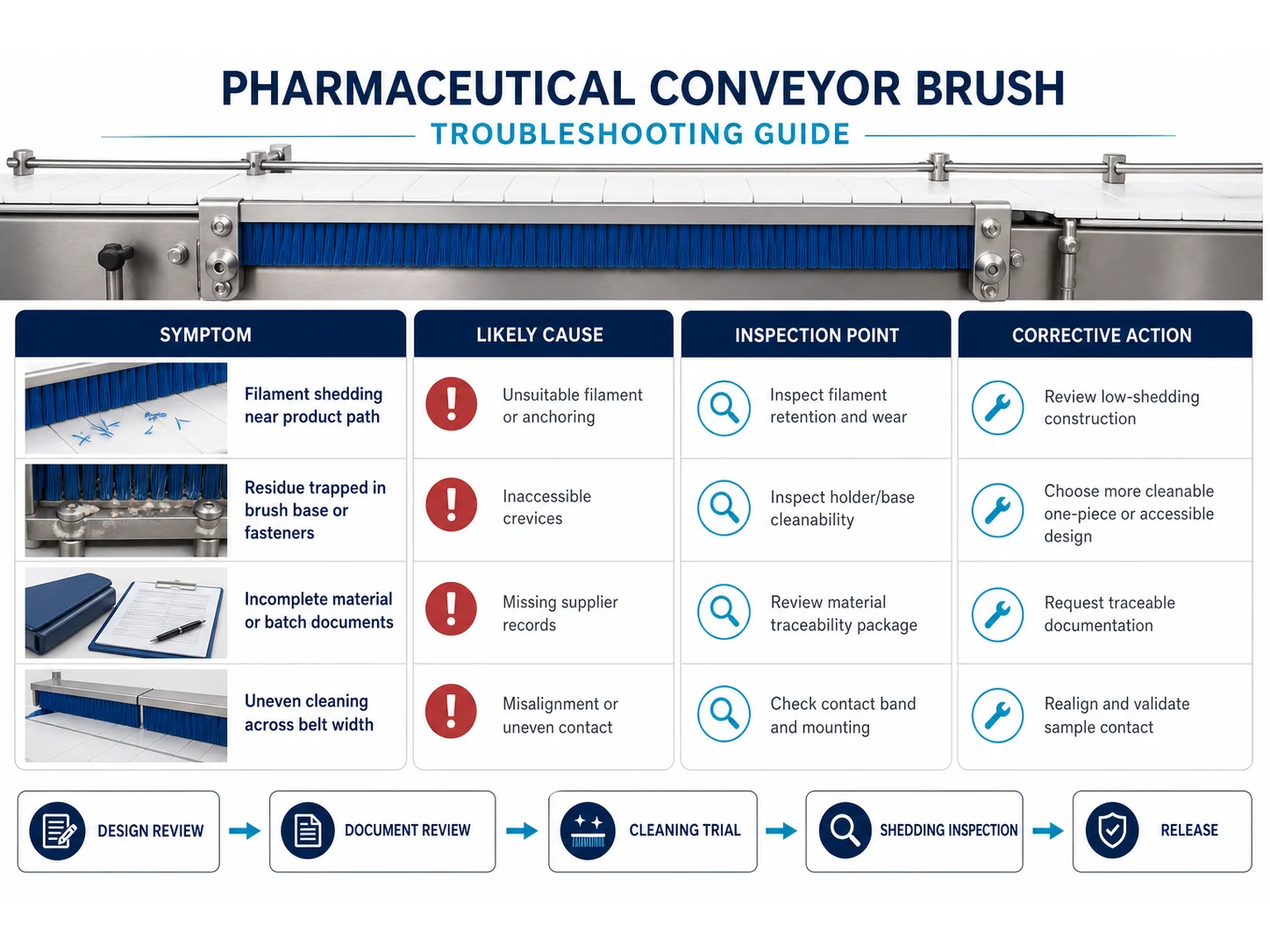
What Is a Pharmaceutical Conveyor Brush?
A pharmaceutical conveyor brush is a mounted bristle assembly designed to perform specific functions on a conveyor line—such as gently moving tablets or vials, removing loose powder before packaging, cleaning the belt surface, or preventing product jams. Unlike generic industrial brushes, these brushes are selected with heightened attention to cleanability, bristle retention, and material traceability to avoid product contamination and ease cleaning validation efforts.
The bristles may contact the product directly or indirectly, so every material choice and construction method must be evaluated for its potential to introduce foreign particles, absorb moisture, or react with cleaning agents or active pharmaceutical ingredients.
Common Types and Design Variations
Pharmaceutical conveyor brushes vary by function, mounting style, and material. Here are the most common categories:
- Transfer Brushes: Used to guide or gently push products from one conveyor to another without damaging delicate tablets or vials. Often employ softer, low-shedding bristles.
- Cleaning Brushes: Positioned to contact the conveyor belt surface, removing residual powder, dust, or debris. These include rotary brush rollers (dust cleaning brush rollers) and stationary strip brushes for conveyor belt cleaning.
- Dust Removal Brushes: Specifically designed to remove airborne or surface dust from products before filling or packaging.
- Anti-Static Brushes: Incorporate conductive bristles to dissipate static charges that can attract dust or cause product misbehavior.
- Custom Specialty Brushes: Made to buyer-supplied or equipment specifications for unique equipment interfaces or container profiles.
Comparison of Bristle Materials for Pharmaceutical Use
Bristle material is the most critical factor influencing cleanability, shedding, and chemical resistance. The table below compares common options without making absolute performance claims.
| Material | Cleanability | Shedding Risk | Chemical Resistance | Typical Use |
|---|---|---|---|---|
| Nylon 6/6 | Good; smooth filaments resist residue buildup | Low when properly retained; individual filaments can break if abraded | Excellent against many cleaning agents and solvents | Transfer, cleaning brush rollers |
| Polyester (PBT) | Very good; low moisture absorption resists microgrowth | Very low; excellent flex fatigue resistance reduces breakage | Good resistance to acids, alkalis, and disinfectants | Low-shedding transfer, dust removal, belt cleaning |
| Horsehair | Moderate; natural porosity can trap residues | Moderate to high; fibers are more prone to breakage | Limited; can degrade with strong chemicals | Gentle product transfer where shedding risk is already managed |
| Tampico Fiber | Poor to moderate; plant-based fibers can shed and absorb moisture | High; not typically recommended where low-shedding is critical | Poor; swells in water, degraded by many cleaners | Wet cleaning applications not requiring high purity |
| Abrasive Nylon (e.g., with silicon carbide) | Lower; abrasive particles can trap contaminants | Higher due to embedded abrasive grain release | Good as base nylon, but abrasive fill can affect | Belt cleaning where some particle release is acceptable |
Bristle Retention Methods for Low-Shedding Design
Even the best bristle material performs poorly if not securely anchored. Common retention methods include:
- Staple-Set: Bristles are folded over a metal wire and pressed into a drilled channel. Cost-effective but prone to bristle loss over time if not perfectly crimped.
- Molded-In: Bristles are placed in a mold and a plastic core is formed around them. Offers excellent retention and eliminates metal wire that could corrode or introduce contaminants. Preferred for low-shedding pharmaceutical applications.
- Epoxy-Set: Bristles are glued into a channel. Can be effective but epoxy compatibility with cleaning agents must be verified; some epoxies may degrade and release particles.
- Crimped Wire / Tubular Core: Bristles are mechanically crimped into a metal strip and coiled into a brush. Often used in cleaning brush rollers; retention depends on crimp precision.
For low-shedding requirements, molded-in or high-quality staple-set with a ground and flagged finish (to remove loose fibers) are common choices.
How to Choose a Pharmaceutical Conveyor Brush
Selecting the right brush involves balancing operational needs with contamination risk. Evaluate these factors:
- Function: Determine whether the brush contacts the product, the belt, or the environment. Direct product contact demands the most stringent low-shedding and chemical compatibility.
- Cleanability: Can the brush be effectively cleaned in place (CIP) or easily removed for cleaning? Smooth, non-absorbent bristles with open patterns reduce residue trapping.
- Shedding Resistance: Look for documented bristle retention methods and materials with high flex fatigue strength. Ask suppliers for test data on bristle loss under simulated production conditions.
- Chemical Exposure: Identify all cleaning agents, disinfectants, and any product contact substances. Verify bristle and core material compatibility over temperature cycles.
- Documentation: For regulated environments, request material certificates, surface finish data, and traceability back to raw material batches. This supports validation and change control.
- Core Material: Stainless steel (304 or 316L) or supported by food-contact documentation plastics are common; avoid materials that can corrode or flake.
- Regulatory Awareness: While no brush alone promises GMP compliance, selecting materials that are known to be suitable for food/pharma contact (e.g., EU 10/2011, FDA 21 CFR) provides a baseline. Always verify with your quality unit.
Setup and Usage Factors
Even a well-chosen brush can cause issues if improperly installed or maintained:
- Mounting Precision: Incorrect angle or pressure can increase bristle wear and shedding. Follow supplier torque specifications for rotating brush rollers.
- Cleaning Protocols: Validate cleaning cycles to ensure no residue remains in the brush. Manual cleaning may require a documented SOP.
- Inspection Schedule: Implement regular visual inspections for bristle loss, core deformation, or chemical attack. Replace brushes before they become a contamination risk.
- Change Parts Documentation: In tested processes, treat brushes as change parts with defined lifetimes or replacement intervals.
Common Mistakes
- Ignoring Traceability: Using a brush without material certificates can become a significant finding during an audit. Always maintain supplier documentation.
- Overlooking Trapped-Residue Areas: Brushes with dense bristle packs or closed-end cores can trap product or cleaning liquids. Choose open-channel or flushable designs.
- Skipping Validation: Assuming a “food-grade” brush is automatically suitable for a pharmaceutical line without verifying extractables, leachables, and particulate data.
- Choosing by cost Alone: A cheaper brush may shed more, requiring more frequent cleaning, increasing downtime, and risking batch rejection. Total cost of ownership should include cleaning labor and rejection risk.
- Mismatched Chemical Compatibility: Using a brush that swells or degrades in alcohol, peroxide, or other common sanitizers can release particles and shorten brush life.
When a Standard Conveyor Brush Is the Wrong Choice
In high-potency, aseptic, or injectable product lines, a standard conveyor brush—even with good documentation—may not provide sufficient assurance. When the process involves:
- Product exposed to sterile environments,
- Highly potent active pharmaceutical ingredients requiring containment,
- Validated cleanroom operations with rigorous particulate limits,
- Direct contact with liquid or semi-solid drug substances,
then your quality and engineering teams should evaluate alternatives such as cleanable, non-brush contact solutions (e.g., vacuum transfer, air knives, or quick-release sterile components) or engage a supplier specializing in cleanroom-validated brush systems. Never assume a brush meets compliance without a formal review of your specific process and risk assessment.
Final Takeaway
A pharmaceutical conveyor brush is a small component that can have an outsized impact on contamination control. Whether you’re handling tablets, cleaning belt surfaces, or reducing static, your selection should be driven by cleanability, low-shedding design, and robust documentation—not by initial cost alone. Match the bristle material and retention method to your chemical environment, and integrate the brush into your cleaning validation and preventive maintenance programs.
Frequently Asked Questions
What is the difference between a pharmaceutical conveyor brush and a food-grade brush?
Both may use similar materials, but pharmaceutical brushes often require stricter documentation (e.g., full material traceability, extractables data) and must withstand more aggressive cleaning agents. Food-grade brushes may be acceptable for ancillary tasks but might not meet the validation standards for direct product contact in pharma.
Can I use a conveyor belt cleaning brush with abrasive bristles in a tablet line?
You can, but you must assess the risk of abrasive particle release. For areas where dust from the brush itself could contaminate product, non-abrasive, low-shedding polyester or nylon brushes are preferred. If you need aggressive belt cleaning, consider a separate closed loop system with filtration.
How do I verify that a brush is low-shedding?
Ask potential suppliers for test reports that document bristle loss under conditions simulating your line speed, temperature, and cleaning cycles. Physical inspection of sample brushes after extended use can also reveal retention quality. There is no universal standard; each manufacturer should describe their testing method.
What documentation should I expect from a brush supplier for a tested process?
Typically, you should receive material certifications (FDA, EU 10/2011 if claimed), a certificate of conformance, surface finish data (for metal cores), and a statement of origin for raw materials. Some suppliers provide change notification policies to support your supply chain control.
Can pharmaceutical conveyor brushes be sterilized?
Many nylon and polyester brushes can withstand steam autoclaving at typical cycles (e.g., 121°C), but you must confirm with the supplier. Horsehair and Tampico are not suitable for high-temperature sterilization. Always validate that sterilization does not cause bristle deformation or increased shedding.
How often should I replace a conveyor brush in a pharmaceutical line?
Replacement frequency depends on wear, cleaning frequency, and contamination risk. Establish a defined interval based on inspection and historical data. In high-purity areas, brushes may be changed on a fixed schedule (e.g., annually) regardless of apparent condition as a preventive measure.
Are there completely metal-free conveyor brushes for metal detector lines?
Yes, brushes with molded-in bristles and plastic cores eliminate all metal components. This is important to avoid false triggers from metal detectors. Some brushes use stainless steel, which is detectable, but a metal-free design simplifies inspection setup.
What if I need a custom brush shape for a unique conveyor profile?
Many brush manufacturers offer custom extrusion, profile machining, or tailored bristle patterns. Work with a supplier early in your design phase to ensure the brush can be integrated into your cleaning and maintenance protocols. Never compromise cleanability for a complex shape without a cleaning demonstrably plan.
Technical References
- eCFR — 21 CFR 211.67 Equipment Cleaning and Maintenance
- OSHA — Machine Guarding
- OSHA — Control of Hazardous Energy
- OSHA — Combustible Dust
- EPA — Particulate Matter Basics
- eCFR — 21 CFR Part 211 Finished Pharmaceutical CGMP
Which bristle material fits this job — Nylon PA, AISI 304 Stainless Steel Wire or Horsehair?
| Material | Continuous temperature (°C) | Peak temperature (°C) | Water absorption | Hardness |
|---|---|---|---|---|
| Nylon PA | 93 | 121 | 0.3–9% by PA grade and conditioning | Medium to firm; filament diameter and trim length control bending force. |
| AISI 304 Stainless Steel Wire | 400 | 500 | 0% | Rockwell B 70–95 depending on temper and cold work |
| Horsehair | 60–80 | 100–120 | 8–15% | — |
| Abrasive Nylon | 120 | 150 | 0.1–1.0% | Abrasive filament; stiffness and cutting level is controlled by PA base, grit type, grit size, filament diameter and trim height. |
Figures as published by Brushtec / DuPont; Alleima; Perlon. Confirm the exact grade against the supplier datasheet before ordering.
What should replace Nylon PA for conveyor belt?
- Nylon PA — Compare Nylon PA with PP, PBT, PET. Change material when wet stiffness, temperature, chemical resistance, conductivity, particle shedding, or surface marking becomes the limiting factor.
- AISI 304 Stainless Steel Wire — Use AISI 316 stainless steel wire for chloride, marine, dairy, beverage, chemical washdown, or higher pitting-resistance requirements. Use carbon steel for dry aggressive cutting and brass or abrasive nylon for lower marking risk.
- Horsehair — Compare Horsehair with Boar bristle, goat hair, microfiber. Change material when wet stiffness, temperature, chemical resistance, conductivity, particle shedding, or surface marking becomes the limiting factor.
- Abrasive Nylon — Compare Abrasive Nylon with PP, PBT, PET. Change material when wet stiffness, temperature, chemical resistance, conductivity, particle shedding, or surface marking becomes the limiting factor.