
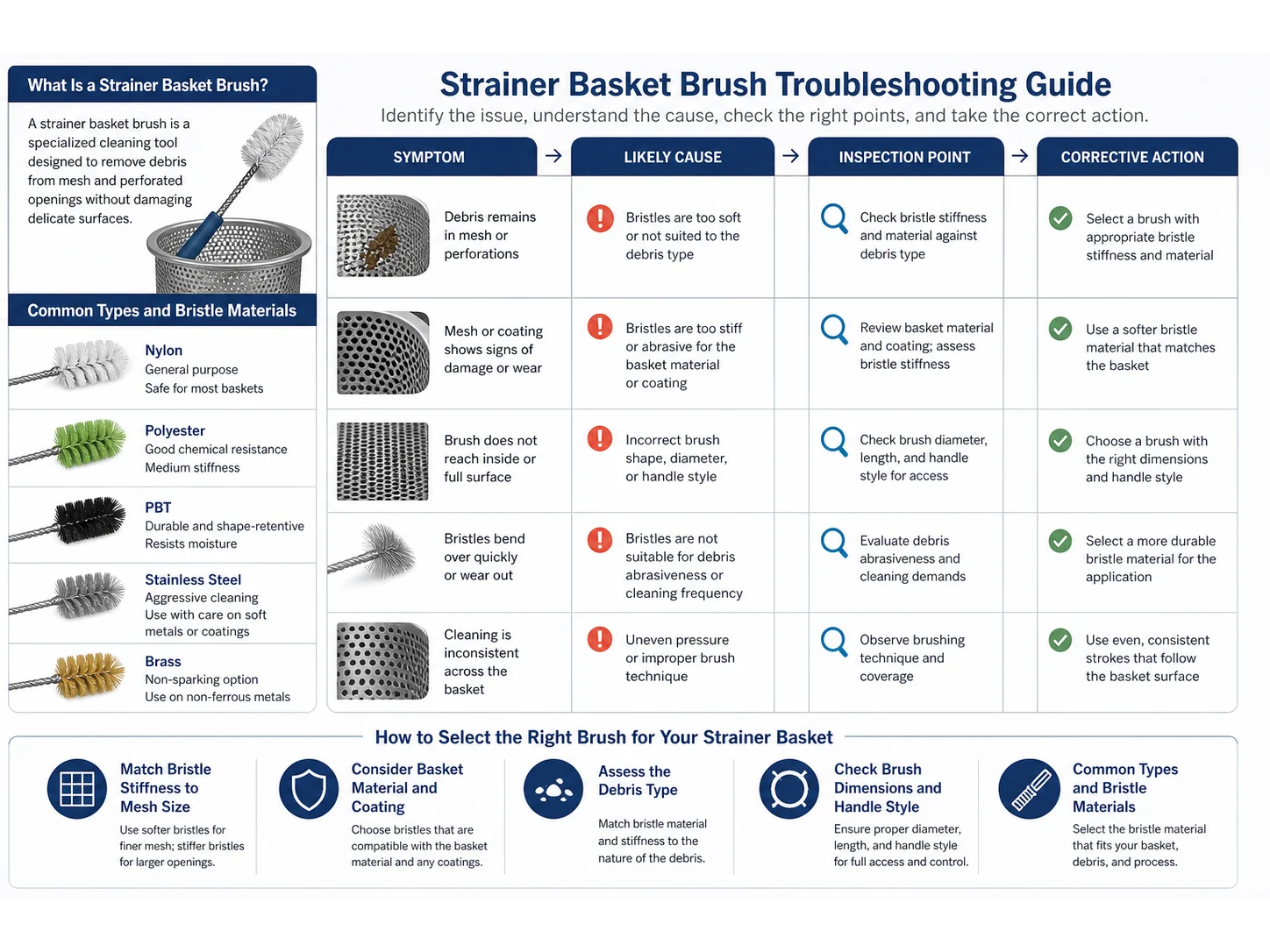
What Is a Strainer Basket Brush?
A strainer basket brush is a brush with bristles specifically selected to be softer than the mesh material but stiff enough to dislodge trapped particles. It typically has a central core or handle that allows the user to reach inside the basket’s interior without forcing bristles between fine openings. Unlike general-purpose brushes, strainer basket brushes are designed to reduce the risk of snagging, bristle break-off, and mesh warping during manual or semi-automated cleaning.
Common Types and Bristle Materials
The three most common bristle categories for strainer basket brushes are synthetic (nylon, polypropylene), natural (horsehair), and metal (fine stainless steel). Each material offers a different balance of stiffness, chemical resistance, and abrasion risk, making it suitable for specific mesh types and debris conditions.
| Bristle Material | Stiffness | Recommended Mesh Types | Debris Compatibility | Advantages | Limitations |
|---|---|---|---|---|---|
| Soft Nylon | Low | Fine mesh (under 500 µm), delicate synthetic screens | Soft slime, loose fibers | Will not scratch or enlarge openings; gentle on coatings | May not remove hardened debris; wears faster on rough baskets |
| Stiff Polypropylene | Medium to high | Medium mesh (200–1000 µm), robust stainless steel baskets | Sticky resins, compacted solids | Effective scrubbing without metal-on-metal contact | Can bend fine mesh if used aggressively; absorbs some chemicals |
| Natural Horsehair | Medium | Fine and medium mesh, brass and stainless steel | Powders, light buildup | Excellent debris release; chemical resistant; leaves no synthetic residue | Not suitable for heavy scraping; limited temperature tolerance |
| Fine Stainless Steel Wire | Very high | Heavy-duty coarse mesh, punched plates, or cast baskets | Hard scales, rust, baked-on process residues | Removes tough deposits quickly | Will damage fine or soft metal mesh; bristles can break off and contaminate product |
How to Select the Right Brush for Your Strainer Basket
Match Bristle Stiffness to Mesh Size
A practical rule of thumb: bristle diameter should be less than half the mesh opening width to prevent snagging and mesh distortion. For very fine meshes (below 200 µm), use only soft nylon or horsehair. For punched plates with larger round holes, stiffer polypropylene or even fine wire may be acceptable if the plate material is thick and rigid.
Consider Basket Material and Coating
Stainless steel baskets can generally handle stiffer bristles than plastic or epoxy-coated models. Abrasive or wire brush contact can scratch protective coatings, leading to corrosion or product contamination. When in doubt, test on a spare or inconspicuous area first.
Assess the Debris Type
Soft, slimy deposits often release with gentle nylon brushing and a water spray. Hardened, sticky, or crystalline residues may require a medium-stiffness polypropylene brush and possibly a compatible cleaning solution. Always verify that the bristle material can withstand any chemical cleaners used; nylon, for example, can degrade with strong acids.
Check Brush Dimensions and Handle Style
The brush diameter must allow clearance within the basket to avoid wedging and excessive side pressure. Measure the inside diameter and subtract at least 10–15% for safe operation. Handle length must reach the basket bottom, and an angled head helps clean internal baffles or deep corners. For large tanks where baskets cannot be removed, consider an extended handle or a flexible shaft.
Best Practices for Using a Strainer Basket Brush
- Whenever possible, remove the basket from the housing and rinse in a separate area to prevent debris from falling back into the system.
- Use a gentle circular motion following the mesh pattern; avoid jabbing or prying at stuck particles.
- Rinse the brush frequently to dislodge accumulated debris and inspect for bristle loss.
- A torn or deformed basket is not repairable with a brush—replace it before further use.
- After cleaning, dry or store the brush away from direct sunlight and chemicals that may embrittle the bristles.
Common Mistakes When Cleaning Strainer Baskets
- Using a wire brush on fine mesh. Even stainless steel wire will catch and deform openings under 500 µm, leading to permanent damage.
- Forcing an oversized brush. Too tight a fit scrapes the basket wall and can force debris deeper into the mesh.
- Ignoring bristle material compatibility. Nylon bristles become brittle in some solvents; polypropylene can swell in oils. Match the brush to the process environment.
- Skipping regular cleaning. Allowing deposits to harden makes removal harder and risks damage from aggressive scrubbing later.
- Using a damaged brush. Bent or broken bristles can scratch the mesh and contaminate downstream with bristle fragments.
When a Strainer Basket Brush Is the Wrong Choice
A strainer basket brush is the right tool for routine debris removal, but it has limits. If the mesh is torn or the frame is bent, no brush can repair it—replacement is necessary. For ultra-fine screens with sub-micron openings or sintered metal, ultrasonic cleaning may be required to reach pores a brush cannot touch. In high-volume automated lines, clean-in-place (CIP) spray systems or automated brush machines may be more efficient and repeatable. For irregularly shaped baskets or critical applications where bristle contamination is a concern, a custom-designed brush validated with a supplier and supported by a sample test or drawing review is often the safest path.
Final Takeaway
Choosing a strainer basket brush comes down to matching the bristle material and size to your mesh openings, basket material, and debris type. Soft nylon or horsehair protects fine filtration surfaces, while stiffer polypropylene handles tougher buildup on robust baskets—but always test gently first. The goal is consistent, damage-free cleaning that extends basket life and keeps your process flowing.
Frequently Asked Questions
What is the difference between a strainer basket brush and a tube brush?
Both are cylindrical brushes, but strainer basket brushes are typically wider and have a larger handle or core designed to sweep the interior of a basket. Tube brushes often have a twisted wire core and narrower diameter for cleaning pipes and tubes. Using a tube brush on a fine mesh basket can snag the mesh because of the exposed wire core.
Can I use a bottle brush instead of a strainer basket brush?
It is not recommended. Bottle brushes usually have a twisted wire stem that can scratch soft metal or plastic mesh. Strainer basket brushes are designed with a smooth core or buffer zone to protect the basket surface.
How do I clean a very fine mesh (under 200 microns) without damage?
Use only soft nylon or natural horsehair bristles. Soak the basket in warm water or an appropriate cleaner to loosen deposits, then gently brush in a circular motion without applying heavy pressure. Rinse from the outside in to push particles back the way they entered.
How often should I clean strainer baskets?
Cleaning frequency depends on the process. Monitor pressure drop across the strainer or observe flow reduction. Clean when the differential pressure reaches the manufacturer’s recommended limit. Routine cleaning prevents hardened buildup that becomes harder to remove later.
What if bristles break off inside the basket?
Immediately stop and rinse the basket thoroughly to remove all loose fragments. Bristle loss indicates the brush is too stiff or worn and should be replaced. Nylon bristles are safer because they are less likely to damage downstream equipment if ingested, but any foreign material is a contaminant.
Can I use a power drill with a brush attachment?
Only on very robust, coarse mesh baskets or punched plates made of thick stainless steel. Even then, use the lowest speed and avoid prolonged contact in one spot. The risk of mesh burn, tearing, or bristle melting is high, so manual brushing is safer for most strainer baskets.
When should I consider a custom strainer basket brush?
If your baskets have unusual geometry, require strict material traceability for FDA or sanitary processes, or must fit automated cleaning systems, a custom brush designed from your basket drawing ensures correct fit and material compliance. Consult with a brush supplier to review samples or prototypes.
Are there food-safe strainer basket brushes?
Yes, brushes made with FDA-compliant polypropylene, nylon, or natural fibers are available. Always confirm with the supplier that the entire brush—including the handle and any adhesive—meets food contact regulations for your specific process.
Which bristle material fits this job — Nylon PA, AISI 304 Stainless Steel Wire or Horsehair?
| Material | Continuous temperature (°C) | Peak temperature (°C) | Water absorption | Hardness |
|---|---|---|---|---|
| Nylon PA | 93 | 121 | 0.3–9% by PA grade and conditioning | Medium to firm; filament diameter and trim length control bending force. |
| AISI 304 Stainless Steel Wire | 400 | 500 | 0% | Rockwell B 70–95 depending on temper and cold work |
| Horsehair | 60–80 | 100–120 | 8–15% | — |
| PBT | 120–140 | 160–180 | 0.05–0.20% | Shore D 80–90 |
Figures as published by Brushtec / DuPont; Alleima; Perlon. Confirm the exact grade against the supplier datasheet before ordering.
What should replace Handheld Detail Brushes for strainer basket brush?
- Handheld Detail Brushes — Handheld detail brushes cover general precision cleaning; auto-detailing brushes impose tighter controls for painted, polished, leather, display, and trim surfaces.
- Nylon PA — Compare Nylon PA with PP, PBT, PET. Change material when wet stiffness, temperature, chemical resistance, conductivity, particle shedding, or surface marking becomes the limiting factor.
- AISI 304 Stainless Steel Wire — Use AISI 316 stainless steel wire for chloride, marine, dairy, beverage, chemical washdown, or higher pitting-resistance requirements. Use carbon steel for dry aggressive cutting and brass or abrasive nylon for lower marking risk.
- Horsehair — Compare Horsehair with Boar bristle, goat hair, microfiber. Change material when wet stiffness, temperature, chemical resistance, conductivity, particle shedding, or surface marking becomes the limiting factor.