
Custom Cleaning Brush
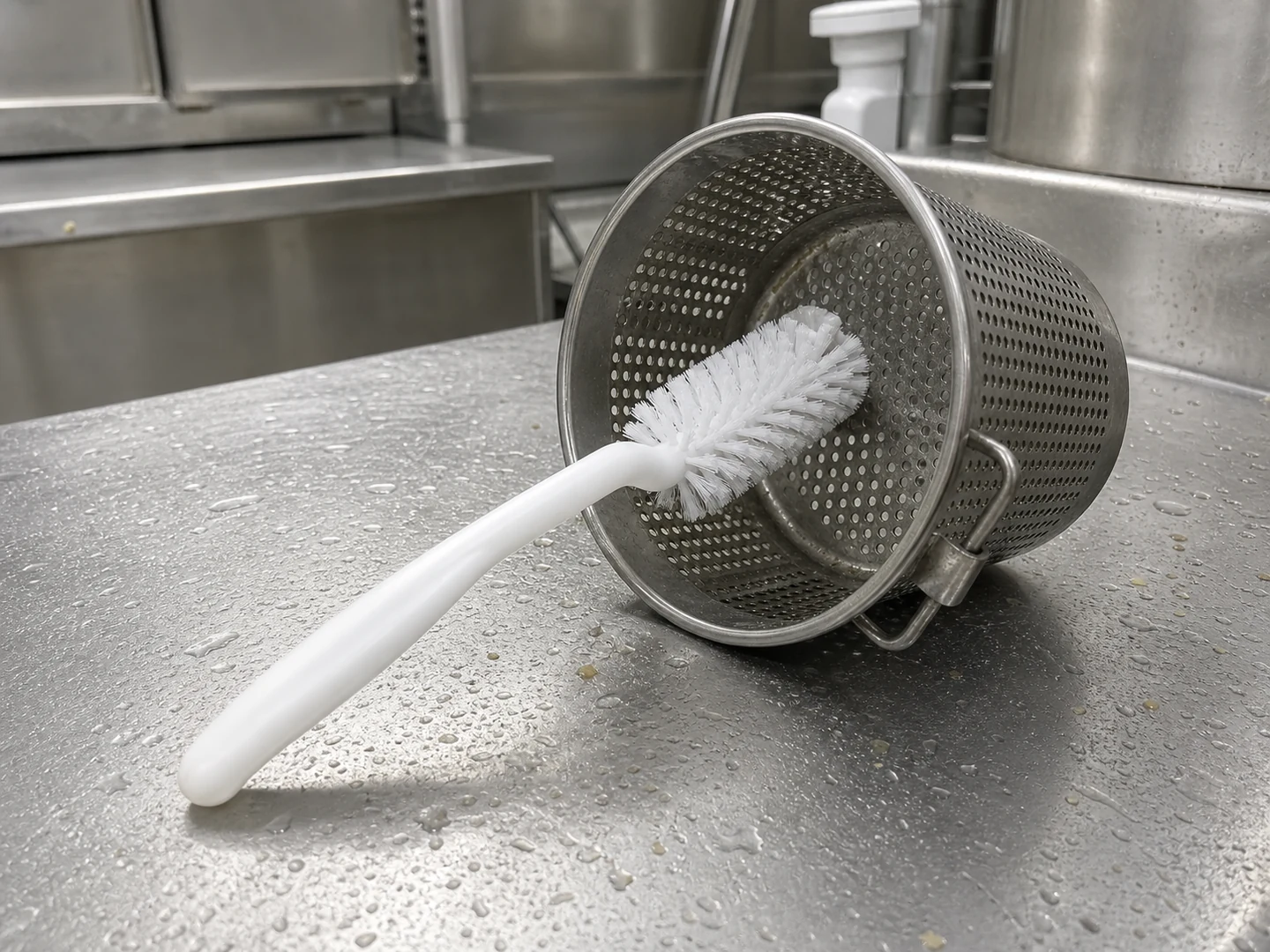
Strainer Basket Brush
Order a custom nylon strainer basket brush for fine screens, perforated baskets and juicer strainers.
Small brush
500 pcs
Minimum order
Held in one hand: tube, bottle, detail and swab brushes — including long-handled ones with a small head.
Production lead time, once the specification is confirmed
- Up to 500 pcsWithin 7 days
- 501–50,000 pcsWithin 14 days
- Over 50,000 pcsWithin 21 days
Peak season can extend these times; the shipping date is confirmed in writing with your quotation. Sampling and shipping are quoted separately.
A specialized nylon brush designed to clean perforated strainer baskets, fine screens, and pulp-retaining mesh. Its shaped head and flexible filaments clear pulp, fibers, seeds, and dried food residue from apertures without bending or scratching the screen.
What can this brush do for you?
Clears Pulp and Fibers from Perforations
Nylon filaments sized from 0.10 to 0.40 mm enter individual apertures and push lodged pulp, seeds, and fibers out the opposite side. The filament diameter is matched to your hole size so each stroke dislodges debris instead of just skimming the screen surface.
Follows Concave and Curved Basket Interiors
Head forms such as tapered, cylindrical, and flat profiles let the brush stay in contact with the sidewalls, bottom, and shoulder transitions of conical and cylindrical strainer baskets. The head width and brush section length are sized to the basket so operators can clean the full interior without dead zones.
Protects Fine Mesh from Damage
Nylon PA filaments are stiff enough to break dried-on pulp bonds but compliant enough to flex at the tip rather than bend or tear delicate perforated metal. For extra-fine mesh, the filament diameter and trim length can be reduced further to keep contact gentle.
Stands Up to Wet Washdown and Food-Safe Cleaning
The nylon fill does not rust, corrode, or absorb water, so the brush holds its stiffness through repeated washing with detergents and hot water. Handles and cores are offered in corrosion-resistant materials such as polypropylene or stainless steel to match food-processing washdown routines.
Configurable for Your Exact Basket
Head dimensions, filament lengths, handle length, and head geometry are all adjustable. Instead of forcing a stock brush into a non-standard basket, we build the brush around your basket diameter, depth, hole size, and operator reach.
What is a Strainer Basket Brush?
A Strainer Basket Brush is a hand-guided cleaning tool with a narrow, profiled head filled with nylon filaments, built specifically for perforated strainer baskets, sieves, and fine screens. Unlike a general-purpose scrub brush, its head shape and filament layout are chosen to get into the concave interior of a basket, poke through the holes, and push residue out from the inside.
In use, the operator inserts the head into the basket and scrubs with a push-pull or rotating motion. The filaments enter each aperture, dislodge pulp or dried particles, and let them fall away for rinsing. The brush can also be used on the outside of the basket to clean the reverse side of the mesh.
This brush is built for routine removal of soft to moderately dried food residue. It is not intended for heavy baked-on carbon, mineral scale, or aggressive abrasive scrubbing—those applications require wire or abrasive brushes or a different cleaning method such as ultrasonic or pressure washing.
Technical Specifications
The table below lists the standard configuration range for the Strainer Basket Brush. All values are adjusted to your specific basket geometry and cleaning requirements.
| Parameter | Value / Options |
|---|---|
| Head width | 15–90 mm, selected to fit inside the basket diameter |
| Brush section (filled length) | 60–180 mm, matched to basket depth |
| Overall length | 200–500 mm, including handle for operator reach |
| Trim length (filament free length) | 10–35 mm, adjusted for penetration and stiffness |
| Filament diameter | 0.10–0.40 mm, selected for hole size and residue type |
| Head form | Flat, tapered, pleat, comb, or cylindrical |
| Fill material | Nylon PA (moisture- and detergent-resistant grades) |
| Handle / core material | Polypropylene, stainless steel, or overmolded TPE (project-specified) |
| Operating temperature | Up to 80°C continuous in wet washdown; higher-temperature options available |
| Brush type | Custom Handheld Detail Brushes |
| How it is driven | Hand-guided |
| Cleaning target | juice extractor and centrifugal juicer strainer basket, food strainer basket and colander, and industrial sifting screen and sieve plate cleaning |
| Surface or part | baskets, screens, holes, metal, filters, wire mesh, cylinders, and plates |
| Residue or debris | pulp, fiber, seeds, food residue, particles, mineral scale, spent grounds, and carbon |
| Mounting / connection | Fixed |
For fine mesh with holes under 0.3 mm, specify the aperture size during inquiry so we can verify that the selected filament diameter will enter and exit the holes without binding.
Where does this brush work best?
- Juice extractor and centrifugal juicer strainer baskets – removes compacted fruit and vegetable pulp, fibers, and seeds from the fine perforated cone or cylinder.
- Food strainer baskets and colanders – cleans the interior and exterior of wire mesh or perforated metal baskets used in fruit, vegetable, and dairy processing.
- Industrial sifting screens and sieve plates – clears dried powder, fiber, and seed particles from apertures without blowing air or using solvents.
- Espresso and coffee filter baskets – a smaller head configuration can dislodge spent grounds and oils from fine filter holes without scratching the metal.
- Pharmaceutical or cosmetic sieve components – where residue removal between batches requires a hand-cleaning tool that reaches into recessed perforations.
How do I choose the right one?
Start with the basket itself: measure the minimum inside diameter, the depth from rim to bottom, and the aperture size. Then follow these steps:
- Set the head width. The head should be slightly narrower than the basket inside diameter to allow rotation and scrubbing without jamming. A gap of 5–10 mm on each side is typical, but can be wider for very deep baskets.
- Match filament diameter to hole size and residue. For holes smaller than 1 mm and soft, fresh pulp, choose 0.10–0.20 mm filaments. For holes 1–3 mm and dried-on residue, choose 0.25–0.35 mm. For holes above 3 mm with sticky or fibrous debris, choose 0.35–0.40 mm. Too thin a filament will flex and not push debris out; too thick a filament will not enter the hole.
- Pick the head form. Use a tapered head for conical baskets, a cylindrical or flat head for straight-sided baskets, a pleat or comb head for convoluted or folded screens, and a rounded-end cylindrical head for baskets with a curved bottom.
- Consider the cleaning environment. Nylon PA is the default for wet washdown with mild detergents and hot water. If your process uses aggressive acids, strong alkalis, or temperatures above 80°C, ask about PBT, PP, or higher-temperature filament options. The handle and core material should also match chemical exposure.
- Decide on handle length and grip. Longer handles give reach into deep baskets or reduce bending; shorter handles improve control for fine scrubbing. Choose a grip material that remains slip-resistant when wet, and consider a hanging hole for storage.
When to choose a different tool. If the residue is baked-on carbon, mineral scale, or heavy rust, a nylon brush will not be effective—use a stainless steel wire brush or an abrasive pad. If the screen has very sharp burrs or edges, nylon filaments may wear quickly; a wire brush with a protective shroud or a nylon-coated wire option may be better. For extremely fine mesh below 0.2 mm hole size, manual filament penetration may be impractical; consider ultrasonic cleaning or high-pressure spray instead.
Can I customize this brush?
Every Strainer Basket Brush we build is configured for a specific basket. To define your custom brush, provide:
- Basket inside diameter, depth, and shape (conical, cylindrical, rounded bottom)
- Aperture size and pattern (round, square, slotted, or expanded metal)
- Residue type and condition (fresh, dried, sticky, fibrous)
- Cleaning chemical, wash temperature, and washdown method
- Operator handle preference (length, grip shape, hanging feature)
- Any drawings, photos, or sample baskets for dimensional verification
We can adjust:
- Head geometry – width, length, taper, pleat, comb, cylindrical, or custom molded profile
- Filament configuration – diameter, trim length, fill density, filament material (Nylon PA, PBT, PP, or others), flagged or feathered tips
- Stem and handle – length, material (PP, stainless steel, TPE overmold), ergonomic shape, color, hanging hole, or branding mark
- Head attachment – fixed, threaded, or replaceable head system for high-wear programs
- Color and marking – custom color, laser marking, pad printing, or identification coding
- Packaging – bulk carton, individual polybag, retail sleeve, or kit with spare heads
If your project requires food-contact material documentation, inspection reports, or third-party testing, we can coordinate those deliverables during the customization process.
What size should a strainer basket brush be, and how long does it last?
How do I confirm the filament diameter will fit my sieve holes?
Test a sample brush (or a filament sample of the selected diameter) against your sieve. The filament should enter the hole with light finger pressure and exit the opposite side without permanently bending. If it buckles or slides over the hole, the filament is too thin; if it cannot enter, it’s too thick. We can provide a short sample strip to confirm before full production.
Should I clean the basket while it is still wet or after it dries?
For fresh fruit and vegetable pulp, brush immediately after use while the residue is still hydrated. If residue has already dried, soak the basket in warm water or a mild detergent for 5–10 minutes before brushing. This softens the bond and reduces the scrubbing force needed, which extends filament life.
Can this brush clean the outside of a strainer basket as well as the inside?
Yes. Use the same head on the external surface with a long scrubbing stroke. A cylindrical or flat head works well for the outside of a conical basket because it follows the outer curve. Rotate the basket in a sink or on a flat surface to speed up coverage.
How can I tell when the brush needs to be replaced?
Inspect after each shift. Replace the brush if filaments are permanently bent, splayed, or worn shorter than the specified trim length; if the head is cracked or the handle is loose; or if the brush no longer clears debris from holes with normal effort. A brush with damaged filaments will require more strokes and may abrade the screen.
Does brushing replace soaking or chemical cleaning?
No. Brushing provides mechanical removal of lodged particles, but it works best as part of a sequence: pre-rinse, optional soak, brush, final rinse, and sanitize if required. For sticky or protein-based residues, a detergent soak loosens the deposit so the brush only needs to push it out of the holes, not break a hard bond.
Is this brush suitable for very fine espresso filter baskets?
Yes, but it requires a narrower head and thinner filaments (typically 0.10–0.15 mm) to avoid clogging the small holes. Provide the filter basket diameter and hole size so we can recommend the correct configuration. For automatic espresso machine group heads, a dedicated grouphead brush is usually a better choice because it includes a specific contours profile.
Guides that go deeper on this
Custom Manufacturing RFQ
Describe Your Application
For an accurate quotation, please provide the main dimensions, material preference, working surface, residue, quantity, and a drawing or photo.
Drawing or photo optional — it speeds things up, it does not gate the enquiry.
Custom Brush RFQ
Send Your Brush Project
Upload a drawing, product photo, or sample photo and provide the core dimensions and cleaning conditions.
“We need a brush to remove wet residue from a stainless steel conveyor, about 800mm wide. The current brush wears quickly. We can send photos.”
“We sell drinkware and need a cleaning brush to include with the product. Quantity around 5,000 pieces.”