
What Is a Tire Mold Cleaning Brush?
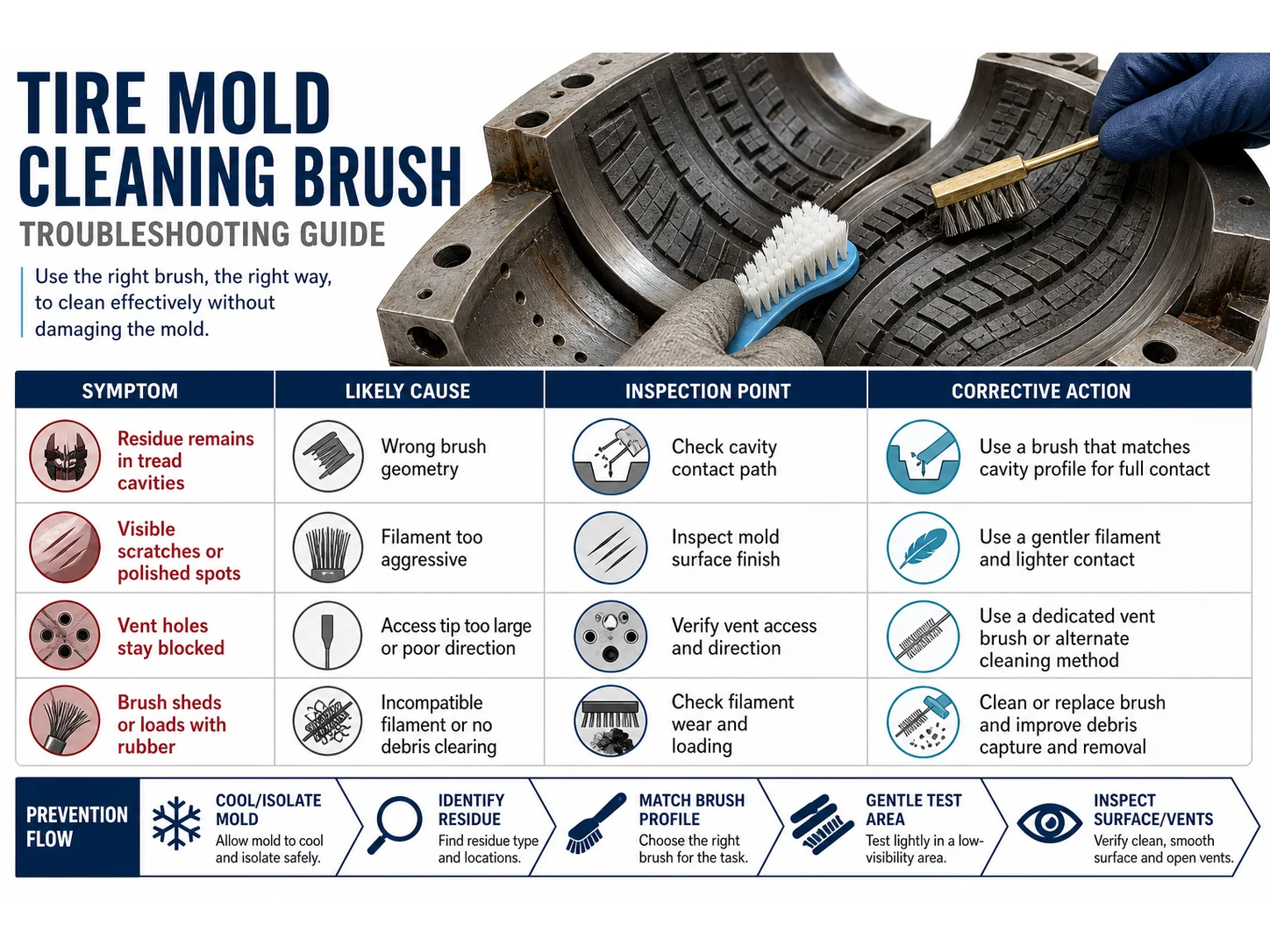
A tire mold cleaning brush is a tool designed specifically to remove buildup—such as cured rubber residue, mold release agents, and light carbon deposits—from the intricate surfaces of tire curing molds. Effective cleaning preserves mold detail, maintains consistent tread patterns, and helps reduce defect risk caused by clogged vents or uneven surface finishes. The right brush balances residue removal strength with the need to protect mold coatings, sidewall lettering, and minute groove geometries.
Common Types of Tire Mold Cleaning Brushes
Tire mold brushes generally fall into three bristle-material categories, each with distinct cleaning characteristics:
- Abrasive nylon brushes – embedded with silicon carbide or aluminum oxide particles; effective on light-to-moderate residue while minimizing scratch risk. Available in various grits and forms (hand, cup, disc).
- Brass wire brushes – softer than stainless steel, brass bristles remove stubborn residue with lower risk of damaging polished or coated mold surfaces. Common as handheld, twisted bore, or rotary brushes.
- Stainless steel wire brushes – aggressive cleaning power for heavy, hardened carbon; greater risk of surface scratching, so they are typically reserved for uncoated molds or areas where fine finish is not critical.
Within these categories, brush configuration matters: twisted-in-wire bore brushes for vent holes, cup brushes for large flat areas, and detail brushes for lettering and sipes.
Brass vs Stainless Steel Wire Brushes for Tire Molds
Choosing between brass or stainless steel wire brush options depends on the mold material, coating, and the type of residue. The table below compares the two metal bristle types alongside abrasive nylon for a complete decision framework.
| Bristle Material | Residue Removal Strength | Risk of Mold Surface Damage | Suitable Mold Surface | Typical Applications | Key Considerations |
|---|---|---|---|---|---|
| Abrasive Nylon | Moderate | Very Low | Coated, polished, textured | Light residue, maintenance cleaning, sensitive areas | Grit selection critical; may not remove heavy carbonized rubber |
| Brass Wire | Medium-High | Low-Medium | Plated, uncoated steel, durable coatings | Stubborn residue, vent holes, intricate grooves | Wears faster than stainless; slight brass transfer possible but non-damaging |
| Stainless Steel Wire | High | Medium-High | Uncoated steel, hard molds | Heavy carbon, baked-on deposits, rough-in cleaning | Avoid on chrome plating, Teflon, or polished surfaces; can scratch or dull finish |
When evaluating brass vs stainless steel wire brush performance, note that brass provides a safer middle ground for mixed mold inventories, while stainless demands strict surface compatibility checks.
How to Choose the Right Brush for Tire Mold Residue Removal
Selection involves assessing the specific mold design, residue type, and cleaning conditions. Prioritize these factors:
- Mold coating and surface sensitivity – polished or coated molds (chrome, Teflon, nickel) require non-marring brushes like abrasive nylon or brass; stainless steel is generally too aggressive.
- Residue characteristics – soft, uncured rubber may be removed with nylon; hardened, carbonized deposits often need brass; severe buildup might exceed brush capability entirely.
- Groove and vent hole geometry – narrow sipes, thin ribs, and small diameter vent holes need appropriately sized bore or detail brushes. A small stainless steel twisted wire bore brush can clean vents effectively but must be used with care.
- Access space – deep sidewall cavities or tight shoulder areas may require longer-reach brushes or specialized forms like angled brushes.
- Cleaning temperature – if cleaning hot molds, ensure the bristle material retains stiffness and the brush handle withstands heat. Nylon can soften at high temperatures.
Key Factors That Affect Brush Performance in Mold Cleaning
Even the correct bristle material can perform poorly if the brush design doesn’t match the application. Consider these operational factors:
- Bristle diameter and density – thicker bristles are more aggressive but less flexible; higher density increases working speed but may trap debris.
- Trim length – shorter trim increases scrubbing force but limits reach into deep details.
- Rotary vs. manual – power tools (cup brushes on angle grinders) speed cleaning but raise the risk of over-application; manual brushing offers better control for delicate areas.
- Vent hole compatibility – always use stainless steel twisted wire bore brushes or nylon brushes sized for the vent diameter; oversizing can enlarge vents or damage the mold.
- Brush contamination – a brush that’s already laden with rubber and chemicals can introduce foreign material, so brushes should be dedicated to mold cleaning and inspected frequently.
Common Mistakes When Cleaning Tire Molds with Brushes
- Using an overly aggressive wire brush – applying a coarse stainless steel brush on a chromed or polished mold can leave permanent scratches, reducing mold life and causing surface defects on tires.
- Ignoring vent holes – clogged vents lead to trapped air, curing defects, and irregular tread shapes. Skipping vent cleaning or using the wrong tool can damage vents or miss buildup.
- Excessive pressure – brushing too hard bends bristles, reduces contact efficiency, and raises the risk of metal bristle fracture into the mold.
- Assuming one brush fits all molds – a single brush type rarely works for every mold in a plant; a set of abrasive nylon, brass, and stainless steel brushes matched to each mold family improves both safety and results.
- Neglecting coating compatibility – some mold release coatings are fragile; even brass can wear them thin if misapplied.
When Brushes Are the Wrong Choice: Alternative Cleaning Methods
While tire mold cleaning brushes handle a wide range of maintenance tasks, certain conditions demand more advanced solutions:
- Dry ice blasting – non-abrasive, non-conductive, and thorough for complex geometries; ideal for molds with delicate coatings or when brush contamination risk is high.
- Chemical cleaning – specialized solvents or gel-based cleaners can dissolve cured rubber without mechanical action; requires proper ventilation and rinsing protocols.
- Ultrasonic cleaning – effective for small mold segments or sidewall plates with deep lettering; removes residue from tight corners without surface impact.
- Mold maker or manufacturer consultation – when introducing a new mold type, the equipment manufacturer can provide recommended cleaning methods, compatible brush materials, and critical no-go areas. This step is especially important for molds under warranty or those with proprietary coatings.
The boundary: brushes remain a fast, cost-effective frontline cleaning method, but they should be part of a broader mold maintenance program that includes periodic deep cleaning with the above methods.
Final Takeaway: Balancing Cleaning Power and Mold Protection
The right tire mold residue cleaning brush selection is all about matching bristle type, brush form, and technique to the specific mold requirements. Start with the least aggressive option that maintains residue removal effectiveness, validate on a non-critical area, and never ignore vent holes. When brushes fall short, move to dry ice blasting or chemical solutions. A thoughtful cleaning protocol extends mold life and ensures consistent tire quality.
Frequently Asked Questions
Can I use a wire brush on a chrome-plated tire mold?
Only with significant caution. Abrasive nylon is safest. If a wire brush is needed, fine brass wire can be used on durable chrome plating with light pressure, but stainless steel wire should be avoided entirely to prevent scratching.
How do I clean tire mold vent holes without damaging them?
Use a small stainless steel twisted wire bore brush or a nylon brush specifically sized for the vent diameter. Insert gently and rotate; avoid pushing bristles beyond the vent opening, which can enlarge or deform the hole. Check the brush regularly for bristle loss.
What’s the difference between brass and stainless steel wire brushes for mold cleaning?
Brass bristles are softer and less likely to scratch mold surfaces, making them suitable for plated or coated molds. Stainless steel bristles are harder and more aggressive, better for heavy carbon on raw steel, but they carry a higher risk of surface damage. In a brass vs stainless steel wire brush comparison, brass usually wins for general mold maintenance.
Can abrasive nylon remove heavy carbon deposits?
It can handle moderate deposits, but when rubber has baked into a hard, shiny carbon layer, abrasive nylon may be too slow or ineffective. In those cases, a brass brush or alternative method (dry ice blasting) becomes necessary.
How often should tire mold cleaning brushes be replaced?
There is no fixed interval; replace when bristles show visible wear, bending, or contamination. A worn brass brush loses stiffness and cleaning power, while a contaminated nylon brush can redeposit gunk. Visual inspection before each use is a good practice.
Is it safe to use a wire brush on segmental tire molds?
Yes, but extra care is needed at segment joints and edges. Avoid dragging wire bristles across parting lines, as this can round sharp edges and affect mold fit. Use a detail brush or manually clean near the parting line.
What should I check before selecting a brush for a new mold type?
Review the mold material, any surface coating (chrome, Teflon, etc.), groove depth, vent hole diameters, and the manufacturer’s cleaning recommendations. If in doubt, start with an abrasive nylon brush and escalate only if residue remains.
Does brush bristle material leave any residue on the mold?
Nylon typically does not. Brass may leave a faint metallic transfer that can be wiped away after cleaning; this is cosmetic and not harmful to the tire. Stainless steel can leave microscopic scratches that may hold release agent unevenly, so a final wipe-down is essential.
Technical References
- OSHA — Heat Exposure
- World Stainless — Corrosion Resistance of Stainless Steels
- OSHA — 1910.177 Servicing Multi-Piece and Single Piece Rim Wheels
- NHTSA — Tire Safety Ratings and Awareness
Which bristle material fits this job — AISI 304 Stainless Steel Wire, Abrasive Nylon or Nylon PA?
| Material | Continuous temperature (°C) | Peak temperature (°C) | Water absorption | Hardness |
|---|---|---|---|---|
| AISI 304 Stainless Steel Wire | 400 | 500 | 0% | Rockwell B 70–95 depending on temper and cold work |
| Abrasive Nylon | 120 | 150 | 0.1–1.0% | Abrasive filament; stiffness and cutting level is controlled by PA base, grit type, grit size, filament diameter and trim height. |
| Nylon PA | 93 | 121 | 0.3–9% by PA grade and conditioning | Medium to firm; filament diameter and trim length control bending force. |
| Rubber | 100 | 130 | very low | Specified by compound and Shore hardness; published TPE families can span roughly 50–80 Shore A, but that is a product-family example rather than a universal rubber range. |
Figures as published by Alleima; Perlon; Brushtec / DuPont. Confirm the exact grade against the supplier datasheet before ordering.
What should replace Handheld Detail Brushes for tire?
- Handheld Detail Brushes — Handheld detail brushes cover general precision cleaning; auto-detailing brushes impose tighter controls for painted, polished, leather, display, and trim surfaces.
- AISI 304 Stainless Steel Wire — Use AISI 316 stainless steel wire for chloride, marine, dairy, beverage, chemical washdown, or higher pitting-resistance requirements. Use carbon steel for dry aggressive cutting and brass or abrasive nylon for lower marking risk.
- Abrasive Nylon — Compare Abrasive Nylon with PP, PBT, PET. Change material when wet stiffness, temperature, chemical resistance, conductivity, particle shedding, or surface marking becomes the limiting factor.
- Nylon PA — Compare Nylon PA with PP, PBT, PET. Change material when wet stiffness, temperature, chemical resistance, conductivity, particle shedding, or surface marking becomes the limiting factor.