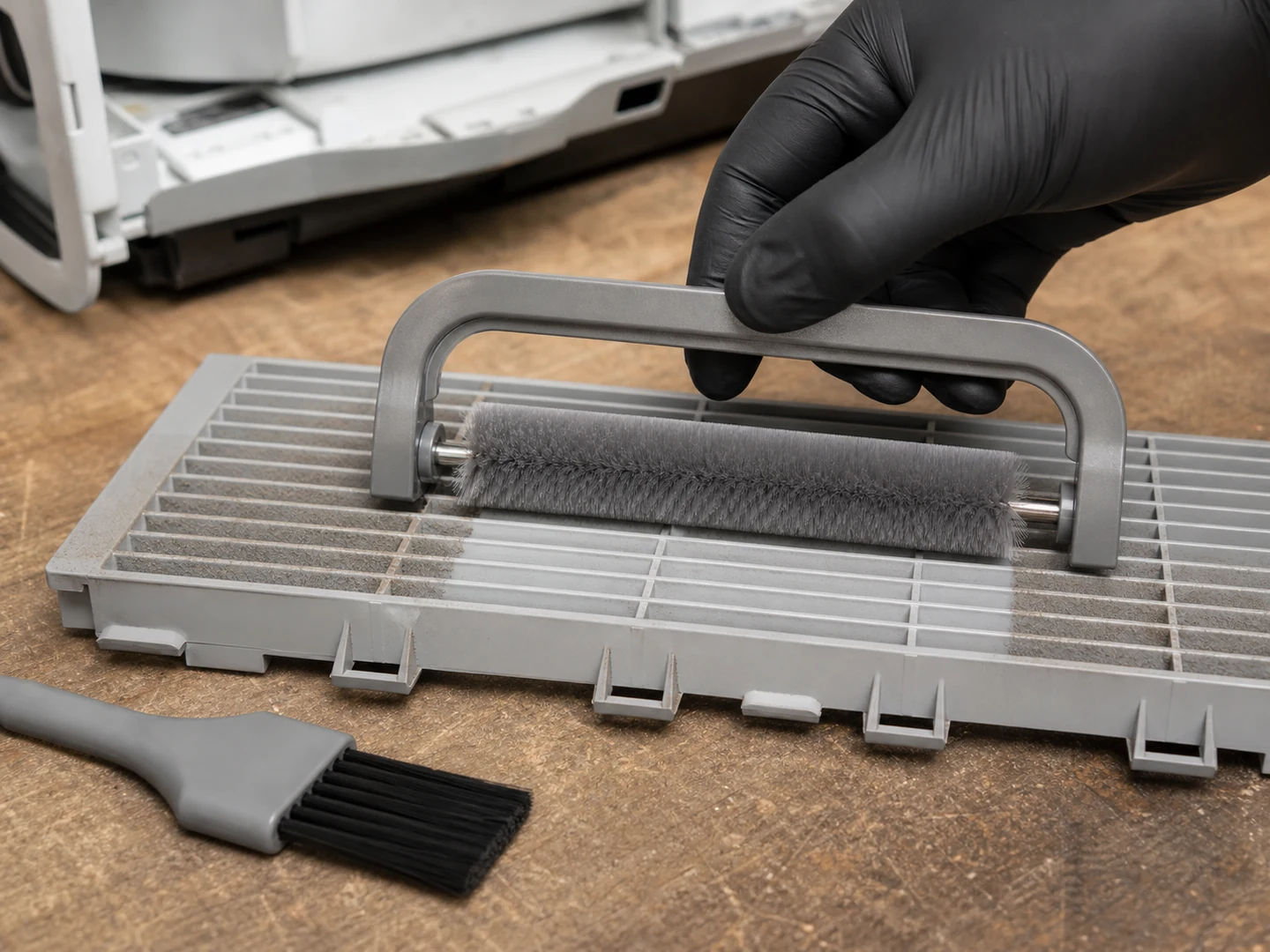
What Is a Coil Cleaning Brush?
A coil cleaning brush is a hand brush made for the air side of a finned coil: the condenser behind a refrigerator kick panel, the evaporator in an air conditioner, the coil in a dehumidifier or ice machine. It has a narrow head and long, fine filaments that slide into the gaps between the fins.
The brush is drawn along the fins, not across them. The filament tips lift the mat of dust and lint off the face of the coil and out of the first rows of fins, where most of it collects.
Three forms cover most appliance work. A flat fin brush with a short handle suits an exposed coil face. A long-handled brush with a slim head reaches a refrigerator condenser under the cabinet or behind a service panel. A round twisted-in-wire brush reaches between tube rows and into narrow coil edges.
When Is a Brush the Right Tool for an Appliance Coil?
A coil brush is the right first tool when the dirt is dry and loose and sits on the face of the coil. That is the normal state of a coil that has simply been running in a home, an office or a light commercial kitchen.
- A grey felt of dust, lint or pet hair on the air-entry face of a refrigerator condenser.
- Pollen, seed fluff or grass clippings on the face of an outdoor air-conditioner coil.
- Dust that a vacuum nozzle leaves behind because it is caught between the fins.
- Routine maintenance, before a coil cleaner is sprayed, so the cleaner reaches the metal instead of soaking into a dust mat.
A clogged coil moves less air, so the compressor runs longer to do the same work. Clearing the face restores the airflow the coil was designed for, which is why coil cleaning appears in every appliance maintenance schedule.
When Is a Coil Cleaning Brush the Wrong Choice?
- Greasy film from a kitchen: the brush smears it. Use a coil cleaner first, let it work, then brush lightly and rinse if the manufacturer allows water.
- Dirt deep inside a thick coil: a brush reaches the face and the first rows only. Deep fouling needs a coil cleaner and a rinse in the reverse direction of the airflow.
- Fins that are already bent flat: straighten them with a fin comb first. Brushing over crushed fins packs debris into them.
- Microchannel coils with flat tubes: follow the manufacturer’s cleaning instructions, which often call for rinsing rather than brushing.
- A coil that cannot be isolated from power, or water that could reach live parts: do not start until the power is locked out.
Which Filament Should a Coil Brush Use?
Most appliance fins are thin aluminum, often on copper tubes, and they bend under very little force. The filament has to be soft enough to flex in the gap without levering the fins over.
| Filament | Contact on aluminum fins | Good for | Watch for |
|---|---|---|---|
| Soft nylon PA | Gentle; the standard choice | Dry dust, lint and pet hair on household coils | Nylon takes up water and softens a little when wet |
| PBT | Gentle, keeps its stiffness wet | Coils brushed with a coil cleaner or rinse water | Slightly stiffer than nylon at the same diameter |
| Polypropylene PP | Gentle | Light dust on low-cost replacement brushes | Recovers less well after bending |
| Anti-static nylon | Gentle | Fine dust that clings to the fins by static charge | Needs a grounded hand or handle to drain the charge |
| Soft brass wire | Firm; can mark or bend thin aluminum | Heavier copper-fin radiators and oil coolers | Not for household aluminum fins |
Steel wire brushes do not belong on appliance coils. They cut and fold aluminum fins and can leave fragments that start corrosion.
How Do You Size a Coil Brush to the Fins?
Start from the fin pitch. Count the fins in one inch, then divide 25.4 by that number to get the pitch in millimeters. At 14 fins per inch the pitch is about 1.8 mm, and the clear gap is a little less once the fin thickness is taken off.
- Filament diameter: fine filament for gaps of 1–3 mm, coarser for wider fin rows, so the tips enter the gap instead of riding on the fin edges.
- Trim length: long enough to reach past the first fin rows, short enough that the filaments do not fold over under light pressure.
- Head width: matched to the coil face or the access opening, not to the whole appliance.
- Reach: a refrigerator condenser under the cabinet usually needs a long handle and a slim head that passes the kick panel opening.
How Should a Coil Brush Be Used?
- Switch the appliance off and isolate the power before removing any panel.
- Vacuum the loose dust off the coil face first, with a soft nozzle held clear of the fins.
- Brush along the fins with light, even strokes, working from top to bottom, and keep the vacuum close to catch what lifts.
- Work on the face where the air enters the coil. That is where most of the dirt sits.
- Check the drain pan and the area under the coil, where loosened debris settles.
- Let a wet coil dry fully before restoring power.
Common Mistakes With Coil Brushes
- Brushing across the fins instead of along them, which folds the fin edges over.
- Pressing hard to shift a greasy mat that needs a coil cleaner, not more force.
- Putting a coil brush in a drill. The speed bends fins faster than the brush cleans them.
- Using a filament too coarse for the fin gap, so it skates over the face and leaves the dirt between the fins.
- Cleaning the coil and leaving the clogged filter or the dirty drain pan that caused the problem.
When Should You Order a Custom Coil Brush?
A standard fin brush covers most household coils. A custom brush makes sense for an appliance range with its own fin pitch, a service kit that has to reach one model’s condenser, or a coil that needs an anti-static or wet-stable filament.
To quote it, send the fin pitch or fins per inch, the coil face size, the access path and opening, the residue, and whether the brush will be used dry or with a coil cleaner. A sample coil section or a photo with a ruler in it settles most questions.
Frequently Asked Questions
Can I clean a refrigerator condenser coil with a brush?
Yes. Unplug the refrigerator, remove the kick panel or rear cover, and use a long, slim condenser brush along the fins while a vacuum picks up the dust. Clean the fan blades and the area around the coil at the same time.
How often should appliance coils be brushed?
It depends on the dust load. A household refrigerator in a clean room may need it once a year; one in a home with pets, or a coil in a commercial kitchen, may need it every few months. A visible felt on the coil face means it is due.
Is a brush better than a vacuum on its own?
They do different jobs. A vacuum removes loose dust from the surface; the brush frees the dust caught between the fins so the vacuum can take it. Used together, brushing then vacuuming, they clear more than either one alone.
Can a coil brush be used with a coil cleaner?
What is the difference between a tube brush and a coil brush?
A tube brush cleans the inside of a pipe or tube. A coil brush cleans the outside of a finned coil, working in the gaps between the fins. On an appliance coil the dirt is on the air side, so the coil brush is the one to use.